
Telehealth Services Market Report Scope & Overview:
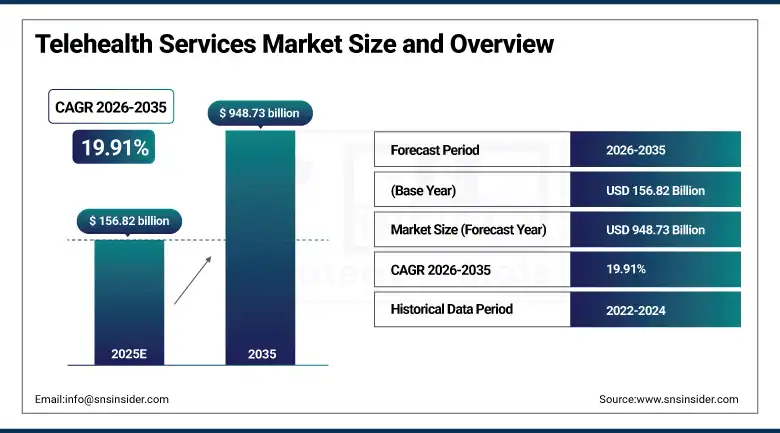
The Telehealth Services Market was valued at USD 156.82 billion in 2025 and is expected to reach USD 948.73 billion by 2035, growing at a CAGR of 19.91% from 2026-2035.
The Telehealth Services Market is rapidly expanding due to high demand for easily accessible, affordable, and convenient healthcare services. The increasing popularity of teleconsultations, remote patient monitoring, and mobile applications is transforming care delivery processes, whereas cloud-based technology facilitates scale and integration. High incidences of chronic illnesses, mental health conditions, and the effort to minimize hospital admissions are driving adoption. The involvement of payers and employers, alongside technology advancements, puts the market on track to achieve double-digit growth until 2035.
Supporting this trend, the World Health Organization (WHO) reported that chronic diseases such as cardiovascular conditions, diabetes, and cancer account for nearly 74% of global deaths, underscoring the urgent need for accessible and continuous care solutions.
In parallel, the U.S. Food and Drug Administration (FDA) has accelerated approvals of digital health technologies, including remote patient monitoring devices and AI‑enabled diagnostic platforms, to strengthen telehealth delivery.
Market Size and Forecast:
-
Market Size in 2025: USD 156.82 Billion
-
Market Size by 2035: USD 948.73 Billion
-
CAGR: 19.91% from 2026 to 2035
-
Base Year: 2025
-
Forecast Period: 2026–2035
-
Historical Data: 2022–2024
To Get more information On Telehealth Services Market - Request Free Sample Report
Telehealth Services Market Trends:
-
Teleconsultation remains the largest service segment, driven by patient demand for convenience.
-
Remote Patient Monitoring (RPM) is the fastest-growing area, fueled by chronic disease management.
-
Mobile health (mHealth) apps are surging, especially in emerging markets with mobile-first adoption.
-
Telepsychiatry is gaining momentum as mental health awareness and accessibility improve.
-
Healthcare providers dominate usage, but patient-driven homecare adoption is accelerating.
-
Partnerships between insurers and telehealth platforms are expanding coverage and reducing costs.
-
Regulatory approvals for digital health tools are strengthening trust and adoption.
U.S. Telehealth Services Market Size Outlook:
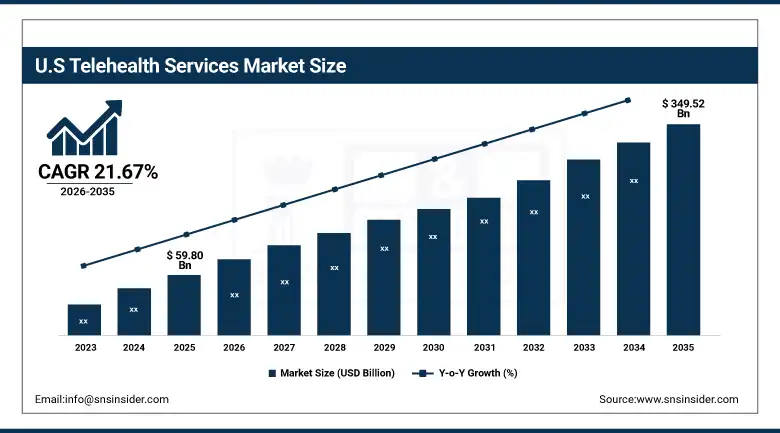
The U.S. Telehealth Services Market was valued at USD 59.80 billion in 2025 and is expected to reach USD 349.52 billion by 2035, growing at a CAGR of 21.67% from 2026-2035. The US market is progressing well on account of increased patient interest in receiving convenient, accessible, and inexpensive healthcare options. With the use of telehealth technologies, the delivery of health services is being transformed, and cloud computing has added a level of integration and scalability to the telehealth ecosystem. There is increasing interest in using telehealth services for mental healthcare, management of chronic diseases, and insurance-backed digital health initiatives.
Supporting this trend, the U.S. Centers for Medicare & Medicaid Services (CMS) has expanded reimbursement pathways for telehealth services, reinforcing virtual care as a mainstream option for patients and providers. In late 2024, Teladoc Health announced new AI‑driven chronic care programs integrated with major insurers, while Amwell partnered with CVS Health to broaden virtual primary care offerings.
At the same time, the FDA has accelerated approvals of remote monitoring devices and digital health platforms, underscoring regulatory commitment to advancing telehealth innovation and positioning the U.S. as a global leader in digital healthcare transformation.
Telehealth Services Market Segment Highlights:
-
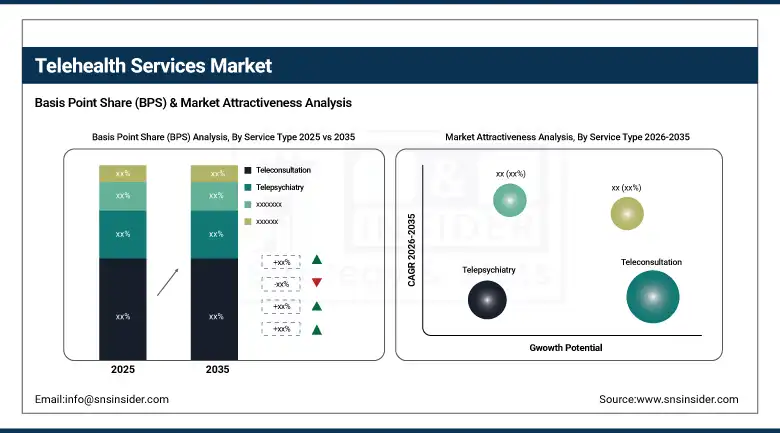
By Service Type, Teleconsultation dominated the Telehealth Services Market with 37.85% share in 2025; Remote Patient Monitoring (RPM) fastest growing (CAGR).
-
By Delivery Mode, Web-based platforms dominated the Telehealth Services Market with 42.73% share in 2025; On-premise solutions fastest growing (CAGR).
-
By Application, General medicine dominated the Telehealth Services Market with 39.71% share in 2025; Mental health Centers fastest growing (CAGR).
-
By End User, Healthcare providers (hospitals & clinics) dominated the Telehealth Services Market with 46.48% share in 2025; Patients (homecare users) fastest growing (CAGR).
By Service Type, Teleconsultation segment dominates the Telehealth Services Market, Remote Patient Monitoring (RPM) segment expected to grow fastest
For the year 2025, the Teleconsultation segment remained a key driver of the Telehealth Services Market, with its share of overall revenue estimated at about 37.85%. The Teleconsultation segment offers real-time virtual consultations through video conferencing, voice consultation, and chats.
Between 2026 and 2035, the RPM segment is likely to be the fastest-growing segment, recording the highest CAGR in the Telehealth Services Market. The RPM segment uses connected devices and digital health technology to continuously monitor patient health indicators including heart rate, blood pressure, blood glucose, and oxygen saturation.
By Delivery Mode, Web-based platforms segment dominates the Telehealth Services Market, On-premise solutions segment expected to grow fastest
The Web-based Platforms Segment occupied the most dominant share of 42.73% in the Telehealth Services Market in 2025. They help in the delivery of healthcare services using browser-based software, which makes them very easy to install. In addition to ease of use, they also support cross-device compatibility to connect seamlessly via desktops, tablets, or smartphones.
The On‑Premise Solutions Segment is projected to grow at the fastest CAGR between 2026 and 2035, outpacing other telehealth delivery models. These solutions involve in‑house installations that provide enterprises and healthcare providers with enhanced data security, compliance control, and customization flexibility compared to cloud‑based alternatives.
By Application, General medicine segment dominates the Telehealth Services Market, Mental health segment expected to grow fastest
The General Medicine segment that had the biggest share in the global Telehealth Services Market in 2025, which earned about 39.71%. It includes all sorts of basic healthcare services like consultation, diagnosis, and treatment of most common illnesses. The huge number of general medical patients, along with the ease of consulting a doctor online, has led to an increased use of telemedicine in the General Medicine segment.
Between 2026 and 2035, the fastest CAGR is expected in the Mental health segment. The increasing number of mental health issues like anxiety, depression, and stress is increasing the need for virtual mental healthcare solutions.
By End User, Healthcare providers (Hospitals & Clinics) segment dominates the Telehealth Services Market, Patients (Homecare Users) segment expected to grow fastest
The Healthcare providers (hospitals & clinics) accounted for the maximum market share in the Telehealth Services Market in 2025 with around 46.48% of overall revenue. Hospitals & clinics are leading adopters of telehealth services as they utilize telehealth technologies to increase their reach as well as make their processes more efficient.
The Patients (homecare users) are expected to experience the highest CAGR growth from 2026 to 2035. With the increasing trend towards patient-oriented treatment plans along with the use of smartphones and wearables, patients can access medical services without the need to visit a clinic or hospital.
Regional Analysis:
|
Region |
Major Country |
Share within Region (%) |
|---|---|---|
|
North America |
United States |
46.74% |
|
Europe |
Germany |
21.51% |
|
Asia Pacific |
China |
20.23% |
|
Middle East & Africa |
UAE |
4.54% |
|
Latin America |
Brazil |
6.98% |
North America Telehealth Services Market Insights
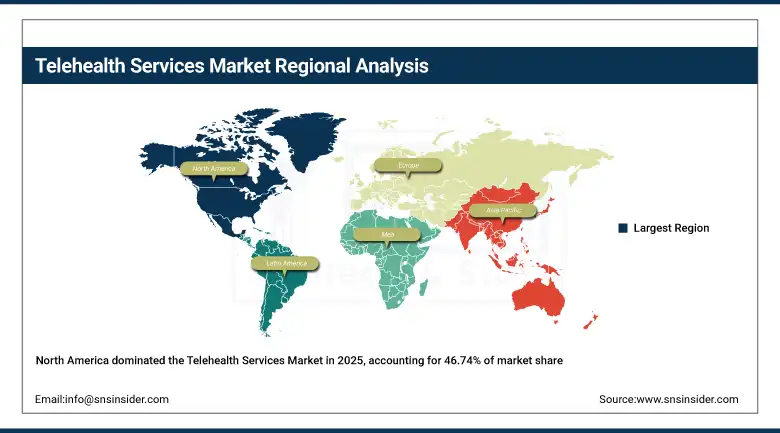
North America Telehealth Services Market is growing dominantly with market share of 46.74% in 2025, owing to well-established healthcare infrastructure, broadband availability, and supportive reimbursement programs. The demand for teleconsultations, remote monitoring, and mental health treatment keeps increasing, while more telehealth services become an integral part of health care provision for both patients and providers. Legislative initiatives and technology advancements, such as the development of AI-enabled solutions and mobile health technologies, consolidate the leadership of North America in this field.
Get Customized Report as per Your Business Requirement - Enquiry Now
Supporting this leadership, North America continues to strengthen its telehealth ecosystem through expanded reimbursement frameworks and large-scale technology integration. In 2025, the U.S. Centers for Medicare & Medicaid Services (CMS) broadened coverage for remote patient monitoring and behavioral health services, ensuring wider patient access.
At the same time, leading providers such as Teladoc Health and Amwell announced strategic collaborations with insurers and retail health networks, while the FDA accelerated approvals of AI‑enabled diagnostic platforms, reinforcing North America’s role as the global hub for telehealth innovation.
Asia Pacific Telehealth Services Market Insights
Asia Pacific is fast proving to be the fastest growing regional market with CAGR of 21.44% for telehealth services, fueled by an increase in smartphone adoption, enhanced internet connectivity, and governmental measures promoting digital health. In countries such as China, India, and Japan, there is increased adoption of mobile health applications as well as cloud platforms, with the growth of telehealth being further boosted by increased demand for services relating to mental health and chronic illness.
Supporting this growth, Asia Pacific governments are actively advancing telehealth adoption through policy and investment. In 2025, China’s National Health Commission expanded digital health pilot programs across rural regions, boosting access to virtual consultations and remote monitoring. India launched new initiatives under its Ayushman Bharat Digital Mission to integrate telemedicine into public healthcare delivery.
Meanwhile, Japan’s Ministry of Health, Labour and Welfare (MHLW) broadened reimbursement coverage for telepsychiatry and chronic disease management, reinforcing Asia Pacific’s role as the fastest-growing hub for telehealth innovation.
Europe Telehealth Services Market Insights
Europe’s Telehealth Services Market is experiencing consistent growth due to government backing, favorable reimbursements, and growing interest in digital healthcare applications. European countries including Germany, the United Kingdom, and France have adopted telehealth through the implementation of electronic health records and cloud telehealth. The focus on providing mental healthcare, chronic illness care, and digital health across borders makes Europe a key market for driving telehealth services.
Supporting this position, the European Commission's Horizon Europe research and innovation program has allocated substantial funding toward digital surgery, robotic-assisted platforms, and AI-enhanced imaging systems as part of the EU's broader health technology investment agenda.
Europe Market is advancing steadily, supported by strong government initiatives, digital health strategies, and rising demand for remote care solutions. Recent developments highlight regulatory support, technology adoption, and insurer integration that are accelerating telehealth’s role in mainstream healthcare across the region.
Middle East & Africa and Latin America Telehealth Services Market Insights
Middle East & Africa Telehealth Services Market is developing at a fast pace owing to various reasons such as the support of government in terms of digital health programs, high smartphone penetration rate, and initiatives to increase healthcare access in underdeveloped areas. Saudi Arabia and UAE have been at the forefront in terms of having a nation-wide strategy related to telehealth services, while in Africa, there is a high adoption rate of mobile telehealth solutions. Likewise, Latin America Telehealth Services Market is witnessing rapid growth due to several reasons.
Supporting development in these regions, Saudi Arabia’s Ministry of Health has advanced its Health Sector Transformation Program, prioritizing telehealth expansion alongside hospital modernization to improve access across urban and rural areas. In South Africa, the Department of Health has rolled out digital health initiatives to strengthen remote consultations and chronic disease monitoring.
Meanwhile, Brazil’s ANVISA has streamlined regulatory pathways for digital health platforms, while Mexico has expanded national telemedicine networks, reinforcing Latin America’s growing commitment to accessible, technology-driven healthcare.
Telehealth Services Market Growth Drivers:
-
Rising patient preference for convenient, accessible, and cost-effective virtual care driving global adoption of telehealth services
The core change in the way patients view healthcare, from the traditional approach of visiting physicians in person to adopting a digital approach for accessing healthcare services anytime and anywhere, constitutes the key structural factor that contributes to the development of the telehealth market. Modern-day patients are inclined towards seeking healthcare services that allow them to save time by not having to travel, avoid waiting times, spend less money on visits to healthcare practitioners, and gain instant access to medical personnel.
WHO estimates that nearly half of the global population lacks access to essential healthcare services, while digital health adoption has grown by over 30% in low- and middle-income countries in the past five years, underscoring its role in improving equity and resilience in healthcare systems.
Telehealth Services Market Restraints:
-
Data privacy concerns, cybersecurity risks, and regulatory complexities limiting large-scale telehealth adoption
The growing dependence on digital channels in the provision of healthcare services poses major obstacles in the form of data security concerns, cyber threats, and legal issues, which serve as a vital barrier to the expansion of telehealth industries. Telemedicine requires the transfer and storing of personal health data of patients, and hence, is susceptible to data leakage, ransomware, and other cyber risks. People are reluctant to share their private information via digital networks because of potential data threats in areas that lack effective cybersecurity systems.
Telehealth Services Market Opportunities:
-
Integration of AI, wearable technologies, and remote patient monitoring creating new growth opportunities in telehealth ecosystem
The exponential evolution of telehealth technology, especially AI, wearables, and RPM, presents lucrative opportunities for the telehealth service market. The technologies help in continuous health monitoring, predicting possible illnesses, and personalizing medical treatments, which have transformed telehealth from being an occasional virtual consultation to a complete health care approach. It is now possible for individuals to monitor their heart rates, blood sugar levels, and oxygen content in real-time while physicians gain valuable insights from the collected data for timely action.
Recent Developments:
-
2025: Teladoc Health expanded its connected care partnerships across new categories including digestive health, fertility, and specialty care. The company integrated these services into its Prism platform, enhancing referrals and coordination for over 93 million members. This move strengthens Teladoc’s whole-person virtual care strategy and deepens its impact on chronic disease management and mental health services.
-
2025: Amwell executed a strategic pivot toward profitability by prioritizing subscription-based software revenue through its Converge platform. The company secured a major contract extension with the U.S. Defense Health Agency, validating its SaaS model for hybrid care delivery. Amwell also invested heavily in AI integration to enhance patient experience and operational efficiency, aiming to achieve break-even by 2026.
-
2025: Philips Healthcare released its 10th annual Future Health Index report, highlighting AI’s transformative role in global healthcare delivery. The report emphasized AI’s potential to reduce delays, improve diagnostics, and alleviate clinician burnout, while also noting trust gaps among patients and providers. Philips continues to integrate AI into telehealth, precision medicine, and remote monitoring solutions to expand access and efficiency worldwide.
-
2025: Cisco Systems completed the integration of Splunk, strengthening its AI-native security and networking portfolio. The company positioned itself as a critical infrastructure provider for the AI era, reporting over USD 2 billion in AI infrastructure orders from webscale customers. Cisco also expanded collaborations with NVIDIA to deliver scalable, secure solutions for enterprise telehealth and healthcare communication systems.
Telehealth Services Market Key Players:
-
Amwell
-
Cisco Systems
-
Microsoft Corporation
-
MDLIVE
-
Doctor on Demand
-
American Telecare
-
GlobalMed
-
Siemens Healthineers
-
GE Healthcare
-
eVisit
-
Babylon Health
-
98point6
-
PlushCare
-
Hicuity Health
-
Doxy.me
-
SnapMD
-
HealthTap
Telehealth Services Market Report Scope:
| Report Attributes | Details |
|---|---|
| Market Size in 2025 | USD 156.82 Billion |
| Market Size by 2035 | USD 948.73 Billion |
| CAGR | CAGR of 19.91% From 2026 to 2035 |
| Base Year | 2025 |
| Forecast Period | 2026-2035 |
| Historical Data | 2022-2024 |
| Report Scope & Coverage | Market Size, Segments Analysis, Competitive Landscape, Regional Analysis, DROC & SWOT Analysis, Forecast Outlook |
| Key Segments | • By Service Type (Teleconsultation, Remote Patient Monitoring (RPM), Tele-ICU, Telepsychiatry, Tele-education / Teletraining, Others), • By Delivery Mode (Web-based platforms, Cloud-based platforms, On-premise solutions, Mobile health (mHealth) applications, Others), • By Application (General Medicine, Mental Health, Cardiology, Dermatology, Radiology, Others), • By End User (Healthcare Providers (Hospitals & Clinics), Patients (Homecare Users), Payers (Insurance Companies), Employers / Corporate Healthcare, Others) |
| Regional Analysis/Coverage | North America (US, Canada), Europe (Germany, UK, France, Italy, Spain, Russia, Poland, Rest of Europe), Asia Pacific (China, India, Japan, South Korea, Australia, ASEAN Countries, Rest of Asia Pacific), Middle East & Africa (UAE, Saudi Arabia, Qatar, South Africa, Rest of Middle East & Africa), Latin America (Brazil, Argentina, Mexico, Colombia, Rest of Latin America). |
| Company Profiles | Teladoc Health, Amwell, Philips Healthcare, Cisco Systems, Microsoft Corporation, Zoom Video Communications, MDLIVE, Doctor on Demand, American Telecare, GlobalMed, Siemens Healthineers, GE Healthcare, eVisit, Babylon Health, 98point6, PlushCare, Hicuity Health, Doxy.me, SnapMD, HealthTap. |
Frequently Asked Questions
The Telehealth Services Market is expected to grow at a CAGR of 19.91% from 2026 to 2035.
The Telehealth Services Market was valued at USD 156.82 billion in 2025.
The major growth is by rising demand for accessible, cost-effective, and convenient healthcare solutions. Increasing patient preference for virtual consultations, remote monitoring, and digital health platforms.
The Teleconsultation segment dominated the Telehealth Services Market in 2025.
North America dominated the Telehealth Services Market in 2025.
