
Total Ankle Replacement Market Report Scope & Overview:
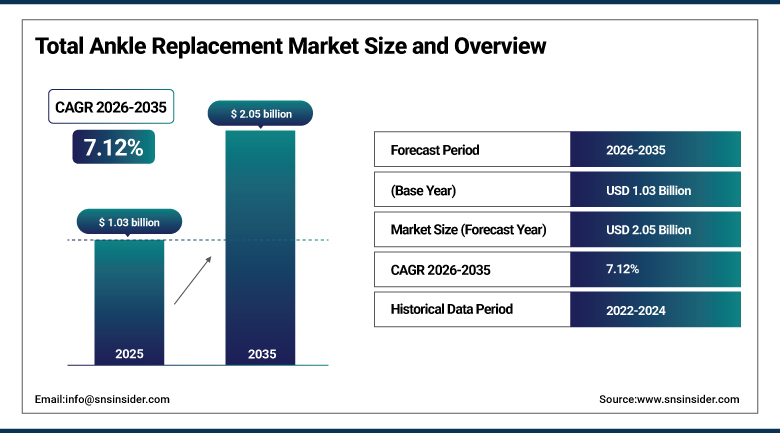
The Total Ankle Replacement Market was valued at USD 1.03 Billion in 2025 and is expected to reach USD 2.05 Billion by 2035, growing at a CAGR of 7.12% from 2026 to 2035.
Total ankle replacement is a joint arthroplasty procedure. In this the damaged articular surfaces of the tibiotalar joint are resected and replaced with a prosthetic implant system that restores pain-free weight-bearing and preserves a functional range of ankle motion. Modern third-generation total ankle replacement systems including the STAR, INFINITY, HINTEGRA, and Scandinavian Total Ankle Replacement have demonstrated improved survivorship data, with studies reporting 10-year implant survival rates exceeding 80%. Ankle arthrodesis effectively relieves arthritic pain by eliminating joint motion. Patient-reported outcome studies consistently document superior gait quality, stair-climbing ability, and participation in recreational activities.
Stryker Corporation received FDA clearance for its Tornier Salto Talaris XT total ankle replacement system in 2025, expanding its total ankle arthroplasty portfolio with an updated implant design incorporating improved bearing surface geometry and enhanced tibial tray fixation features. The clearance positioned Stryker to compete more directly in the growing U.S. total ankle replacement market against Integra LifeSciences and Wright Medical.
Market Size and Forecast
-
Market Size in 2026E: USD 1.10 Billion
-
Market Size by 2035: USD 2.05 Billion
-
CAGR: 7.12% from 2026 to 2035
-
Fastest Growing Region: Asia Pacific
-
Largest Region: North America
To Get more information Total Ankle Replacement Market - Request Free Sample Report
Total Ankle Replacement Market Trends
-
Advanced third-generation implant designs are expanding total ankle replacement eligibility through improved fixation, kinematics, and modular implant systems.
-
Specialized surgeon training and fellowship programs are increasing clinical confidence and procedural adoption of ankle arthroplasty techniques.
-
Patient-specific implants and robotic-assisted positioning are improving surgical accuracy while reducing technique-dependent procedural variability significantly.
-
Minimally invasive ankle replacement approaches are reducing tissue disruption, rehabilitation time, and postoperative wound complication risks.
-
Rising patient awareness of motion-preserving ankle replacement alternatives is increasing referrals to specialized orthopedic treatment centers.
The U.S. Total Ankle Replacement Market Outlook
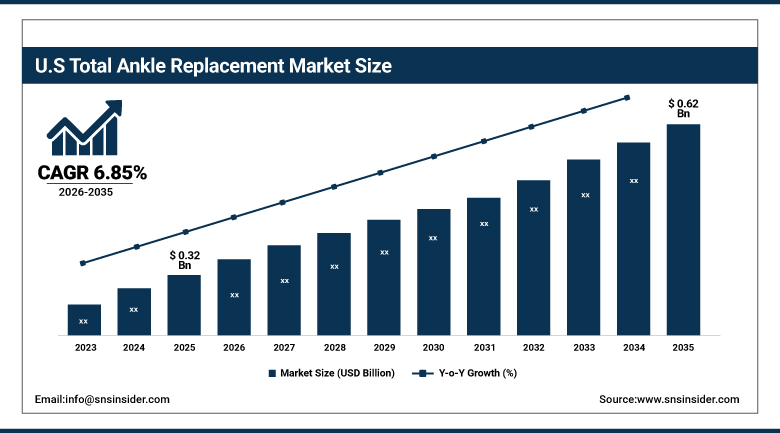
The U.S. total ankle replacement market was valued at USD 0.32 Billion in 2025 and is expected to reach USD 0.62 Billion by 2035, growing at a CAGR of 6.85% from 2026 to 2035.
The United States is the world's largest total ankle replacement market. The American Orthopedic Foot and Ankle Society's clinical guidance and professional education programmes have been instrumental in expanding surgeon adoption of total ankle replacement. The U.S. ankle replacement market is growing faster than the broader total joint replacement market as the procedure penetrates a larger proportion of the approximately 50,000 annual ankle arthrodesis cases that represent the primary patient population available for conversion to arthroplasty.
Integra LifeSciences expanded adoption of its INFINITY Total Ankle System in the United States through 2025, supported by growing implant volumes and patient-reported outcome studies comparing ankle replacement with ankle fusion, strengthening surgeon confidence in long-term implant durability and clinical effectiveness.
Total Ankle Replacement Market Segment Analysis
-
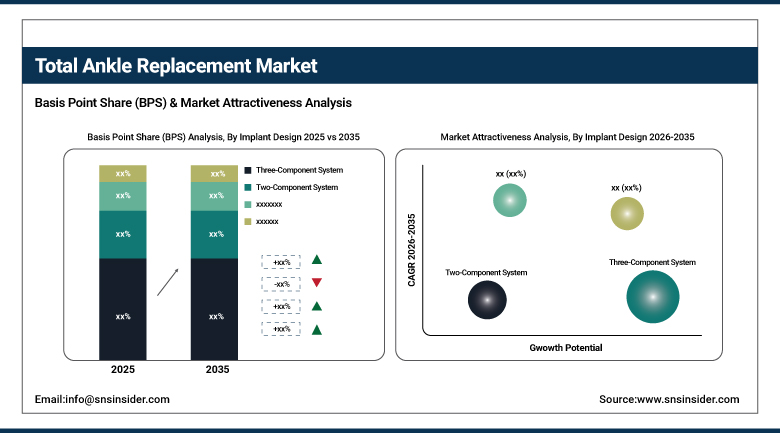
By Implant Design, the three-component system dominated the market in 2025, while the two-component system is the fastest growing design during 2026 to 2035.
-
By Fixation Type, the uncemented/cementless segment dominated the market in 2025, while the cemented segment retains application in specific bone quality and revision contexts.
-
By Material, the metal & polyethylene segment dominated the market in 2025, while ceramic materials are growing in select bearing surface applications.
-
By Indication, the osteoarthritis segment dominated the market with the largest share in 2025, while the post-traumatic arthritis segment is the fastest growing indication during 2026 to 2035.
-
By End User, the hospitals segment dominated the market in 2025, while ambulatory surgical centers are the fastest growing end user during 2026 to 2035.
By Implant Design, three-component systems dominate, two-component systems grow fastest
Three-component total ankle replacement systems, incorporating a mobile polyethylene bearing articulating between the tibial tray and talar dome, generated the dominant market revenue in 2025. Their implant architecture is validated by the the Scandinavian Total Ankle Replacement system's registry data demonstrating satisfactory 10 to 15-year performance. The mobile bearing concept's theoretical advantage of reduced constraint and broader contact stress distribution across the tibiotalar interface has been the primary clinical rationale for three-component system preference among experienced ankle replacement surgeons.
Two-component fixed-bearing designs are growing fastest as their simpler surgical technique, elimination of the mobile bearing dislocation risk, and contemporary clinical data demonstrating competitive survivorship outcomes are attracting adoption among surgeons transitioning into total ankle replacement who prefer the reduced technical complexity of the fixed-bearing approach.
By Indication, osteoarthritis dominates, post-traumatic arthritis grows fastest
Osteoarthritis retained the dominant indication position in 2025, representing the most prevalent underlying pathology in the ankle arthritis patient population. Primary osteoarthritis of the ankle, though less common than osteoarthritis of the knee and hip due to the ankle joint's greater congruency and lower contact stress under normal biomechanical loading, affects a substantial patient population whose age and activity profile aligns well with total ankle replacement's optimal patient selection criteria of adequate bone stock, appropriate body weight, and realistic activity expectations.
Post-traumatic arthritis is growing fastest, reflecting the growing recognition that prior ankle fracture, ligament injury, and osteochondral damage are the most common underlying causes of end-stage ankle arthritis. The post-traumatic arthritis patient's typically younger age and higher activity expectations make total ankle replacement's motion-preserving advantage over arthrodesis particularly compelling compared to the older primary osteoarthritis patient cohort.
Regional Analysis
|
Region |
Major Country |
Share within Region, 2025 (%) |
|---|---|---|
|
North America |
United States |
84.73% |
|
Europe |
Germany |
28.47% |
|
Asia Pacific |
Japan |
32.84% |
|
Middle East & Africa |
UAE |
22.84% |
|
Latin America |
Brazil |
43.84% |
North America Total Ankle Replacement Market Insights
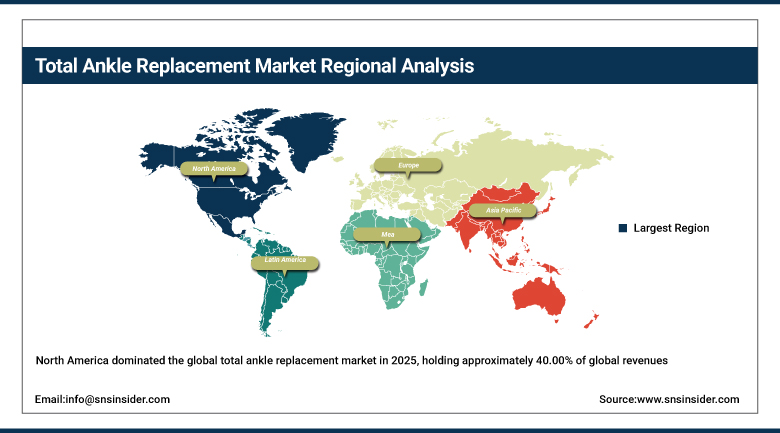
North America dominated the global total ankle replacement market in 2025, holding approximately 40.00% of global revenues. The United States accounts for approximately 84.73% of regional revenue through its commercial scale of foot and ankle surgical practice, private insurance reimbursement infrastructure, and the established presence of leading total ankle implant manufacturers. The United States annual total ankle replacement procedure volume exceeds 10,000 cases and is growing at approximately 8 to 10% annually, representing both organic procedure adoption growth and the progressive conversion of ankle arthrodesis cases among surgeons whose expanding total ankle replacement training enables them to offer arthroplasty.
Get Customized Report as per Your Business Requirement - Enquiry Now
Europe Total Ankle Replacement Market Insights
Europe held a significant share of the global total ankle replacement market in 2025, supported by the well-established European foot and ankle surgical traditions, the presence of leading implant manufacturers and designers in Germany, Switzerland, and France. Germany accounts for approximately 28.47% of European revenues through its high-quality orthopedic surgical standards, the commercial presence of implant developers including HINTEGRA at Integra LifeSciences and the Salto system's European heritage, and its well-funded public hospital infrastructure whose orthopedic procedure volumes sustain consistent implant procurement.
Asia Pacific Total Ankle Replacement Market Insights
Asia Pacific is the fastest-growing regional total ankle replacement market, driven by rapidly ageing populations across Japan, China, South Korea, and Australia, rising awareness of ankle arthroplasty as an alternative to fusion among the region's growing foot and ankle specialist surgical community. Japan accounts for approximately 32.84% of Asia Pacific revenues through its high-quality orthopedic surgical infrastructure, rapidly ageing demographic profile creating large ankle arthritis patient volumes, and regulatory approval of leading international total ankle replacement systems whose commercial availability.
MEA & Latin America Total Ankle Replacement Market Insights
Middle East and Latin America are emerging total ankle replacement markets supported by expanding orthopedic infrastructure, medical tourism growth, and increasing advanced implant adoption. The UAE accounts for nearly 22.84% of MEA revenues through advanced private orthopedic programmes. Brazil represents approximately 43.84% of Latin American revenues due to its large orthopedic surgical base and expanding private healthcare investment in joint replacement technologies.
Market Dynamics
Growth Drivers: Growing ankle arthritis cases, ageing populations, and improving implant durability are driving total ankle replacement market growth.
The global prevalence of ankle arthritis, predominantly post-traumatic in aetiology among younger patients and degenerative in older populations, creates a growing patient demand base. The correlation between ankle arthritis and prior ankle trauma means that the rising sports participation rates, particularly in running and football, among younger adult demographics is progressively building a post-traumatic arthritis patient population that will require ankle arthroplasty solutions over the coming two to three decades.
Improved implant design durability, with third-generation systems demonstrating 10-year survival rates that approach the benchmark of 90% survivorship that defines clinical acceptability for joint replacement, is removing the primary clinical barrier to total ankle replacement adoption among orthopedic surgeons who had historically preferred arthrodesis for its more predictable long-term outcome profile.
Restraints: Technically complex surgical procedures and limited long-term survivorship data restrain market adoption growth.
Total ankle replacement is acknowledged as one of the most technically demanding procedures in orthopedic arthroplasty, requiring precise bone cuts within narrow tolerance windows, thorough surgeon training, and intraoperative imaging confirmation that many general orthopedic surgeons do not routinely deploy. The technical complexity creates a learning curve that produces inferior early outcomes in surgeons with limited ankle replacement experience, generating complication and revision rates that support the continuing preference for arthrodesis among general Orthopedists.
Limited long-term survivorship data beyond 10 years for most third-generation systems, compared to the 20-plus-year performance records of established knee and hip arthroplasty systems, maintains clinical caution among surgeons and payers whose implant selection philosophy privileges procedures with well-characterized long-term durability.
Opportunities: Robotic-assisted and patient-specific ankle replacement technologies can expand the eligible patient population significantly.
Robotic-assisted total ankle replacement systems are drawing on the demonstrated accuracy improvement of robotic-assisted total knee replacement to address the bone cut precision challenge that is the primary technical complexity driver in ankle arthroplasty. Patient-specific implant systems that use pre-operative CT imaging to generate custom tibial and talar component designs precisely matched to individual patient anatomy reduce the fit and sizing compromises that standard-sized implant inventories create and may improve the biomechanical outcomes and implant survivorship for patients whose anatomy falls outside the optimal range for standard-sized implant systems.
Together, these precision technology advances have the potential to substantially reduce the surgeon training investment required to achieve consistent total ankle replacement outcomes and thereby expand the population of surgeons capable of offering the procedure to eligible patients.
Recent Developments:
-
2025: Stryker received FDA clearance for its Tornier Salto Talaris XT total ankle replacement system with improved bearing surface geometry and enhanced tibial tray fixation features.
-
2025: Integra LifeSciences reported continued U.S. commercial adoption of its INFINITY Total Ankle System supported by expanded surgeon training programmes and clinical outcome data presentations.
-
2024: Wright Medical (now Stryker) published extended 10-year outcome data for the INFINITY Total Ankle System demonstrating survivorship rates exceeding 82%, contributing to the growing clinical evidence base.
Total Ankle Replacement Market Key Players are:
-
Integra LifeSciences Corporation
-
Stryker Corporation (Wright Medical Group)
-
Zimmer Biomet Holdings Inc.
-
DJO Global LLC
-
Smith+Nephew PLC
-
Corin Group Ltd.
-
Exactech Inc.
-
In2Bones Global Inc.
-
Limacorporate SpA
-
Tecres SpA
-
Paragon 28 Inc.
-
DepSurgical Inc.
-
Globus Medical Inc.
-
Arthrex Inc.
-
Aesculap Implant Systems LLC (B. Braun)
-
Vilex LLC
-
MatOrtho Ltd.
-
Surgical Theatre LLC
-
3T Medical AG
-
Enovis Corporation
Total Ankle Replacement Market Report Scope:
| Report Attributes | Details |
|---|---|
| Market Size in 2025 | USD 1.03 Billion |
| Market Size by 2035 | USD 2.05 Billion |
| CAGR | CAGR of 7.12% From 2026 to 2035 |
| Base Year | 2025 |
| Forecast Period | 2026-2035 |
| Historical Data | 2022-2024 |
| Report Scope & Coverage | Market Size, Segments Analysis, Competitive Landscape, Regional Analysis, DROC & SWOT Analysis, Forecast Outlook |
| Key Segments | • By Implant Design (Three-Component System, Two-Component System) • By Fixation Type (Cemented, Uncemented/Cementless) • By Material (Metal & Polyethylene, Ceramic, Others) • By Indication (Osteoarthritis, Rheumatoid Arthritis, Post-Traumatic Arthritis, Others) • By End User (Hospitals, Orthopedic Specialty Clinics, Ambulatory Surgical Centers) |
| Regional Analysis/Coverage | North America (US, Canada), Europe (Germany, UK, France, Italy, Spain, Russia, Poland, Rest of Europe), Asia Pacific (China, India, Japan, South Korea, Australia, ASEAN Countries, Rest of Asia Pacific), Middle East & Africa (UAE, Saudi Arabia, Qatar, South Africa, Rest of Middle East & Africa), Latin America (Brazil, Argentina, Mexico, Colombia, Rest of Latin America). |
| Company Profiles | Integra LifeSciences Corporation, Stryker Corporation (Wright Medical Group), Zimmer Biomet Holdings Inc., DJO Global LLC, Smith+Nephew PLC, Corin Group Ltd., Exactech Inc., In2Bones Global Inc., Limacorporate SpA, Tecres SpA, Paragon 28 Inc., DepSurgical Inc., Globus Medical Inc., Arthrex Inc., Aesculap Implant Systems LLC (B. Braun), Vilex LLC, MatOrtho Ltd., Surgical Theatre LLC, 3T Medical AG, Enovis Corporation |

Frequently Asked Questions
The total ankle replacement market is expected to grow at a CAGR of 7.12% from 2026 to 2035.
The total ankle replacement market was valued at USD 1.03 Billion in 2025.
Ageing populations, sports injuries, durable implants, surgeon training expansion, and rising awareness are driving total ankle replacement adoption globally.
The osteoarthritis segment dominated the total ankle replacement market with the largest share in 2025.
North America dominated the total ankle replacement market in 2025, holding approximately 40.00% of global revenues.
