
Vessel Tracking System Market Report Scope & Overview:
Vessel Tracking System Market was valued at USD 6.21 billion in 2025E and is expected to reach USD 10.02 billion by 2033, growing at a CAGR of 6.24% from 2026-2033.
The Vessel Tracking System Market is growing due to increasing global maritime trade, rising demand for fleet management and operational efficiency, and stringent regulatory compliance requirements. Advancements in satellite-based tracking, AIS, and IoT-enabled monitoring systems are driving adoption. Additionally, growing safety concerns, need for cargo visibility, and expansion of commercial shipping, defense, and research vessels contribute to market growth, supporting technological integration and enhanced real-time vessel tracking worldwide.
Global maritime trade reached 12,720 million tons in 2024, up 2.2% year-over-year and exceeding the 2013–2023 average, fueling demand for advanced vessel tracking amid fleet optimization and regulatory mandates like SOLAS-mandated AIS.
Vessel Tracking System Market Size and Forecast
-
Vessel Tracking System Market Size in 2025: USD 6.21 Billion
-
Vessel Tracking System Market Size by 2033: USD 10.02 Billion
-
CAGR: 6.24% from 2026 to 2033
-
Base Year: 2025E
-
Forecast Period: 2026–2033
-
Historical Data: 2022–2024

To Get more information On Vessel Tracking System Market - Request Free Sample Report
Vessel Tracking System Market Trends
-
Rising demand for real-time monitoring and navigation efficiency is driving the vessel tracking system market.
-
Growing adoption in commercial shipping, defense, and port management is boosting market growth.
-
Expansion of IoT, GPS, and satellite-based tracking technologies is enhancing fleet visibility and operational efficiency.
-
Increasing focus on maritime safety, regulatory compliance, and environmental monitoring is shaping adoption trends.
-
Advancements in predictive analytics, AI, and data-driven decision support are improving route optimization and fuel efficiency.
-
Rising global trade and expansion of shipping logistics are fueling system deployment.
-
Collaborations between technology providers, shipping companies, and port authorities are accelerating innovation and global market penetration.
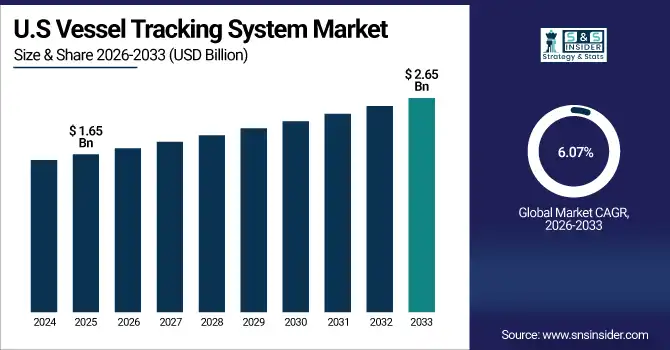
U.S. Vessel Tracking System Market was valued at USD 1.65 billion in 2025E and is expected to reach USD 2.65 billion by 2033, growing at a CAGR of 6.07% from 2026-2033.
The U.S. Vessel Tracking System Market is growing due to advanced maritime infrastructure, strict regulatory compliance, increasing fleet modernization, and rising demand for real-time monitoring, operational efficiency, and safety across commercial shipping, defense, and research vessels.
Vessel Tracking System Market Growth Drivers:
-
Rising adoption of real-time vessel tracking for improved operational efficiency and fleet management across commercial and defense sectors
The growing need for real-time vessel monitoring is driving the adoption of advanced tracking systems in commercial shipping, defense, and logistics sectors. Companies and maritime authorities increasingly rely on satellite-based and AIS systems to enhance fleet management, optimize routes, and improve operational efficiency. The ability to monitor vessel location, speed, and cargo status remotely reduces human error, prevents unauthorized deviations, and ensures timely delivery of goods. Additionally, real-time data aids in predictive maintenance and reduces fuel consumption, making vessel operations more cost-effective and environmentally sustainable, thus accelerating market growth globally.
AIS integration in fleet management cut fuel consumption by 10–15% through dynamic routing and speed adjustments, with real-time data enabling predictive maintenance and port arrival optimization for 90% of global container traffic.
Companies like Maersk use satellite AIS for 24/7 global monitoring, reducing delays by 20% via automated collision avoidance and just-in-time arrivals in high-traffic areas.
Vessel Tracking System Market Restraints:
-
High installation and maintenance costs of advanced vessel tracking systems limiting adoption among smaller operators
The considerable investment required for hardware installation, satellite subscriptions, and software integration poses a significant challenge for small and medium-sized shipping companies. Costs associated with retrofitting older vessels with modern tracking solutions further limit adoption. Additionally, recurring maintenance expenses, firmware updates, and staff training add to the financial burden. These high expenditures can discourage smaller operators, especially in developing regions, from implementing advanced vessel tracking solutions despite their operational benefits. As a result, market growth is restrained, and penetration remains concentrated among large enterprises and government-backed fleets that can absorb the high capital and operational costs of such systems.
Vessel Tracking System Market Opportunities:
-
Expanding adoption of IoT and AI-based vessel tracking solutions enabling predictive analytics and operational optimization
The integration of IoT sensors, AI analytics, and cloud-based platforms in vessel tracking systems presents a significant opportunity. Operators can now monitor vessel performance, predict maintenance needs, and optimize navigation routes using advanced analytics. These technologies improve fuel efficiency, reduce operational costs, and enhance fleet management accuracy. Furthermore, AI-driven anomaly detection supports risk mitigation by identifying potential issues before they escalate. As shipping companies increasingly seek digital transformation, demand for smart, connected tracking systems is expected to rise, providing new revenue streams for technology providers and encouraging innovation in predictive maritime operations globally.
|
Company |
AI Model(s) Used |
|---|---|
|
Maersk |
ML algorithms (ANN/RF on IoT data) |
|
MariApps |
ANN in OceanAI FaultSenseAI |
|
Ship Universe |
RF/XGBoost for pumps/turbochargers |
|
Anglo-Eastern |
AI predictive tools for safety |
|
Synthetica |
Custom ML for vessel maintenance |
Vessel Tracking System Market Segment Highlights
-
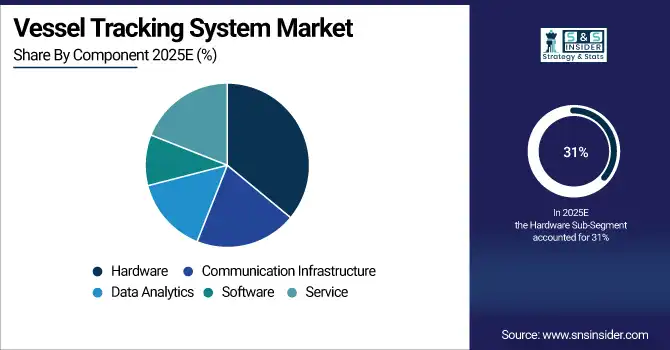
By Component, Hardware dominated with ~31% share in 2025; Data Analytics fastest growing (CAGR).
-
By End-Use, Commercial Shipping dominated with ~36% share in 2025; Research Vessels fastest growing (CAGR).
-
By Technology, Automatic Identification System (AIS) dominated with ~33% share in 2025; Satellite Based Tracking fastest growing (CAGR).
-
By Application, Fleet Management dominated with ~32% share in 2025; Cargo Monitoring fastest growing (CAGR).
Vessel Tracking System Market Segment Analysis
By Component, Hardware dominated the Market, while Data Analytics is expected to grow at the fastest CAGR
Hardware segment dominated the Vessel Tracking System Market with the highest revenue share in 2025 due to the essential role of sensors, transceivers, and onboard devices in enabling real-time vessel monitoring. The widespread deployment of reliable hardware ensures accurate location tracking, navigational safety, and seamless integration with software platforms, driving high adoption.
Data Analytics segment is expected to grow at the fastest CAGR from 2026-2033 owing to increasing demand for actionable insights from vessel movement data. Advanced analytics helps operators optimize routes, reduce fuel consumption, predict maintenance, and enhance fleet efficiency. Growing emphasis on predictive operations and decision-making is accelerating adoption across commercial, defense, and research vessels.
By End-Use, Commercial Shipping led the market, with Research Vessels projected to grow at the fastest CAGR
Commercial Shipping segment dominated the Vessel Tracking System Market with the highest revenue share in 2025 as large fleets require continuous monitoring for route optimization, safety compliance, and operational efficiency. High shipping volumes and global trade dependency drive widespread implementation, making commercial operators the largest adopters of vessel tracking solutions.
Research Vessels segment is expected to grow at the fastest CAGR from 2026-2033 due to increasing marine research activities, oceanographic studies, and environmental monitoring projects. Advanced tracking systems ensure precise positioning, data collection, and safety for research missions, driving faster adoption among scientific organizations and research institutes globally.
By Technology, Automatic Identification System (AIS) dominated the market, while Satellite-Based Tracking is expected to register the fastest growth
Automatic Identification System (AIS) segment dominated the Vessel Tracking System Market with the highest revenue share in 2025 because of regulatory mandates requiring AIS installation for commercial and defense vessels. AIS provides real-time vessel identification, location, and navigational information, ensuring maritime safety and compliance, which fuels its widespread deployment.
Satellite Based Tracking segment is expected to grow at the fastest CAGR from 2026-2033 as demand rises for global, uninterrupted vessel monitoring in remote areas. Satellite systems offer extensive coverage, reliable real-time tracking, and integration with IoT and analytics platforms, making them essential for long-distance shipping and defense operations.
By End-Use, Fleet Management led the market, with Cargo Monitoring anticipated to grow at the fastest CAGR
Fleet Management segment dominated the Vessel Tracking System Market with the highest revenue share in 2025 due to operators’ need for efficient route planning, fuel optimization, and overall fleet performance monitoring. Centralized fleet management platforms ensure operational efficiency, cost savings, and compliance with maritime regulations, driving widespread adoption across commercial shipping companies.
Cargo Monitoring segment is expected to grow at the fastest CAGR from 2026-2033 owing to increasing demand for real-time tracking of goods, ensuring safety, security, and timely delivery. Advanced monitoring solutions reduce theft, damage, and operational inefficiencies, making them critical for logistics companies and global supply chains.
Vessel Tracking System Market Regional Analysis
North America Vessel Tracking System Market Insights
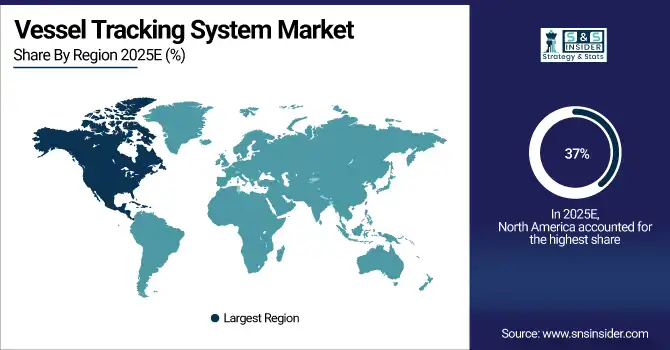
North America dominated the Vessel Tracking System Market with the highest revenue share of about 37% in 2025 due to the presence of major shipping companies, advanced maritime infrastructure, and early adoption of cutting-edge tracking technologies. Strict regulatory compliance, high investments in fleet modernization, and the growing need for efficient fleet management across commercial and defense sectors further contributed to market dominance, making North America the largest revenue-generating region globally.
Get Customized Report as per Your Business Requirement - Enquiry Now
Asia Pacific Vessel Tracking System Market Insights
Asia Pacific segment is expected to grow at the fastest CAGR of about 7.89% from 2026-2033 owing to rapid expansion in maritime trade, increasing port development, and rising investments in smart shipping technologies. Growing commercial shipping activities, government initiatives to enhance maritime safety, and rising demand for real-time vessel monitoring in countries like China, India, and Japan are driving faster adoption of advanced vessel tracking systems across the region.
Europe Vessel Tracking System Market Insights
Europe dominated the Vessel Tracking System Market in 2025 due to strict maritime safety regulations, high adoption of AIS and satellite-based tracking, and advanced port infrastructure. The region’s focus on fleet efficiency, environmental compliance, and technological integration in commercial shipping and defense sectors drives consistent demand, making Europe a significant contributor to global market revenue and adoption of vessel tracking solutions.
Middle East & Africa and Latin America Vessel Tracking System Market Insights
Middle East & Africa and Latin America dominated the Vessel Tracking System Market in 2025 due to growing maritime trade, strategic port developments, and increasing adoption of AIS and satellite-based tracking systems. Rising commercial shipping, fishing activities, and regulatory compliance initiatives in both regions drive demand for advanced vessel tracking solutions, enhancing fleet operational efficiency, safety, and maritime security across key ports and coastal areas, contributing significantly to regional market growth.
Vessel Tracking System Market Competitive Landscape:
ORBCOMM Inc.
ORBCOMM is a global provider of satellite-based IoT and Automatic Identification System (AIS) solutions, specializing in real-time vessel tracking, fleet management, and supply chain monitoring. Its platform integrates satellite and cellular connectivity with analytics, enabling maritime operators, logistics firms, and industrial clients to optimize operations, improve safety, and ensure regulatory compliance. ORBCOMM’s solutions support global tracking, monitoring, and reporting, and its recent acquisition by S&P Global expands its AIS-based maritime and supply-chain offerings.
-
2025: ORBCOMM’s AIS business was acquired by S&P Global, enhancing maritime and supply-chain data offerings with satellite AIS vessel monitoring solutions.
Reference
Spire Global
Spire Global, together with exactEarth, delivers advanced satellite-based AIS data and analytics for maritime, aviation, and weather intelligence. Its services provide real-time vessel positioning, predictive insights, and global maritime domain awareness. Leveraging satellite constellations, cloud analytics, and API integration, Spire enhances fleet management, operational efficiency, and regulatory compliance. The company continually updates its platform, exemplified by the 2025 Maritime 2.0 upgrade, expanding coverage, improving analytics, and integrating smarter AIS capabilities worldwide.
-
2025: Launched Maritime 2.0, updating vessel-tracking services with GraphQL support, smarter AIS data, expanded global coverage, and improved analytics for maritime operations.
-
2024: Awarded €8.4 M contract by European Maritime Safety Agency (EMSA) to provide satellite-AIS data services, enhancing global vessel tracking and maritime domain awareness.
-
2023: Selected by Enqlare to supply AIS vessel tracking data via API, integrating real-time positions and vessel insights into its maritime SaaS platform.
Kongsberg Gruppen ASA
Kongsberg Gruppen ASA is a leading provider of integrated maritime, defense, and industrial solutions, offering advanced vessel tracking, fleet management, and operational analytics. Its platforms combine satellite connectivity, IoT telemetry, and intelligent analytics to optimize shipping efficiency, safety, and compliance across global maritime operations. The company collaborates with partners such as Inmarsat to enhance satellite-based vessel monitoring, delivering actionable insights for commercial, government, and industrial clients, strengthening real-time maritime situational awareness and fleet intelligence.
-
2025: Collaborated with Inmarsat to integrate satellite connectivity with vessel tracking and fleet analytics platforms, enhancing maritime monitoring capabilities.
Vessel Tracking System Market Key Players
-
ORBCOMM Inc.
-
Spire Global / exactEarth
-
Garmin Ltd.
-
Saab AB
-
SRT Marine Systems
-
Japan Radio Co., Ltd.
-
Wärtsilä Voyage (Wärtsilä Corporation)
-
Raytheon Intelligence & Space / Raytheon Company
-
Transas / Transas Marine Limited
-
MarineTraffic
-
VesselFinder
-
FleetMon
-
Inmarsat plc
-
Kongsberg Gruppen ASA
-
BAE Systems
-
Signalis
-
Big Ocean Data Ltd
-
CNS Systems AB
| Report Attributes | Details |
|---|---|
| Market Size in 2025E | USD 6.21 Billion |
| Market Size by 2033 | USD 10.02 Billion |
| CAGR | CAGR of 6.24% From 2026 to 2033 |
| Base Year | 2025 |
| Forecast Period | 2026-2033 |
| Historical Data | 2022-2024 |
| Report Scope & Coverage | Market Size, Segments Analysis, Competitive Landscape, Regional Analysis, DROC & SWOT Analysis, Forecast Outlook |
| Key Segments | • By End-Use (Commercial Shipping, Fishing Vessels, Defense and Coast Guard, Yachting, Research Vessels) • By Component (Hardware, Software, Service, Communication Infrastructure, Data Analytics) • By Technology (Satellite Based Tracking, Automatic Identification System, RFID Tracking, AIS Based Systems, Cellular Networks) • By Application (Navigation, Fleet Management, Regulatory Compliance, Search and Rescue Operations, Cargo Monitoring) |
| Regional Analysis/Coverage | North America (US, Canada), Europe (Germany, UK, France, Italy, Spain, Russia, Poland, Rest of Europe), Asia Pacific (China, India, Japan, South Korea, Australia, ASEAN Countries, Rest of Asia Pacific), Middle East & Africa (UAE, Saudi Arabia, Qatar, South Africa, Rest of Middle East & Africa), Latin America (Brazil, Argentina, Mexico, Colombia, Rest of Latin America). |
| Company Profiles | ORBCOMM Inc., Spire Global / exactEarth, Garmin Ltd., Thales Group, Saab AB, SRT Marine Systems, Japan Radio Co., Ltd., Wärtsilä Voyage (Wärtsilä Corporation), Raytheon Intelligence & Space / Raytheon Company, Transas / Transas Marine Limited, MarineTraffic, VesselFinder, FleetMon, Inmarsat plc, Kongsberg Gruppen ASA, BAE Systems, Signalis, VesselLink, Big Ocean Data Ltd, CNS Systems AB |
Frequently Asked Questions
The market is expected to grow at a CAGR of 6.24% from 2026 to 2033 due to rising global maritime trade and fleet monitoring demand.
North America dominated in 2025 owing to advanced maritime infrastructure, fleet modernization, regulatory compliance, and early adoption of vessel tracking technologies.
The Hardware segment dominated the market due to essential sensors, transceivers, and onboard devices enabling accurate real-time vessel tracking and operational efficiency.
Market growth is primarily driven by increasing demand for real-time vessel monitoring, fleet management efficiency, and regulatory compliance across commercial and defense sectors.
The Vessel Tracking System Market was valued at USD 6.21 billion in 2025, driven by growing maritime trade and adoption of tracking technologies.
