
Visualization Instruments For MIS Market Report Scope & Overview:
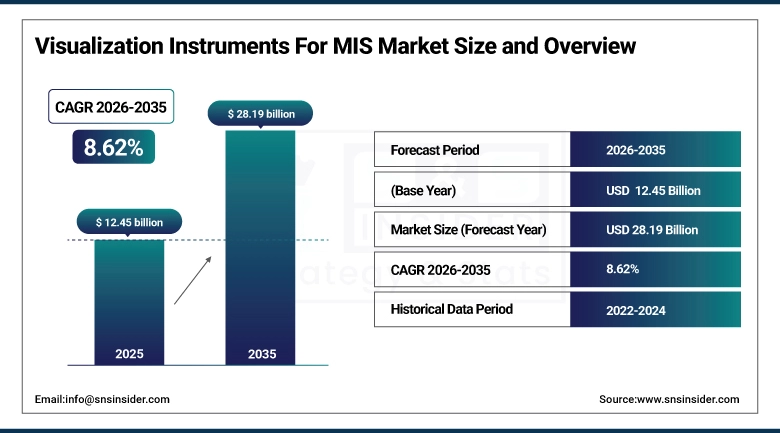
The Visualization Instruments for MIS Market was valued at USD 12.45 billion in 2025 and is expected to reach USD 28.19 billion by 2035, growing at a CAGR of 8.62% from 2026–2035.
Visualization Instruments for MIS Market is showing strong growth owing to the increasing use of minimally invasive surgeries that depend on high-quality imaging and visualization. Increasing preference towards accuracy-based surgeries that minimize risk, increase efficiency, and facilitate better decision making is driving the growth in the use of imaging platforms such as 3D imaging, 4k and even fluorescence-based systems.
Globally, the increased number of surgeries being carried out annually has also been propelling the growth in the visualization instruments for MIS market. According to data provided by the WHO, over 300 million surgeries are conducted globally each year, and this is expected to continue growing at a rapid pace as more procedures become less complicated and easier with the use of visualization instruments.
Another factor fuelling the growth in the visualization instruments for MIS market is technological advances. There has been an increasing trend in the development of artificial intelligence and image enhancement technology in operating rooms, supported by leading authorities like the FDA in the U.S.
To Get more information on Visualization Instruments for MIS Market - Request Free Sample Report
Visualization Instruments For MIS Market Trends
-
Rising adoption of minimally invasive surgical procedures is increasing demand for high-definition visualization systems that enhance surgical precision and outcomes.
-
Growing shift toward 3D, 4K, and ultra-HD imaging technologies is improving depth perception, accuracy, and intraoperative decision-making.
-
Rapid integration of AI-assisted visualization, image enhancement algorithms, and real-time analytics is advancing surgical guidance and workflow efficiency.
-
Increasing adoption of fluorescence imaging and image-guided surgery is enabling better tissue differentiation and improved detection of critical structures.
-
Growing demand for integrated operating room (OR) solutions is driving adoption of connected visualization platforms with seamless data sharing and interoperability.
-
Rising focus on outpatient and ambulatory surgical settings is accelerating demand for compact, portable, and cost-effective visualization systems.
-
Continuous advancements in endoscopic camera systems and sensor technologies are enhancing image clarity, color accuracy, and low-light performance.
-
Increasing investments in smart hospitals and digital surgery ecosystems are supporting the deployment of advanced visualization and imaging infrastructure.
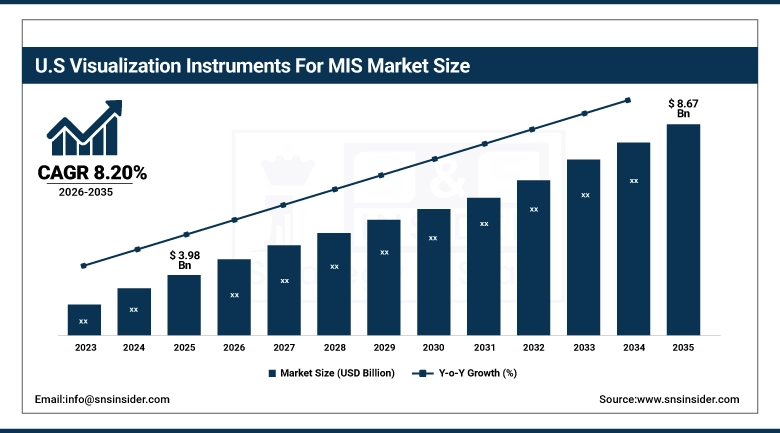
U.S. Visualization Instruments For MIS Market was valued at USD 3.98 billion in 2025 and is expected to reach USD 8.67 billion by 2035, growing at a CAGR of 8.20% from 2026–2035.
The U.S. Visualization Instruments for MIS Market represents the largest global hub, supported by advanced surgical infrastructure, high adoption of minimally invasive procedures, and strong presence of leading medical technology companies such as Stryker Corporation, Medtronic plc, and Johnson & Johnson. Increasing preference for precision-driven surgeries and rapid transition toward digital operating rooms are accelerating the adoption of high-definition visualization platforms, including 4K, 3D, and fluorescence imaging systems across hospitals and ambulatory surgical centers.
Supporting this trend, the Centers for Disease Control and Prevention reports that chronic conditions such as obesity, gastrointestinal disorders, and urological diseases continue to rise in the U.S., significantly increasing the volume of procedures requiring advanced endoscopic and laparoscopic visualization systems. This expanding procedural base is directly fueling demand for next-generation imaging technologies that enhance surgical accuracy and patient outcomes.
Furthermore, the U.S. Food and Drug Administration continues to facilitate innovation through streamlined approvals of advanced imaging and visualization technologies, strengthening the country’s leadership in surgical visualization innovation and adoption.
Visualization Instruments For MIS Market Segment Highlights
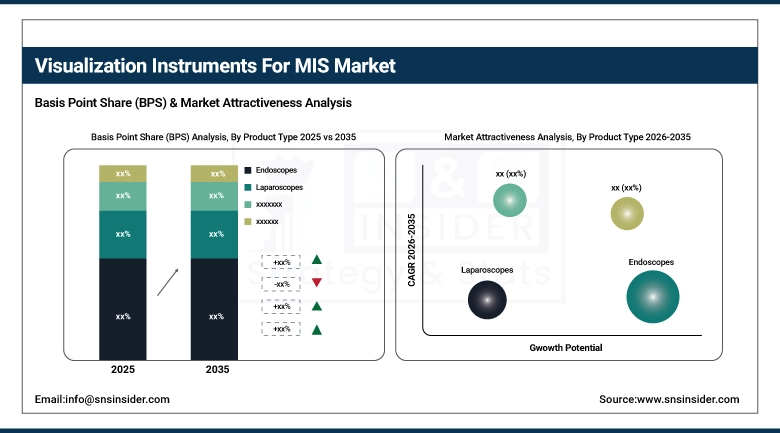
• By Product Type, Endoscopes dominated the Visualization Instruments for MIS Market with 40.36% share in 2025; 3D & 4K Visualization Systems fastest growing CAGR
• By Technology Type, 2D Visualization Systems dominated the market with 47.45% share in 2025; AI-Assisted Visualization Platforms fastest growing CAGR
• By Application, General Surgery dominated the market with 32.85% share in 2025; Urology Surgery fastest growing CAGR
• By End User, Hospitals dominated the market with 62.94% share in 2025; Ambulatory Surgical Centers (ASCs) fastest growing CAGR
• By Modality / System Type, Standalone Visualization Systems dominated the market with 44.51% share in 2025; Portable / Compact Visualization Systems fastest growing CAGR
Visualization Instruments For MIS Market Segment Analysis
By Product Type, Endoscopes segment dominates the Visualization Instruments for MIS Market, 3D & 4K Visualization Systems segment expected to grow fastest
In 2025, the Endoscopes (Rigid Endoscopes, Flexible Endoscopes, Capsule Endoscopes) segment maintained its dominant position in the Visualization Instruments for MIS Market, accounting for 40.36% of total revenue. This segment includes a wide range of diagnostic and therapeutic visualization tools extensively used across gastrointestinal, urology, and pulmonary procedures.
From 2026 to 2035, the 3D & 4K Visualization Systems segment is projected to record the highest CAGR. The growing need for enhanced depth perception, superior image clarity, and precision in complex surgical procedures is accelerating adoption. Surgeons increasingly prefer high-resolution systems for improved anatomical visualization, particularly in laparoscopic and robotic-assisted surgeries. Continuous innovation in ultra-HD imaging, coupled with integration into digital operating rooms, is significantly driving segment growth.
By Technology Type, 2D Visualization Systems segment dominates the Visualization Instruments for MIS Market, AI-Assisted Visualization Platforms segment expected to grow fastest
The 2D Visualization Systems segment held the largest share of 47.45% in 2025, primarily due to its cost-effectiveness, widespread availability, and established usage across healthcare facilities. These systems remain the standard in a large number of surgical settings, particularly in emerging markets where affordability and operational familiarity play a critical role. Their ease of integration and lower capital investment continue to sustain their dominance despite technological advancements.
The AI-Assisted Visualization Platforms segment is expected to register the highest CAGR during the 2026–2035 forecast period. Increasing demand for real-time image analysis, automated tissue differentiation, and decision-support systems is driving rapid adoption. AI integration enhances surgical precision, reduces human error, and improves workflow efficiency. Growing investments in smart operating rooms and digital surgery ecosystems are further accelerating the deployment of AI-enabled visualization technologies.
By Application, General Surgery segment dominates the Visualization Instruments for MIS Market, Urology Surgery segment expected to grow fastest
In 2025, the General Surgery segment accounted for the largest share of 32.85%, supported by the high volume of minimally invasive procedures such as laparoscopic appendectomies, hernia repairs, and cholecystectomies. The widespread adoption of MIS techniques in general surgery, combined with increasing patient preference for faster recovery and reduced complications, has reinforced the segment’s leading position. The availability of advanced visualization systems across hospitals has further contributed to its dominance.
The Urology Surgery segment is projected to register the highest CAGR during the forecast period. Rising incidence of urological disorders, including kidney stones, prostate conditions, and bladder diseases, is driving demand for endoscopic and minimally invasive procedures. Increased use of high-definition imaging and robotic-assisted visualization in urology is enhancing procedural outcomes, thereby accelerating segment growth.
By End User, Hospitals segment dominates the Visualization Instruments for MIS Market, Ambulatory Surgical Centers (ASCs) segment expected to grow fastest
The Hospitals segment maintained the highest share of 62.94% in 2025, driven by the availability of advanced surgical infrastructure, higher patient inflow, and the presence of skilled healthcare professionals. Hospitals serve as primary centers for complex and high-risk minimally invasive procedures requiring advanced visualization systems. Strong capital investment capacity and integration of cutting-edge technologies have further strengthened their dominance.
The Ambulatory Surgical Centers (ASCs) segment is projected to achieve the highest growth rate with a CAGR during 2026–2035.
By Modality / System Type, Standalone Visualization Systems segment dominates the Visualization Instruments for MIS Market, Portable / Compact Visualization Systems segment expected to grow fastest
The Standalone Visualization Systems segment accounted for the largest share of 44.51% in 2025. These systems are widely used due to their reliability, ease of deployment, and compatibility with existing surgical infrastructure. Hospitals and surgical centers prefer standalone systems for their flexibility and lower integration complexity compared to fully integrated operating room setups.
The Portable / Compact Visualization Systems segment is projected to register the highest CAGR of during the 2026–2035 forecast period.
Visualization Instruments For MIS Market Regional Analysis
|
Region |
Major Country |
Share within Region (%) |
|---|---|---|
|
North America |
United States |
35.43% |
|
Europe |
Germany |
25.14% |
|
Asia Pacific |
China |
26.75% |
|
Middle East & Africa |
UAE |
7.04% |
|
Latin America |
Brazil |
5.64% |
North America Visualization Instruments For MIS Market Insights
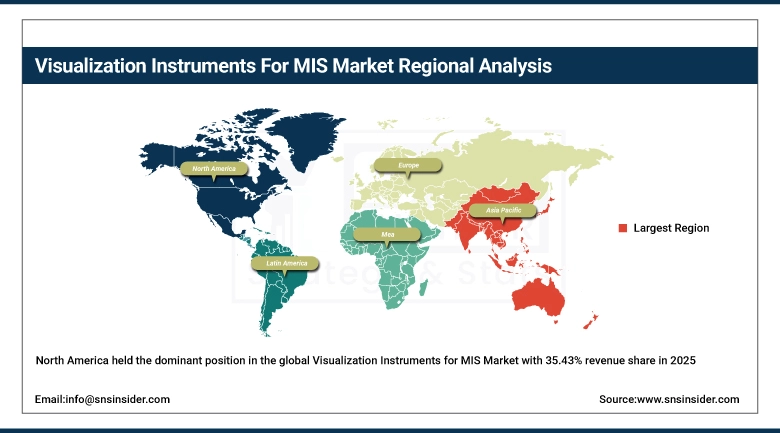
North America held the dominant position in the global Visualization Instruments for MIS Market with 35.43% revenue share in 2025, supported by highly advanced surgical infrastructure, early adoption of high-definition imaging technologies, and strong presence of leading visualization system manufacturers such as Stryker Corporation, Medtronic plc, and Olympus Corporation. The United States accounts of the regional market, driven by widespread use of 4K, 3D, and fluorescence imaging systems across hospitals and ambulatory surgical centers, along with rapid adoption of integrated digital operating rooms.
Supporting this leadership, the Centers for Medicare & Medicaid Services continues to expand reimbursement frameworks for minimally invasive and outpatient procedures, indirectly accelerating procurement of advanced visualization equipment across healthcare systems.
In 2024, Stryker Corporation strengthened its U.S. portfolio with enhancements to its 1688 AIM 4K visualization platform, incorporating advanced fluorescence imaging capabilities to improve real-time surgical visualization and precision.
Get Customized Report as per Your Business Requirement - Enquiry Now
Asia Pacific Visualization Instruments for MIS Market Insights
Asia Pacific is projected to register the highest CAGR of 9.19% during 2026–2035, driven by rapid healthcare infrastructure expansion, increasing surgical volumes, and growing demand for technologically advanced yet cost-effective visualization systems. Key markets such as China, India, Japan, and South Korea are witnessing accelerated adoption, with China contributing of regional revenue due to large-scale hospital expansion and rising investments in advanced medical technologies.
Growth is further supported by increasing awareness of minimally invasive procedures and rising middle-class healthcare expenditure. Governments across the region are prioritizing modernization of surgical facilities and adoption of advanced imaging systems to improve clinical outcomes.
In 2024, Olympus Corporation expanded the deployment of its EVIS X1 endoscopy system across Asia-Pacific markets, enhancing access to next-generation imaging technologies and strengthening regional adoption of high-definition visualization platforms.
Europe Visualization Instruments for MIS Market Insights
Europe accounted for the global Visualization Instruments for MIS Market in 2025, making it the second-largest regional market. Growth is supported by a well-established healthcare ecosystem, strong regulatory frameworks, and increasing adoption of advanced imaging technologies in countries such as Germany, the United Kingdom, France, and Italy. The region demonstrates high penetration of minimally invasive procedures, supported by trained surgical professionals and continuous investment in operating room modernization.
The regulatory environment, led by the European Union’s medical device standards, ensures high-quality and safe adoption of advanced visualization systems, boosting confidence among healthcare providers.
In 2024, Karl Storz SE & Co. KG introduced advanced IMAGE1 S™ Rubina fluorescence imaging solutions across European surgical centers, enhancing intraoperative visualization and supporting precision-guided minimally invasive procedures.
Middle East & Africa and Latin America Visualization Instruments for MIS Market Insights
The Middle East & Africa (MEA) and Latin America regions are experiencing steady growth in the Visualization Instruments for MIS Market, driven by increasing healthcare investments, rising adoption of minimally invasive procedures, and gradual improvement in surgical infrastructure. In the MEA region, countries such as Saudi Arabia, the UAE, and South Africa are leading adoption, supported by government-led healthcare transformation initiatives and investments in advanced hospital equipment.
In Latin America, Brazil and Mexico dominate regional demand, benefiting from expanding private healthcare sectors and improving access to advanced surgical technologies. Increasing focus on cost-effective and portable visualization systems is also supporting adoption across smaller healthcare facilities.
Supporting regional development, Saudi Ministry of Health continues to invest in hospital modernization programs under Vision 2030, including procurement of advanced endoscopic and visualization systems.
Visualization Instruments For MIS Market Growth Drivers:
-
Rising global shift toward minimally invasive procedures requiring high-precision imaging is driving strong demand for advanced surgical visualization systems
The accelerating transition from conventional open surgeries to minimally invasive techniques is the most critical structural driver for the Visualization Instruments for MIS Market. As surgical procedures become increasingly dependent on real-time imaging for accuracy and safety, high-definition visualization systems have evolved from supportive tools to essential surgical components. Surgeons now rely heavily on enhanced imaging technologies such as 3D, 4K, and fluorescence-guided visualization to achieve superior depth perception, precise tissue differentiation, and improved intraoperative navigation.
Supporting this trend, the World Health Organization estimates that more than 300 million surgical procedures are performed globally each year, with a rapidly increasing proportion being conducted using minimally invasive techniques that require advanced visualization systems. Additionally, the Agency for Healthcare Research and Quality highlights a sustained rise in laparoscopic and endoscopic procedure volumes across the United States, reinforcing the growing reliance on visualization technologies as a core component of surgical workflows.
Further strengthening this trajectory, recent industry developments reflect continuous innovation in visualization capabilities. In 2024, Olympus Corporation expanded the global rollout of its EVIS X1 endoscopy system, integrating advanced imaging modalities such as texture and color enhancement imaging to significantly improve lesion detection and procedural accuracy.
Visualization Instruments For MIS Market Restraints:
-
High capital investment and infrastructure integration requirements for advanced visualization systems in Visualization Instruments For MIS limiting adoption across cost-sensitive healthcare settings and emerging economies
The substantial cost burden associated with acquiring and maintaining advanced MIS visualization instruments—such as 3D/4K imaging systems, integrated OR visualization platforms, and AI-enabled surgical imaging suites—acts as a key restraint on market expansion. These systems require significant upfront capital investment, often running into hundreds of thousands of dollars per installation, along with recurring expenses for software upgrades, calibration, maintenance, and skilled technical support.
Visualization Instruments For MIS Market Opportunities:
-
Rapid advancement of next-generation high-resolution, AI-integrated visualization ecosystems is creating strong opportunities for precision-driven Visualization Instruments For MIS across high-growth clinical segments
The ongoing evolution of surgical visualization technologies is unlocking significant market opportunities through the integration of artificial intelligence, real-time image enhancement, and advanced optical engineering. Next-generation 3D/4K/8K visualization platforms, combined with AI-powered tissue recognition and intraoperative analytics, are enabling surgeons to achieve unprecedented levels of accuracy in complex procedures such as oncology, neurology, and cardiovascular interventions.
Recent Developments:
-
2026: Olympus Corporation advanced its next-generation EVIS X1 endoscopy platform enhancements, integrating improved 4K imaging processing, narrower diameter flexible scopes, and AI-assisted lesion detection support across gastrointestinal and pulmonary minimally invasive procedures, with expanded clinical rollout across Asia Pacific and European hospital networks, strengthening early disease detection and precision endoscopy adoption.
-
2026: Stryker Corporation expanded its 1688 AIM 4K 3-Chip Camera Platform ecosystem, integrating enhanced fluorescence-guided imaging and upgraded digital visualization modules for orthopedic and general minimally invasive procedures, improving intraoperative clarity and supporting broader adoption in ambulatory surgical centers and high-volume hospital operating rooms globally.
-
2025: Medtronic strengthened its Hugo™ robotic-assisted surgery ecosystem integration with advanced visualization modules, improving compatibility with high-definition 3D imaging systems and expanding real-time surgical visualization capabilities across urology or gynecology MIS procedures, while increasing deployments in European and select Asia-Pacific hospital networks.
-
2025: Karl Storz SE & Co. KG expanded its IMAGE1 S™ imaging platform portfolio, introducing enhanced 4K fluorescence imaging and digital OR integration features, enabling improved visualization precision in laparoscopic and endoscopic surgeries and accelerating adoption across specialty surgical centers and teaching hospitals globally.
Visualization Instruments For MIS Market Key Players
Some of the Visualization Instruments For MIS Market Companies
-
Olympus Corporation
-
Karl Storz SE & Co. KG
-
Stryker Corporation
-
Medtronic plc
-
Johnson & Johnson
-
Fujifilm Holdings Corporation
-
Boston Scientific Corporation
-
Smith & Nephew plc
-
Conmed Corporation
-
Richard Wolf GmbH
-
B. Braun Melsungen AG
-
Intuitive Surgical Inc.
-
Canon Medical Systems Corporation
-
Sony Corporation
-
Zimmer Biomet Holdings Inc.
-
Hoya Corporation
-
Ambu A/S
-
Arthrex Inc.
-
Mindray Medical International Limited
-
Shenzhen Mindray Bio-Medical Electronics Co. Ltd.
Visualization Instruments For MIS Market Report Scope:
| Report Attributes | Details |
|---|---|
| Market Size in 2025 | USD 12.45 Billion |
| Market Size by 2035 | USD 28.19 Billion |
| CAGR | CAGR of 8.62% From 2026 to 2035 |
| Base Year | 2025 |
| Forecast Period | 2026-2035 |
| Historical Data | 2022-2024 |
| Report Scope & Coverage | Market Size, Segments Analysis, Competitive Landscape, Regional Analysis, DROC & SWOT Analysis, Forecast Outlook |
| Key Segments | • By Product Type (Endoscopes (Rigid Endoscopes, Flexible Endoscopes, Capsule Endoscopes), Laparoscopes, Arthroscopes, Visualization Towers / Integrated Systems, 3D & 4K Visualization Systems, Others) • By Technology Type (2D Visualization Systems, 3D Visualization Systems, 4K / Ultra-HD Imaging Systems, AI-Assisted Visualization Platforms, Others) • By Application (General Surgery, Gynecology Surgery, Urology Surgery, Orthopedic Surgery, Others) • By End User (Hospitals, Ambulatory Surgical Centers (ASCs), Specialty Clinics, Diagnostic Centers) • By Modality / System Type (Standalone Visualization Systems, Integrated Operating Room (OR) Visualization Systems, Portable / Compact Visualization Systems) |
| Regional Analysis/Coverage | North America (US, Canada), Europe (Germany, UK, France, Italy, Spain, Russia, Poland, Rest of Europe), Asia Pacific (China, India, Japan, South Korea, Australia, ASEAN Countries, Rest of Asia Pacific), Middle East & Africa (UAE, Saudi Arabia, Qatar, South Africa, Rest of Middle East & Africa), Latin America (Brazil, Argentina, Mexico, Colombia, Rest of Latin America). |
| Company Profiles | Olympus Corporation, Karl Storz SE & Co. KG, Stryker Corporation, Medtronic plc, Johnson & Johnson, Fujifilm Holdings Corporation, Boston Scientific Corporation, Smith & Nephew plc, Conmed Corporation, Richard Wolf GmbH, B. Braun Melsungen AG, Intuitive Surgical Inc., Canon Medical Systems Corporation, Sony Corporation, Zimmer Biomet Holdings Inc., Hoya Corporation, Ambu A/S, Arthrex Inc., Mindray Medical International Limited, Shenzhen Mindray Bio-Medical Electronics Co. Ltd. |
Frequently Asked Questions
North America dominated the Visualization Instruments For MIS Market in 2025.
The Endoscopes (Rigid Endoscopes, Flexible Endoscopes, Capsule Endoscopes) segment dominated the Visualization Instruments For MIS Market in 2025.
Rising adoption of high-precision surgical visualization technologies such as 3D/4K imaging systems, AI-assisted endoscopic platforms, and integrated operating room visualization solutions—driven by the need for enhanced surgical accuracy, real-time intraoperative guidance, and improved clinical outcomes—is the primary growth driver of the Visualization Instruments for Minimally Invasive Surgery (MIS) Market.
The Visualization Instruments For MIS Market was valued at USD 12.45 billion in 2025.
The Visualization Instruments For MIS Market is expected to grow at a CAGR of 8.62% from 2026 to 2035.
