
Wound Debridement Control Market Report Scope & Overview:
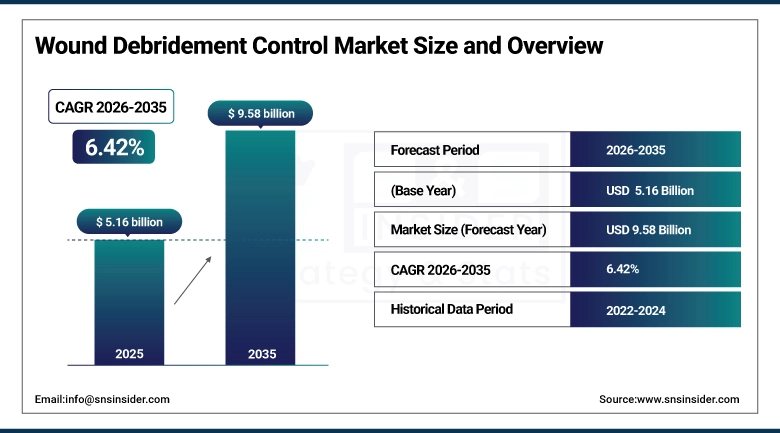
The Wound Debridement Market size is valued at USD 5.16 Billion in 2025 and is projected to reach USD 9.58 Billion by 2035, growing at a CAGR of 6.42% during the forecast period 2026–2035.
Insights on the Wound Debridement Market highlight key trends, technological advancements, and the expanding role of advanced wound care across hospitals and outpatient settings. Market growth is driven by rising prevalence of chronic wounds, increasing diabetes-related complications, and growing adoption of enzymatic and ultrasonic debridement techniques. Additionally, the shift toward outpatient and home healthcare, along with demand for faster healing and improved infection control outcomes, is accelerating market expansion from 2026 to 2035.
Wound care treatments are being widely adopted across hospitals and specialty clinics globally, with increasing demand for faster healing and infection control solutions, and the market is expanding steadily with next-generation wound management approaches by 2035.
Market Size and Forecast:
-
Market Size in 2025: USD 5.16 Billion
-
Market Size by 2035: USD 9.58 Billion
-
CAGR: 6.42% from 2026 to 2035
-
Base Year: 2025
-
Forecast Period: 2026–2035
-
Historical Data: 2022–2024
To Get more information on Wound Debridement Market - Request Free Sample Report
Wound Debridement Control Market Trends:
-
Rising prevalence of chronic wounds, diabetic foot ulcers, and pressure ulcers driving continuous demand for debridement procedures
-
Increasing adoption of enzymatic, ultrasonic, and hydro-surgical debridement techniques for improved precision and faster healing outcomes
-
Growing shift toward outpatient care, ambulatory centers, and home healthcare-based wound management solutions
-
Rising focus on infection control, early wound intervention, and improved patient recovery outcomes in clinical settings
-
Expanding geriatric population and increasing global diabetes burden supporting long-term market growth
-
Increasing utilization of advanced wound care products including bioactive agents, gels, and specialized dressings
-
Growing awareness among clinicians regarding timely and effective debridement to prevent complications and amputations
-
Rising healthcare investments and expanding wound care infrastructure in emerging economies driving market penetration
U.S. Wound Debridement Control Market Insights:
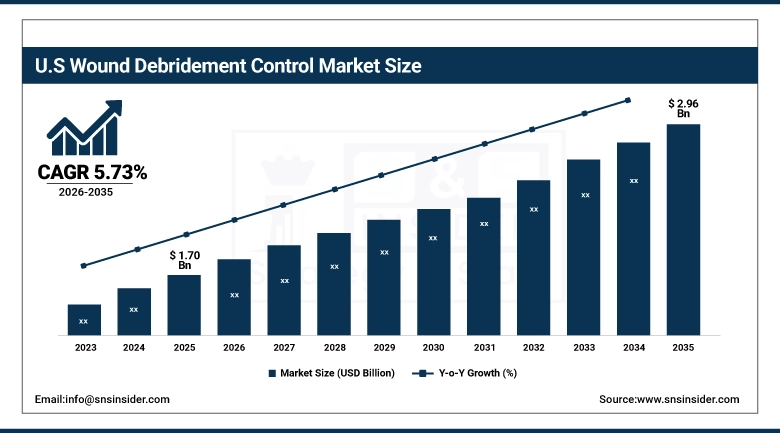
The Wound Debridement Market is projected to grow from USD 1.70 Billion in 2025 to USD 2.96 Billion by 2035, at a CAGR of 5.73%. Positive growth drivers for the industry include an increase in the incidence rate of chronic wounds like diabetic foot ulcers and pressure wounds, an increased acceptance of debridement technologies such as enzymatic debridement and ultrasonic debridement, and a higher focus on faster healing times and more effective infection control. An increasing trend towards ambulatory settings, home-based health care services, and minimally invasive wound care products is contributing to better efficiencies and market growth from 2026 to 2035.
Wound Debridement Control Market Growth Drivers:
-
Rising prevalence of chronic wounds, diabetic foot ulcers, and pressure ulcers is significantly driving the demand for advanced wound debridement procedures across hospitals, specialty clinics, and outpatient care centers.
Incredible progress has been made in enzyme debridement, ultrasound debridement, and hydro-surgery debridement technologies to increase precision, minimize tissue injury, and quicken the recovery process when compared to conventional surgical procedures. The increasing usage of cutting-edge wound care materials, which include bioactive materials, hydrogels, and antimicrobial dressings, is contributing positively toward achieving greater effectiveness in clinical settings and faster tissue regeneration.
Over 60% of chronic wound cases globally now require repeated debridement interventions as of 2025, highlighting the critical role of advanced wound management solutions in long-term healthcare delivery systems.
Wound Debridement Control Market Restraints:
-
High cost of advanced debridement technologies such as enzymatic agents, ultrasonic devices, and bioactive wound care products is limiting widespread adoption, particularly in cost-sensitive healthcare systems and developing regions.
The dependence on conventional surgery and mechanical means of debridement continues to be prominent because of low procedure costs and the familiarity of practitioners with the process. The lack of reimbursement coverage for modern wound care procedures and inconsistencies in health-care finance policy from one region to another continue to hinder their widespread acceptance. Moreover, the requirement for trained health care professionals to carry out advanced procedures in debridement makes the process more difficult.
Wound Debridement Control Market Opportunities:
-
Rapid expansion of advanced wound care ecosystems and specialized wound management centers is creating strong opportunities for innovative debridement solutions globally.
The Wound Debridement Market is also experiencing gains due to rising trend towards the standardization of chronic wounds care pathways, whereby hospitals/clinics are adopting cutting-edge treatment regimens in order to enhance wound healing processes and minimize chances of complications. Increased adoption of non-hospital based wound care centers and home care treatments is paving way for novel avenues into the debridement space through the development of convenient portable debridement solutions. Increased developments in innovative wound care solutions such as enzyme based products, smart bandages, and energy assisted debridement solutions, among others, have enabled patient-centered debridement therapies.
Over 55% of global advanced wound care centers will be adopting tech-enabled debridement methods and chronic wound care pathways in 2035.
Wound Debridement Control Market Segmentation Analysis:
-
By Method, Surgical / Sharp Debridement held the largest market share of 35.45% in 2025, while Biological Debridement is expected to grow at the fastest CAGR of 9.80% during 2026–2035.
-
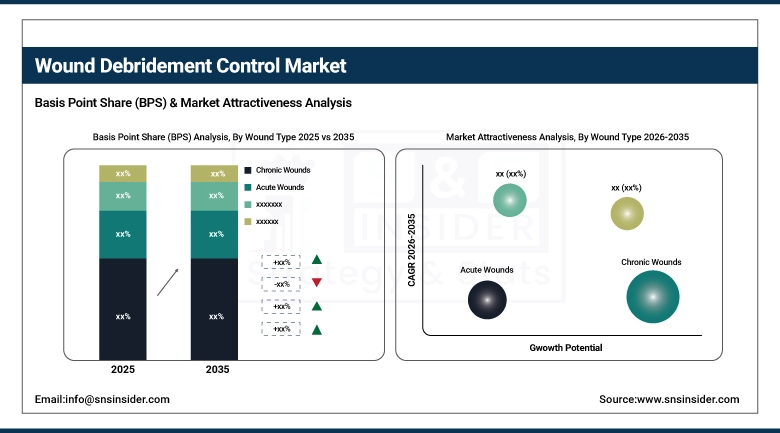
By Wound Type, Chronic Wounds dominated with 62.45% market share in 2025, while Chronic Wounds are expected to grow at the fastest CAGR of 6.55% during 2026–2035.
-
By End User, Hospitals held the largest share of 51.85% in 2025, while Home Healthcare Settings are expected to grow at the fastest CAGR of 7.51% during 2026–2035.
-
By Product Type, Debridement Devices dominated with 34.21% market share in 2025, while Debridement Pads & Dressings are expected to grow at the fastest CAGR of 12.64% during 2026–2035.
By Wound Type, Chronic Wounds Dominate While Chronic Wounds Also Grow Rapidly:
Chronic Wounds segment dominated the market because of the prevalence of diabetic foot ulcers, pressure ulcers, and venous leg ulcers, which require regular debridement procedures. The increase in the number of patients suffering from diabetes, obesity, and an aging population fuels the demand for products in the market.
Chronic Wounds is also the fastest-growing segment, due to the growing number of patients and widespread adoption of advanced debridement methods for wounds that take long to heal.
By Method, Surgical / Sharp Debridement Dominates While Biological Debridement Grows Rapidly:
Surgical / Sharp Debridement segment dominated the market due to its strong clinical reliability, rapid removal of necrotic tissue, and widespread adoption in hospital-based wound management protocols. Its established role in both acute and chronic wound treatment ensures consistent utilization across healthcare systems.
Biological Debridement is the fastest-growing segment, driven by increasing adoption of maggot-based therapy and biologically assisted wound healing approaches for complex chronic wounds. Growing preference for minimally invasive and tissue-preserving treatment methods is accelerating its uptake.
By End User, Hospitals Dominate While Home Healthcare Settings Grow Rapidly:
The hospitals segment dominated the market owing to higher patient influx, presence of wound care facilities, and a preference for surgical debridement methods. The hospitals will continue to be the major centers for managing chronic wounds.
The home healthcare settings segment is expected to witness the fastest growth owing to the trend towards decentralization of care, rising number of elderly patients, and the need for affordable wound treatment solutions.
By Product Type, Debridement Devices Dominate While Debridement Pads & Dressings Grow Rapidly:
Debridement Devices segment dominated the market owing to the widespread application of surgical devices, mechanical devices, and energy-based devices during wound care treatments. The necessity of these devices in accurate tissue elimination guarantees their adoption in medical facilities such as hospitals and specialist centers.
The market for Debridement Pads & Dressings is growing at the fastest rate since there is an increasing requirement for innovative consumables for wound care management that maintain proper moisture content, prevent infections, and ensure consistent healing processes.
Wound Debridement Control Market Regional Analysis:
North America Wound Debridement Market Insights:
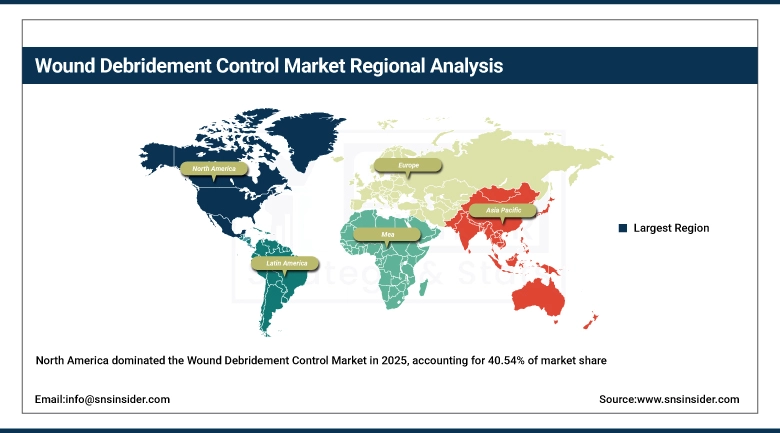
The North America Wound Debridement Market is dominated, holding a 40.54% share in 2025 due to its very developed healthcare infrastructure, established wound care industry ecosystem, and high incidences of chronic wounds like diabetic foot ulcers and pressure sores. This region enjoys a prominent presence of major players in the medical device industry, efficient hospital networks, and specialized wound care facilities that encourage the use of advanced surgical, enzymatic, and debridement methods. Technological innovations within the bioactive wound care segment, effective reimbursement policies, and efforts made to minimize the duration of hospitalization are contributing toward reinforcing market dominance.
Get Customized Report as per Your Business Requirement - Enquiry Now
United States Wound Debridement Market Insights:
United States Wound Debridement Market holds the top position within the regional market environment owing to its high burden of chronic wounds, high expenditure capabilities on healthcare services, and early adoption of advanced wound care technologies. Next-generation wound care and debridement technologies like enzymatic preparations, ultrasonic debridement machines, and advanced wound dressings are receiving significant attention in the United States.
Asia-Pacific Wound Debridement Market Insights:
The Asia-Pacific Wound Debridement Market is the fastest-growing region, projected to expand at a 7.55% CAGR during 2026–2035. The major drivers are increasing prevalence of diabetes ulcers, increasing aging population base, and rapid growth in the healthcare infrastructure in the emerging economies. Nations like China, India, Japan, and South Korea are making substantial investments in building new infrastructure for providing quality wound care services, including more sophisticated wound debridement techniques and technology. Rising awareness about chronic wounds, increased hospitalizations for diabetic complications, and adoption of cost-efficient wound care treatments are further aiding the demand for wound debridement products in the region.
China Wound Debridement Market Insights:
The Wound Debridement market in China is being propelled by the rising numbers of diabetic patients, cases of chronic wound development, and an increasing interest from the Chinese government to promote advanced healthcare services. The nation is building its capacity in the wound care sector through widespread adoption of innovative wound debridement technologies in its hospitals and clinics.
Europe Wound Debridement Market Insights:
The Europe Wound Debridement Market receives significant support from efficient healthcare facilities, high standards of wound care, and rising interest in chronic diseases across major countries like Germany, France, UK, and Italy. It enjoys the advantage of established procedures for treating wounds, high levels of awareness regarding advanced wound debridement methods, and extensive use of enzymatic and surgical wound care treatments in hospitals and specialty care centers. There has been an increasing trend towards chronic diseases like geriatric conditions, diabetes-related wounds, and evidence-based wound care procedures. Favorable reimbursement policies and clinical innovations in wound care products have also added to the market growth.
Germany Wound Debridement Market Insights:
The Germany Wound Debridement Market receives significant boost from its advanced healthcare system, extensive research and development capabilities, and wide usage of precision-oriented wound care treatments. Increasing focus on effective chronic wound treatment using advanced clinical pathways and incorporation of wound debridement procedures in hospitals and clinics has also been witnessed. Increasing demand for infection control, accelerated wound healing rates, and shorter hospital stays have increased demand for enzymatic, surgical, and wound care treatments.
Latin America Wound Debridement Market Insights:
The Latin America Wound Debridement Market is showing strong growth trends due to the high incidence of diabetes wounds, improved access to healthcare services, and investments in hospitals' infrastructures. Emerging markets like Brazil, Mexico, and Argentina are investing in wound debridement facilities, especially in urban healthcare centers and specialized clinics. Awareness about the importance of chronic wound care and debridement solutions is boosting market growth.
Middle East & Africa Wound Debridement Market Insights:
The Middle East & Africa Wound Debridement Market is gaining momentum on account of the growing prevalence of chronic ailments, increased number of surgeries, and improved healthcare infrastructure in major markets such as Saudi Arabia, UAE, Israel, and South Africa. The region is recording an increase in the adoption of innovative wound debridement products and solutions in hospitals and specialized centers, especially for patients suffering from diabetes and traumatic injuries.
Wound Debridement Control Market Competitive Landscape:
-
Smith & Nephew plc is a leading multinational corporation that deals with advanced wound care and surgery products and has a robust footprint in technologies such as wound debridement, which includes enzymatic, surgical, and advanced wound care management solutions. It is well-known for its innovative range of products for managing chronic wounds like diabetic foot ulcers and pressure injuries. The competitive advantage of the firm stems from its comprehensive wound care system, constant innovation in products, and extensive global distribution network.
-
In March 2025, Smith & Nephew advanced its wound care portfolio by expanding its enzymatic debridement and negative pressure wound therapy integration solutions, strengthening clinical efficiency in chronic wound management pathways.
Mölnlycke Health Care AB is one of the world's leading companies that offer solutions in medical products and services. This firm deals primarily with wound care and surgical products with an emphasis on infection prevention and optimized wound healing. In addition, this company enjoys dominance in the use of wound debridement with the help of its advanced dressings, wound care surgeries, and bio-compatible wound care products. This firm's competitive strength mainly stems from its emphasis on clinical research, excellent wound care products, and presence in Europe and other parts of the world.
-
In February 2025, Mölnlycke Health Care expanded its advanced wound care portfolio by enhancing its antimicrobial and moisture-balancing dressing technologies aimed at improving debridement efficiency and accelerating chronic wound healing outcomes.
ConvaTec Group plc is a major global medical products company with a strong presence in advanced wound care, ostomy care, and continence care solutions, offering a comprehensive range of debridement-related wound management products. The company plays a key role in chronic wound treatment through its hydrofiber dressings, enzymatic wound care solutions, and advanced infection control technologies used across hospitals and homecare settings. Its competitive strength lies in its strong chronic care focus, recurring revenue-driven product portfolio, and growing presence in home healthcare wound management.
-
In April 2025, ConvaTec Group strengthened its advanced wound care segment by launching enhanced hydrofiber-based wound dressing solutions designed to support improved autolytic debridement and faster healing in chronic wound patients.
Wound Debridement Control Market Key Players:
Some of the Wound Debridement Control Market Companies are:
-
Smith & Nephew plc
-
Mölnlycke Health Care AB
-
ConvaTec Group plc
-
Coloplast A/S
-
B. Braun Melsungen AG
-
3M Company
-
Integra LifeSciences Holdings Corporation
-
Medtronic plc
-
Cardinal Health Inc.
-
Medline Industries Inc.
-
Paul Hartmann AG (HARTMANN Group)
-
Lohmann & Rauscher GmbH & Co. KG
-
Organogenesis Holdings Inc.
-
Baxter International Inc.
-
Zimmer Biomet Holdings Inc.
-
Urgo Medical
-
Essity AB
-
MiMedx Group Inc.
-
Advanced Medical Solutions Group plc
-
Hollister Incorporated
| Report Attributes | Details |
|---|---|
| Market Size in 2025 | USD 5.16 Billion |
| Market Size by 2035 | USD 9.58 Billion |
| CAGR | CAGR of 6.42% From 2026 to 2035 |
| Base Year | 2025 |
| Forecast Period | 2026-2035 |
| Historical Data | 2022-2024 |
| Report Scope & Coverage | Market Size, Segments Analysis, Competitive Landscape, Regional Analysis, DROC & SWOT Analysis, Forecast Outlook |
| Key Segments | • By Method (Surgical / Sharp Debridement, Mechanical Debridement, Autolytic Debridement, Enzymatic Debridement, Biological Debridement, Ultrasonic / Hydro-surgical Debridement) • By Wound Type (Chronic Wounds (Diabetic Foot Ulcers, Pressure Ulcers, Venous Leg Ulcers), Acute Wounds (Surgical Wounds, Traumatic Wounds, Burns,Others) • By Product Type (Debridement Devices, Debridement Gels & Ointments, Debridement Pads & Dressings, Enzymatic Agents, Consumables & Accessories) • By End-User (Hospitals, Wound Care / Specialty Clinics, Ambulatory Surgical Centers (ASCs), Home Healthcare Settings) |
| Regional Analysis/Coverage | North America (US, Canada), Europe (Germany, UK, France, Italy, Spain, Russia, Poland, Rest of Europe), Asia Pacific (China, India, Japan, South Korea, Australia, ASEAN Countries, Rest of Asia Pacific), Middle East & Africa (UAE, Saudi Arabia, Qatar, South Africa, Rest of Middle East & Africa), Latin America (Brazil, Argentina, Mexico, Colombia, Rest of Latin America). |
| Company Profiles | Smith & Nephew plc, Mölnlycke Health Care AB, ConvaTec Group plc, Coloplast A/S, B. Braun Melsungen AG, 3M Company, Integra LifeSciences Holdings Corporation, Medtronic plc, Cardinal Health Inc., Medline Industries Inc., Paul Hartmann AG (HARTMANN Group), Lohmann & Rauscher GmbH & Co. KG, Organogenesis Holdings Inc., Baxter International Inc., Zimmer Biomet Holdings Inc., Urgo Medical, Essity AB, MiMedx Group Inc., Advanced Medical Solutions Group plc, Hollister Incorporated. |
Frequently Asked Questions
North America dominated with a 40.54% share in 2025, while Asia-Pacific is the fastest-growing region, expected to expand at a CAGR of 7.55% during 2026–2035.
Surgical / Sharp Debridement dominated with a 38.45% share in 2025, while Biological Debridement are projected to grow at the fastest CAGR of 9.80% during 2026–2035.
Growth is driven by rising prevalence of chronic wounds such as diabetic foot ulcers and pressure injuries, along with increasing adoption of advanced debridement techniques including enzymatic and ultrasonic wound care solutions.
The market is valued at USD 5.16 Billion in 2025 and is projected to reach USD 9.58 Billion by 2035.
The Wound Debridement Control Markets projected to grow at a CAGR of 6.42% during 2026–2035.
