
Yard Access Control Kiosk Market Report Scope & Overview:
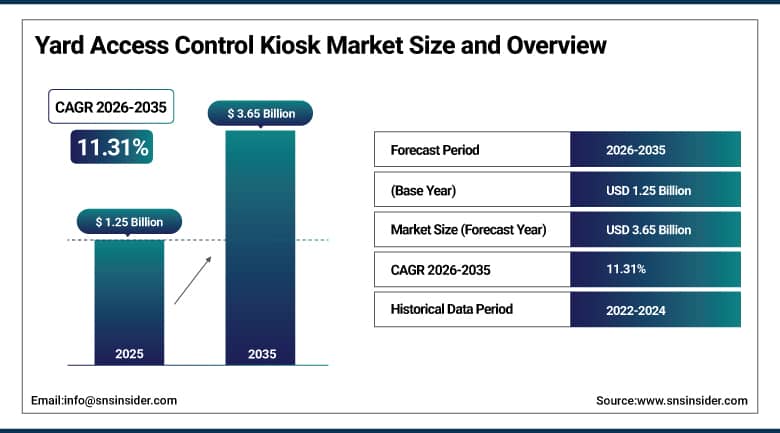
The Yard Access Control Kiosk Market was valued at USD 1.25 Billion in 2025 and is projected to reach USD 3.65 Billion by 2035, expanding at a CAGR of 11.31% during the forecast period 2026–2035.
There is substantial growth in the yard access control kiosk market due to the growing digitization of logistics operations, development of smart freight terminals, warehouse automation, and rising need for vehicle access management systems. Self-service access control kiosks are becoming a popular trend among distribution centers, ports, manufacturing plants, logistics parks, and intermodal terminals, as they help automate such processes as driver identification, visitor registration, appointment scheduling, and vehicle entry while minimizing the manual involvement. The use of technologies such as biometric authentication, RFID technology, QR code verification, automatic license plate recognition (ALPR), cloud platform management, and AI allows for optimizing the operations, improving the security of facilities, and reducing vehicle turnarounds.
From 2025 to 2026, several technology companies in logistics industry have launched AI-based yard access kiosks with the functions of biometric authentication, cloud computing, automatic license plate recognition, and security management.
To Get More Information On Yard Access Control Kiosk Market - Request Free Sample Report
Yard Access Control Kiosk Market Trends
-
Increasing deployment of self-service digital kiosks for automated truck check-in and gate access across logistics facilities.
-
Rising adoption of biometric authentication and AI-powered identity verification technologies to enhance yard security and regulatory compliance.
-
Growing implementation of cloud-based yard management platforms integrated with access control kiosks for centralized fleet and visitor management.
-
Expanding utilization of automatic license plate recognition (ALPR), RFID, and QR code technologies for touch less vehicle authentication.
-
Increasing investments in smart logistics hubs, automated distribution centers, and intelligent transportation infrastructure supporting digital gate automation.
The U.S. Yard Access Control Kiosk Market Size Outlook
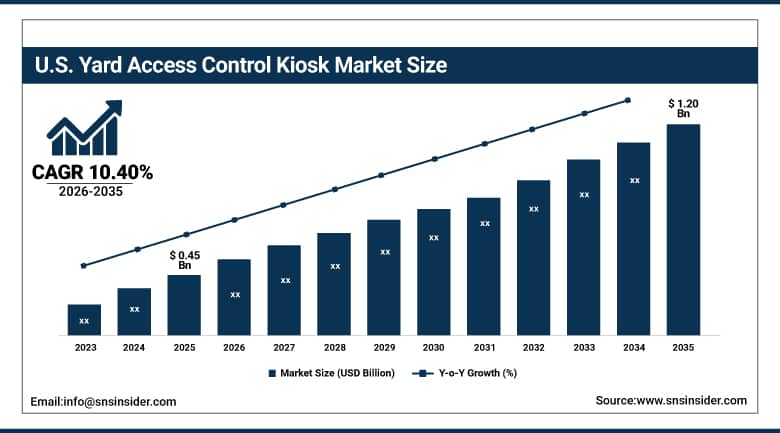
The U.S. Yard Access Control Kiosk Market was valued at USD 0.45 billion in 2025 and is expected to reach approximately USD 1.20 billion by 2035, expanding at a CAGR of 10.40% during 2026–2035.
The United States is still the largest market for yard access control kiosk systems owing to the availability of high-end logistics infrastructure, huge freight transport systems, automation in warehouses, and rising use of digital solutions in supply chains. Several distribution centers, ports, manufacturing plants, and third-party logistics firms are opting for intelligent access control systems to streamline the gateways and increase the speed of freight movements, tighten security measures, and minimize manual processes. Continuous investments in smart warehouses, cloud-based transport management systems, and artificial intelligence-based security solutions are continuously propelling market growth. The implementation of various solutions such as biometric identification, automatic license plate identification, RFID vehicle identification, and visitor management system.
During the year 2026, many of the logistics technology companies operating in the United States have implemented AI-powered gate automation systems that include kiosk systems, biometric identification, and freight management.
Yard Access Control Kiosk Market Segment Analysis
-
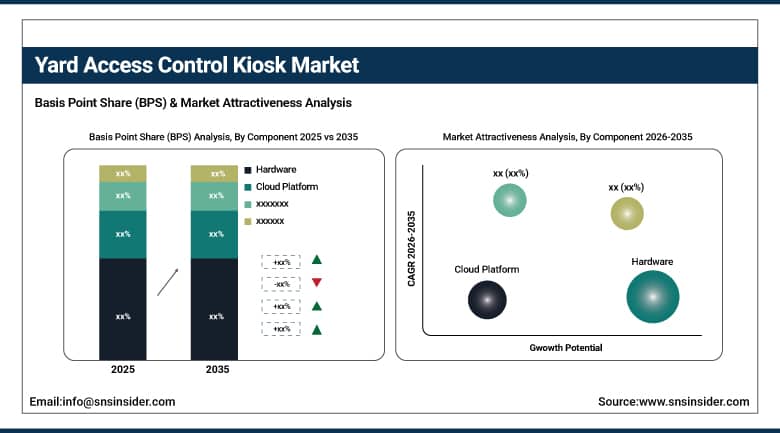
By Component, hardware dominated the market with 48.00% share in 2025, while cloud platform is projected to witness the fastest growth with 14.46% CAGR during the forecast period.
-
By Authentication, RFID dominated the market with 37.00% share in 2025, while license plate recognition is projected to witness the fastest growth with 14.11% CAGR during the forecast period.
-
By Deployment, standalone dominated the market with 44.00% share in 2025, while integrated security platform is projected to witness the fastest growth with 14.31% CAGR during the forecast period.
-
By End User, logistics yards dominated the market with 39.00% share in 2025, while ports & terminals are projected to witness the fastest growth with 11.95% CAGR during the forecast period.
By Component, Hardware dominated the market, while cloud platform is projected to witness the fastest growth.
The largest market share of 48.00% was held by the Hardware segment in 2025, which includes widespread use of the physical kiosk infrastructure, touch-screen terminals, ruggedized enclosures, RFID readers, barcode scanners, biometrics, license plate recognition cameras, printers, networking equipment in logistics facilities. The hardware component in each yard access control system has to be able to operate reliably 24/7 in challenging outdoor conditions and ensure secure vehicle and driver identification. Increased investments into warehouse automation, smart freight terminals, and digital gate infrastructures raised the demand for durable hardware kiosk solutions. In 2025–2026, a number of access control solutions providers launched next generation outdoor kiosks with AI-based cameras, multi-factor authentication devices and increased durability.
The cloud platform segment is expected to show the highest CAGR of 14.46% during the forecast period because of increasing use of cloud-based yard management systems and access control platforms. Companies are using cloud-based solutions for managing multiple logistics facilities from a single dashboard, providing real-time monitoring, automatic updates, remote diagnostics, as well as integrations with TMS, WMS, and ERP platforms. In 2026, a number of logistics software vendors launched cloud-based gate automation platforms featuring artificial intelligence, predictive analytics and remote management features.
By Authentication, RFID dominated the market, while license plate recognition is projected to witness the fastest growth.
The RFID segment had a significant revenue share of 37.00% in 2025 owing to the ability of RFID technology to identify vehicles, trailers, containers, and authorized people entering logistics premises in a quick, precise, and contactless manner. Many distribution centers, manufacturing units, and freight terminals use RFID-based authentication methods to minimize gate processing time, manual verification processes, ensure smooth traffic flow and operational precision. RFID technology's ability to integrate into automated gates, inventory solutions, and fleet management systems makes RFID the most popular choice for authentication purpose. In 2025-2026, many logistics companies updated their existing RFID gates with connectivity to cloud services and AI-driven monitoring to increase access efficiency and premises' security.
During the forecast period, the license plate recognition (LPR) segment will register the highest CAGR of 14.11% owing to the increasing need for full vehicle recognition and touch less gate access technology. The LPR technology makes use of artificial intelligence-based algorithms along with high-definition cameras to identify registered vehicles quickly without needing any physical documents or manual verification process. In 2026, a number of gate automation companies improved their AI-driven LPR systems for automated vehicle identification, anomaly detection, and gate access.
By Deployment, standalone dominated the market, while integrated security platform is projected to witness the fastest growth.
The standalone deployment market Segment occupied the largest share of 44.00% during the year 2025 attributed to the fact that this deployment segment has low installation complexity and ease of implementation and works best for logistics yard facilities and manufacturing facilities that do not need to integrate access kiosk solution with IT. The small and medium sized logistics yard facilities are implementing standalone kiosks that register drivers, verify visitors and control entry and exit from facility. Several logistic facilities installed new standalone access control kiosks with touch screen interface, biometric authentication module and RFID during the year 2025-2026.
The fastest CAGR of 14.31% during the forecast period is expected in the Integrated Security Platform segment because enterprises are in search of integrated security ecosystems that comprise access control systems, security surveillance, visitor management system, identity verification services, alarm monitoring services and facility management on an integrated platform. The large scale logistic facilities are integrating their yard kiosks with cloud based security management system, transport management system, warehouse management system and AI analytics. During the year 2026 several enterprise security providers launched access control platforms that are AI powered, cloud monitored, video surveillance systems and intelligent gate automation.
Regional Analysis
|
Region |
Major Country |
Share within Region, 2025 (%) |
|---|---|---|
|
North America |
United States |
94.00% |
|
Europe |
Germany |
26.00% |
|
Asia Pacific |
China |
27.00% |
|
Middle East & Africa |
UAE |
5.00% |
|
Latin America |
Brazil |
4.00% |
North America Yard Access Control Kiosk Market Insights
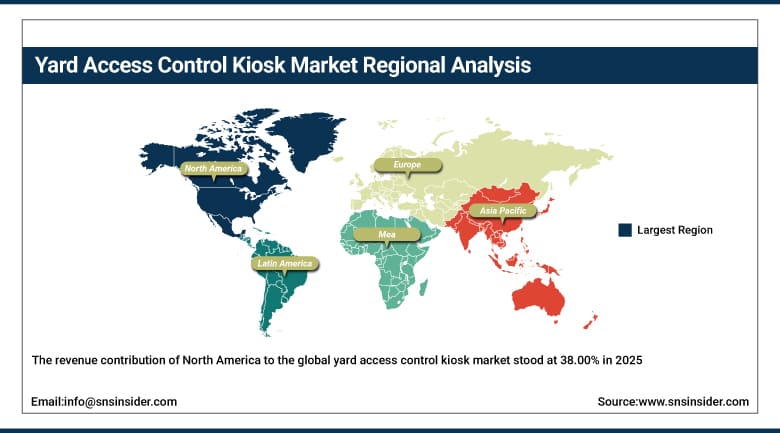
The revenue contribution of North America to the global yard access control kiosk market stood at 38.00% in 2025 and hence, the region is the top revenue generator amongst all the other regions. The reason behind the dominance of this region is the presence of developed logistics infrastructure, automation of warehouses, investment in digitalization of freight management system, and quick adoption of intelligent access control solutions in the United States and Canada. Automated kiosks with RFID integration, biometric identification, cloud-based platforms, and license plate recognition have been adopted in distribution centers, ecommerce fulfillment centers, ports, manufacturing facilities, and logistics service providers to manage vehicle entry efficiently, prevent congestion, and enhance the security of facilities.
In 2025-2026, some of the major North American logistics companies expanded the use of AI-based gate automation systems including cloud-based kiosks, automatic license plate recognition, biometric authentication, and transportation management software.
Get Customized Report as Per Your Business Requirement - Enquiry Now
Europe Yard Access Control Kiosk Market Insights
The growth rate in Europe persists because of the increased investments made in the automation of logistics, digitization of supply chains, and smart ports in Germany, the UK, France, the Netherlands, Italy, and other countries from Europe. The increased use of yard access control systems for logistics companies and manufacturers in order to increase efficiency, meet transport security regulations, and facilitate proper vehicle traffic in logistics hubs remains ongoing. Systems such as cloud visitor management services, intelligent surveillance systems, and identity verification systems are contributing to the increased deployment of access control kiosks. Modernization of freight centers and development of cross-border transport network facilities persist as well.
In 2026, a number of logistics technology vendors from Europe launched yard access systems that include biometric authentication, RFID, AI-powered video analytics, and cloud-based fleet management solutions.
Asia Pacific Yard Access Control Kiosk Market Insights
The Asia Pacific is estimated to witness the highest CAGR of 13.90% over the forecast period due to the rapid growth in logistics infrastructure, development of warehouses, growth in e-commerce operations, and investments in smart transportations systems in China, India, Japan, South Korea, Singapore, and Australia. There is significant investment in digital freight corridors, automated logistics parks, and intelligent ports in the Asia Pacific to increase the efficiency of the supply chain. The growing need for contactless access controls, real-time vehicle verification, and cloud-based security systems is driving the adoption of advanced yard access kiosks in the region. Growth in manufacturing activity and international business transactions is creating lucrative growth prospects for players operating in the access control solution market.
From 2025 to 2026, many logistics centers in the Asia Pacific have adopted AI-enabled access control kiosks with license plate recognition, biometric verification, RFID technology, and cloud-based yard management system.
Middle East & Africa and Latin America Yard Access Control Kiosk Market Insights
There is ongoing growth in the Middle East & Africa market through investments in logistic centers, free zones, port infrastructure projects, and intelligent transport infrastructure projects within the UAE, Saudi Arabia, South Africa, and many others. The governments are investing in digital logistics solutions that enhance cargo security, increase efficiency, and enable diversification of economies. There has been increased deployment of intelligent access control kiosks combined with cloud management and automated verification processes.
Latin America has been seeing healthy market growth through the modernization of freight transport infrastructure, increased automation in warehousing and rising adoption of digital logistics technologies in countries such as Brazil, Mexico, Argentina, and Chile. The logistics providers have been using automated access control kiosks to improve the process of vehicle management, increase security, and increase operational efficiency. Increased investments in e-commerce fulfillment and cross border logistics will further drive the demand. In 2025–2026, several logistics providers in Latin America and the Middle East deployed AI powered gate automation system with cloud management, RFID authentication, and intelligent vehicle identification.
Market Dynamics
Growth Drivers: Increased automation in logistics facilities, as well as the growing use of smart yard management systems.
Increased automation in logistics facilities, as well as the growing use of smart yard management systems, have been one of the key drivers of the Yard Access Control Kiosk Market growth. Logistics operators, ports, manufacturing sites, and distribution centers face ongoing pressure to boost efficiency and minimize manual processes and vehicle wait times. Smart access control kiosks automate the process of driver and visitor check-ins, document verification, vehicle authentication, and access control, which substantially improves the speed of cargo movement through logistics facilities.
The integration of RFID, biometrics, QR code, ALPR, AI and cloud-based management allows companies to increase their security, save on labor costs and gain greater supply chain visibility. There has been a steady rise in the adoption of automated yard access control kiosks in various parts of the globe due to investments made in the development of digital logistics infrastructure, warehouse automation, and intelligent transportation systems. In 2025-2026, a number of logistics tech companies introduced AI-powered yard access control kiosks equipped with intelligent features such as traffic prediction.
Restraints: High costs of deployment and complex integration with existing logistics infrastructure.
Although the market experiences considerable growth, deployment of the latest yard access control kiosks implies large initial investments in equipment, software solutions, network infrastructure, cyber security systems, and integration services. Logistics organizations with small and medium budgets experience delays in deploying full-fledged access automation solutions due to financial barriers. At the same time, many logistics companies still operate with their existing transport management systems, warehouse management solutions, and security infrastructure that require large customizations to work properly with modern access control systems.
Moreover, cybersecurity issues, costs of maintenance, training of staff, and interoperability challenges also complicate implementation of new solutions. Facilities working in multiple locations can also experience difficulties when deploying unified access control procedures in diverse infrastructures. In 2026, several logistics providers used phased digital transformation approach and cloud deployment to address high implementation costs and enhance compatibility with logistics infrastructure.
Opportunities: Growth of AI-enabled touch less access control solutions and logistics ecosystems enabled by cloud.
Increased migration to digitized supply chains and smart logistics ecosystems offers considerable growth prospects for yard access control kiosk vendors. Artificial intelligence, cloud technologies, machine learning, and edge analytics are making access control systems capable of offering predictive traffic management, automated visitor verification, vehicle tracking, and security monitoring. The rising requirement for touch less authentication via biometric identification, mobile credentials, QR code, RFID tagging, and automatic license plate reading is leading to rapid modernization of logistics infrastructures globally.
The integration of transport management systems (TMS), warehouse management systems (WMS), enterprise resource planning (ERP) systems, and fleet management systems further adds value for the companies. Expansion of smart logistics parks, automated ports, and digital freight corridors in emerging economies is likely to generate promising growth prospects in the future. During 2025-2026, multiple technology vendors launched cloud-based access control systems with features like AI-enabled analytics, remote administration, predictive maintenance, and multi-gate management at multiple sites.
Recent Developments
-
2026: Kaleris expanded its digital yard management platform by enhancing AI-powered gate automation, self-service driver kiosks, and cloud-based vehicle access management capabilities for large logistics facilities.
-
2026: Genetec Inc. strengthened its unified physical security platform by introducing advanced access control integrations combining automatic license plate recognition, intelligent video analytics, and cloud-managed gate security for logistics and industrial facilities.
-
2025: Dormakaba Holding AG introduced upgraded self-service access control solutions integrating biometric authentication, QR code verification, and centralized visitor management to improve secure entry across logistics sites.
-
2025: HID Global expanded its RFID and mobile credential portfolio with intelligent authentication technologies supporting touchless vehicle identification, secure driver verification, and automated gate access for modern logistics operations.
Yard Access Control Kiosk Market Key Players are:
-
Kaleris
-
HID Global Corporation
-
dormakaba Holding AG
-
Genetec Inc.
-
Honeywell International Inc.
-
Johnson Controls International plc
-
AMAG Technology
-
Gunnebo Entrance Control
-
Nedap N.V.
-
Identiv, Inc.
-
Suprema Inc.
-
Thales Group
-
Bosch Security Systems
-
Siemens AG
-
ASSA ABLOY AB
-
Gallagher Group Limited
-
Invixium Inc.
-
Integrated Control Technology (ICT)
-
Feenics Inc.
-
Vanderbilt Industries
Yard Access Control Kiosk Market Report Scope:
| Report Attributes | Details |
|---|---|
| Market Size in 2025 | USD1.25 Billion |
| Market Size by 2035 | USD 3.65 Billion |
| CAGR | CAGR of 11.31% From 2026 to 2035 |
| Base Year | 2025 |
| Forecast Period | 2026-2035 |
| Historical Data | 2022-2024 |
| Report Scope & Coverage | Market Size, Segments Analysis, Competitive Landscape, Regional Analysis, DROC & SWOT Analysis, Forecast Outlook |
| Key Segments | • By Component (Hardware, Software, Services, Cloud Platform) • By Authentication (RFID, Biometric, QR/Barcode, License Plate Recognition) • By Deployment (Standalone, Integrated Security Platform, Cloud Managed) • By End User (Logistics Yards, Ports & Terminals, Manufacturing Facilities, Others) |
| Regional Analysis/Coverage | North America (US, Canada), Europe (Germany, UK, France, Italy, Spain, Russia, Poland, Rest of Europe), Asia Pacific (China, India, Japan, South Korea, Australia, ASEAN Countries, Rest of Asia Pacific), Middle East & Africa (UAE, Saudi Arabia, Qatar, South Africa, Rest of Middle East & Africa), Latin America (Brazil, Argentina, Mexico, Colombia, Rest of Latin America). |
| Company Profiles | Kaleris, HID Global Corporation, dormakaba Holding AG, Genetec Inc., Honeywell International Inc., Johnson Controls International plc, AMAG Technology, Gunnebo Entrance Control, Nedap N.V., Identiv, Inc., Suprema Inc., Thales Group, Bosch Security Systems, Siemens AG, ASSA ABLOY AB, Gallagher Group Limited, Invixium Inc., Integrated Control Technology (ICT), Feenics Inc., Vanderbilt Industries |

Frequently Asked Questions
The market is projected to reach USD 3.65 Billion by 2035.
The market is expected to expand at a CAGR of 11.31% during the forecast period.
Asia Pacific is projected to register the fastest CAGR of 13.90% during 2026–2035.
North America dominated the global market in 2025 with approximately 38.00% revenue share.
The Yard Access Control Kiosk Market was valued at USD 1.25 Billion in 2025.
