The automated nucleic acid extraction equipment market in Europe is expanding owing to the rise in the investment made by hospitals, diagnostic centers, biotechnology organizations, pharmaceutical companies, and educational institutes into molecular analysis and laboratory automation technologies. The automated systems aid in the improvement of the nucleic acid extraction process and also assist in reducing the time of the manual process, its variation, and time consumption. The rising need for genomics, infectious disease testing, personalized medicine, biomarkers, and high-throughput diagnosis is driving European laboratories towards the integration of extraction and robotic systems.
According to SNS Insider, Europe Automated Nucleic Acid Extraction Market is projected to have a value of about USD 1.25 Billion in 2025 and rise to a value of USD 3.13 Billion until 2035, showing a CAGR of about 9.60%. Globally speaking, the market is estimated at USD 4.31 Billion in 2025 and is forecast to reach USD 11.21 Billion in 2035, representing a CAGR of 10.03%.
Gain Actionable Intelligence on the Automated Nucleic Acid Extraction Market – Request a Free Sample Report
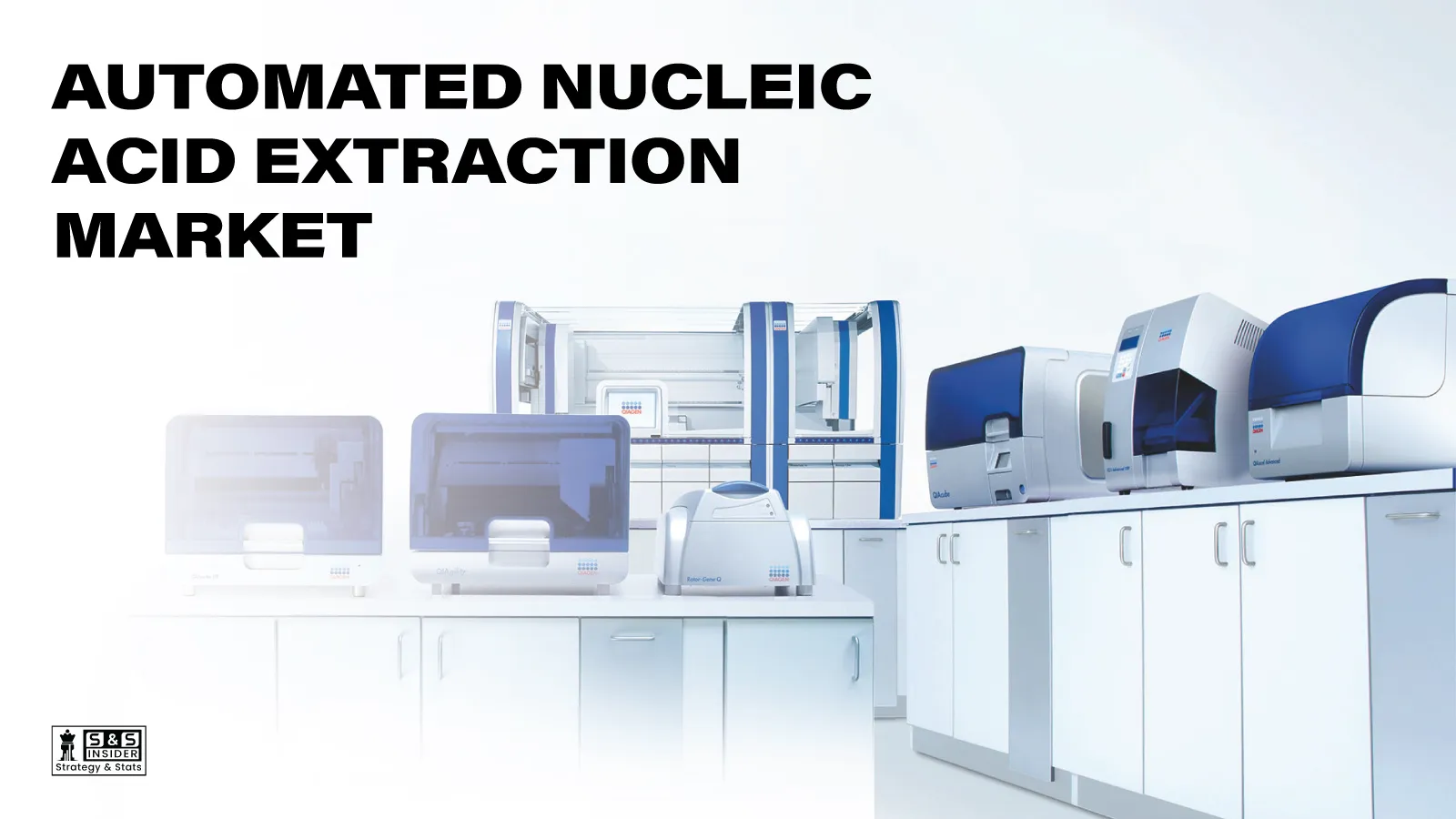
Why Europe Is an Important Automated Extraction Market
Europe has existing healthcare infrastructure, life sciences research capability, extensive use of molecular diagnostics, and investments in lab automation.
Increased use of automation and high throughput processes will be especially critical as labs will have to deal with an increasing number of samples that need to be tested for infectious diseases diagnostics, genomics, oncology, and personalized medicine. Quality criteria and regulations will push laboratories toward implementing extraction systems that can help achieve reproducibility and minimize errors. Germany is one of the important regional markets due to its advanced diagnostics and lab automation.
Instruments Continue to Lead Product Demand
Instruments comprised around 42.78% of the market share globally in 2025, which means they were the largest category of products in the industry. Automated extraction instruments are commonly used in hospitals, diagnostic laboratories, biotechnology firms, and research centers due to their standardization and efficient sample processing.
Software and analysis tools will experience the most rapid growth at an estimated 12.47% CAGR. Artificial intelligence, bioinformatics, cloud computing, and sophisticated sample tracking are contributing factors in the growth of software and analysis tools. The use of hardware and software in tandem is becoming increasingly significant to European laboratories.
Companies Supporting Europe’s Automated Extraction Market
QIAGEN
 QIAGEN, a company based in Germany, is a leading supplier of automated nucleic acid extraction systems, consumables, and bioinformatics solutions. The company's systems have been adopted for use in molecular diagnostics, infectious disease testing, and life-sciences research. On November 2025, QIAGEN released the new QIAsymphony Connect, an automated nucleic acid purification system that processes up to 96 samples at a time. The system offers advanced sample tracking, yield optimization, and cloud connectivity capabilities, cementing the firm’s leadership in Europe’s clinical and research laboratories.
Roche Diagnostics
 Roche Diagnostics, whose headquarters are in Switzerland, provides automated molecular test systems, reagents, and diagnostic tools to hospitals, laboratories, and biotechnology firms. The company’s high clinical expertise and emphasis on molecular diagnostics aid in the use of automated sample preparation in Europe. Roche Diagnostics launched a partnership in October 2025 between the Wellcome Sanger Institute and Broad Clinical Labs to assess its SBX sequencing technology for multi-omics applications. This enhances the company’s wider participation in genomic workflows that need reliable nucleic acid sample preparation.
Thermo Fisher Scientific
 Thermo Fisher Scientific manufactures automatic extraction devices, chemicals, software, and laboratory technologies that are employed in molecular diagnostics, genomics, and precision medicine. Thermo Fisher Scientific offers its technologies that focus on high throughput, reproducibility, and workflow standardization. In August 2025, the company released the Applied Biosystems MagMAX HMW DNA Kit that works with the KingFisher automatic devices and is aimed at extraction of large DNA molecules. Such advancement is helpful in long-read sequencing and genomic studies, which are becoming more popular in Europe.
Market Challenges and Outlook
The challenges faced include high cost of instruments, complex workflows, validation, certification of reagents and personnel. Small laboratories might experience challenges in implementing an automated platform due to its high cost even though it would prove efficient in the long run.
For the period until 2035, the European market for automated nucleic acid extraction will gain from the growth in molecular diagnostics, lab automation, genomics research, infectious disease testing, precision medicine, and AI automation. The countries that will be majorly adopting this technology include Germany, the United Kingdom, France, and Italy.