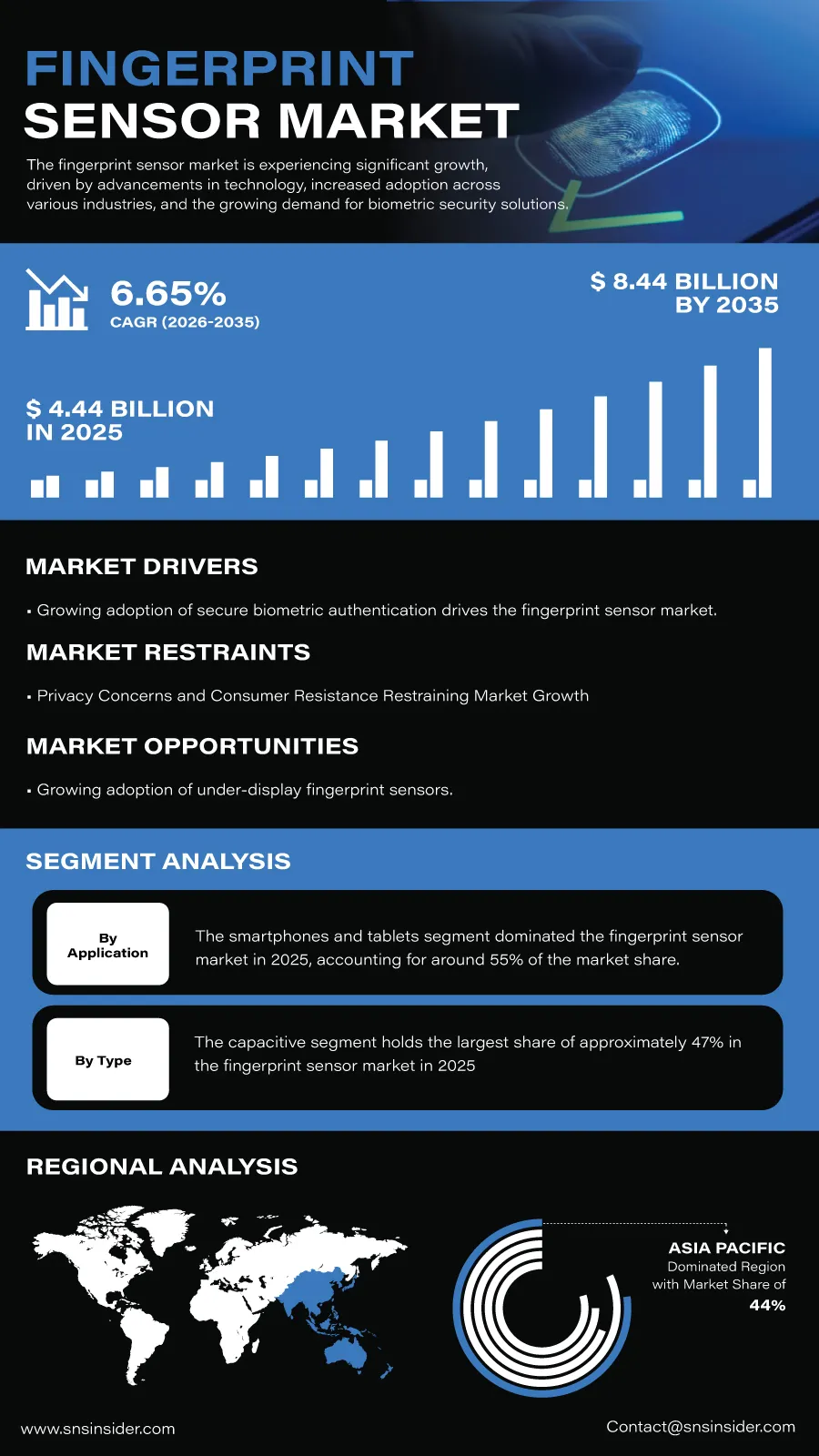
The global Fingerprint Sensor Market is projected to expand steadily as businesses and consumers increasingly prioritize secure digital identification, convenient authentication, and protection against unauthorized access. “According to a recent study by SNS Insider, the global Fingerprint Sensor Market size valued at USD 4.44 billion in 2025, is anticipated to grow to USD 8.44 billion by 2035, registering a CAGR of 6.65% over the 2026–2035 forecast period.”
The rising use of smartphones, digital banking, and the proliferation of connected devices has increased the demand for fingerprint scanning technology. Companies are creating biometric solutions that are fast and accurate at the same time to be used in consumer electronics, banking, healthcare, automotive industry, and enterprise security.
Improvements in the field of ultrasonic sensing, artificial intelligence, and under-screen technology have opened new possibilities for fingerprint scanners. This is motivating companies to include biometric features in smaller devices.
To Get Detailed Insights on the Fingerprint Sensor Market – Request a Sample Report
Digital Security Investments Create New Growth Opportunities
Increased focus on cashless payments and biometric identity verification is paving way for more opportunities for the manufacturers of fingerprint sensors. The banking sector and payment card technologies are investigating biometric payment cards that will enable users' identity verification using their fingerprint scan, thereby eliminating the need for conventional PIN-based verification methods.
Government bodies and organizations are implementing biometric ID verification for managing identities, accessing and authenticating users. On the other hand, smart homes, automotive, and industrial IoT systems are contributing to more requirements for small-scale authentication solutions.
There still are worries regarding biometric data privacy, high implementation costs, and security of the stored fingerprint data. Increasingly, the manufacturers of fingerprint sensors are emphasizing the importance of secure data processing, device-level authentication, and privacy-based architectures.
Key Market Insights Highlight Shifting Demand Patterns
By application, smartphones and tablets accounted for approximately 55% of global market revenue in 2025, reflecting the widespread use of fingerprint authentication in consumer electronics. The IoT and other applications segment is projected to record the fastest growth through 2035 as connected devices increasingly require secure access management and identity verification.
Based on sensor type, capacitive technology held the leading position, representing approximately 47% of market revenue in 2025 due to its established manufacturing ecosystem, cost-effectiveness, and reliable recognition performance across smartphones, laptops, and other electronic devices. Ultrasonic fingerprint sensors are expected to experience the fastest growth as manufacturers pursue more advanced authentication systems with three-dimensional fingerprint detection and improved performance under challenging conditions.
The increasing popularity of edge-to-edge smartphone displays is further encouraging the development of under-display biometric solutions. These systems allow manufacturers to integrate authentication capabilities without relying on prominent physical fingerprint buttons.
Advanced Biometric Technologies Strengthen Authentication Capabilities
Fingerprint technology is becoming more innovative and extending its use beyond phone locks to other digital security applications. The application of artificial intelligence can aid in enhancing the fingerprint matching process, recognition efficiency, and detection of false biometric traits from true ones.
Biometric technology is increasingly being embraced by healthcare facilities for user identification and secure access, whereas car manufacturers are developing fingerprint car access methods and customized car configurations. Biometric payments in finance provide another opportunity for making transactions more convenient and secure.
The integration of fingerprint recognition with multi-factor authentication is also gaining attention as organizations seek to strengthen security without introducing unnecessary complexity for users.
Asia Pacific Holds 44% of Fingerprint Sensor Market Revenue as North America Drives Future Expansion
The Asia Pacific region was responsible for about 44% of the Fingerprint Sensor Market in the year 2025. It held the same place as the dominating region. High volume of production of smartphones, growth of digital payments ecosystems, and high manufacturing capability of consumer electronics in China, India, Japan, and South Korea.
The North American region is anticipated to hold the highest rate of growth in the forecast period due to rising biometric authentication in financial services, enterprise security, connected devices, and digital identity solutions. United States will also contribute in growth with its market estimated to grow from USD 1.80 billion in 2025 to USD 3.42 billion by 2035 with a CAGR of 6.65%.
Europe will benefit from the demand of secure digital services and enterprise authentication, while Latin America and the Middle East and Africa will find opportunities through growing digital identities solutions, mobile banking and smart infrastructure investments.
Industry Participants Focus on Innovation and Product Development
Competition in the fingerprint sensor market is increasingly centered on recognition accuracy, power efficiency, compact designs, and enhanced protection against spoofing. Manufacturers are investing in ultrasonic sensing, advanced semiconductor components, and integration partnerships to strengthen their positions across consumer and enterprise markets.
Key companies operating in the global Fingerprint Sensor Market include Shenzhen Goodix Technology Co., Ltd., Fingerprints (Sweden), Synaptics Incorporated, NEXT Biometrics, Novatek Microelectronics Corp., Qualcomm Technologies, Inc., Thales, HID Global Corporation, SecuGen Corporation, IDEMIA, 3M Cogent Inc., Precise Biometrics, EGIS Technology Inc., Crossmatch, OXI Technology, IDloop, Sonavation Inc., Touch Biometrix, Vkansee, ELAN Microelectronics, CMOS Sensor Inc., and ID3 Technologies.
An SNS Insider analyst Sushant Kadam commented, “Growing demand for secure digital authentication, expanding biometric payment applications, and continued advances in sensor technology are creating sustainable opportunities for the fingerprint sensor industry. Companies that combine reliable recognition, privacy-focused security, and seamless integration across connected devices will be well positioned to capitalize on evolving market demand.”
About the Author

Get in touch