The emergence of quantum computing technology is changing the entire world technological environment with all governments, technology firms, organizations, and sectors investing in new computing technologies. The quantum chip plays an important role because the quantum computer can handle very complicated problems that could pose challenges to classical computing. Various uses in defense, banking, healthcare, drug development, artificial intelligence, and cryptography, alongside developments in superconductivity and semiconductor technologies, provide great commercialization potential.
As per SNS Insider, the Quantum Chip Market size was valued at USD 0.38 billion in 2024 and is projected to reach USD 7.04 billion by 2032, recording a CAGR of 44.16% from 2025 to 2032, as reported by SNS Insider. Increased investment in quantum studies, government-driven efforts, and increased involvement of technology firms have contributed to the faster growth of the market and have helped foster innovations and research.
To Get more information On Quantum Chip Market - Request Free Sample Report
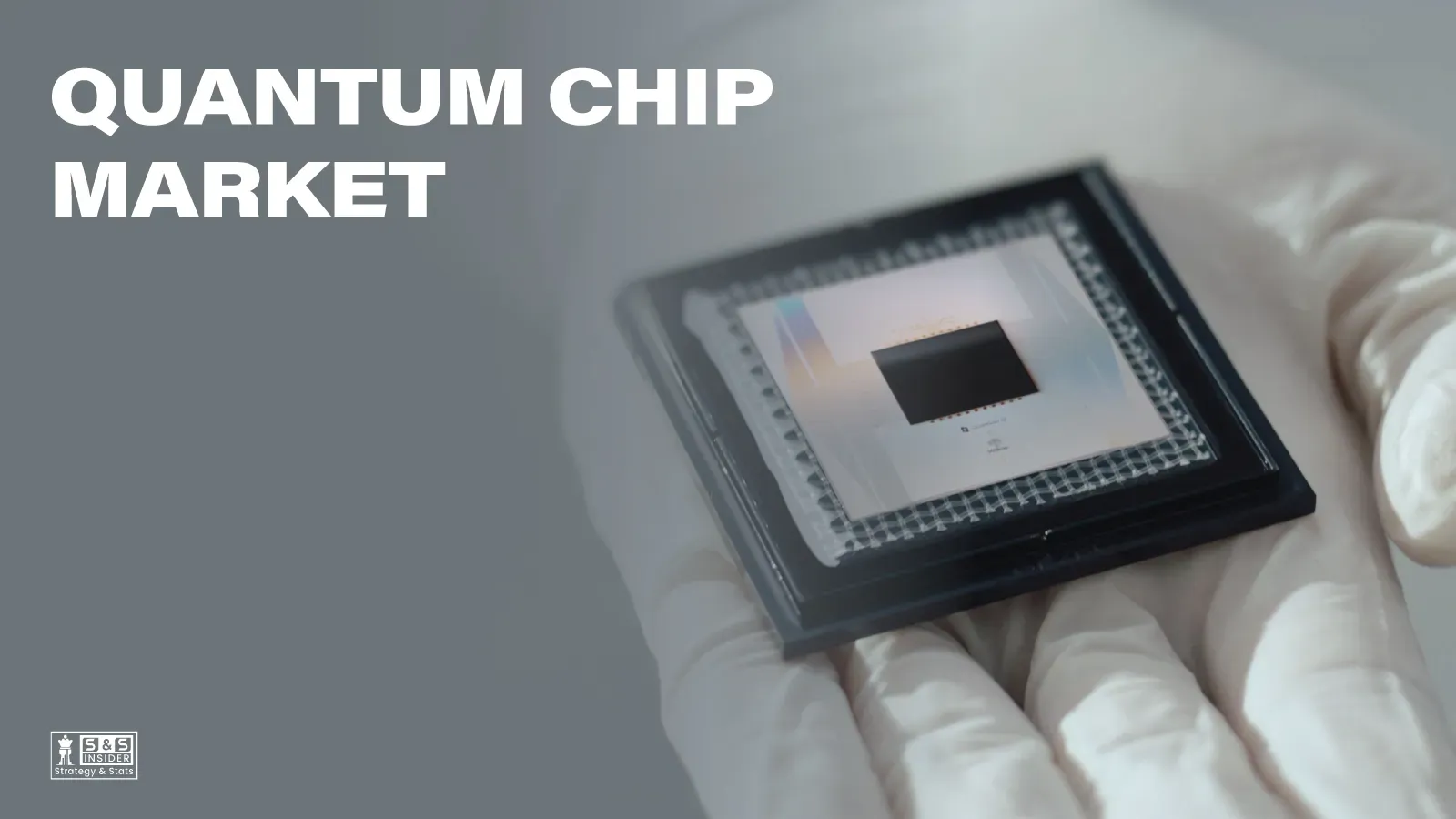
Below are 5 Companies Making Significant Contributions to Innovation in The Global Quantum Chip Market.
IBM
 IBM is one of the leading companies developing hardware for quantum computing, especially in superconducting quantum chips, quantum processors, software and other related infrastructure. IBM’s quantum computing research is focused on making quantum processors more scalable and reliable so that businesses can explore the potential of quantum computers in optimization, artificial intelligence, chemistry and cryptography. IBM remains committed to investing in quantum computing research as the industry heads towards commercially viable solutions. The Eagle quantum processor developed by IBM has made important contributions to processor architecture and scalability, among others.
 Google is developing the field of quantum chips through the use of superconducting qubits as well as research in reliable and scalable quantum computation. Sycamore, Google's processor, was able to showcase how quantum chips could undertake very specialized computational problems, making researchers and technology firms interested in quantum chips. In December 2024, Google reported that their Willow quantum chip accomplished subthreshold quantum error correction along with completing the Random Circuit Sampling task in around five minutes. According to Google, completing the same task would take an estimate of about 10²⁵ years for today's most advanced supercomputers.
Microsoft
 Microsoft has been working on quantum computing technology through Azure Quantum, which consists of various hardware technologies aimed at creating scalable quantum computing. Through Microsoft’s approach, users can work with quantum computing technology without having the need for owning quantum computing equipment, as its process consists of researching, cloud service, software development, and collaboration. In February 2025, the company introduced Majorana, which is a quantum computing chip that uses a novel form of matter created through topological conductors. The idea behind the quantum computing technology is to enable scalability and more stable qubits in quantum computing.
IonQ
 The company IonQ is dedicated to developing trapped-ion quantum computers that utilize ions as individual qubits in order to ensure accuracy and quantum state control. The technologies developed by the firm target use cases that require advanced computational capacities such as optimization, machine learning, financial modeling and scientific research. Trapped-ion quantum computers have been gaining popularity due to their prospects in terms of low error rates and high-fidelity operations. According to forecasts, the ion trap quantum chip market segment will experience a CAGR of 45.66% between 2025 and 2032.
Rigetti Computing
 Rigetti Computing designs superconducting quantum processors and quantum computing systems. Their work is centered around enhancing the performance, scalability, and access of quantum processors and providing the user with the capability to investigate quantum applications using cloud-based infrastructure. Processor architectures designed by Rigetti include Aspen and are used to conduct investigations in areas such as optimization, artificial intelligence and computational chemistry. With growing demands for high-performance computing, further development of superconducting processors will facilitate the commercialization of quantum computing technology.
The Road Ahead
The market for Quantum Chips is expected to witness extremely fast growth owing to increased funding by both government and non-governmental entities on research and commercialization of quantum computing. Demand for high-performance computing in areas such as military, financial services, healthcare, pharmaceuticals, and cryptography is expected to fuel growth significantly. Quantum computing may be able to solve very complex optimization and simulation problems.
North America will continue to be a large market owing to high levels of technology capability and investments made in quantum computing. The Asia-Pacific region will see rapid growth fueled by government efforts and increasing quantum computing research in China, South Korea and Australia. Europe will also see growth due to government research and investments from the private sector, while Middle East & Africa and Latin America are seeing gradual development due to increased interest in quantum computing.
Error corrections and qubit stability are still going to be essential focus areas. Quantum computers are highly susceptible to their surroundings and it is very challenging to maintain coherence and minimize errors as systems become more complex. Innovations in material science, chip design, cryogenics, control systems and error corrections will undoubtedly be crucial in influencing the pace at which quantum computers reach commercialization.