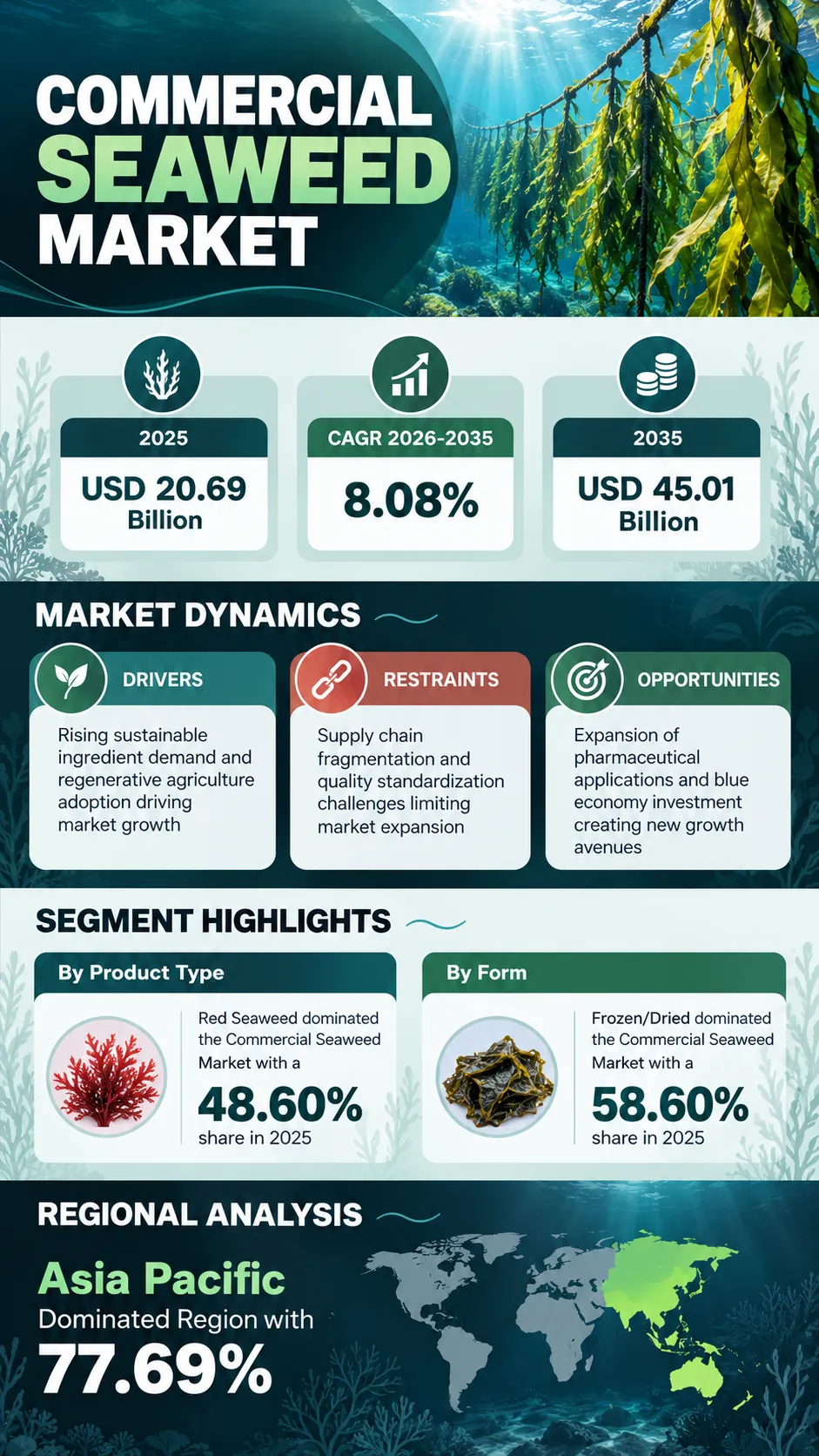
The global Commercial Seaweed Market is set for significant expansion as sustainable ingredient demand and regenerative agriculture adoption continue to reshape natural resource sourcing worldwide. “According to a recent study by SNS Insider, the global Commercial Seaweed Market size valued at USD 20.69 billion in 2025, is anticipated to grow to USD 45.01 billion by 2035, registering a CAGR of 8.08% over the 2026–2035 forecast period.”
There have been notable changes within seaweed cultivation and processing technology over time, due to which many processors who aim at improving yield and bioactive compound purity can take advantage of this trend. This includes the need for more advanced aquaculture and extraction techniques that will provide food, cosmetics, and pharmaceutical companies with the ability to access reliable, sustainable seaweed ingredients. This applies in situations where commercial seaweed supports food and beverage, agriculture, and personal care applications. Processors are constantly working hard to ensure that their seaweed products perform better than before in order to meet various sustainability and quality requirements.
To Get Detailed Insights on the Commercial Seaweed Market – Request a Sample Report
Regenerative Agriculture and Bioactive Compound Innovation Create New Demand
The commercial seaweed industry has changed from being used merely for food purposes to becoming an increasing range of natural product which can be utilized for food, agriculture, cosmetology, and even pharmaceutical purposes. As a result, the increasing number of large-scale cultivation, alginate and carrageenan extraction, as well as biostimulant production by various processors has necessitated the development of more flexible and environmentally friendly seaweed products.
Advanced cultivation and extraction methods can result in better purification of compounds, make processes scalable, and expand the application field of seaweed in food, agriculture, and pharmaceutical industry. In that way, companies are able to produce differentiated products based on high-quality materials and sustainable production process.
Seaweed producers, hydrocolloids processors, as well as food and cosmetology companies have started cooperating because of increased interest in creating sustainable seaweed products.
Key Market Findings Highlight High-Growth Segments
The red seaweed segment dominated all categories in the commercial seaweed market share with a 48.6% share in 2025 due to substantial levels of bioactive compounds including carrageenan. The fastest growing category is expected to be brown seaweed which will grow at a CAGR of 9.87% through 2031, owing to rising demand for alginate extracts in food, cosmetics, and medical applications.
By form, dried seaweed dominated product forms, generating USD 9.4 billion in 2025, due to ease of storage and processing. Fresh and chilled seaweed will see the fastest growth in revenue generation at a 10.25% CAGR, driven by growing demand for premium, minimally processed products.
Based on cultivation method, cultivated seaweed accounted for the largest share, reaching USD 15.6 billion in 2025, thanks to scalable aquaculture production. On the other hand, wild harvest will be the segment recording the fastest revenue growth at a 7.20% CAGR, supported by growing demand for specialty, differentiated sourcing narratives.
Distributive application trends are changing as well. Food and beverages accounted for the largest revenue share owing to seaweed's established role as a nutrient-dense ingredient. But pharmaceuticals will turn out to be the fastest-growing application through 2035, on the back of growing bioactive compound utilization in drug formulation and functional health products.
Bioactive Purity, Sustainability, and Cultivation Scalability Gain Importance
In this regard, food, cosmetics, and pharmaceutical manufacturers have been looking at commercial seaweed products that would deliver more consistent bioactive purity while requiring greater sustainability credentials and cultivation scalability.
Innovation in scalable aquaculture, alginate and carrageenan extraction technology, and biostimulant formulation has been making it possible for companies to come up with products that appeal to increasingly quality-conscious and sustainability-focused manufacturers. In addition to that, increasing emphasis on blue economy policy support is also making it possible for cultivators to find solutions that expand sustainable seaweed production capacity. Such trends are likely to become even more prominent in the future.
Asia Pacific Emerges as the Largest Market with 77.69% Regional Revenue Share Amid Long Seaweed Consumption History
The Asia Pacific region represented the largest share of regional market revenue in 2025 at 77.69%, owing to the long history of seaweed consumption in China, Japan, and South Korea, alongside favorable climate and marine conditions. On the other hand, North America is expected to register strong growth momentum during the forecast period through 2035, propelled by rising utilization of seaweed in food products and technological advancements in algae cultivation.
Leading Companies Drive Innovation and Competition
The environment continues to stay very dynamic since players continue innovating on scalable aquaculture and extraction technology as well as forming partnerships in order to enhance their position in the industry. Some of the major companies that operate in the global commercial seaweed market are CP Kelco, Cargill, Acadian Seaplants, Gelymar, Qingdao Bright Moon Seaweed Group, IFF, Roullier Group, Cargill Algae Solutions, Seaweed Energy Solutions, and Ocean Harvest Technology.
An SNS Insider analyst Santosh Bhul commented, "The growing consumer and agricultural demand for sustainable, bioactive-rich natural resources is creating sustained opportunities across food, agriculture, cosmetics, and pharmaceutical applications. Processors that successfully combine scalable aquaculture innovation, extraction technology, and application-specific expertise will be best positioned to capitalize on emerging opportunities across conventional and specialty commercial seaweed segments."
About the Author

Get in touch