
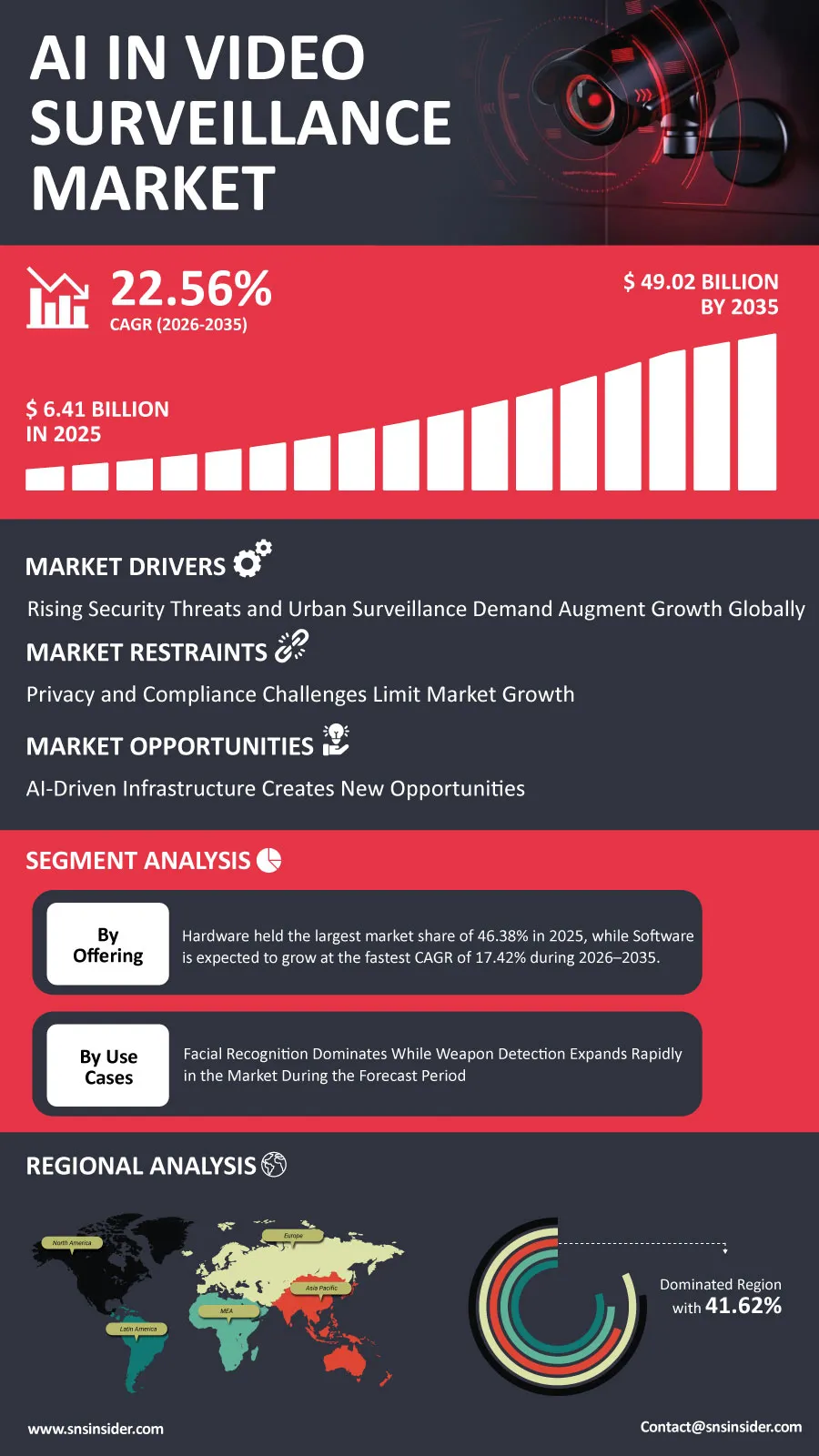
The global AI in Video Surveillance Market is entering a high-growth phase as organizations increasingly deploy intelligent monitoring systems to strengthen security, automate threat detection, and improve real-time situational awareness. According to a recent study by SNS Insider, the global AI in Video Surveillance Market size valued at USD 6.41 billion in 2025, is anticipated to grow to USD 49.02 billion by 2035, registering a CAGR of 22.56% over the 2026–2035 forecast period.
The factors of fast-paced urbanization, increasing security needs, and growth of connected infrastructure are making way for a greater demand for systems which can not only capture images but also interpret them. It is becoming more common for corporations, government agencies, transportation companies, and public organizations to deploy AI to detect suspicious behaviors and crowd movement in case of any incident.
Development of deep learning, computer vision, edge computing, and cloud computing has been taking the traditional surveillance systems to intelligent security infrastructures. It is anticipated that the incorporation of AI into IoT ecosystems along with high-speed connectivity will extend the reach of this technology even further.
To Get Detailed Insights on the AI in Video Surveillance Market – Request a Sample Report
Smart City Investments Create New Growth Opportunities
Intelligent video analytics technology is also finding its way into larger urbanization efforts through governments and municipal institutions. The AI can be used to monitor traffic, analyze crowds, secure infrastructure, and respond to emergencies, making it easier for officials to process large amounts of visual data.
With more attention being paid to edge computing, there are also possibilities that come with having video analytics technology be done closer to where the videos are captured. This could help lower latency, decrease the need for bandwidth, and allow security incidents to be detected more quickly. Simultaneously, cloud video analytics is increasing in popularity among those who want centralized management and easy software updates.
Growing interest in privacy-preserving technologies, federated learning, and compliant analytics is expected to help address concerns surrounding sensitive data while supporting responsible expansion across regulated markets.
Key Market Insights Highlight Shifting Demand Patterns
By offering, hardware is expected to account for 46.38% of global market revenue in 2025, supported by continued deployment of AI-enabled cameras, processors, and smart sensing infrastructure. Software is projected to register the fastest growth, expanding at a CAGR of 17.42% through 2035 as organizations seek sophisticated analytics, automated threat recognition, and centralized video intelligence.
Based on deployment, on-premises solutions are anticipated to hold a 58.91% revenue share in 2025, particularly across government, defense, and critical infrastructure environments where data control and low-latency processing remain priorities. Cloud-based deployments are forecast to experience the fastest growth at a CAGR of 18.05% as enterprises adopt scalable, remotely managed surveillance platforms.
By use case, facial recognition is expected to lead with a 24.76% market share in 2025, supported by applications in access management, identity verification, transportation security, and law enforcement. Weapon detection is projected to be the fastest-growing use case, driven by rising demand for automated threat identification across schools, public venues, and other high-security environments.
By end use, the commercial sector is forecast to contribute 39.84% of market revenue in 2025. Government and public facilities are expected to record the fastest growth through 2035 as investments increase in public safety, critical infrastructure protection, border monitoring, and smart policing.
Intelligent Analytics Reshape Modern Security Operations
AI-based analytics' increasing prevalence is changing the role of surveillance systems from reactive recording mechanisms to proactive security devices. Intelligent monitoring is used by retailers to detect potential threats and ensure loss prevention, and by transport authorities to analyze passenger traffic and detect any anomalies in it.
Furthermore, manufacturing enterprises are implementing AI-enhanced surveillance to enhance perimeter security and operational oversight. With the demand for quicker incident detection and more effective monitoring solutions, the convergence of AI with IoT, 5G, and edge computing is likely to continue being an important market trend.
Asia Pacific Leads with 41.62% Revenue Share While North America Advances at a 16.82% CAGR
Asia-Pacific region is anticipated to contribute to 41.62% of the total market revenue by 2025 owing to significant smart cities initiatives, robust surveillance system, and advanced technology production. China would continue contributing significantly to the demand generated in the region, whereas Japan and South Korea would continue investing in intelligent transportation and security systems.
North America region is forecasted to grow at the highest compound annual growth rate of 16.82% during the forecast period ending 2035. Growth in the region would be driven by modernization of enterprise security, critical infrastructure protection, transportation surveillance, and adoption of privacy-focused AI solutions.
As governments and businesses continue investing in connected security infrastructure, demand for AI-enabled video analytics is expected to accelerate across both mature and emerging markets.
Industry Participants Focus on AI Innovation and Intelligent Platforms
The competitive landscape remains dynamic as technology providers focus on improving AI accuracy, edge processing, cybersecurity, and integrated video management capabilities. Companies are increasingly developing solutions that combine intelligent cameras, analytics software, cloud connectivity, and access control into unified security ecosystems.
Key companies operating in the global AI in Video Surveillance Market include Hikvision, Dahua Technology, Axis Communications, Bosch Security Systems, Hanwha Vision, FLIR Systems, Vivotek, Samsung Techwin, GeoVision, PureTech Systems, Avigilon (Motorola Solutions), Mobotix, Uniview (UNV), Netvue, BriefCam, Genetec, Honeywell Security Solutions, Verkada, Eagle Eye Networks, and NEC Corporation.
An SNS Insider analyst Sushant Kadam commented, “The convergence of artificial intelligence, edge computing, and connected security infrastructure is creating a fundamental shift in how organizations monitor and respond to threats. Vendors that combine accurate analytics, scalable deployment models, strong cybersecurity, and privacy-conscious solutions will be well positioned to capture the expanding demand for intelligent video surveillance worldwide.”
About the Author

Get in touch




