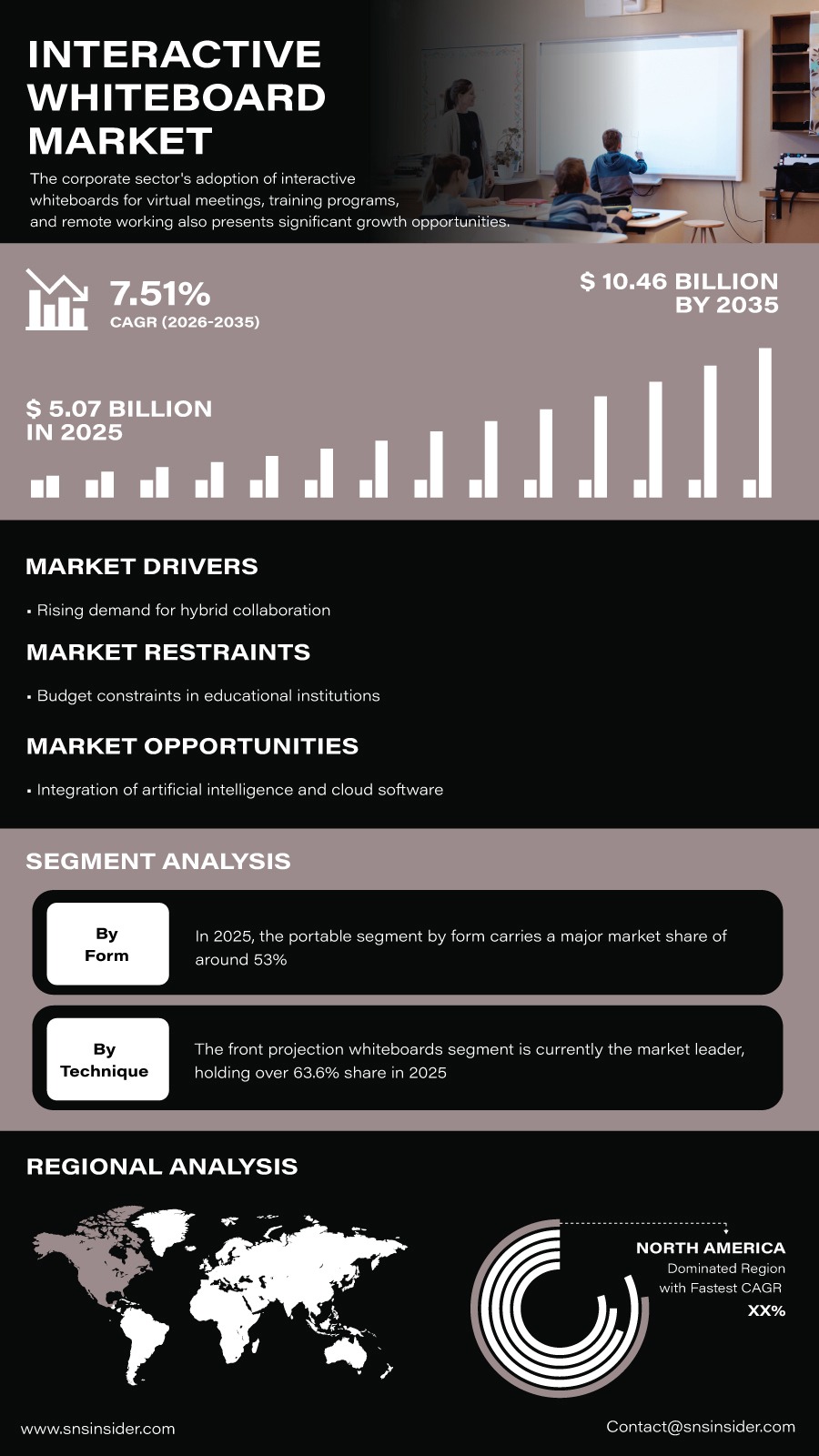
The global Interactive Whiteboard Market is projected to expand steadily as educational institutions and businesses accelerate the adoption of digital collaboration technologies. "According to a recent study by SNS Insider, the global Interactive Whiteboard Market size valued at USD 5.07 billion in 2025, is anticipated to grow to USD 10.46 billion by 2035, registering a CAGR of 7.51% over the 2026–2035 forecast period."
The rise in popularity of hybrid learning, virtual conferences, and technologically advanced classrooms is fueling the market demand for interactive displays. Schools are beginning to incorporate interactive tools into regular classroom education, while companies are adopting the use of interactive whiteboards to enhance communication, presentations, and participation among geographically distributed workers.
With developments in technologies such as touch displays, artificial intelligence, and cloud connections, new capabilities continue to be unlocked in these devices. Companies are coming up with technologies that blend together the basic presentation capabilities with collaboration software and multimedia.
To Get Detailed Insights on the Interactive Whiteboard Market – Request a Sample Report
Digital Transformation in Education and Business Creates New Growth Opportunities
Modernization of the educational infrastructure continues to be an important factor driving market growth. Educational establishments are implementing interactive technologies that help in the visualization of learning, collaboration activities, and digital distribution of lessons. Also, government policies related to the implementation of technology in education are generating business opportunities for manufacturers, especially in areas where the classroom infrastructure needs improvement.
An increase in demand from corporations has followed the rise in hybrid work environment trends. Interactive whiteboards which are compatible with video conferencing software and productivity tools enable the user to highlight information, share ideas and view shared materials while in a meeting. These features are making interactive whiteboards popular in corporate training centers and conference rooms.
However, the high cost of installation, software, maintenance, and installation may limit adoption among cost-sensitive organizations. Manufacturers offering affordable, easy-to-deploy solutions are likely to gain opportunities in underserved markets.
Key Market Insights Highlight Shifting Demand Patterns
By technology, resistive touch systems accounted for 42.55% of market revenue in 2025, supported by their versatility and compatibility with different input methods. Capacitive technology is gaining momentum as demand increases for responsive touch interfaces, precise interaction, and multi-user collaboration.
Based on form, portable interactive whiteboards segment held approximately 53% of market revenue in 2025. Their flexibility makes them suitable for classrooms, training sessions, and business presentations requiring adaptable configurations. Fixed interactive whiteboards are also gaining traction, with the segment expected to register a CAGR exceeding 6.01% during 2026–2035 as organizations invest in permanent digital collaboration infrastructure.
By technique, front-projection interactive whiteboards held around 63.6% of market revenue in 2025. Their suitability for large classrooms, conference facilities, and presentation spaces supports their continued adoption. Rear-projection systems are expected to attract additional interest as organizations explore alternative display configurations and specialized presentation environments.
AI and Cloud Connectivity Transform Interactive Collaboration
Interactive whiteboard technology is not stopping at simple computerized writing and presentation abilities. Through artificial intelligence technology, interactive whiteboard technology can include handwriting recognition capabilities, voice commands for controlling, and automatic content organization, making the users' task of capturing and sharing information easier.
Cloud collaboration capabilities are also gaining significance, giving the users the ability to access shared documents, record meeting notes, and collaborate irrespective of their location. In addition, integration with Learning Management Systems (LMS) and enterprise productivity solutions is enhancing these capabilities.
Such advances are making interactive whiteboards increasingly important as a means of collaboration that is interconnected with other systems, rather than just a standalone display device. Continued improvements in usability, interoperability, and software capabilities are expected to support broader market adoption.
North America Leads Interactive Whiteboard Market as Europe Modernizes Classrooms and Asia Pacific Accelerates Adoption
The region of North America is forecasted to retain the dominance of Interactive Whiteboards market due to the presence of already developed educational technologies infrastructure, digitization of companies, and collaboration software. Integration into learning management systems and business communication platforms further drives the demand for the region, especially within schools, universities, and companies in the United States.
The continent is reaping the gains of modernization of classrooms and initiatives aimed at enhancing digital literacy. Some of the important regions include the United Kingdom, Germany, and France, where there is the integration of interactive technology in educational institutions to enhance teaching and learner engagements.
The Asia Pacific region offers great opportunities for growth since the high uptake of the internet, development of education infrastructure, and investments in e-learning platforms drive the adoption of technology. There are many growing demands from various schools, colleges, and corporates in China, India, and other countries.
Industry Participants Focus on Product Innovation
Competition in the interactive whiteboard market is influenced by developments in image display, touch sensitivity, software compatibility, and collaboration. Companies are working towards designing user-friendly products that can be used by more than one person, allowing hybrid collaboration and integration into existing digital environment.
Key companies operating in the global Interactive Whiteboard Market include BenQ Corporation, Epson, Microsoft, Google, Boxlight, Cisco Systems, Hitachi Ltd., Hon Hai Precision Industry Co. Ltd., Newline, Panasonic Corporation, Promethean Ltd., Samsung, Ricoh, NEC Corporation, ViewSonic, and SMART Technologies.
Samsung continues to develop interactive display solutions for education and corporate collaboration, while Avocor focuses on interactive displays designed for classrooms and business environments. Product development across the industry reflects growing demand for high-resolution displays, multi-touch functionality, and integrated collaboration software.
An SNS Insider analyst Sushant Kadam commented, “The growing emphasis on digital education, hybrid collaboration, and connected workplace technologies is creating sustained opportunities for interactive whiteboard manufacturers. Companies that combine intuitive interfaces, reliable software integration, and cost-effective deployment options will be well positioned to benefit from increasing demand across education and enterprise environments.”
About the Author

Get in touch