
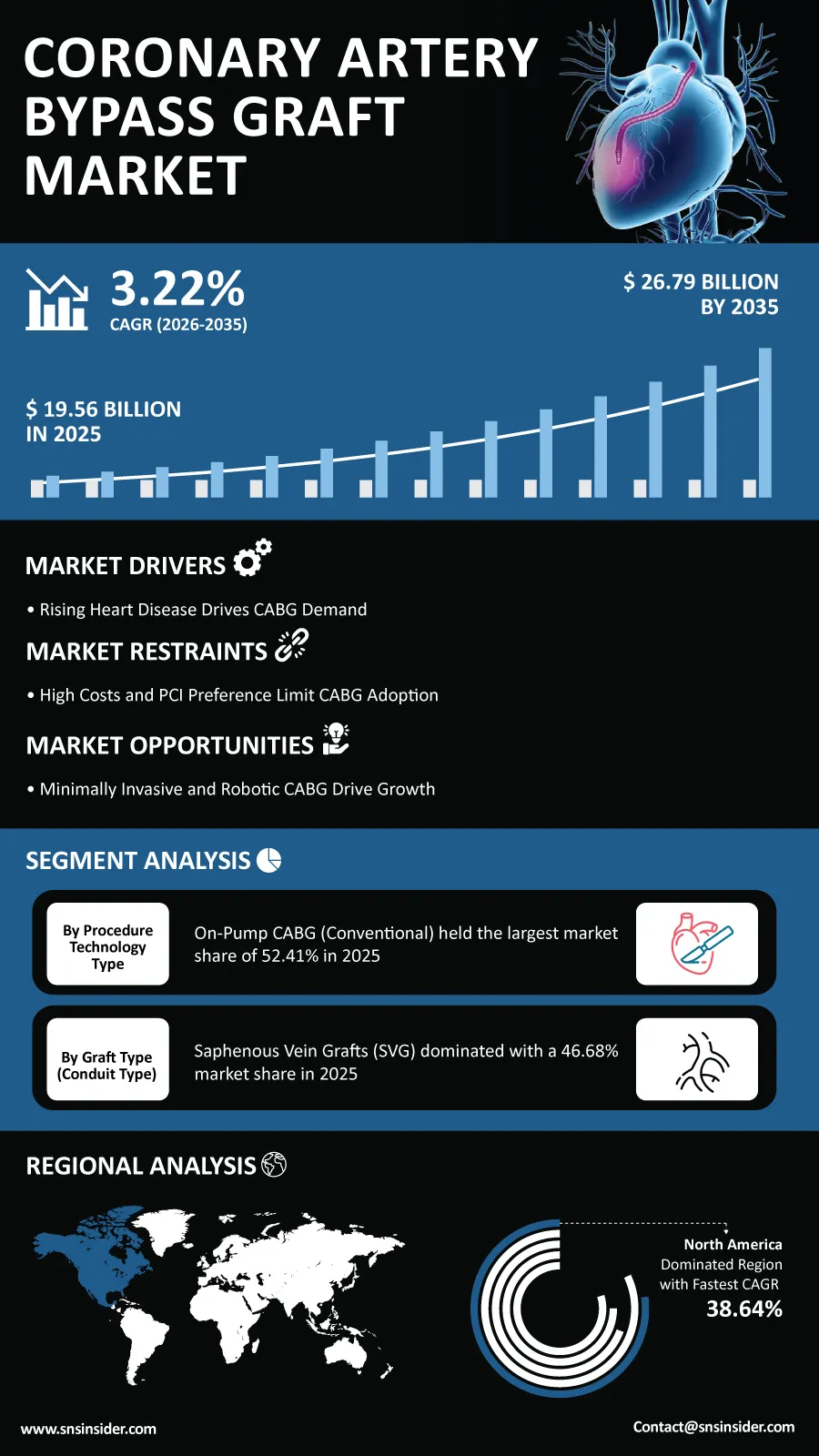
The global Coronary Artery Bypass Graft (CABG) Market is projected to witness steady growth over the coming decade as healthcare systems continue strengthening cardiovascular care and investing in advanced surgical technologies. “According to a recent study by SNS Insider, the global Coronary Artery Bypass Graft Market size valued at USD 19.56 billion in 2025, is anticipated to grow to USD 26.79 billion by 2035, registering a CAGR of 3.22% over the 2026–2035 forecast period.”
Increasing needs for better treatments for complicated coronary artery disease along with increasing availability of advanced cardiac care facilities is generating growth opportunities in the global market. Advanced surgical procedures and technologies used in the operation theaters are being adopted by the healthcare professionals in order to increase the accuracy and reduce the recovery time of the patients.
With cardiovascular diseases being among the major causes of deaths around the world, further investments in heart care programs are anticipated to foster the growth of the market during the forecast period.
To Get Detailed Insights on the Coronary Artery Bypass Graft Market – Request a Sample Report
Surgical Innovation Continues to Advance Cardiac Care
The rapid advancement in cardiovascular surgery is revolutionizing the approach in which the coronary revascularization procedures are being conducted. Improvements in the area of robotic-assisted surgery, minimally invasive techniques, improved imaging technology, and surgical planning are assisting health professionals in conducting increasingly complicated surgeries in an effective manner.
Healthcare organizations are also investing in hybrid ORs and specialized heart centers in order to deal with increasing numbers of patients. This trend is aiding the adoption of the latest surgical technologies in addition to making CABG more important in heart disease treatment.
Advancements in the development of new surgical instruments, grafts, and perioperative care will continue to enhance the experience of the patients and their results.
Key Market Findings Highlight Emerging Opportunities
Amongst procedure types, on-pump CABG contributed 52.41% of the revenue generated by the market in 2025 owing to the usage of such procedures in complex coronary revascularization procedures with established surgical procedures.
However, robotic-assisted CABG procedures are anticipated to be amongst the fastest growing procedures type at a CAGR of 6.92% from 2025 to 2035 owing to the rising demand for minimally invasive cardiac surgeries and the adoption of robotic systems.
Saphenous vein grafts were one of the most widely used grafts, accounting for 46.68% of revenue generated in 2025 for the treatment of multi-vessel coronary bypass procedures. Simultaneously, radial artery grafts are anticipated to grow at the highest CAGR of 4.19% during the forecast period owing to the increased usage of arterial grafting strategies.
On the basis of devices, the market revenue share held by cardiopulmonary bypass machines in the year 2025 was 31.57%, while endoscopic vessel harvesting systems are likely to see the highest growth rate, recording a CAGR of 4.66% during the forecast period owing to the increasing focus on minimally invasive surgery.
Healthcare facilities still represent the largest consumers of coronary artery bypass grafting devices, as hospitals have been found to contribute to 68.82% of the overall market revenue generated in the year 2025. Nevertheless, ambulatory surgical centers will demonstrate the highest CAGR of 4.73%.
Expanding Cardiac Care Infrastructure Supports Long-Term Growth
Healthcare infrastructures in both developed and developing countries are constantly making investments in sophisticated cardiovascular infrastructure, surgical instruments, and skilled cardiac care professionals in order to cater to the rising need for complicated heart surgeries.
Awareness regarding cardiovascular health, greater availability of diagnostics tests, and early detection of coronary artery disease will allow patients to get themselves operated surgically if and when required. This will result in higher demand for CABG in the future.
Regional Markets Continue to Present Strong Opportunities
The share of North America in the global market revenue in 2025 was 38.64%, thanks to highly developed cardiovascular care infrastructure, high volume of procedures, and use of advanced surgical techniques. Continued investments in health care and availability of highly developed cardiovascular centers reinforce its dominance.
Asia Pacific is expected to become the most rapidly developing regional market with a CAGR of 4.79% until 2035. Growing expenditures on health care, growing availability of cardiovascular surgery, aging population, and improvement of the infrastructure of the health care system provide many development opportunities.
Industry Leaders Continue to Invest in Advanced Cardiac Technologies
In addition to that, competition within the coronary artery bypass graft industry stays high as top companies from the medical technology industry continue developing and investing in surgical innovations, cardiovascular equipment, imaging equipment, and clinical collaborations.
Key companies operating in the global coronary artery bypass graft market include Medtronic, Boston Scientific, Abbott Laboratories, Terumo Corporation, Edwards Lifesciences, Getinge, LivaNova, B. Braun, Johnson & Johnson, and Teleflex.
An SNS Insider analysit Parry Kardani commented, "Continued advancements in minimally invasive cardiac surgery, robotic technologies, and next-generation surgical devices are reshaping the future of coronary revascularization. Healthcare providers that invest in precision-driven cardiovascular care are expected to play an important role in improving long-term patient outcomes while supporting sustained market growth."
About the Author

Get in touch




