
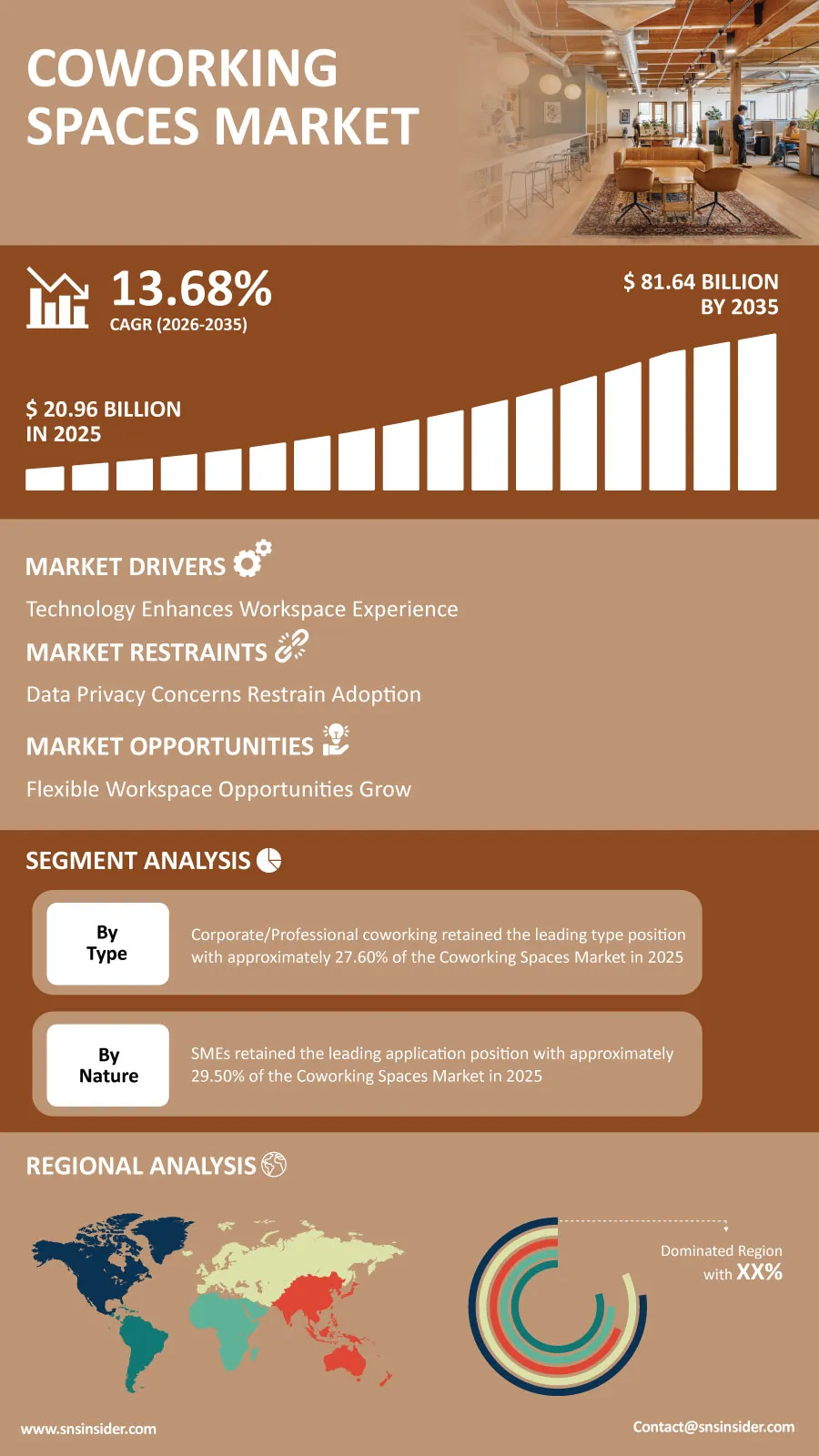
The global Coworking Spaces Market is witnessing strong momentum as organizations rethink long-term office strategies and prioritize flexible workspace solutions that support distributed teams. “According to a recent study by SNS Insider, the Coworking Spaces Market size valued at USD 20.96 billion in 2025, is anticipated to grow to USD 81.64 billion by 2035, registering a CAGR of 13.68% over the 2026–2035 forecast period.”
The evolution of the work environment will be ongoing as companies try to enhance flexibility while taking into account employee cooperation and saving costs. More firms from sectors like technology, finance, consulting, and professional services are adding flexible workspace membership to their work environments, thus maintaining high demand for coworking facilities in large urban areas.
The expansion of the startup environment, the growth of the freelance labor pool, and the rise in the number of small businesses will all play into favorable market conditions, along with the development of online reservation systems, intelligent access systems, and other workplace features.
To Get Detailed Insights on the Coworking Spaces Market – Request a Sample Report
Hybrid Workplace Strategies Open New Growth Opportunities
The flexible workspace operators are taking advantage of the constant evolution of the hybrid workplace model in all multinational corporations. The need for a more agile business environment that will not tie the organization to long-term commercial office leases is growing, allowing the teams to work in a professional environment without having to enter into any commitment.
New markets provide an opportunity for expansion due to the growth of entrepreneurship and the digital transformation in cities. Premium services and wellness-oriented office environment, as well as special concepts for different industries such as the creative industry, IT, health care, and research institutions, are being offered by the operators.
AI-driven space management, automated booking, analysis of occupancy, and smart buildings will continue to make operations more efficient and improve the customer experience through the effective use of space.
Key Market Insights Highlight Shifting Demand Patterns
Based on type, the Corporate/Professional segment accounted for approximately 27.60% of market revenue in 2025 due to increasing enterprise demand for premium flexible office solutions with advanced business services. The Conventional/Open coworking segment is projected to register the fastest growth through 2035 as operators expand into emerging business districts and secondary cities.
By nature, the Managed segment held nearly 24.40% of the global market in 2025 owing to rising demand for professionally operated workspaces. Meanwhile, the Hybrid segment is expected to witness the highest growth during the forecast period as businesses increasingly combine traditional offices with flexible workspace networks.
In terms of application, SMEs represented approximately 29.50% of total revenue in 2025 as small businesses continued to prioritize flexible infrastructure and lower occupancy costs. The Freelancers segment is anticipated to record the fastest expansion through 2035, driven by the steady growth of independent professionals and the global gig economy.
Smart Technologies Transform Modern Workspace Experiences
Innovation is constantly changing the dynamics of coworking through the implementation of smart workplace solutions to make workspaces more productive, efficient, and sustainable. The use of artificial intelligence is being employed in order to maximize space utilization and booking processes, along with obtaining occupancy insights for the benefit of resource management.
Access control, workplace technology infrastructure, advanced security systems, and digital collaboration solutions have become common among top-tier coworking spaces. Wellness in office spaces has been emphasized as a priority through ergonomic office furniture, clean air quality, natural light sources, and collaborative workspaces.
North America Held the Largest Share of the Coworking Spaces Market in 2025; Asia Pacific Projected to Register the Fastest CAGR Through 2035
North America continues to dominate as the top regional market due to extensive hybrid work model usage in enterprises, advanced flexible workspace ecosystem, and demand by tech firms, start-ups, and professional service providers. Commercial property owners are teaming up with shared workspace companies to enhance occupancy in suboptimal commercial spaces.
Asia Pacific will grow at the highest pace in the coming years due to rapid urbanization, entrepreneurial activity, digitized entrepreneurship, and growth in service economies resulting in an ongoing need for flexible office infrastructures. Increased investment in India, China, Southeast Asia, and other emerging regions boosts market opportunities in the region.
Europe retains a major market share owing to the thriving start-up scene, increased focus on sustainable work environment, and increasing investments in high-end shared office space facilities. Similarly, Latin America and Middle East & Africa continue to be promising regions for shared workspace companies.
Industry Participants Focus on Enterprise Solutions and Digital Innovation
Competition across the coworking spaces industry remains dynamic as leading providers expand their geographic presence, introduce technology-enabled workspace management solutions, and strengthen enterprise-focused service offerings. Companies are investing in premium office environments, digital workplace platforms, managed workspace solutions, and specialized coworking formats to address evolving customer requirements while improving operational performance.
Key companies operating in the global Coworking Spaces Market include IWG plc (Regus, Spaces, HQ, Signature), WeWork, Industrious (CBRE), Impact Hub, Awfis Space Solutions, Ucommune, The Executive Centre, Servcorp, Mindspace, Knotel (Newmark), Serendipity Labs, Kr Space, SOHO 3Q, CommonGrounds, Techspace, Green Desk, Convene, The Hive, Workbar, and Smartworks.
An SNS Insider analyst Sakshi Kale commented, "Organizations are increasingly embracing flexible workplace models that prioritize scalability, employee experience, and operational efficiency. As enterprises continue optimizing office portfolios and workforce strategies, coworking operators investing in digital technologies, premium services, and specialized workspace offerings are expected to unlock significant long-term growth opportunities."
About the Author

Get in touch




