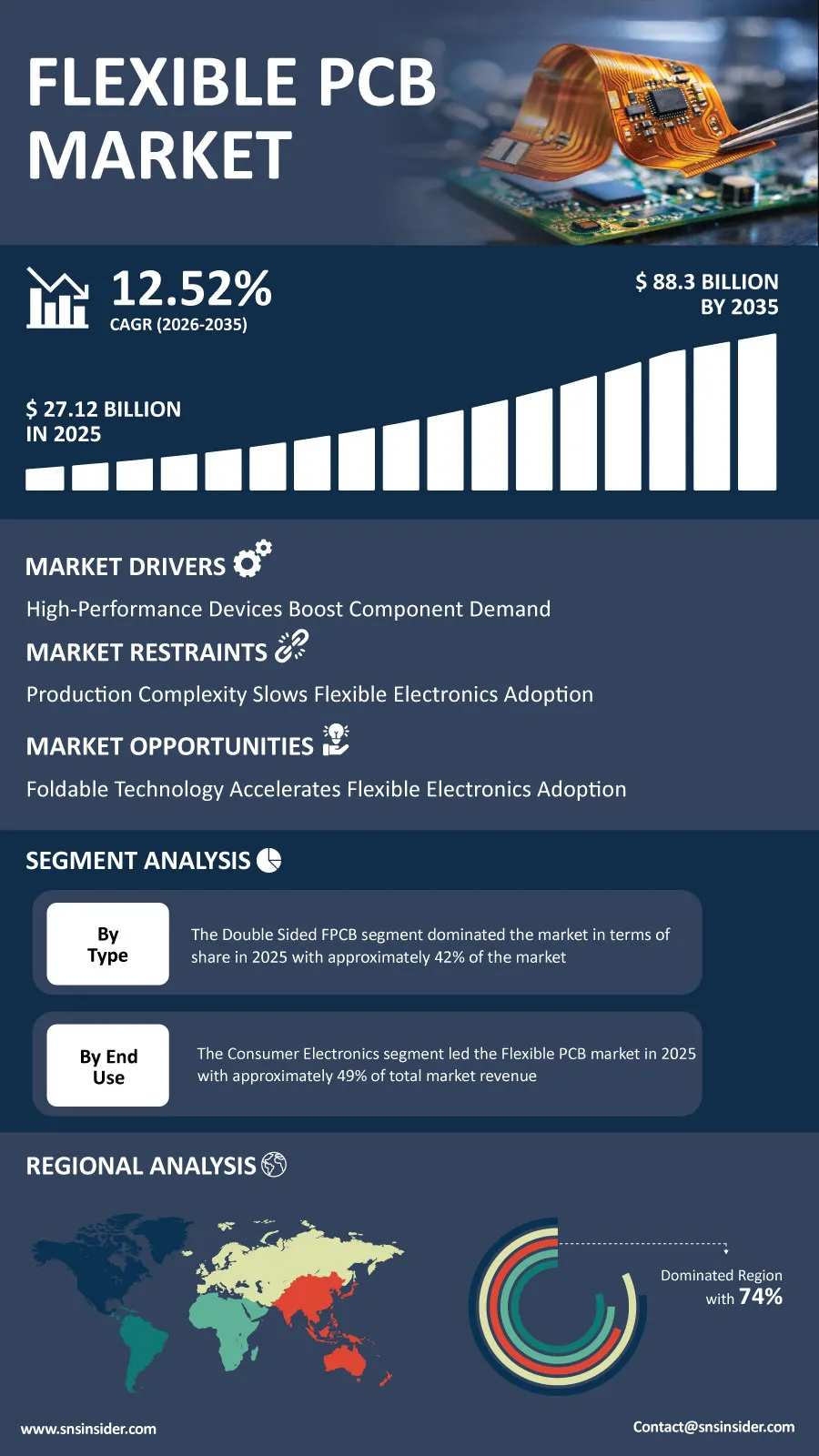
The global Flexible PCB Market is entering a strong growth phase as manufacturers across electronics, automotive, telecommunications, healthcare, and aerospace increasingly require compact circuit solutions that can accommodate sophisticated functionality within smaller device footprints. According to a recent study by SNS Insider, the global Flexible Printed Circuit Boards Market size valued at USD 27.12 billion in 2025, is anticipated to grow to USD 88.3 billion by 2035, registering a CAGR of 12.52% over the 2026–2035 forecast period.
With the increasing move towards lightweight and compact electronic designs, the use of flexible printed circuit boards has become more important in the development of products in the future. Products such as smartphones, wearable gadgets, electric cars, medical machines, and modern communication technologies are starting to adopt flexible circuits to allow for connectivity while minimizing weight and assembly.
The fast growth in 5G networks, IoT environments, AI-based gadgets, and connected mobility is presenting even more opportunities for manufacturers of flexible circuits. On the other hand, the advancements in manufacturing processes are helping manufacturers increase the density and accuracy of circuits.
To Get Detailed Insights on the Flexible Printed Circuit Boards Market – Request a Sample Report
Electronics Miniaturization Continues to Create New Growth Opportunities
In addition, the electronics industry worldwide is shifting towards more miniaturized products that do not sacrifice on efficiency or usability. With flex PCBs, it is possible for engineers to have more options in terms of routing circuits around curves, thin gaps, and other awkward spaces, making them extremely useful when designing such products where the standard rigid PCBs and wiring would limit the design.
Automotive electrification will drive yet another significant demand for PCBs. As electric cars become more widespread, there will be an increasing need for battery management, intelligent driver assist, infotainment, and sensor capabilities – all of which require interconnection.
Moreover, foldable gadgets, health monitoring devices and instruments, flexible screens, and wearable healthcare equipment are providing more avenues of opportunity. Research into high-density interconnect fabrication, laser fabrication, and additive electronics will enhance the industry's future outlook.
Key Market Insights Highlight Shifting Demand Patterns
By type, double-sided FPCBs segment dominated with 42% of global market revenue in 2025. Their ability to support higher circuit density while maintaining a relatively economical manufacturing profile makes them suitable for consumer electronics, automotive systems, and industrial equipment. Multilayer FPCBs are projected to record the fastest growth through 2035 as manufacturers seek greater circuit integration, improved signal performance, and efficient thermal management in compact products.
Based on end use, consumer electronics segment held approximately 49% of market revenue in 2025. Strong demand for smartphones, tablets, laptops, smartwatches, and foldable devices continues to drive adoption. IT and telecom are expected to witness the fastest growth as 5G network expansion, data center investments, edge computing, and IoT connectivity increase demand for high-performance flexible circuits.
Advanced Electronics and Connected Technologies Strengthen Market Demand
Rising complexities in the design of electronic products have made it essential for companies to use flexible interconnect technology. Flexible PCBs are being used in healthcare products such as wearable monitors, mobile diagnostic instruments, and advanced medical electronics.
Rigid-flex circuits are receiving significant interest in aerospace and defense due to the need for compact designs, reliability, and environmental toughness. The use of flexible circuits in automotive products such as battery packs, sensing technologies, display systems, and electronic controls is also increasing.
The use of flexible hybrid electronics and printed electronics might extend the reach of the market. The use of flexible circuits in new applications such as stretchable electronics, flexible displays, and bioelectronic systems is anticipated to drive the market forward.
Asia Pacific Leads with More Than 74% Revenue Share While North America Accelerates Growth
Asia Pacific region will continue to be the dominant region in terms of market size and revenue generation, contributing to over 74% of global revenue in 2025. This regional dominance is fueled by its well-established ecosystem for electronics manufacturing within China, Japan, South Korea, and Taiwan regions, along with high demands for smartphones, displays, wearables, and electric vehicles.
The North American region is anticipated to experience the highest growth rate in the forecast period, owing to investments in aerospace & defense, advanced healthcare equipment, telecom systems, and advanced automotive electronics. In addition, there are initiatives toward strengthening domestic electronics manufacturing and semiconductors chain, thus increasing investments in regional flexible PCB manufacturing facilities.
Industry Participants Focus on Manufacturing Innovation
The competitive landscape remains active as manufacturers expand production capacity and invest in advanced fabrication technologies to meet rising demand for high-density and miniaturized circuit solutions. Companies are focusing on improving precision, manufacturing efficiency, material performance, and product reliability while developing capabilities for increasingly complex electronic applications.
Key companies operating in the global Flexible Printed Circuit Boards Market include Nippon Mektron, Zhen Ding Technology Holding Ltd., Sumitomo Electric Industries, Interflex Co. Ltd., Career Technology (Mfg.) Co., Ltd., Ichia Technologies Inc., Multi-Fineline Electronix, Inc. (MFLEX), NewFlex Technology Co., Ltd., FLEXium Interconnect, Inc., Daeduck GDS, SIFlex Co., Ltd., BHflex Co., Ltd., Interconnect Systems Inc., Samsung Electro-Mechanics, and Nitto Denko Corporation.
An SNS Insider analyst Sushant Kadam commented, “The accelerating shift toward compact, connected, and electrified products is positioning flexible PCBs as a critical enabling technology across multiple high-growth industries. Manufacturers that strengthen high-density production capabilities, improve process efficiency, and develop advanced solutions for automotive, healthcare, telecom, and emerging flexible electronics applications will be well placed to capture future market opportunities.”
About the Author

Get in touch