
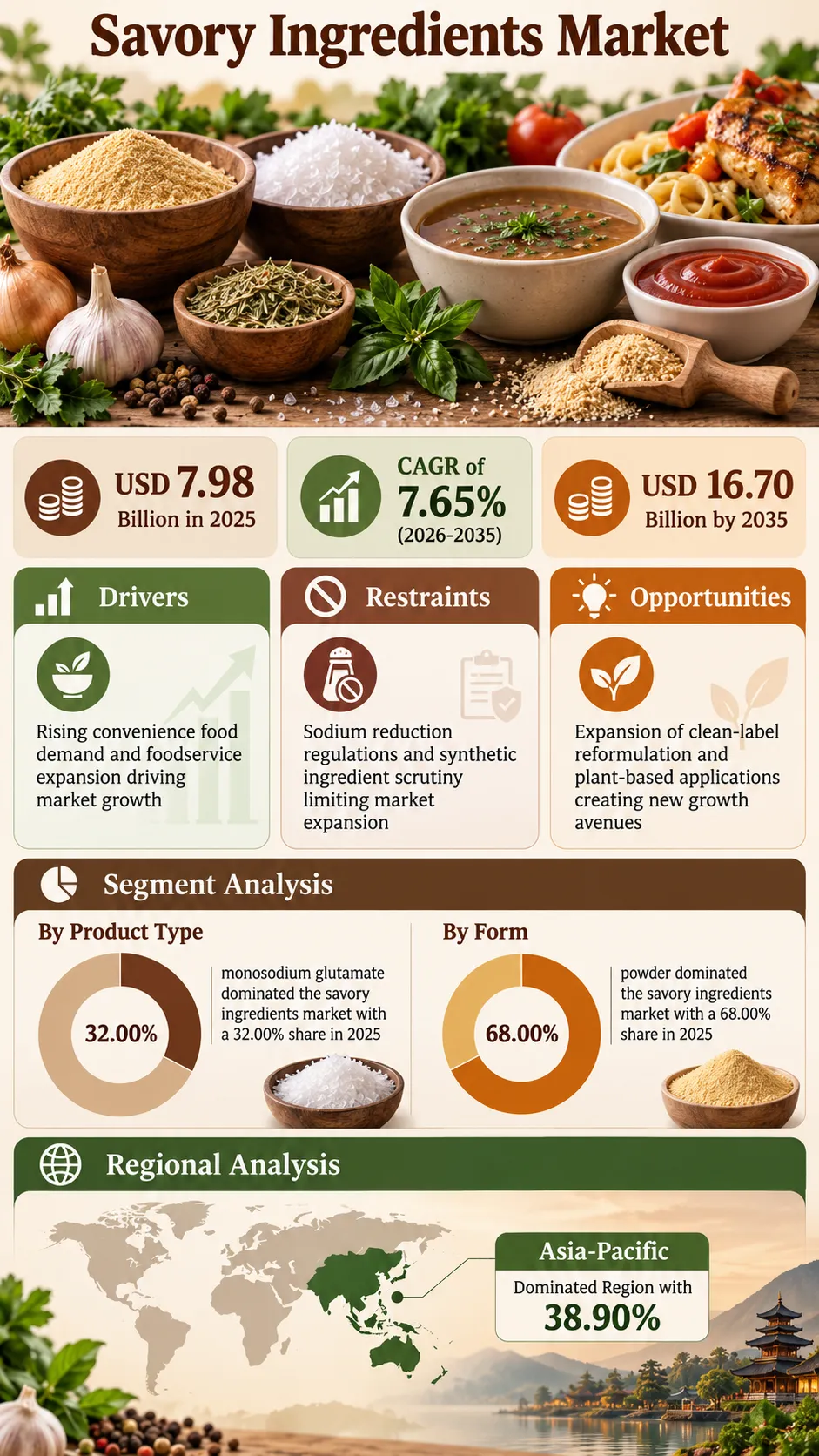
The global Savory Ingredients Market is set for significant expansion as convenience food demand and clean-label reformulation continue to reshape flavor enhancement ingredient sourcing worldwide. “According to a recent study by SNS Insider, the global Savory Ingredients Market size valued at USD 7.988 billion in 2025, is anticipated to grow to USD 16.70 billion by 2035, registering a CAGR of 7.65% over the 2026–2035 forecast period.”
There have been notable changes within flavor enhancement technology over time, due to which many food manufacturers who aim at improving taste and label transparency of their products can take advantage of this trend. This includes the need for more naturally derived, clean-label savory ingredients that will provide food companies with the ability to meet evolving consumer and regulatory expectations. This applies in situations where savory ingredients support snacks, soups and sauces, ready meals, and plant-based food applications. Manufacturers are constantly working hard to ensure that their flavor enhancement solutions perform better than before in order to meet various consumer taste and label transparency requirements.
To Get Detailed Insights on the Savory Ingredients Market – Request a Sample Report
Clean-Label Reformulation Creates New Demand
The savory ingredients market has evolved from a synthetic flavor enhancer-dominated category to an increasingly natural, clean-label-focused ingredient landscape. The growing investment in yeast extract technology, fermentation-derived umami boosters, and natural seasoning development across manufacturers of all sizes has required the development of more transparent and effective savory ingredient products.
New extraction and formulation techniques can increase natural umami flavor intensity, improve label transparency, and allow for expansion into increasingly diverse plant-based and convenience food applications. In this way, food product producers will be able to provide strong taste experiences for consumers that are also aware of increasing consumer desire for clear ingredient labeling.
Flavor enhancer companies, savory ingredients producers, and food service industry firms have been collaborating as a result of increasing need to develop future technologies for natural flavor enhancement.
Key Market Findings Highlight High-Growth Segments
The monosodium glutamate sector held the highest market share among all the segments in the savory ingredients industry share at 32.00% in 2024 on account of its low cost and highly efficient umami flavoring characteristics. The yeast extracts sector is projected to grow at the highest CAGR of 7.60% through 2035 on account of growing demand for clean label ingredients.
In terms of form, powder captured the highest percentage of market revenues at 68.00% in 2024 on account of its convenience and increased shelf life as well as being easy to use in the food manufacturing process. The liquid segment will witness the fastest growth in terms of revenue generation at a CAGR of 7.20%.
Based on application, food processing generated a 31.20% share of market revenue in 2026 thanks to savory ingredients' foundational role across snacks and seasoning blends. On the other hand, ready meals will be the segment recording the fastest revenue growth at a CAGR of 8.20%, supported by growing consumer demand for convenient, flavorful meal options.
Distributive origin trends are changing as well. Natural ingredients captured a majority share of market revenue owing to growing consumer avoidance of artificial additives. This segment continues to register strong growth momentum as regulatory changes across major markets increasingly support natural ingredient positioning over synthetic alternatives.
Flavor Intensity, Label Transparency, and Application Versatility Gain Importance
In this regard, food manufacturers have been looking at savory ingredients that would deliver more authentic umami flavor while requiring greater label transparency and regulatory compliance.
Innovation in yeast extract technology, fermentation-derived umami boosters, and natural seasoning development has been making it possible for companies to come up with products that appeal to increasingly clean-label-focused food manufacturers. In addition to that, increasing emphasis on plant-based flavor replication is also making it possible for suppliers to find solutions that meet evolving dietary preference and regulatory expectations. Such trends are likely to become even more prominent in the future.
Asia Pacific Emerges as the Largest Market with 38.90% Regional Revenue Share Amid Deep-Rooted Umami Culinary Traditions
The Asia Pacific region represented the largest share of regional market revenue in 2024 at 38.90%, owing to deeply ingrained culinary traditions emphasizing umami and savory flavors, rapid urbanization, and expanding packaged food industries. On the other hand, North America is expected to grow at a notable CAGR during the forecast period through 2035, propelled by rising demand for low-sodium, gluten-free, and plant-based savory components.
Leading Companies Drive Innovation and Competition
The environment continues to stay very dynamic since players continue innovating on natural flavor technology and clean-label reformulation as well as forming partnerships in order to enhance their position in the industry. Some of the major companies that operate in the global savory ingredients market are Ajinomoto, Kerry Group, dsm-firmenich, Givaudan, Archer Daniels Midland, Sensient Technologies, IFF, Tate & Lyle, Symrise, and Ohly.
An SNS Insider analyst Parry Kardani commented, "The growing consumer demand for natural, transparent flavor enhancement is creating sustained opportunities across snacks, ready meals, and plant-based applications. Manufacturers that successfully combine natural sourcing innovation, clean-label reformulation, and application-specific expertise will be best positioned to capitalize on emerging opportunities across conventional and specialty savory ingredient segments."
About the Author

Get in touch




