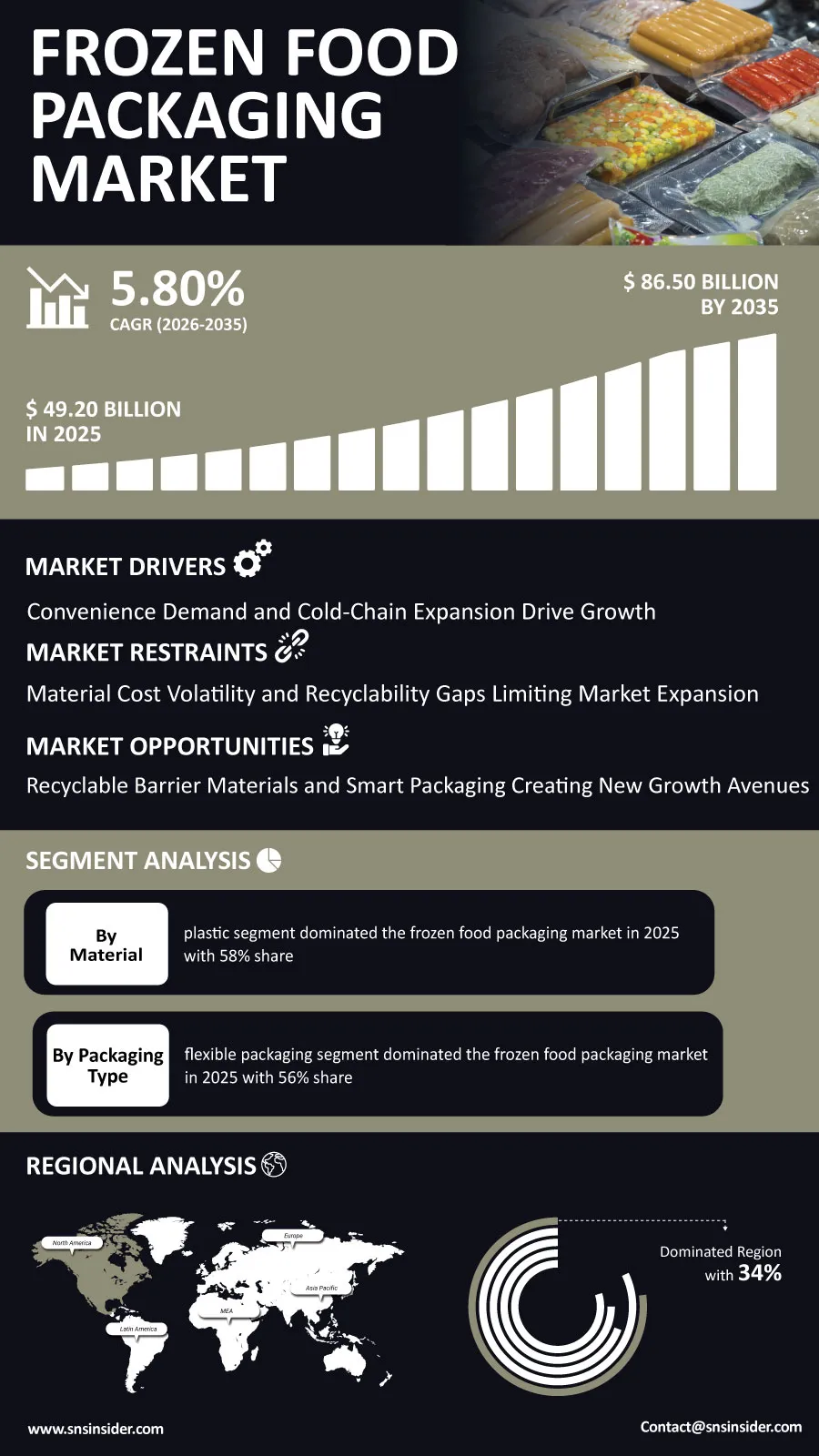
The global Frozen Food Packaging Market is on a steady growth trajectory through 2035, as convenience food demand and expanding cold-chain retail infrastructure continue reshaping packaging requirements worldwide. “According to a recent study by SNS Insider, the global Frozen Food Packaging Market size valued at USD 49.20 billion in 2025, is anticipated to grow to USD 86.50 billion by 2035, registering a CAGR of 5.80% over the 2026-2035 forecast period.”
Frozen food packaging has quietly become one of the more technically demanding categories in consumer packaging, required to survive months at freezer temperatures, perform through a microwave or oven cycle, and increasingly meet recyclability standards that older multilayer barrier structures were never designed for. Brands that cannot keep pace with all three requirements at once are starting to lose shelf space to competitors who can.
Retailers and regulators are pushing this shift faster than market forces alone would manage, particularly in Europe and parts of North America, where packaging waste rules are tightening well ahead of most brands' original sustainability timelines.
To Get Detailed Insights on the Frozen Food Packaging Market – Request a Sample Report
Recyclable Barrier Innovation Reshapes Category Standards
Where multilayer plastic films once dominated by default, packaging suppliers are increasingly commercializing mono-material films and freezer-grade paperboard coatings that can match the barrier performance frozen food requires without sacrificing recyclability.
This shift is changing product development priorities across the industry, since barrier performance, seal integrity, and recyclability now all have to be engineered together rather than treated as separate design considerations.
Material science partnerships between packaging suppliers and frozen food brands are becoming more common as both sides work to solve the freezer-performance-versus-recyclability trade-off that has limited faster material transitions until recently.
Key Market Findings Highlight High-Growth Segments
Bags & pouches held the largest share of the Frozen Food Packaging Market in 2025, at 38%, reflecting their material efficiency and widespread use across frozen vegetable, fruit, and bulk meat categories.
Tubs & cups are the fastest-growing format, expanding at an 8.40% CAGR, pulled forward by ice cream, frozen yogurt, and single-serve dessert categories favoring rigid, stackable packaging.
By material, plastic remained dominant at 58% share, while paperboard is growing fastest, at a 9.10% CAGR, as brands respond to plastic-reduction regulation and consumer demand for curbside-recyclable packaging.
Meat & poultry led application demand at 34% share, but ready meals & bakery is climbing fastest, at a 9.80% CAGR, driven by rising convenience food consumption and grocery delivery adoption.
Freezer Performance and Recyclability Are Now Engineered Together
Packaging suppliers are no longer treating barrier performance and recyclability as competing priorities, they are being asked to deliver both at once, and that shift is reshaping product development timelines across the industry.
Investment in freezer-grade coating technology and mono-material film development is becoming a genuine competitive differentiator, particularly as retailers tighten their own packaging specifications ahead of regulatory deadlines.
This trend is expected to accelerate further as more markets adopt EU-style packaging waste regulations.
North America Leads as Asia Pacific Grows Fastest
North America holds the largest share of global market revenue, underpinned by deeply established frozen food consumption habits and extensive dedicated freezer retail infrastructure. Asia Pacific, meanwhile, is growing fastest, propelled by urbanization, rising disposable incomes, and rapidly expanding cold-chain retail infrastructure across China, India, and Southeast Asia.
Europe holds a meaningful, mature share as well, shaped heavily by the region's packaging waste regulations, which are forcing faster material transitions than almost anywhere else in the world.
Leading Companies Drive Innovation and Competition
Competition in this market is playing out largely around recyclable material capability and freezer-grade performance, with suppliers investing heavily in barrier coating and mono-material film technology to meet tightening retailer and regulatory specifications.
Some of the major companies that operate in the global frozen food packaging market are Amcor plc, Mondi Group, Sonoco Products Company, Sealed Air Corporation, Huhtamaki Oyj, International Paper Company, Smurfit Westrock plc, Crown Holdings Inc.
An SNS Insider Analyst Santosh Bhul commented, “Frozen food packaging has moved well past being a simple protective format, brands now need barrier performance, oven or microwave compatibility, and genuine recyclability all in the same package, and suppliers that can deliver all three are capturing the fastest-growing parts of this market. As cold-chain infrastructure keeps expanding into new markets, the packaging specification bar is only going to keep rising.”
About the Author

Get in touch