
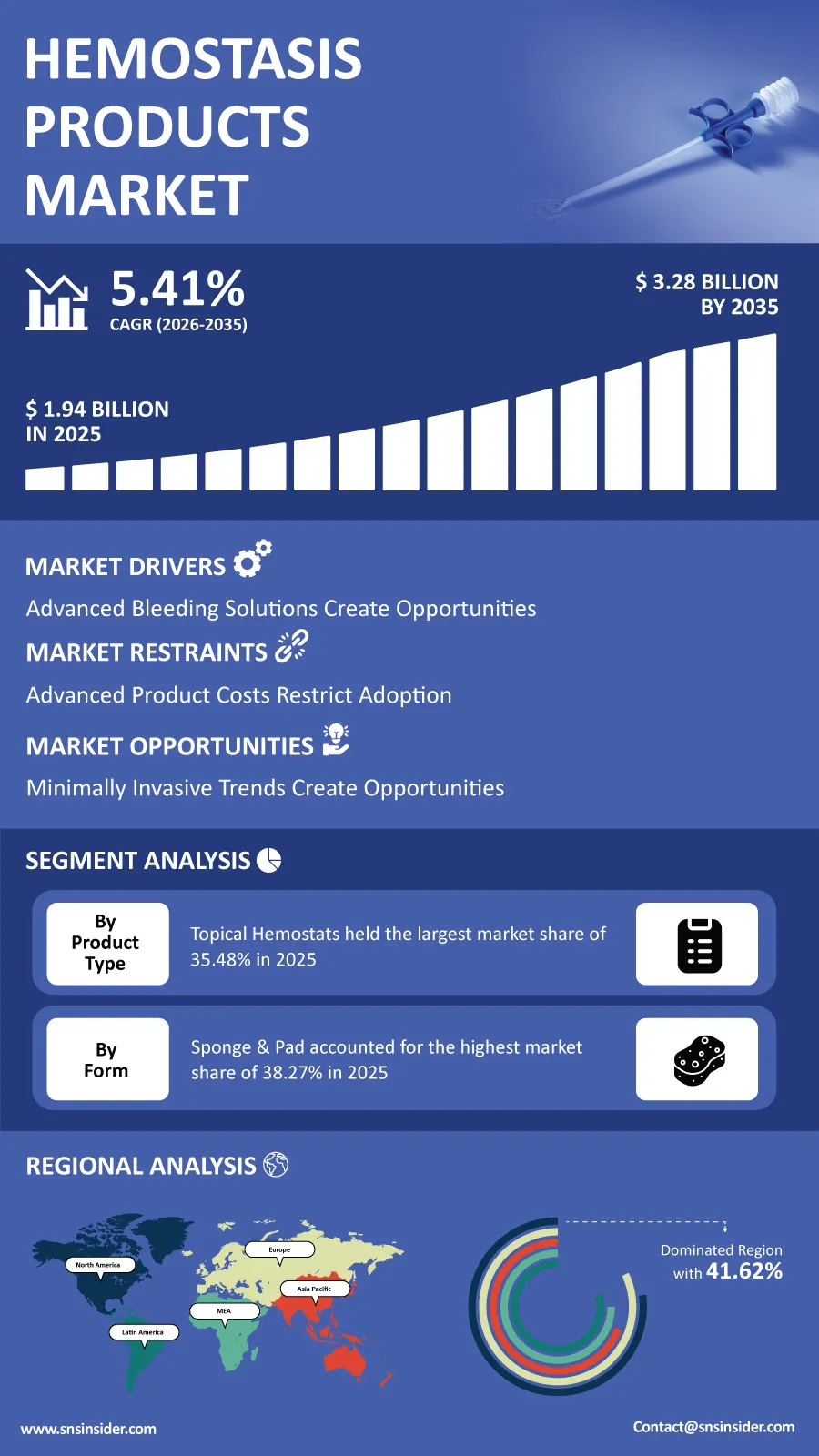
The global Hemostasis Products Market is projected to experience steady growth over the next decade as healthcare providers continue investing in advanced surgical technologies that improve procedural efficiency and patient safety. “According to a recent study by SNS Insider, the global Hemostasis Products Market size valued at USD 1.94 billion in 2025, is anticipated to grow to USD 3.28 billion by 2035, registering a CAGR of 5.41% over the 2026–2035 forecast period.”
The rising trend of surgical procedures around the world, greater emphasis on lowering blood loss during surgery, and advancements in surgical practices are contributing to a need for novel bleeding management techniques. Healthcare facilities have been showing interest in devices that reduce the duration of surgeries, increase the accuracy of surgeries, and facilitate better recovery after the operation.
With the ongoing modernization of operating theaters in hospitals and ambulatory surgery centers, there will be an increasing need for the development of innovative technologies that can control bleeding efficiently.
To Get Detailed Insights on the Hemostasis Products Market – Request a Sample Report
Innovation Continues to Transform Surgical Bleeding Management
Biomaterial advances, absorbable technology advances, and new surgical devices are changing how physicians deal with bleeding in their more difficult procedures. Companies have begun to develop products that offer faster hemostasis, better usability, and more compatibility with minimally invasive surgery.
The focus of healthcare systems is increasingly geared towards efficient operations and reduced risks in surgeries. This is leading to increased use of advanced hemostatic products in cardiovascular surgery, orthopedics, neurology, and general surgery.
Growing investments in surgical innovation and clinician training are expected to further strengthen adoption as healthcare organizations continue expanding access to advanced surgical care.
Key Market Findings Highlight Emerging Growth Opportunities
By product categories, topical hemostats accounted for 35.48% of global market revenue in 2025, maintaining their position as the leading product segment due to widespread clinical acceptance and broad surgical applications.
Meanwhile, flowable hemostats are projected to register the fastest growth through 2035, expanding at a CAGR of 6.12%, supported by increasing demand for precise bleeding control during minimally invasive and complex surgical procedures.
Based on product form, sponge and pad products represented 38.27% of total market revenue in 2025, reflecting their extensive use across hospitals and surgical facilities worldwide. At the same time, matrix and gel formulations are expected to witness the fastest growth at a CAGR of 6.45%, driven by continuous advancements in absorbable biomaterials and surgeon preference for versatile bleeding management solutions.
Application trends continue to demonstrate strong clinical demand. Surgical procedures accounted for 42.13% of market revenue in 2025, while trauma care is anticipated to record the fastest growth, advancing at a CAGR of 6.03% during the forecast period, reflecting increasing investments in emergency medicine and critical care services.
On the basis of end users, hospitals held 48.56% of global market revenue in 2025, supported by high procedural volumes and advanced surgical capabilities. Meanwhile, ambulatory surgical centers are projected to expand at the fastest CAGR of 6.21% through 2035, driven by rising outpatient surgeries and growing adoption of minimally invasive treatment pathways.
Expanding Surgical Infrastructure Supports Long-Term Demand
Healthcare institutions globally keep putting their money into state-of-the-art surgery facilities that can provide efficient and patient-focused healthcare services. The increasing number of surgeries being performed, the increased focus on recovery protocols, and continued growth in the area of out-patient surgery have been contributing positively towards the emergence of bleeding management technologies.
Innovations that have emerged within manufacturers include development of devices that can streamline the processes involved in surgery, improve the ease of use of technology, and maintain consistent performance for various types of surgery.
Regional Markets Continue to Present Strong Growth Potential
The North American market had a share of 41.62% of the overall market revenue generated in 2025 owing to its highly developed healthcare system, high number of surgical procedures, and use of innovative surgical devices. The region continues to gain from large-scale investment in healthcare and the adoption of bleeding management products among healthcare professionals.
On the other hand, the Asia Pacific region is estimated to witness the highest CAGR of 6.63% through 2035. Increasing investment in healthcare, growing surgical capabilities, improved infrastructure in hospitals, and increased availability of advanced medical technologies present many growth opportunities for the region.
Industry Leaders Continue to Drive Product Innovation
Competition within the hemostasis products market remains dynamic as manufacturers continue investing in research, product development, strategic collaborations, and geographic expansion. Companies are focusing on delivering innovative technologies that improve surgical efficiency while supporting safer and more effective patient care.
Key companies operating in the global hemostasis products market include Johnson & Johnson, Baxter International, B. Braun Melsungen, Becton, Dickinson and Company, Medtronic, Pfizer, CSL Behring, Integra LifeSciences, Abbott Laboratories, and Zimmer Biomet.
An SNS Insider analyst Parry Kardani commented, "The evolution of surgical care continues to increase demand for innovative bleeding management solutions that enhance clinical efficiency and patient safety. Companies investing in next-generation biomaterials, minimally invasive technologies, and surgeon-focused product innovation are expected to remain well-positioned as procedural volumes continue to rise globally."
About the Author

Get in touch




