
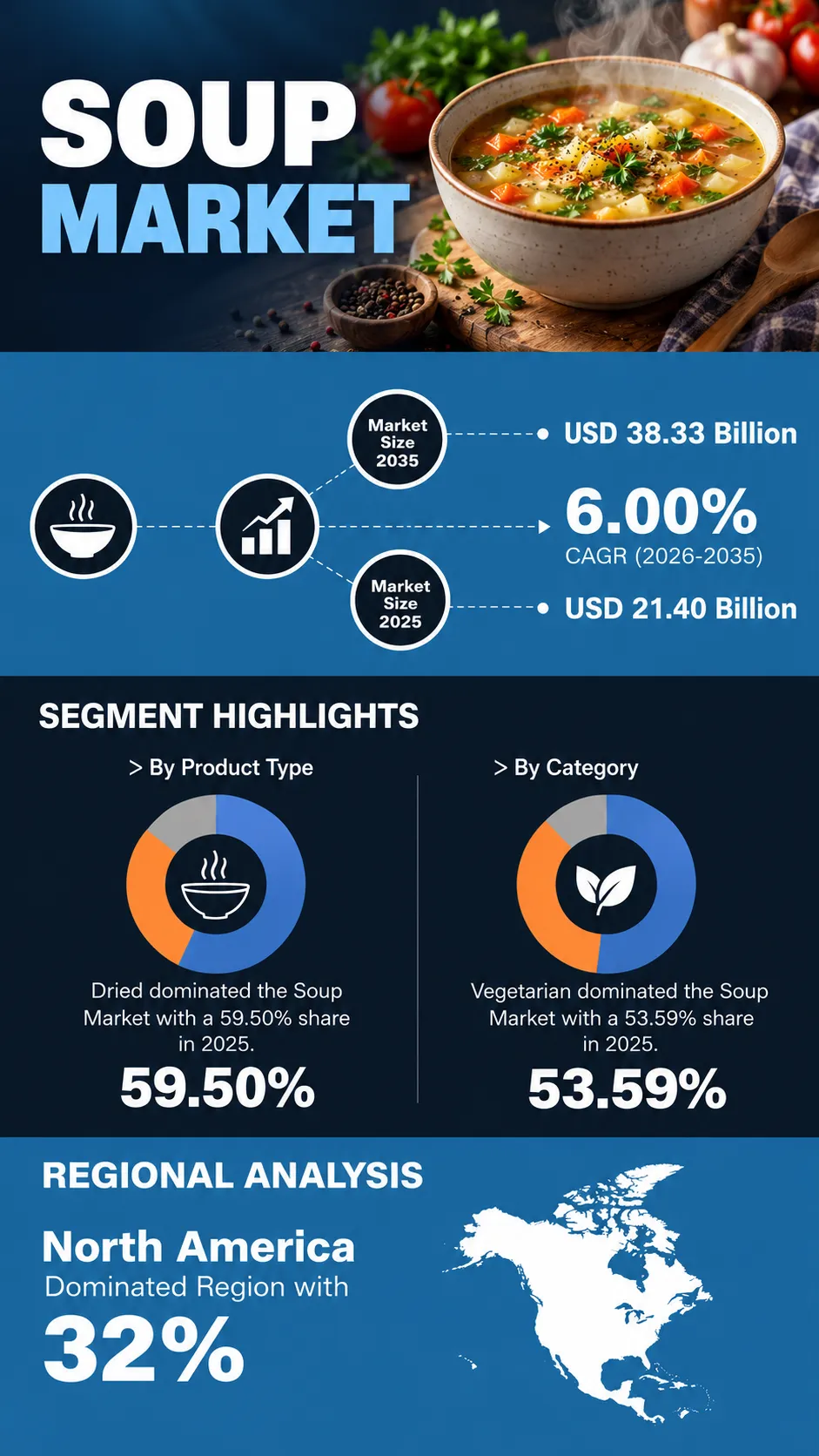
The global Soup Market is set for significant expansion as convenience food demand and healthier formulation innovation continue to reshape packaged meal consumption worldwide. “According to a recent study by SNS Insider, the global Soup Market size valued at USD 21.40 billion in 2025, is anticipated to grow to USD 38.33 billion by 2035, registering a CAGR of 6.00% over the 2026–2035 forecast period.”
There have been notable changes within soup processing and packaging technology over time, due to which many manufacturers who aim at improving convenience and health positioning of their products can take advantage of this trend. This includes the need for more advanced UHT processing and sustainable packaging techniques that will provide consumers with the ability to access convenient, nutrient-rich meal solutions. This applies in situations where soup supports household consumption, foodservice, and emergency preparedness applications. Manufacturers are constantly working hard to ensure that their soup products perform better than before in order to meet various consumer convenience and health-conscious requirements.
To Get Detailed Insights on the Soup Market – Request a Sample Report
Plant-Based Innovation and Chilled Formats Create New Demand
The soup market has evolved from a basic canned convenience category to an increasingly diversified market spanning conventional, premium, and plant-based product positioning. The growing investment in UHT processing, chilled soup infrastructure, and sustainable packaging across manufacturers of all sizes has required the development of more differentiated soup products.
The use of new technologies may contribute to extending shelf-life, making product health-conscious convenient to access and expand the variety of premium and functional food solutions. As a result, the opportunity exists for companies to tap into not only traditional consumer base but also into health-conscious and plant-based consumer segments.
Collaborations between soup producers, retailers and the cold-chain logistics providers become more and more frequent due to the growing trend toward development of premium sustainable soup products in the future.
Key Market Findings Highlight High-Growth Segments
The dried segment dominated all categories in the soup market share with a 59.5% share in 2023 due to extended shelf stability and cost-effective production. The fastest growing category is expected to be UHT soups which will grow at the fastest CAGR through the forecast period, owing to long-shelf-life ingredients that don't require refrigeration.
By category, vegetarian soup accounted for 53.59% of market share in 2025 and also carries the fastest growth trajectory, outpacing non-vegetarian offerings as flexitarian diets become mainstream and plant-based eating expands beyond niche segments.
Based on distribution channel, supermarkets and hypermarkets accounted for a 56.9% share thanks to broad product variety and convenient one-stop shopping. On the other hand, online retail will be the segment recording the fastest revenue growth at an estimated 11.0%-12.0% CAGR, supported by digital grocery adoption and subscription opportunities.
Distributive packaging trends are changing as well. Canned and preserved soup accounted for approximately 44.9% of market revenue owing to extended shelf life without refrigeration. But pouches and flexible packaging will turn out to be the fastest-growing packaging category through 2035, on the back of growing demand for clean ingredients in reusable and sustainable packaging.
Convenience, Health Positioning, and Sustainable Packaging Gain Importance
In this regard, consumers have been looking at soup products that would deliver more consistent convenience while requiring less sodium content and greater sustainable packaging credentials.
Innovation in UHT processing, chilled soup infrastructure, and flexible packaging development has been making it possible for companies to come up with products that appeal to increasingly diverse, health-conscious households. In addition to that, increasing emphasis on plant-based formulation is also making it possible for manufacturers to find solutions that meet evolving flexitarian and vegetarian consumer preferences. Such trends are likely to become even more prominent in the future.
Europe Emerges as the Largest Market with 37.66% Regional Revenue Share Amid Deep-Rooted Consumption Traditions
The Europe region represented the largest share of regional market revenue in 2025 at 37.66%, owing to the region's deep-rooted soup consumption traditions and strong presence of leading soup manufacturers. On the other hand, Asia Pacific held a 25%-29% share in 2025 and is growing at the fastest CAGR of 8.0%-9.0% during the forecast period through 2035, propelled by urbanization and expanding middle-class populations.
Leading Companies Drive Innovation and Competition
The environment continues to stay very dynamic since players continue innovating on UHT processing and sustainable packaging as well as forming partnerships in order to enhance their position in the industry. Some of the major companies that operate in the global soup market are Campbell Soup Company, Nestlé, General Mills, Unilever, Baxters Food Group, Amy's Kitchen, The Kraft Heinz Company, Conagra Brands, New Covent Garden Soup Co., and Yorkshire Provender.
An SNS Insider analyst Parry Kardani commented, "The growing consumer demand for convenient, health-conscious meal solutions is creating sustained opportunities across conventional, premium, and plant-based soup segments. Manufacturers that successfully combine processing innovation, sustainable packaging, and plant-based formulation will be best positioned to capitalize on emerging opportunities across household, foodservice, and premium chilled soup categories."
About the Author

Get in touch




