
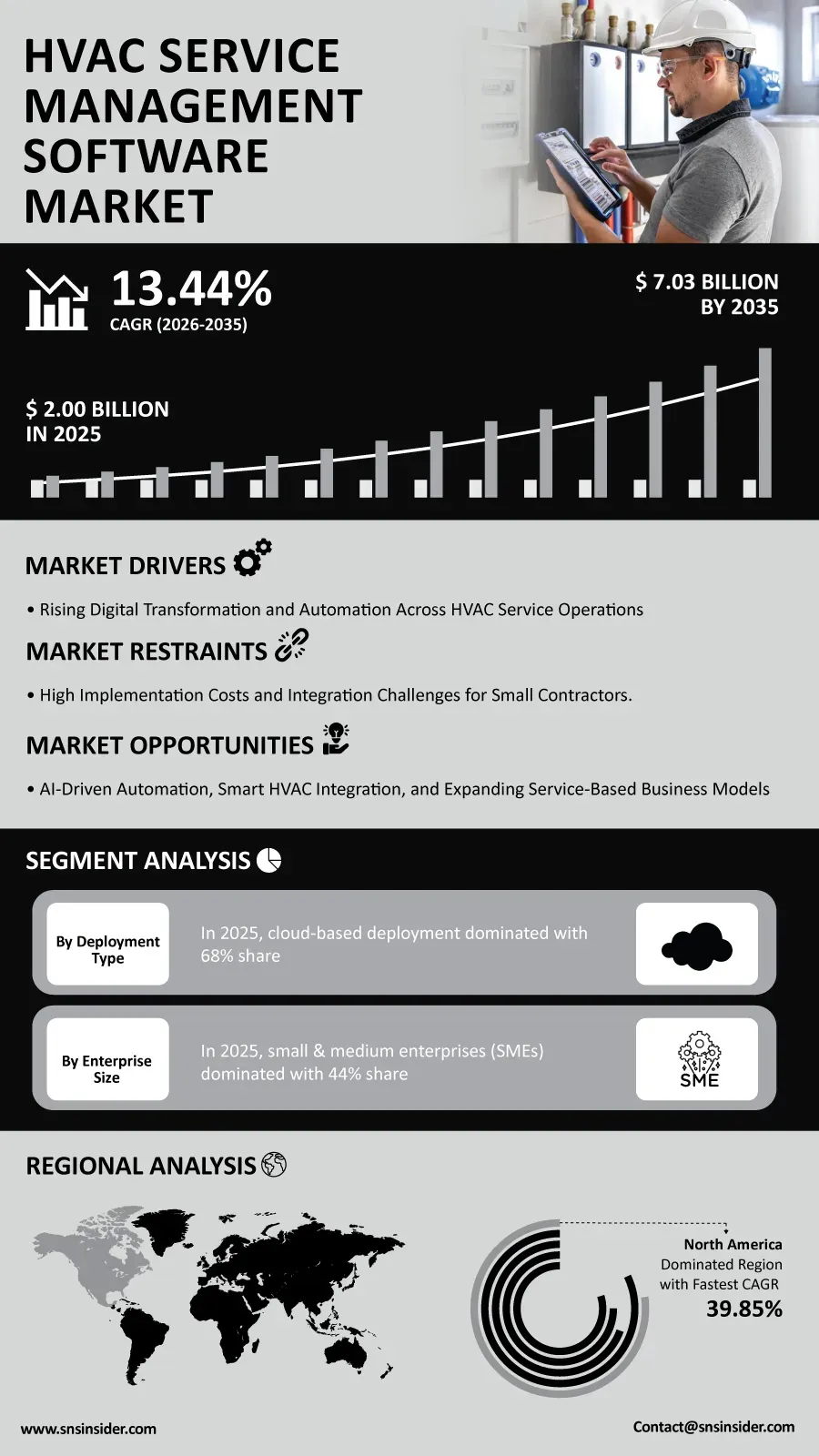
The global HVAC Service Management Software Market is expected to witness substantial growth as HVAC contractors and facility service providers increasingly modernize their operations through digital technologies. “According to a recent study by SNS Insider, the global HVAC Service Management Software Market size valued at USD 2.00 billion in 2025, is anticipated to grow to USD 7.03 billion by 2035, registering a CAGR of 13.44% over the 2026–2035 forecast period.”
The shift to cloud-based service management platforms is revolutionizing the way HVAC firms schedule their technicians, handle customer interaction, and manage field activities. There is a move from traditional processes to sophisticated software that increases efficiency and speed and also increases service delivery quality in both residential and commercial settings.
Increased use of connectivity between HVAC systems and other advanced technologies in buildings is increasing the need for software platforms that can coordinate preventive maintenance, scheduling, inventory, and customer communications all within one virtual platform. AI and data analysis tools are also helping service firms make the best use of labor force.
To Get Detailed Insights on the HVAC Service Management Software Market – Request a Sample Report
Intelligent Field Service Platforms Create Long-Term Growth Opportunities
HVAC service businesses are making substantial investments in technological solutions that will help them perform day-to-day activities and grow in the future. Automated scheduling, automatic tracking of technicians, workforce mobility technology, and predictive maintenance are allowing companies to provide faster and more reliable services, while decreasing their administration workload.
Another promising opportunity comes from the increasing number of subscription-based maintenance agreements. Companies are actively searching for technologies that will allow them to automate their maintenance schedule, track the performance of their equipment, and retain clients through maintenance programs.
Lastly, the connection between HVAC management software and Internet of Things (IoT) technologies makes it possible to monitor the equipment on a constant basis. Such technologies allow contractors to identify the problems with the equipment before it fails.
Key Market Insights Highlight Shifting Demand Patterns
Based on deployment type, the cloud-based systems are projected to represent 68% share of the global market revenue in 2025 because of the scalability, availability remotely, automatic software update, and reduced infrastructure needs. On-premise is forecasted to be the fastest growing segment up to 2035 because of the increased focus of bigger companies on managing their data security and compliance as well as customizing their system according to their specific needs.
By enterprise size, small and medium enterprises (SMEs) will generate 44% of market revenue in 2025 due to rising adoption of digital technology and affordability of subscription-based software. Micro and sole proprietors are forecasted to show the highest growth rate during the forecast period because of the rising popularity of the mobile-first platforms.
In terms of application, work order and job management represented around 41% market share in 2025 because of the key role that it plays in scheduling, tracking, and workflow management of technicians. Billing, invoicing, and payments are forecasted to be the fastest growing application segment up to 2035 because of rising automation of financial management and digital payment.
Among end users, HVAC contractors and service providers represented 52% of total market revenue in 2025, while facility management companies are expected to experience the strongest growth as demand rises for centralized management of large-scale commercial HVAC assets.
AI and Smart HVAC Technologies Accelerate Industry Transformation
HVAC service management software is advancing at a fast pace through the use of AI, machine learning, cloud computing, and predictive analytics technologies. Modern software is assisting contractors in automating scheduling, optimizing routes for technicians, predicting maintenance needs, and improving first time fix rates by leveraging operational intelligence.
Software vendors are also enhancing integrations with smart HVAC units, Internet of Things sensors, ERP solutions, and CRM systems. This is allowing HVAC service providers to provide connected maintenance services leveraging the power of data and increasing operational efficiencies.
North America Held Approximately 39.85% of the HVAC Service Management Software Market Share in 2025; Asia Pacific Projected to Register the Fastest CAGR Through 2035
The North American region is predicted to hold about 39.85% of the global market revenue by 2025 due to the extensive adoption of cloud-based field service management solutions, efficient digital infrastructure, and the rising demand for workforce automation by HVAC contractors in the region. The availability of key software vendors and the high level of technology adoption continue to cement the regional market dominance.
The Asia Pacific region is set to be the fastest growing regional market till 2035 due to the rising urbanization, commercial construction, cloud computing adoption, and smart city initiatives driving the adoption of HVAC service management software. The increased digital transformation initiatives are encouraging HVAC service providers to adopt field service software in the region.
The European region has been showing significant momentum in terms of market growth due to the increased adoption of HVAC service management software due to compliance issues, sustainability initiatives, and energy-efficient building programs. Latin America and the Middle East & Africa regions have been recording increasing adoption of the software due to the development of commercial infrastructure and smart buildings.
Industry Participants Focus on AI-Powered Service Automation Solutions
The competitive landscape remains highly dynamic as leading software providers continue investing in artificial intelligence, cloud-native architectures, mobile workforce management, predictive analytics, and integrated customer engagement capabilities. Product innovation, strategic partnerships, and expanded platform functionality are enabling vendors to address the evolving operational requirements of HVAC contractors while supporting greater efficiency, profitability, and customer satisfaction.
Key companies operating in the global HVAC Service Management Software Market include ServiceTitan, Inc., FieldEdge, LLC, Housecall Pro, Inc., Jobber Group, Inc., SimPRO Software Pty Ltd, Synchroteam SAS, WorkWave LLC, Verizon Connect, Inc., ServiceMax, Inc., Service Fusion, Inc., FieldEZ Technologies Pvt. Ltd., Jonas Software Inc., Tradify Limited, FieldAware, Inc., Commusoft Limited, BuildOps, Inc., Connecteam Ltd., Praxedo SA, FieldPulse, Inc., and mHelpDesk, Inc.
An SNS Insider analyst Sakshi Kale commented, "The increasing adoption of cloud-based field service platforms, AI-enabled workflow automation, and connected HVAC technologies is reshaping service operations worldwide. Companies investing in intelligent scheduling, predictive maintenance capabilities, and integrated digital ecosystems will be well positioned to capitalize on the growing demand for efficient HVAC service management solutions over the next decade."
About the Author

Get in touch




