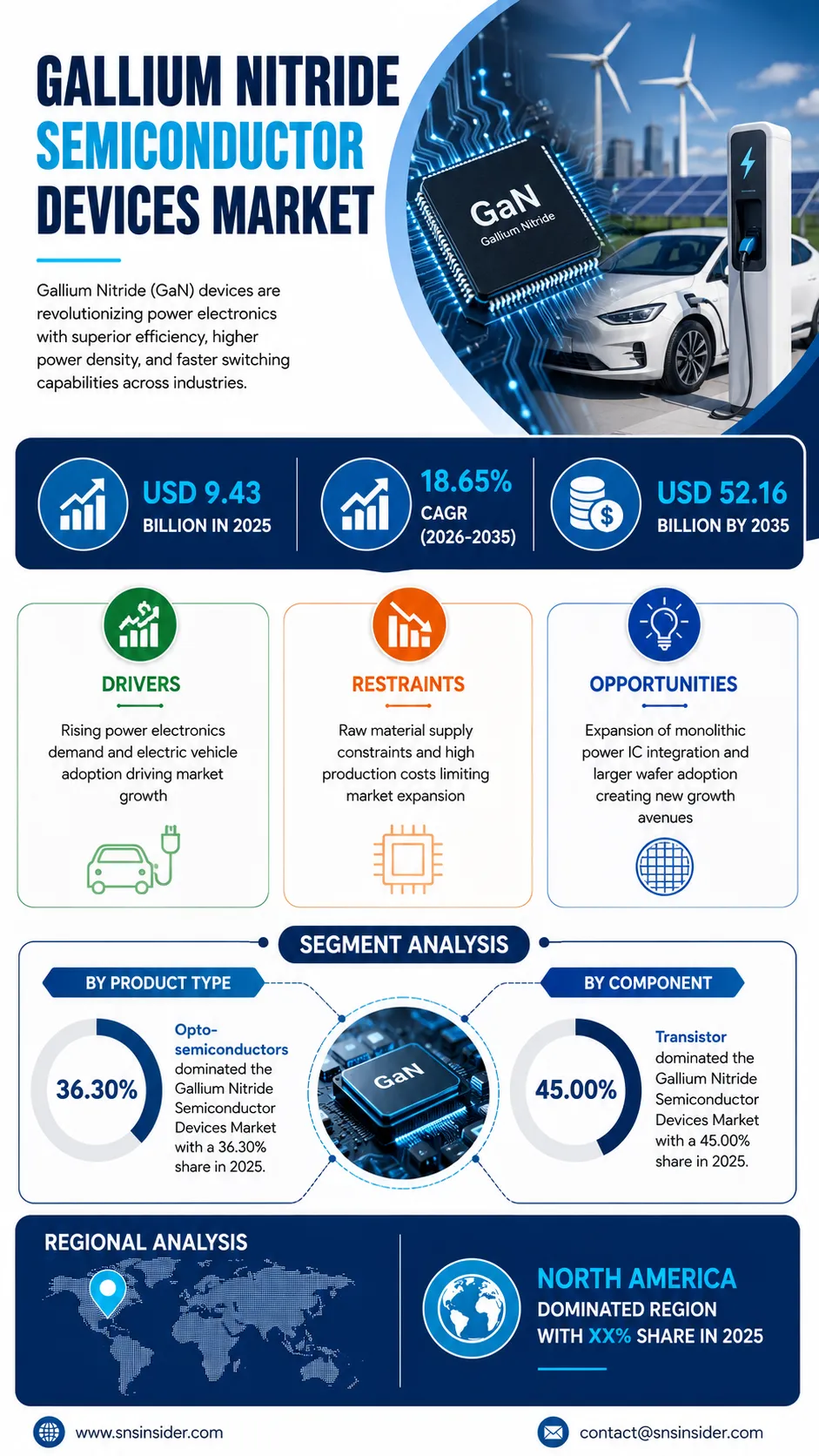
The global Gallium Nitride Semiconductor Devices Market is set for significant expansion as power electronics demand and electric vehicle adoption continue to reshape semiconductor technology worldwide. “According to a recent study by SNS Insider, the global Gallium Nitride Semiconductor Devices Market size valued at USD 9.43 billion in 2025, is anticipated to grow to USD 52.16 billion by 2035, registering a CAGR of 18.65% over the 2026–2035 forecast period.”
There have been tremendous changes within power semiconductor technology over time, due to which many manufacturers who aim at improving efficiency and switching performance can take advantage of this trend. This includes the need for more advanced substrate and packaging technologies that will provide device makers with the ability to deliver higher power density at lower cost. This applies in situations where GaN semiconductors support electric vehicle powertrains, 5G infrastructure, data center power systems, and defense radar applications. Manufacturers are constantly working hard to ensure that their GaN devices perform better than before in order to meet various customer efficiency and cost requirements.
To Get Detailed Insights on the Gallium Nitride Semiconductor Devices Market – Request a Sample Report
Wide-Bandgap Power Efficiency Creates New Demand
The gallium nitride semiconductor devices market has evolved from a niche RF and optoelectronic technology to an increasingly mainstream power semiconductor platform. The growing investment in monolithic power IC integration, larger wafer diameter production, and cost-competitive GaN-on-Si substrate technology across device manufacturers of all sizes has required the development of more efficient and commercially scalable GaN products.
New device architectures can increase switching speed, improve thermal performance, and allow for expansion into increasingly demanding automotive, data center, and defense applications. This gives power electronics designers the possibility to achieve higher efficiency and power density than conventional silicon-based alternatives permit.
GaN device manufacturers, foundries, and end-use equipment makers are increasingly cooperating thanks to the growing interest in developing future solutions for cost-effective, high-performance wide-bandgap semiconductor technology.
Key Market Findings Highlight High-Growth Segments
The opto-semiconductors segment dominated all categories in the gallium nitride semiconductor devices market share with a market revenue share of 36.30% in 2025 due to widespread use in LED display and laser diode applications. The fastest growing category is expected to be GaN radio frequency devices which will grow at a CAGR of 19.23% through 2035, owing to expanding deployment in 5G infrastructure and defense radar systems.
By component, transistors held the largest share of total market revenue at 45.00% in 2025 due to extensive use in switching and high-power conversion applications. Power ICs will see the fastest growth in revenue generation at a CAGR of 29.55%, driven by growing demand for simplified, monolithic power system design.
Based on voltage rating, the 100V-650V class generated a share of 69.72% of market revenue in 2025 thanks to widespread applicability across consumer electronics and data center applications. On the other hand, the above 650V segment will be the segment recording the fastest revenue growth at a CAGR of 39.67%, supported by growing 800V electric vehicle platform adoption.
Distributive substrate technology trends are changing as well. GaN-on-SiC accounted for a 59.74% revenue share in 2025 owing to superior thermal performance for high-power RF applications. But GaN-on-Si will turn out to be the fastest-growing substrate technology through 2035, on the back of improved cost competitiveness with existing silicon fabrication infrastructure.
Switching Speed, Power Density, and Cost Competitiveness Gain Importance
In this regard, power electronics designers have been looking at GaN devices that would deliver higher switching speed and power density while requiring lower production costs to compete with mature silicon alternatives.
Innovation in monolithic power IC integration, larger wafer diameter production, and GaN-on-Si substrate technology has been making it possible for companies to come up with devices that can operate effectively across increasingly cost-sensitive and performance-demanding applications. In addition to that, increasing emphasis on energy efficiency across automotive, data center, and telecommunications infrastructure is also making it possible for manufacturers to find solutions that meet evolving customer requirements. Such trends are likely to become even more prominent in the future.
North America Emerges as the Largest Market Amid Rising Power Electronics and EV Adoption
North America was responsible for holding the largest percentage of market revenue for regions in the year 2025 as a result of extensive use of advanced power electronics, the adoption of electric vehicles, and deployment of 5G network infrastructure. Asia Pacific, on the other hand, is projected to be the fastest growing market due to technological advancements resulting in high demand for radio frequency components in the consumer electronic manufacturing industries within the region.
Leading Companies Drive Innovation and Competition
The environment continues to stay very dynamic since players continue innovating on substrate technology and monolithic integration as well as forming partnerships in order to enhance their position in the industry. Some of the major companies that operate in the global gallium nitride semiconductor devices market are Infineon Technologies, Qorvo, Wolfspeed, GaN Systems, Efficient Power Conversion Corporation, Sumitomo Electric Industries, Texas Instruments, STMicroelectronics, ROHM, and Navitas Semiconductor.
An SNS Insider analyst Sushant Kadam commented, "The accelerating shift toward wide-bandgap power semiconductors is creating unprecedented demand for higher-efficiency, higher-power-density GaN devices across automotive, telecommunications, and data center applications. Manufacturers that successfully combine substrate innovation, monolithic integration, and manufacturing cost reduction will be best positioned to capitalize on emerging opportunities across power, RF, and optoelectronic device categories."
About the Author

Get in touch