
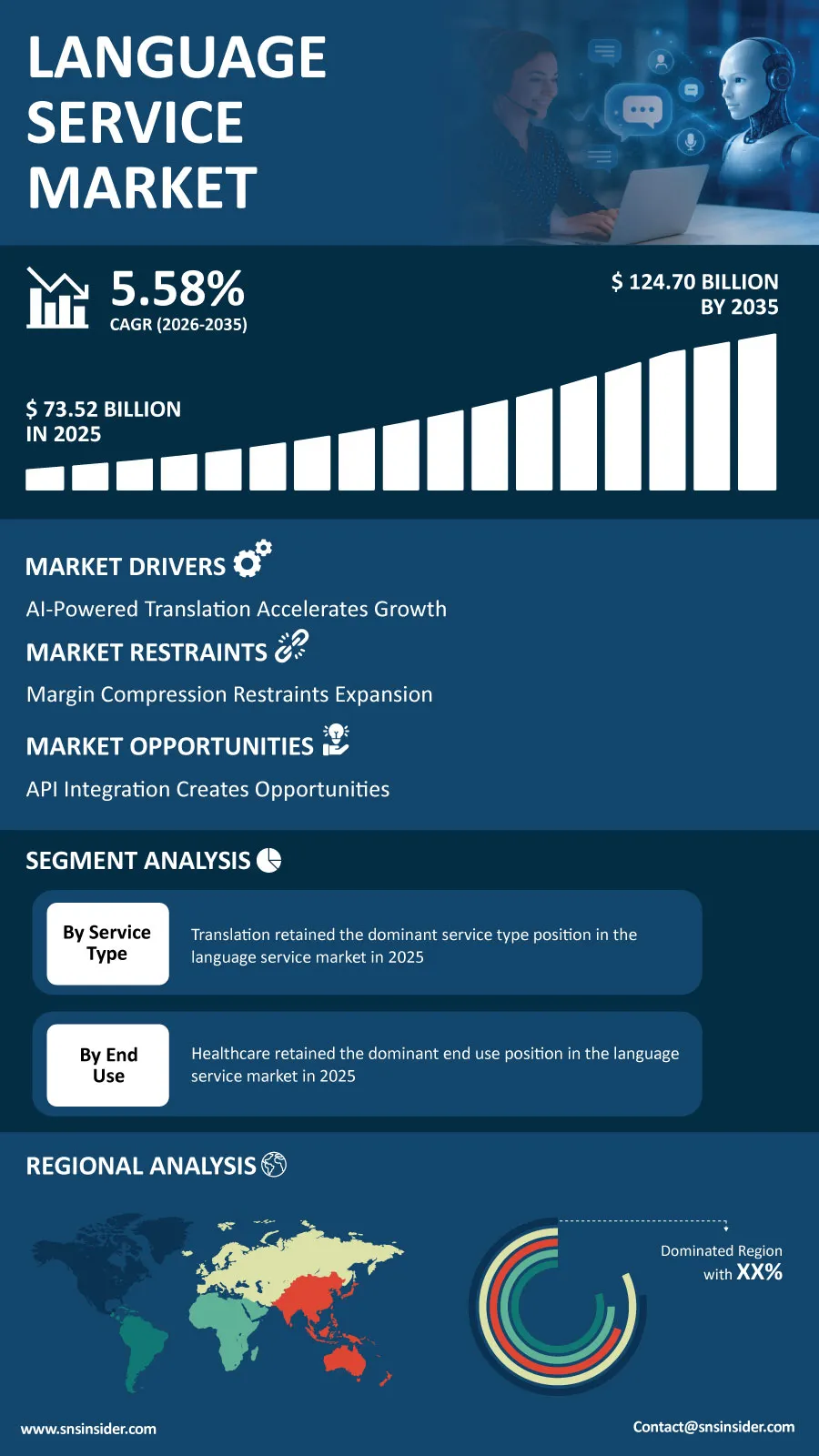
The global Language Service Market is entering a new phase of development as enterprises strengthen multilingual communication strategies to support international expansion, digital customer engagement, and regulatory compliance. “According to a recent study by SNS Insider, the global Language Service Market size valued at USD 73.52 billion in 2025, is anticipated to grow to USD 124.70 billion by 2035, registering a CAGR of 5.58% over the 2026–2035 forecast period.”
In healthcare, technology, financial services, media, and governmental fields, there is increased funding for professional language solutions in order to provide customers with improved experience and accuracy of communication in international markets. There is also a trend to update translation processes by leveraging both human resources and sophisticated AI tools in order to deliver projects quickly without reducing their quality when it comes to very complex materials.
The fast development of various digital products, including e-commerce and software programs that can be used in multiple languages is a reason for constant need for translation, localization, interpretation, transcription, and other types of language services. When expanding geographically, language accessibility becomes an integral part of a company's strategy.
To Get Detailed Insights on the Language Service Market – Request a Sample Report
AI-Driven Localization and Digital Content Expansion Create New Growth Opportunities
Artificial intelligence is transforming the language service landscape by automating repetitive translation tasks while allowing professional linguists to focus on cultural adaptation, quality review, and industry-specific terminology. This combination of technology and human expertise is improving productivity and enabling providers to manage increasingly complex multilingual content requirements.
Growing investments in streaming platforms, enterprise software, online education, and digital marketing are also creating significant opportunities for localization specialists. Companies launching products across multiple countries require websites, applications, product documentation, training materials, and customer support content to be adapted for regional audiences, driving long-term demand for language services.
In addition, governments and regulated industries continue expanding multilingual communication initiatives to improve accessibility for citizens and customers. These developments are encouraging service providers to invest in advanced workflow automation, cloud-based translation platforms, and secure language management solutions.
Key Market Insights Highlight Shifting Demand Patterns
Based on service type, translation accounted for the largest share of global market revenue in 2025 due to its widespread adoption across commercial, healthcare, legal, and public sector applications. Localization is projected to register the fastest growth through 2035 as businesses increasingly adapt digital products and customer experiences for regional markets.
By deployment mode, cloud-based solutions dominated the market in 2025 because of their scalability, collaborative capabilities, and seamless integration with enterprise content platforms. Hybrid deployment is anticipated to witness the fastest expansion during the forecast period as organizations prioritize security, compliance, and flexible infrastructure.
In terms of enterprise size, large enterprises represented the leading revenue share in 2025, supported by extensive international operations and continuous multilingual communication needs. Small and medium-sized enterprises (SMEs) are expected to record the highest growth through 2035 as affordable AI-powered language platforms become more accessible.
Based on end use, healthcare held the dominant market position in 2025 owing to increasing requirements for patient communication, medical documentation, and regulatory translation. The media & entertainment segment is projected to experience the fastest growth as global demand for multilingual video content, subtitling, and dubbing continues to accelerate.
Advanced AI Technologies Continue Transforming Language Services
Language services providers are increasingly incorporating generative AI technology, neural machine translation, process automation, and intelligent quality management systems into their portfolio of services. The aforementioned technologies have been instrumental in ensuring that companies decrease turnaround times without compromising on consistency in large-scale multilingual projects.
There has been innovation in areas such as live translation, automatic subtitle creation, multilingual customer care, and enterprise content management. With improvements in the AI space, language services providers have increased their offering of added-value consulting and linguistic validation.
North America Held the Largest Language Service Market Share in 2025; Asia Pacific Projected to Register the Fastest CAGR Through 2035
North America is the dominant market region throughout 2025 owing to the high demands from tech firms, healthcare providers, media organizations, and government entities that require multilingual communication services. The United States remains the major revenue generator of this region due to continuous investment in localization, interpretation, and enterprise translation solutions.
Asia-Pacific is anticipated to register the highest growth rate during the forecast period owing to the digital transformation and international trade that result in higher demands for localization services. The growing technology adoption in China, India, Japan, and Southeast Asia makes enterprises to invest in language solutions in order to expand their operations in the region.
Europe will continue to hold its significant position in the market because of the multilingual regulation framework, cross-border businesses and high demands from manufacturing, legal, and public administration sectors. At the same time, Latin America and MEA will continue to grow owing to increasing digital services and international business activities in the region.
Industry Participants Expand AI Capabilities and Specialized Language Solutions
Competition within the language service market continues to intensify as leading providers invest in artificial intelligence, cloud-based translation platforms, multimedia localization, and industry-specific language expertise. Companies are also expanding strategic partnerships and technology capabilities to improve workflow automation, enhance translation quality, and address the growing complexity of multilingual enterprise communication.
Key companies operating in the global Language Service Market include TransPerfect, LanguageLine Solutions, RWS Holdings plc, Welocalize, Acolad Group, STAR Group, Hogarth Worldwide, Centific, LanguageWire, CyraCom International, Propio Language Services, AMN Language Services, Argos Multilingual, ZOO Digital, United Language Group, Pixelogic Media, Dubbing Brothers, LOGOS Group, TAKARA, and Equiti.
An SNS Insider analyst Sakshi Kale commented, “Growing demand for multilingual digital experiences, combined with advances in artificial intelligence and localization technologies, is creating long-term opportunities across the global language service industry. Organizations that combine automation with specialized linguistic expertise will be best positioned to meet evolving customer and regulatory expectations.”
About the Author

Get in touch




