
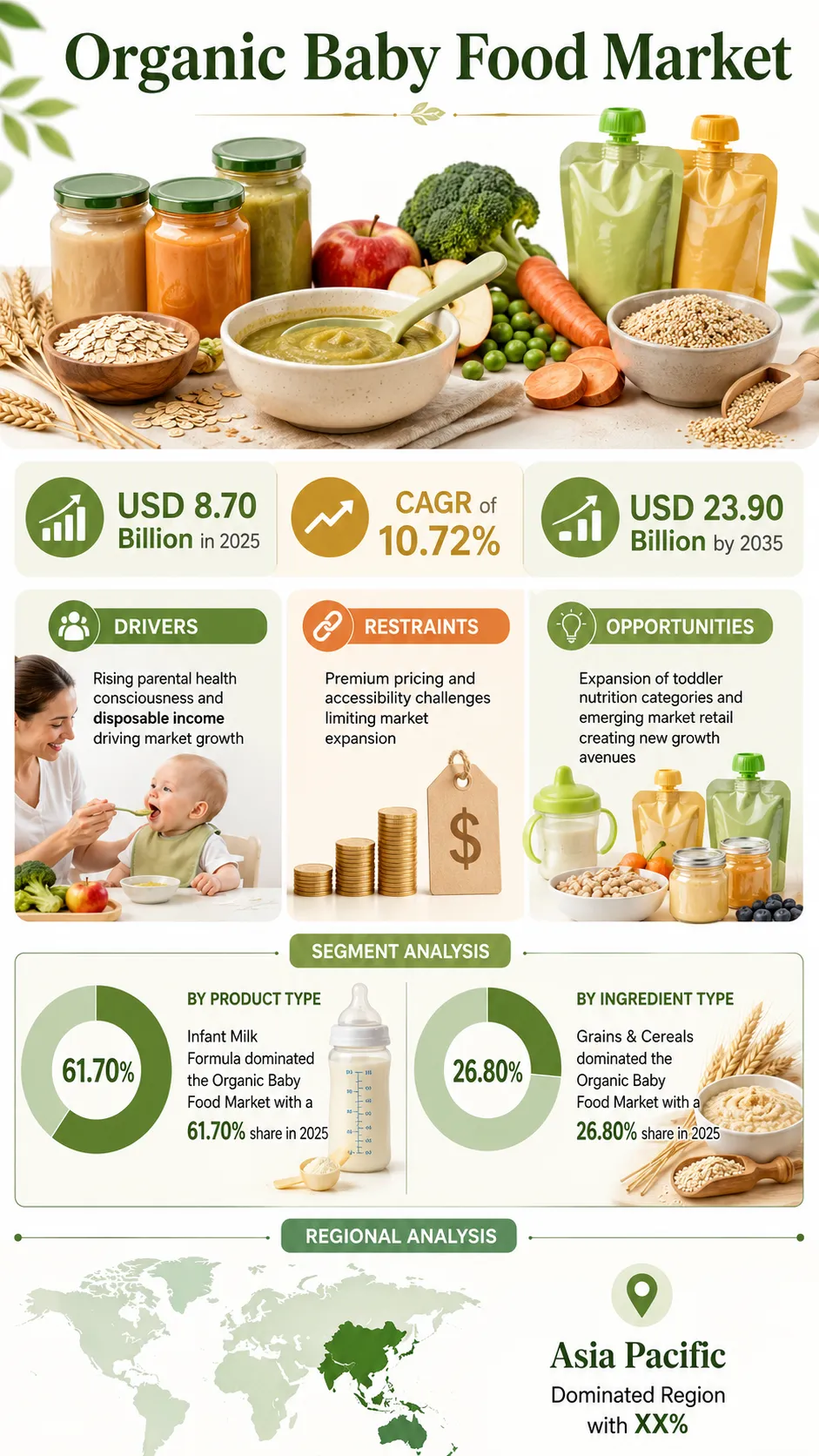
The global Organic Baby Food Market is set for significant expansion as parental health consciousness and disposable income growth continue to reshape infant nutrition worldwide. “According to a recent study by SNS Insider, the global Organic Baby Food Market size valued at USD 8.70 billion in 2025, is anticipated to grow to USD 23.90 billion by 2035, registering a CAGR of 10.72% over the 2026–2035 forecast period.”
There have been notable changes within infant nutrition formulation over time, due to which many brands who aim at improving trust and transparency of their products can take advantage of this trend. This includes the need for more traceable, chemical-free sourcing that will provide parents with the ability to confidently select first-food products during critical developmental windows. This applies in situations where organic baby food supports formula feeding, solid food introduction, and toddler nutrition transition. Brands are constantly working hard to ensure that their organic infant nutrition products perform better than before in order to meet various parental trust and nutritional requirements.
To Get Detailed Insights on the Organic Baby Food Market – Request a Sample Report
Ingredient Transparency Creates New Demand
The organic baby food market has evolved from a niche premium category to an increasingly mainstream parental purchasing priority. The growing investment in traceable sourcing, age-specific formulation, and sustainable packaging across brands of all sizes has required the development of more trustworthy and nutritionally sound organic infant nutrition products.
New formulation and sourcing techniques can increase ingredient transparency, improve nutritional density, and allow for expansion into increasingly diverse toddler snack and beverage categories. This gives parents the possibility to confidently select products supporting their child's nutritional development from formula feeding through solid food transition.
Organic baby food brands, retailers, and e-commerce platforms are increasingly cooperating due to the growing interest in developing future solutions for accessible, trustworthy infant nutrition products.
Key Market Findings Highlight High-Growth Segments
The milk formula category was the leading segment of the organic baby foods market and had a market revenue share of 61.70% in 2025 due to the increasing population of mothers who work and require convenience of nutrition for babies. The prepared or wet baby food category is forecasted to grow with the highest CAGR of 8.90% until 2035 due to consumers' preference for pre-cooked food.
On the basis of the age segment, the 6-12 months age group had the highest revenue share in the total market at 42.85% in 2025 due to its significance during the transition into solid foods. The 12-24 months age group is forecasted to have the highest CAGR in terms of revenue generation at 10.62%.
Based on packaging type, pouches generated a share of 61.10% of market revenue in 2025 thanks to portability and convenience for on-the-go feeding. On the other hand, tetra-pak and cartons will be the segment recording the fastest revenue growth at a CAGR of 14.30%, supported by growing demand for recyclable, sustainable packaging.
Distributive channel trends are changing as well. Supermarkets and hypermarkets accounted for a 56.10% revenue share in 2025 owing to wide product assortment and one-stop shopping convenience. But online retail will turn out to be the fastest-growing distribution channel through 2035, on the back of growing subscription-based delivery penetration.
Transparency, Convenience, and Sustainability Gain Importance
In this regard, parents have been looking at organic baby food products that would deliver more nutritional transparency while requiring less preparation time and offering greater packaging sustainability.
Innovation in traceable sourcing, age-specific formulation, and recyclable packaging has been making it possible for companies to come up with products that appeal to increasingly informed, health-conscious parents. In addition to that, increasing emphasis on globally inspired flavor development is also making it possible for brands to find solutions that support infant palate development during critical feeding transition periods. Such trends are likely to become even more prominent in the future.
Asia Pacific Emerges as the Largest Market Amid Rising Newborn Populations
The Asia Pacific region represented the largest share of regional market revenue in 2025, owing to the rising number of newborns in China and India, combined with growing consumer awareness of chemical-free food benefits. On the other hand, the Middle East & Africa region is expected to be the fastest-growing market during the forecast period through 2035, propelled by rapidly expanding modern retail infrastructure and growing parental awareness of organic infant nutrition benefits.
Leading Companies Drive Innovation and Competition
The environment continues to stay very dynamic since players continue innovating on formulation transparency and packaging sustainability as well as forming partnerships in order to enhance their position in the industry. Some of the major companies that operate in the global organic baby food market are Nestlé, Danone, Abbott Laboratories, Mead Johnson, Hain Celestial Group, Hero Group, HiPP, Perrigo, Bellamy's Australia, and Ella's Kitchen.
An SNS Insider analyst Santosh Bhul commented, "The growing parental demand for traceable, trustworthy infant nutrition is creating sustained opportunities across formula, prepared food, and toddler snack categories. Brands that successfully combine ingredient transparency, age-specific formulation, and sustainable packaging will be best positioned to capitalize on emerging opportunities across developed and emerging organic baby food markets."
About the Author

Get in touch




