Pharmacy Automation Devices Market is entering a new phase of expansion as healthcare institutions are making significant investments in technology designed to manage medications efficiently and safely. Automated dispensers, robots, and other devices used by hospitals and retail pharmacy companies are becoming more common in order to meet the increasing need for medications and to reduce associated risks.
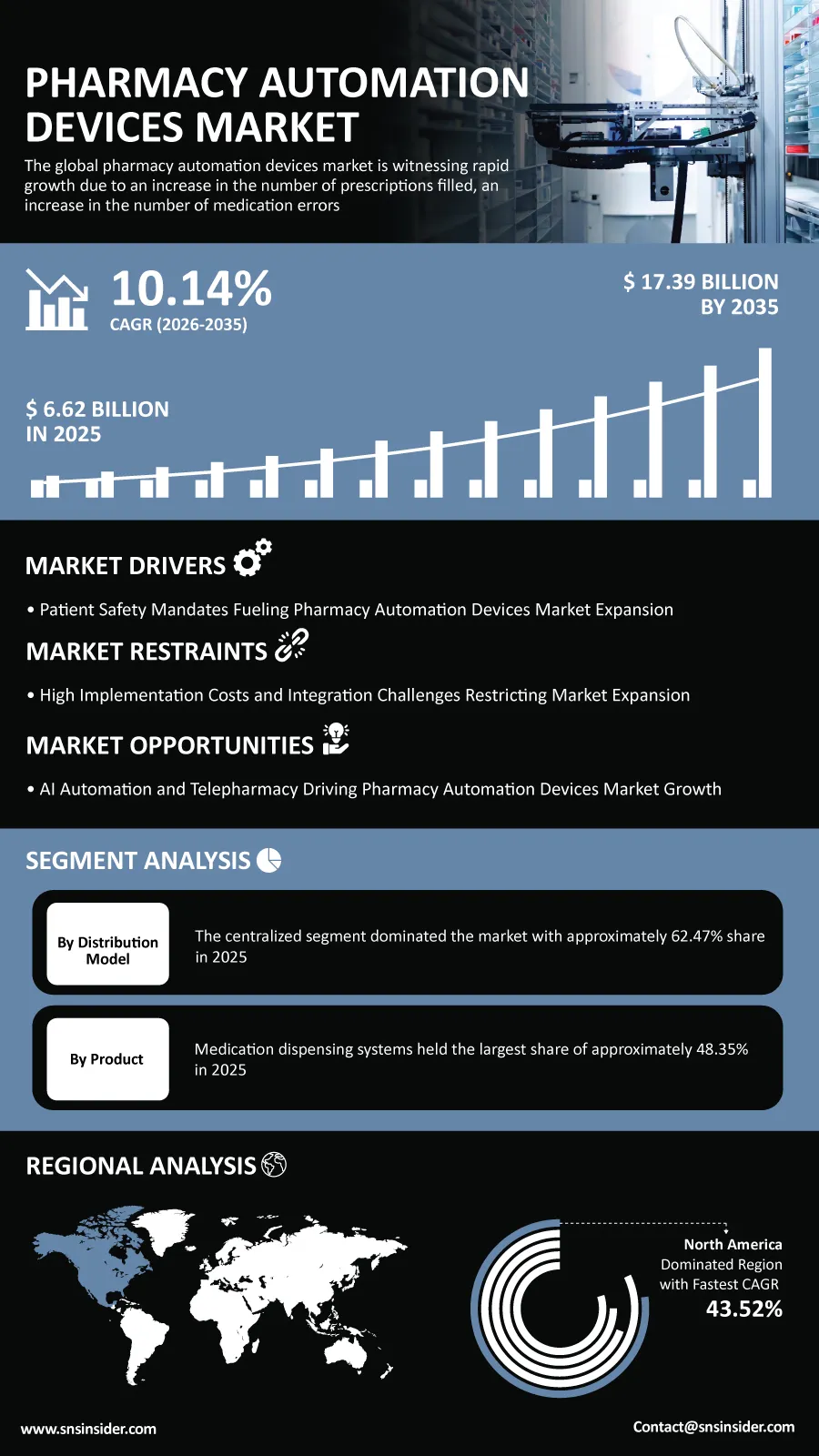
According to a recent study by SNS Insider, the global Pharmacy Automation Devices Market size valued at USD 6.62 billion in 2025, is anticipated to grow to USD 17.39 billion by 2035, registering a CAGR of 10.14% over the 2026–2035 forecast period. The market is benefiting from healthcare digitalization, increasing demand for workflow optimization, and greater emphasis on accurate medication dispensing across clinical settings.
In the context of shortages of manpower and increasing number of patients in the healthcare industry, automation has become crucial for pharmacies. Through the use of robotic devices, cloud technology for inventory management and artificial intelligence for analytics, the processes have been made easier for the medical providers.
To Get Detailed Insights on the Pharmacy Automation Devices Market – Request a Sample Report
Intelligent Pharmacy Technologies Reshape Medication Management
There is an ongoing shift away from conventional dispensing systems towards smarter automation in healthcare organizations as part of the medication delivery process. The use of artificial intelligence, smart pharmacy systems, and inventory prediction systems is making it possible for pharmacists to keep track of their inventories, reduce wastages, and improve dispensing accuracy.
There is increasing use of central pharmacy automation systems that make it easier for pharmacies to prepare, package, label, and deliver medications via highly automated systems. On the other hand, small tabletop dispensing systems are allowing more pharmacies to adopt automation technology at lower costs.
Market Segments Highlight Expanding Automation Opportunities
By distribution model, the centralized segment led the global market in 2025, accounting for approximately 62.47% of total revenue as large healthcare institutions increasingly consolidated pharmacy operations to improve efficiency and reduce operational costs. The decentralized segment is projected to record the fastest expansion, registering a CAGR of 11.58% through 2035 as hospitals continue deploying point-of-care dispensing technologies across emergency departments, nursing units, and outpatient facilities.
Among products, medication dispensing systems captured the largest market share of approximately 48.35% in 2025, reflecting widespread deployment of automated dispensing cabinets and robotic dispensing systems. Packaging and labeling systems are expected to deliver the strongest future growth with a CAGR of 11.23%, supported by increasing demand for automated unit-dose packaging and medication adherence solutions.
Based on end use, inpatient pharmacies represented nearly 45.18% of global revenue in 2025 due to strict medication safety requirements and growing hospital automation initiatives. Meanwhile, pharmacy benefit management organizations and mail-order pharmacies are anticipated to register the highest growth rate at a CAGR of 12.07%, driven by expanding prescription fulfillment volumes and direct-to-patient delivery models.
AI and Connected Systems Strengthen Market Momentum
Innovation in technology keeps on revolutionizing the work process in pharmacies around the world. Artificial intelligence is being used to enhance medication predictions, stock management, and processes. Automation through cloud connections is being used to monitor operations remotely, update software, and integrate with EHR systems.
Cybersecurity practices and data integrity protocols are becoming stronger within the realm of healthcare due to the growing significance of connected pharmacies within the system of healthcare. The mentioned improvements enable businesses to attain more transparency in their operations while meeting healthcare regulations.
Regional Markets Continue Expanding Through Healthcare Modernization
North America remained the top regional market in 2025, generating more than 43.52% of the total revenue worldwide. This is largely attributed to its strong healthcare facilities, robust investments for modernizing pharmacies, and stringent medication safety regulations.
The U.S. Pharmacy Automation Devices Market was estimated to be worth USD 2.68 billion in 2025, and it is projected to grow to USD 7.12 billion by 2035 at a CAGR of 10.23%. Increasing automation, supportive healthcare policies, and persistent shortage of labor will continue to drive automation investments.
The Asia Pacific region is projected to lead in terms of regional growth rate at a CAGR of 12.18% during 2026-2035. Healthcare infrastructure development in China, India, Japan, and South Korea along with government initiatives towards digitization of healthcare and building smart hospitals creates a large number of growth opportunities for automation solutions vendors.
Europe remains strong on account of continuous modernization of hospitals, and Latin America and the Middle East & Africa are gaining momentum owing to increasing investments in pharmacy automation.
Industry Leaders Accelerate Innovation
Competition across the pharmacy automation devices market is intensifying as leading manufacturers introduce next-generation robotic technologies and AI-enabled medication management platforms. In March 2025, Omnicell, Inc. launched its latest Central Pharmacy Robot featuring enhanced AI-driven inventory optimization for high-volume health systems. Becton, Dickinson and Company (BD) introduced an upgraded Pyxis MedStation ES in July 2024, incorporating biometric authentication and advanced controlled-substance monitoring. Meanwhile, Swisslog Healthcare expanded deployment of its PillPick automated unit-dose dispensing system across Southeast Asia during November 2024, supporting hospital automation initiatives in Singapore and Malaysia.
Major companies operating in the global pharmacy automation devices market include Omnicell, Inc., Becton, Dickinson and Company (BD), Swisslog Healthcare, Capsa Healthcare, ScriptPro LLC, ARxIUM, Parata Systems, Innovation Associates, Inc., RxMedic Systems, TCGRx, Yuyama Co., Ltd., TOSHO Inc., Willach Pharmacy Solutions, McKesson Corporation, Baxter International Inc., Pearson Medical Technologies, AutoMed Technologies, and Medline Industries, LP.
An SNS Insider analyst Parry Kardani commented, "Pharmacy automation is becoming a strategic investment for healthcare providers seeking to improve medication accuracy, enhance operational efficiency, and address workforce challenges. Continued advances in robotics, artificial intelligence, and connected pharmacy technologies will play a central role in shaping the next generation of medication management worldwide."
About the Author

Get in touch