
AI in Cardiology Market Report Scope & Overview:
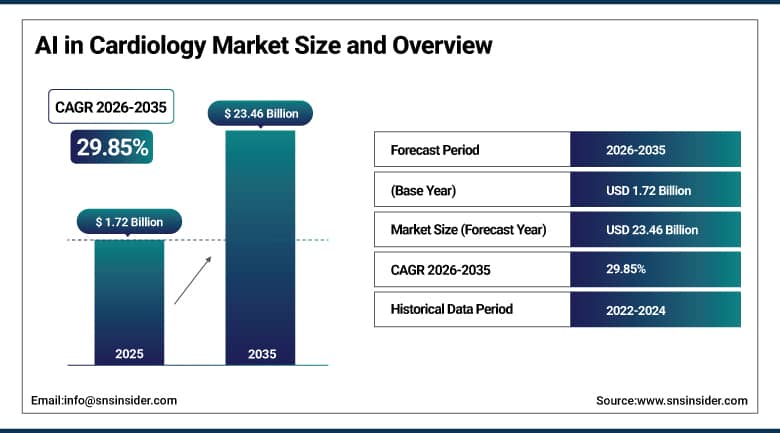
The AI in Cardiology Market was valued at USD 1.72 Billion in 2025 and is expected to reach USD 23.46 Billion by 2035, growing at a CAGR of 29.85% from 2026-2035.
The AI in Cardiology Market covers machine learning software, imaging hardware and services that interpret electrocardiograms, echocardiograms and coronary scans to diagnose, predict and manage cardiovascular disease. Adoption is advancing as hospitals confront a rising burden of heart disease alongside a shortage of cardiologists and sonographers able to read studies at scale. Hardware bundled with imaging equipment books the largest revenue, while standalone software expands faster as cloud deployment and subscription licensing spread across health systems. Diagnosis tools dominate clinical use today, and prediction algorithms that flag silent disease years before symptoms appear are witnessing faster adoption. North America holds the largest share, while Asia Pacific grows fastest.
⮞In February 2025, the American Heart Association reported that cardiovascular disease caused 941,652 deaths in the United States in 2022, up from 931,578 in 2021, or one death roughly every 34 seconds. A death toll of that scale keeps hospitals searching for faster, more scalable ways to screen and triage cardiac patients.
To Get More Information On AI in Cardiology Market - Request Free Sample Report
AI in Cardiology Market Trends:
-
Generative and multimodal models are being trained to combine ECG waveforms, echo video and structured chart data into a single cardiac risk read.
-
Health systems are moving AI ECG and imaging tools from pilot radiology carts onto hospital-wide electronic health record platforms.
-
Payers are introducing dedicated billing codes for AI-assisted cardiac analysis, turning pilots into reimbursed clinical workflows.
-
Point-of-care and handheld devices are pairing with AI to bring specialist-level cardiac screening into primary care and rural clinics.
-
Large device makers are acquiring or partnering with algorithm developers rather than building every model internally.
U.S. AI in Cardiology Market Outlook:
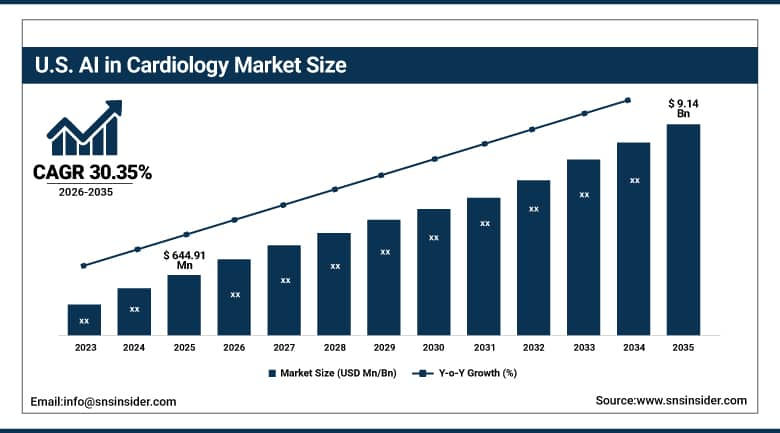
The U.S. AI in Cardiology Market was valued at USD 644.91 Million in 2025 and is expected to reach USD 9.14 Billion by 2035, growing at a CAGR of 30.35% from 2026-2035.
The U.S. AI in Cardiology Market is the largest national market within North America. A dense base of academic medical centers, early Food and Drug Administration clearance activity and a growing list of payer billing codes for AI-assisted cardiac analysis support rapid adoption across large health systems and smaller practices alike. Device makers and software developers headquartered in the country continue to launch new clearances first at home before expanding abroad. A shortage of cardiologists and echocardiography technicians pushes hospitals toward automated tools that extend existing staff capacity. Fragmented reimbursement across private insurers and slow hospital technology budgets temper how quickly every clearance reaches routine bedside use.
⮞In June 2025, the U.S. Centers for Disease Control and Prevention's WONDER database, cited in a Journal of the American Heart Association study, showed that arrhythmia mortality rose 450% between 1970 and 2022. Such a sharp rise in arrhythmia-related deaths strengthens the case for AI tools built specifically to catch irregular heart rhythms earlier.
AI in Cardiology Market Segment Analysis:
-
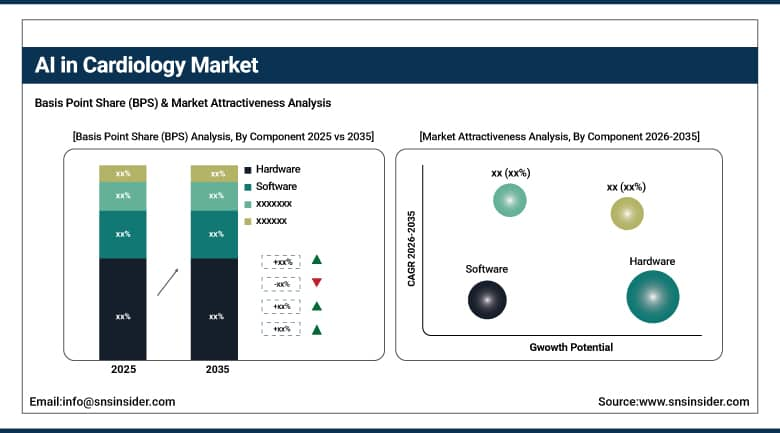
By Component, the Hardware segment dominated the AI in Cardiology Market with approximately 37.40% share in 2025, while the Software segment is the fastest growing with a CAGR of approximately 33.50%.
-
By Application, the Diagnosis segment dominated the AI in Cardiology Market with approximately 39.60% share in 2025, while the Prediction segment is the fastest growing with a CAGR of approximately 34.80%.
-
By Medical Condition, the Ischemic Heart Disease segment dominated the AI in Cardiology Market with approximately 37.75% share in 2025, while the Cardiac Arrhythmias segment is the fastest growing with a CAGR of approximately 33.20%.
By Component, Hardware Dominates the AI in Cardiology Market and Software Grows Fastest
Hardware holds the largest share because AI capability is still most often sold bundled into echocardiography machines, cardiac CT and MRI scanners and electrocardiograph carts rather than purchased as a separate line item. Hospitals replacing aging imaging fleets acquire the embedded algorithm along with the equipment, which keeps hardware revenue ahead of standalone licensing. Large device makers also prefer bundled pricing because it protects equipment margins and ties customers to a single vendor for service contracts. This equipment-led purchasing pattern, reinforced by multi-year capital budgeting cycles common across radiology and cardiology departments, keeps hardware the largest revenue pool through the current forecast window.
Software is growing fastest as cloud-hosted algorithms are increasingly licensed separately from any single imaging machine, letting hospitals run the same model across scanners from different manufacturers and across several hospital sites at once. Subscription and per-study pricing lower the upfront cost of adoption compared with buying new hardware outright, which appeals to smaller cardiology practices and outpatient imaging centers operating on tighter capital budgets. Regulatory clearances for software-only algorithms have multiplied faster than hardware-embedded approvals in recent years, widening the pool of standalone products available to buyers. As electronic health record vendors open their platforms to third-party algorithms, software adoption is expected to outpace hardware sales growth.
⮞In mid-2025, Cardiovascular Business reported that 116 clinical AI algorithms cleared by the U.S. Food and Drug Administration were in use specifically in cardiology, or 184 once cardiac-focused imaging tools listed under radiology are included. That pipeline of cleared software gives hospitals a steadily widening menu of standalone tools to deploy.
By Application, Diagnosis Dominates the AI in Cardiology Market and Prediction Grows Fastest
Diagnosis holds the largest application share because most AI cardiology tools were first built and cleared to read a completed scan or tracing and flag an existing abnormality such as valve disease, reduced ejection fraction or coronary blockage. Radiologists and cardiologists already have workflows built around interpreting a finished study, so diagnostic overlays fit naturally into existing reading rooms without demanding new clinical pathways. Regulatory bodies have also cleared more diagnostic algorithms than any other application type, since demonstrating accuracy against a confirmed diagnosis is more straightforward than proving a future clinical outcome. This track record keeps diagnosis-focused tools the largest application segment by revenue today.
Prediction is the fastest-growing application as hospitals look for tools that flag risk years before a patient becomes symptomatic rather than only confirming disease that has already appeared. Algorithms trained on electrocardiogram waveforms can now surface signs of silent coronary disease, low ejection fraction or incoming atrial fibrillation from a routine tracing that would otherwise look unremarkable to a human reader. Health systems managing value-based contracts have a direct financial incentive to catch disease earlier and avoid costly emergency admissions later. As more predictive algorithms earn regulatory clearance and payer coverage, this application is expected to expand faster than diagnostic tools through 2035.
⮞In an October 2023 study using health records from more than 7 million patients, Mayo Clinic researchers found that three linked ECG-AI models could flag hidden coronary artery disease risk up to three years before it would otherwise be identified. Findings of that kind illustrate why predictive algorithms are drawing faster adoption than tools built only to confirm disease already present.
By Medical Condition, Ischemic Heart Disease Dominates the AI in Cardiology Market and Cardiac Arrhythmias Grows Fastest
Ischemic heart disease holds the largest condition-specific share because coronary artery disease remains the single most common and most studied cardiac condition, giving developers the largest pool of labeled imaging and ECG data to train algorithms against. Coronary CT angiography, invasive angiography and stress testing all generate large volumes of data suited to AI plaque and blockage analysis, and insurers increasingly recognize AI-assisted coronary assessment as a covered service. Established clinical guidelines for managing coronary disease make it easier for hospitals to slot an AI reading step into an existing diagnostic pathway. These factors keep ischemic heart disease the leading application of cardiology AI by patient volume and revenue.
Cardiac arrhythmias are the fastest-growing condition segment as wearable and ambulatory monitors generate far more rhythm data than clinicians can review manually, creating a direct need for automated triage. Atrial fibrillation in particular is increasingly recognized as more common than earlier estimates suggested, and algorithms that scan long continuous ECG recordings for brief, infrequent irregular beats can catch cases a human reviewer might miss during a quick read. Device makers are pairing arrhythmia-detection algorithms directly into implantable monitors and consumer wearables, extending screening outside the hospital. As monitoring duration and patient volume keep rising, arrhythmia-focused algorithms are projected to grow faster than any other condition category.
⮞In a study whose findings were summarized in September 2024, the American College of Cardiology's flagship journal reported that about 10.55 million Americans have diagnosed atrial fibrillation, roughly three times earlier national estimates. A patient population that large gives arrhythmia-focused AI tools a correspondingly large base of undiagnosed and under-monitored cases to find.
Regional Analysis:
|
Region |
Major Country |
Share within Region, 2025 (%) |
|---|---|---|
|
North America |
United States |
83.60% |
|
Europe |
Germany |
27.45% |
|
Asia Pacific |
China |
35.90% |
|
Middle East and Africa |
Saudi Arabia |
29.70% |
|
Latin America |
Brazil |
46.20% |
North America AI in Cardiology Market Insights
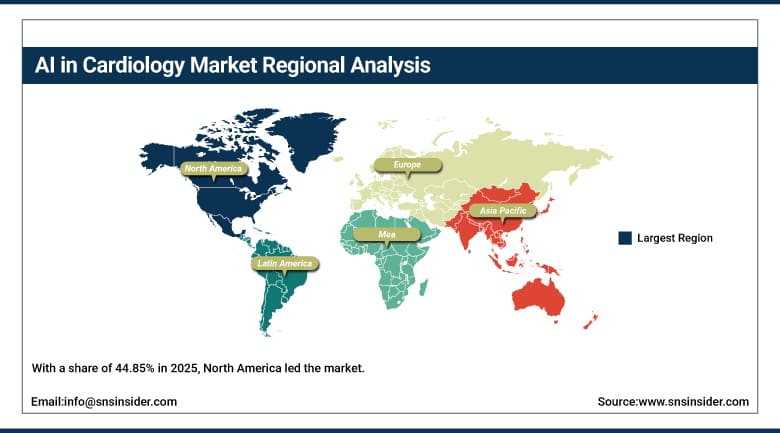
With a share of 44.85% in 2025, North America led the market. The United States anchors regional demand through a dense network of academic medical centers, the largest concentration of AI cardiology developers headquartered in the country and an expanding list of payer billing codes written specifically for AI-assisted cardiac analysis. Canada contributes steady demand through its public hospital imaging programs. Early and frequent regulatory clearance activity in the region gives hospitals a wide menu of cleared tools to choose from well before many products reach other markets. Strong venture funding for cardiology AI startups based in the United States further reinforces the region's lead in product variety.
Health systems across the region are weaving AI reading tools directly into radiology and cardiology picture archiving platforms rather than running them as separate pilot software, which raises day-to-day clinical use. Competition among device makers, electronic health record vendors and independent algorithm developers keeps pricing pressure on hospitals negotiating multi-year contracts. Fragmented coverage decisions among private insurers, together with slow technology budgeting cycles at some community hospitals, limit how quickly every cleared tool reaches routine bedside use. Even so, the region retains its lead because of its large base of cleared products, deep capital markets and the sheer scale of its hospital network.
⮞In 2025, the Centers for Medicare & Medicaid Services set a national payment rate of USD 128.90 under new Category III CPT codes 0764T and 0765T for AI-based computerized ECG analysis used to detect cardiac pathology. A dedicated national payment rate gives hospitals a clearer financial path to routine AI-assisted ECG use.
Get Customized Report as Per Your Business Requirement - Enquiry Now
Asia Pacific AI in Cardiology Market Insights
Asia Pacific is the fastest-growing region, projected to expand at a CAGR of 33.80% from 2026 to 2035. China, Japan, India, South Korea and Australia lead regional activity as a large and aging population drives rising cardiovascular disease volumes across heavily utilized hospital systems. Japan and South Korea in particular have moved quickly to clear and reimburse AI-based coronary and ECG tools, giving regional developers an early home-market base before expanding into the United States and Europe. India's large population of undiagnosed cardiac disease, combined with a shortage of specialist cardiologists outside major cities, creates strong demand for automated screening tools that extend limited specialist capacity.
Local technology companies and hospital groups are partnering with global device makers to adapt cardiology AI tools for regional imaging equipment, languages and clinical guidelines, which speeds local uptake compared with importing products unchanged from Western markets. Price sensitivity among public hospital systems and uneven reimbursement across the region's many health systems can slow conversion from pilot programs to funded routine use. Even so, rising hospital imaging volumes, expanding national health insurance coverage in several countries and a deep pool of local engineering talent give Asia Pacific the strongest growth trajectory of any region through the full forecast period to 2035.
⮞In June 2025, Japan's Pharmaceuticals and Medical Devices Agency approved AutocathFFR, an AI tool from MedHub-AI that estimates fractional flow reserve directly from a standard coronary angiogram in about 37 seconds without a pressure-sensing guidewire. A clearance of that kind in one of the region's most demanding regulatory systems signals growing regional confidence in angiogram-based AI analysis.
Europe AI in Cardiology Market Insights
Europe is the second largest region, with strong activity concentrated in Germany, the United Kingdom, France and the Nordic countries. National health systems with centralized imaging budgets give AI cardiology vendors a smaller number of larger procurement decisions to win compared with the more fragmented private hospital landscape in the United States. European universities and cardiac centers are also prominent contributors of published validation studies, which supports clinician confidence in adopting new algorithms. Strong public investment in digital health infrastructure across several Western European countries is helping hospitals integrate AI reading tools directly into existing radiology and cardiology information systems rather than running them as standalone pilots.
The region's layered regulatory environment, which combines medical device rules with an incoming artificial intelligence law that classifies most clinical algorithms as high risk, adds compliance steps that can slow smaller developers more than larger, well-resourced device makers. Budget constraints across several national health systems limit how quickly every cleared tool converts into funded routine use, even well after formal approval is granted. At the same time, a strong tradition of multi-center clinical research and growing interest from national health technology assessment bodies in AI-assisted cardiac care are expected to keep adoption rising steadily across both large and smaller European markets through 2035.
⮞In 2025, the European Society of Cardiology published an updated cardiovascular disease statistics report covering member countries, part of a series that has tracked rising non-ischemic cardiac conditions such as arrhythmia and heart failure across the region. A continuing publication program of that scale gives European hospitals and regulators a steady supply of data to benchmark AI-assisted cardiac tools against.
MEA & Latin America AI in Cardiology Market Insights
The Middle East and Africa is a smaller but quickly developing region. Gulf countries lead adoption through well-funded flagship hospitals, large government investment in digital health and a rising burden of cardiovascular disease linked to diabetes and obesity, while South Africa adds urban demand through its private hospital networks. Showcase deployments of AI-powered cardiovascular screening at regional health technology events are helping introduce new tools to hospital buyers across the Gulf. Limited specialist cardiology capacity, lower health spending and uneven access to imaging equipment in many African countries slow broader adoption, although new flagship hospital projects and growing public health investment are gradually widening the installed base.
Latin America adds demand through large urban populations and a rising burden of cardiovascular disease across Brazil, Mexico, Argentina and Colombia. Brazil leads regional use, supported by a large private hospital sector and academic cardiology centers that have published decades of national cardiovascular statistics tracking disease trends across the country. Currency volatility, import costs for imaging hardware and uneven public insurance coverage for AI-assisted services can hold back faster uptake outside leading private hospital networks. Even so, rising investment in hospital digitization, growing public awareness of cardiovascular risk and expanding private insurance coverage for advanced diagnostics are expected to support a steady rise in regional demand through 2035 and beyond.
Market Dynamics:
Growth Drivers: Rising cardiovascular disease burden and chronic specialist shortages are accelerating AI adoption
The strongest driver is the sheer and rising scale of cardiovascular disease, which keeps overwhelming the number of cardiologists, sonographers and ECG readers available to interpret studies in a timely manner. Hospitals facing growing patient volumes for echocardiograms, coronary imaging and continuous rhythm monitoring are turning to AI triage to prioritize urgent cases and reduce reading backlogs without having to hire proportionally more specialist staff. Long-running mortality and disease trend data covering decades of cardiac death records give health systems a clear, well-documented basis for believing the underlying caseload will keep growing rather than leveling off, which supports continued capital investment in automated reading tools.
A second driver is the expansion of regulatory clearances and payer billing codes that turn what were once research pilots into reimbursed clinical services. As more AI cardiology algorithms earn clearance across diagnosis, prediction and monitoring, hospitals gain confidence that the technology meets an established safety bar rather than remaining experimental. Growing acceptance of remote and wearable cardiac monitoring, accelerated during recent years of expanded telehealth use, is extending AI-assisted screening beyond hospital walls into primary care and home settings. Together these forces are broadening the addressable population for cardiology AI well beyond the specialist cardiology clinics where the technology first took hold.
⮞In a report released in 2023, the World Heart Federation found that global cardiovascular disease deaths rose about 60% over the preceding three decades, with roughly four in five such deaths occurring in low- and middle-income countries. A disease burden rising at that pace reinforces the case for scalable, automated cardiac screening tools in resource-constrained health systems.
Restraints: Fragmented reimbursement and tightening AI regulation limit faster deployment
A persistent restraint is uneven and fragmented reimbursement across public and private payers, which means a cleared algorithm in one country, or even one insurance plan, may have no clear billing pathway in another. Hospitals weighing a new AI tool must often absorb the cost during a pilot phase before any dedicated payment code exists, which slows purchasing decisions, particularly at smaller or rural facilities operating on thinner margins. Differences in how national health systems evaluate and approve new digital health technologies add further delay, so a tool cleared quickly in one market may wait years for comparable approval and funding elsewhere, fragmenting the pace of global rollout.
Tightening artificial intelligence regulation adds a second restraint, as authorities increasingly classify clinical cardiology algorithms as high risk and require more extensive validation, monitoring and documentation before and after approval. Smaller developers without large regulatory affairs teams can find these added requirements more burdensome relative to their size than larger, well-resourced device makers, which may slow the pace of new entrants even as clinical demand grows. Hospitals must also manage integration with existing electronic health record and imaging systems, which can involve significant information technology resources and vendor coordination. These combined pressures keep deployment timelines longer than the pace of algorithm development alone would suggest.
⮞In an article published in January 2025, legal commentators tracking the European Union's incoming artificial intelligence law noted that most higher-risk medical devices using machine learning face a compliance deadline of August 2027, requiring new documentation layered on top of existing medical device rules. Compliance work of that scope adds cost and lead time for vendors selling AI cardiology tools into the European market.
Opportunities: New reimbursement codes and underserved markets are opening fresh paths to revenue
A major opportunity lies in the steady creation of dedicated billing codes for AI-assisted cardiac services, which convert previously unfunded pilots into recurring, budgeted hospital spending. As more national payers follow early movers in setting formal payment rates for AI-based ECG, imaging and monitoring analysis, vendors gain a clearer path to predictable revenue tied directly to patient volume rather than one-time software sales. This shift also lowers the financial risk hospitals take on when adopting a new tool, since an established payment code signals that regulators and payers view the underlying service as a legitimate, billable part of cardiac care rather than an experimental add-on.
A second opportunity lies in underserved markets across Asia Pacific, the Middle East, Africa and Latin America, where a shortage of specialist cardiologists relative to patient populations creates strong demand for automated tools that extend limited clinical capacity. Partnerships between global device makers and regional distributors, along with national reimbursement approvals in individual Asia Pacific markets, are opening paths into health systems that earlier cardiology AI products largely bypassed. Wearable and handheld devices paired with AI analysis also let screening reach primary care clinics and community health programs well outside specialist hospital departments, widening the addressable patient population by a wide margin.
⮞In 2025, the American Medical Association's Category III CPT code set for AI-based computerized ECG analysis, created to describe detection of cardiac pathology from standard electrocardiograms, became the basis for a new national Medicare payment rate covering that exact service. A newly funded code of this kind gives other payers a template to follow as they build their own cardiology AI reimbursement policies.
Recent Developments:
-
In September 2025, HeartFlow received FDA 510(k) clearance for its Next Gen HeartFlow Plaque Analysis algorithm, reporting 95% agreement with intravascular ultrasound and a 21% improvement in plaque detection over its prior version, based on a nomogram built from about 273,000 patients.
-
In July 2025, Anumana received FDA 510(k) clearance (K250652) for its ECG-AI Low Ejection Fraction 12-lead algorithm. In a trial spanning more than 22,000 adults across 45 clinics and hospitals, use of the algorithm improved clinicians' diagnostic accuracy for low ejection fraction by 31% without increasing echocardiogram use.
-
In July 2026, Eko Health received FDA 510(k) clearance for its CORE 300 digital stethoscope, which launched in the United States that October with an AI feature that analyzes recordings for suspected structural heart murmurs, offered through an Eko+ subscription following a 14-day trial.
-
In May 2025, Cleerly announced its first value-based care partnership, teaming with Cardiac Care Alliance to deploy its AI-based coronary CT angiography analysis across cardiology practices in Texas, with the aim of directing symptomatic patients to noninvasive assessment before cardiac catheterization.
AI in Cardiology Market Key Players:
-
GE HealthCare Technologies Inc.
-
Koninklijke Philips N.V.
-
Siemens Healthineers AG
-
Canon Medical Systems Corporation
-
Medtronic plc
-
Viz.ai, Inc.
-
HeartFlow, Inc.
-
Cleerly, Inc.
-
Ultromics Limited
-
Eko Health, Inc.
-
AliveCor, Inc.
-
Anumana, Inc.
-
iRhythm Technologies, Inc.
-
Boston Scientific Corporation
-
Idoven S.L.
-
Implicity SAS
-
Circle Cardiovascular Imaging Inc.
AI in Cardiology Market Report Scope:
| Report Attributes | Details |
|---|---|
| Market Size in 2025 | USD 1.72 Billion |
| Market Size by 2035 | USD 23.46 Billion |
| CAGR | CAGR of 29.85% From 2026 to 2035 |
| Base Year | 2025 |
| Forecast Period | 2026-2035 |
| Historical Data | 2022-2024 |
| Report Scope & Coverage | Market Size, Segments Analysis, Competitive Landscape, Regional Analysis, DROC & SWOT Analysis, Forecast Outlook |
| Key Segments | • By Component (Software, Hardware, Services) • By Application (Diagnosis, Prediction, Drug Discovery, Others) • By Medical Condition (Ischemic Heart Disease, Cardiac Arrhythmias, Heart Failure, Others) |
| Regional Analysis/Coverage | North America (US, Canada), Europe (Germany, UK, France, Italy, Spain, Russia, Poland, Rest of Europe), Asia Pacific (China, India, Japan, South Korea, Australia, ASEAN Countries, Rest of Asia Pacific), Middle East & Africa (UAE, Saudi Arabia, Qatar, South Africa, Rest of Middle East & Africa), Latin America (Brazil, Argentina, Mexico, Colombia, Rest of Latin America). |
| Company Profiles | GE HealthCare Technologies Inc., Koninklijke Philips N.V., Siemens Healthineers AG, Canon Medical Systems Corporation, Medtronic plc, Viz.ai, Inc., HeartFlow, Inc., Cleerly, Inc., Ultromics Limited, Eko Health, Inc., AliveCor, Inc., Anumana, Inc., iRhythm Technologies, Inc., Boston Scientific Corporation, Idoven S.L., Implicity SAS, Circle Cardiovascular Imaging Inc. |

Frequently Asked Questions
The market includes GE HealthCare, Philips, Siemens Healthineers, Canon Medical Systems, Medtronic, Viz.ai, HeartFlow, Cleerly, Ultromics, Eko Health, AliveCor, Anumana, iRhythm Technologies, Boston Scientific, Idoven, Implicity, and Circle Cardiovascular Imaging, among others.
The main opportunities lie in new reimbursement codes for AI-assisted cardiac services and expansion into underserved markets across Asia Pacific, the Middle East, Africa and Latin America, where specialist cardiologists remain scarce relative to patient populations.
The key growth factor is the combination of a rising cardiovascular disease burden and a persistent shortage of cardiologists and sonographers, which pushes hospitals toward AI tools that triage, diagnose and predict cardiac disease at scale.
By component, the Hardware segment dominated the market with approximately 37.40% share in 2025, as AI capability remains most often bundled into imaging equipment rather than sold as standalone software.
North America dominated the market with approximately 44.85% share in 2025, supported by dense academic medical centers and early regulatory clearance activity. Asia Pacific is the fastest-growing region with a projected CAGR of 33.80% from 2026 to 2035.
