
Vascularized Organoids Market Report Scope & Overview:
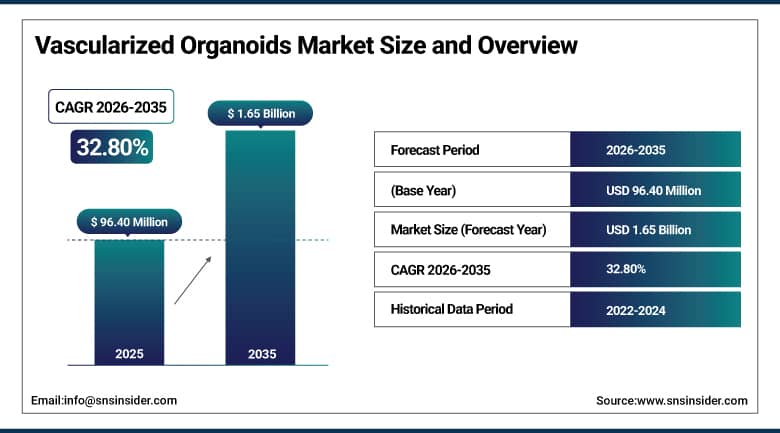
The Vascularized Organoids Market was valued at USD 96.40 Million in 2025 and is expected to reach USD 1.65 Billion by 2035, growing at a CAGR of 32.80% from 2026-2035.
The Vascularized Organoids Market covers stem cell derived tissue models engineered with blood vessel networks, together with the kits, instruments and bioprinting platforms used to build them. Unlike static organoids, these constructs are supplied with nutrients and oxygen through perfused channels, allowing them to grow larger and last longer. Pharmaceutical companies and research organizations are using them to replace animal testing to screen for toxicity and efficacy and academic groups are studying organ development. Kits, reagents and media are the most common product type. Liver constructs are the predominant organoid type in current research programs. By region, North America is leading in revenue, and Asia Pacific region is witnessing the highest growth, as agencies are moving toward human relevant, non-animal research models.
⮞In April 2025, Hans Clevers received the Animal Welfare Research Prize 2025 from Germany's Federal Ministry of Food and Agriculture for developing organoid technology that supports the reduction of animal testing. Recognition at this level signals growing institutional backing for organoid based alternatives to conventional animal models.
To Get More Information On Vascularized Organoids Market - Request Free Sample Report
Vascularized Organoids Market Trends:
-
Microfluidic chip platforms are replacing static culture dishes as laboratories seek organoids that can be perfused like living tissue.
-
Three dimensional bioprinting of vascular networks is shortening the time needed to build viable, nutrient fed tissue constructs.
-
Pharmaceutical sponsors are pairing vascularized organoid data with artificial intelligence models to prioritize drug candidates earlier in development.
-
Regulatory agencies in the United States and Europe are formally recognizing non-animal models within approval and safety assessment pathways.
-
Contract research organizations are building dedicated vascularized tissue service lines to meet pharmaceutical outsourcing demand.
U.S. Vascularized Organoids Market Outlook:
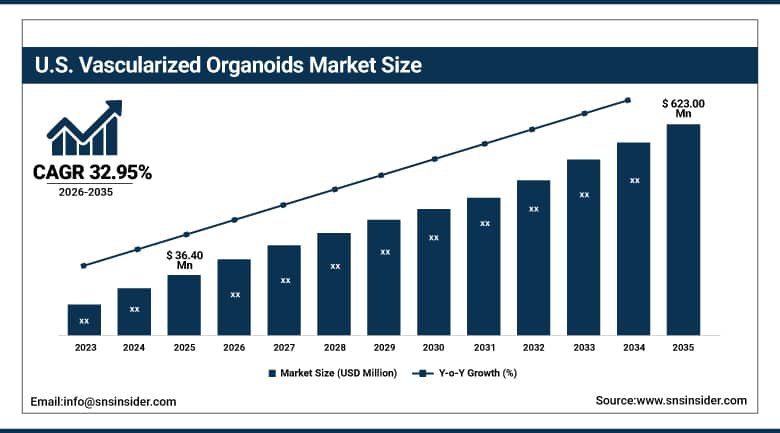
The U.S. Vascularized Organoids Market was valued at USD 36.40 Million in 2025 and is expected to reach USD 623.00 Million by 2035, growing at a CAGR of 32.95% from 2026-2035.
The U.S. Vascularized Organoids Market is the largest national market within North America. Federal agencies including the Food and Drug Administration and the Advanced Research Projects Agency for Health are funding organ chip and bioprinted tissue programs, giving U.S. developers a supportive policy environment to build on. Leading instrument and reagent suppliers, along with specialized organ-on-chip companies, are headquartered in the country, concentrating technical talent near pharmaceutical buyers. Academic medical centers in California, Massachusetts, and Texas run active vascularized tissue research programs that feed into commercial partnerships. Even so, high capital costs for microfabrication equipment and a shortage of trained bioengineers constrain how quickly smaller laboratories can adopt these models.
⮞In January 2026, the Advanced Research Projects Agency for Health awarded up to USD 176.8 million to five university-led teams under its PRINT program to develop vascularized, bioprinted human organs. Federal commitment at this scale accelerates U.S. progress on the blood vessel networks that vascularized organoid models depend on.
Vascularized Organoids Market Segment Analysis:
-
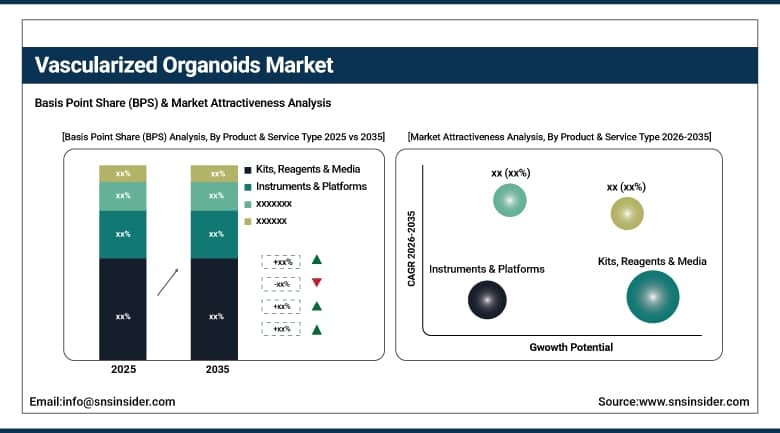
By Product & Service Type, the Kits, Reagents & Media segment dominated the Vascularized Organoids Market with approximately 47.85% share in 2025, while the Instruments & Platforms segment is the fastest growing with a CAGR of approximately 35.60%.
-
By Vascularization Approach, the Static In Vitro Methods segment dominated the Vascularized Organoids Market with approximately 41.30% share in 2025, while the Perfused & Microfluidic Systems segment is the fastest growing with a CAGR of approximately 36.75%.
-
By Organoid Type, the Liver segment dominated the Vascularized Organoids Market with approximately 25.70% share in 2025, while the Cardiac segment is the fastest growing with a CAGR of approximately 35.15%.
-
By Application, the Drug Discovery & Development segment dominated the Vascularized Organoids Market with approximately 35.65% share in 2025, while the Precision & Personalized Medicine segment is the fastest growing with a CAGR of approximately 36.20%.
By Product & Service Type, Kits, Reagents & Media Dominates the Vascularized Organoids Market and Instruments & Platforms Grows Fastest
Kits, reagents and media lead the product mix because every vascularized organoid protocol depends on growth factors, extracellular matrix substitutes and differentiation media that must be repurchased for each experimental run. Laboratories favor ready to use kits over in-house formulation because they shorten setup time and reduce batch to batch variation across research sites. Suppliers bundle endothelial and organ specific cell media into application specific packages, which lowers the technical barrier for groups new to vascularized culture. This recurring consumable demand gives the category a durable revenue base that scales directly with the growing number of active vascularized research programs worldwide.
Instruments and platforms are growing fastest as laboratories move from manual pipetting toward benchtop systems that automate perfusion, imaging and multi-organ linkage. Newer platforms let a single system run single-organ, multi-organ and higher throughput configurations without swapping hardware, which appeals to contract research organizations handling varied client protocols. Falling costs for microfluidic fabrication and growing availability of turnkey systems are drawing in mid-sized laboratories that previously lacked the engineering staff to build custom chips of their own. As pharmaceutical sponsors demand reproducible, instrument-driven workflows over manual culture, platform sales are set to expand faster than any other product category through 2035.
⮞In April 2024, Queen Mary University of London received a GBP 7 million UK Research and Innovation grant to train the next generation of organ-on-chip scientists and bioengineers. Investment in specialized talent supports wider adoption of the instruments this market depends on.
By Vascularization Approach, Static In Vitro Methods Dominates the Vascularized Organoids Market and Perfused & Microfluidic Systems Grows Fastest
Static in vitro methods retain the largest share because they remain the simplest and least expensive way to culture organoids with some endothelial content, requiring no pumps, tubing or specialized fabrication. Most academic laboratories began their organoid work with static protocols and continue to rely on them for exploratory biology where perfusion is not yet essential. Established suppliers provide well validated static culture kits with extensive published literature behind them, which reduces adoption risk for researchers under publication deadlines. These factors keep static culture the default entry point for new laboratories even as more advanced vascularization techniques steadily mature elsewhere.
Perfused and microfluidic systems are growing fastest because they deliver the continuous nutrient and oxygen flow that lets organoids exceed the size and functional limits of static culture. Microfluidic chips connect a self-organizing vascular bed to an embedded organoid, so the two networks link and allow sustained perfusion over weeks rather than days. Pharmaceutical sponsors increasingly specify perfused models for toxicity studies because the added blood flow produces drug response data that correlates more closely with living tissue. As fabrication costs fall and more laboratories gain access to shared microfluidics facilities, this approach is expected to outpace static culture through the forecast period.
⮞In February 2024, researchers at the CEA-Leti and CEA-Irig institutes in Grenoble reported in Nature Communications that organoids perfused through a self-organizing vascular network on a microfluidic chip matured for 30 days with improved physiological function. The result demonstrates that chip-based perfusion can approach outcomes previously reached only through animal xenotransplantation.
By Organoid Type, Liver Dominates the Vascularized Organoids Market and Cardiac Grows Fastest
Liver organoids hold the largest share because drug-induced liver injury remains a leading cause of clinical trial failure and post-market withdrawal, which keeps hepatotoxicity screening a priority for every pharmaceutical sponsor. Liver tissue is also comparatively well characterized, with established stem cell differentiation protocols that research teams can adapt without starting from scratch. Vascularization is particularly valuable for liver constructs because hepatocytes are metabolically demanding and deteriorate quickly without adequate oxygen delivery. Suppliers have accordingly built the deepest catalog of liver specific reagents and fully validated protocols, which reinforces its lead over every other organoid type currently on the market.
Cardiac organoids are growing fastest as cardiovascular safety testing becomes a standard requirement for new drug candidates following several high-profile withdrawals linked to heart toxicity. Vascularized cardiac constructs recreate the oxygen demand of beating heart tissue more faithfully than static alternatives, which pharmaceutical sponsors value for predicting arrhythmia and contractility risk before clinical trials begin. Advances in differentiating multiple cardiac cell types within a single construct are improving how closely these models mimic embryonic heart development. As cardiotoxicity remains a top reason for drug attrition, demand for vascularized cardiac testing is projected to grow faster than any other organoid category.
⮞In June 2025, Stanford Medicine researchers reported in the journal Science that a refined culture recipe produced heart organoids with branching, tube-like blood vessels and adapted the same method to create vascularized liver organoids. The achievement shows that a single vascularization approach can extend across multiple organoid types.
By Application, Drug Discovery & Development Dominates the Vascularized Organoids Market and Precision & Personalized Medicine Grows Fastest
Drug discovery and development leads application demand because pharmaceutical companies need human relevant models earlier in their pipelines to reduce costly late-stage failures tied to species differences in drug response. Vascularized organoids let researchers test absorption, metabolism and toxicity in tissue that behaves much more like a living organ than conventional cell monolayers. Contract research organizations have built screening services around these models to serve sponsors that lack in-house vascularized culture expertise. The steady, recurring nature of preclinical screening work across the global pharmaceutical industry keeps this application well ahead of every other single use case in total overall demand.
Precision and personalized medicine is growing fastest as clinicians and researchers use patient-derived vascularized organoids to predict how an individual will respond to a specific therapy before it is administered. Oncology teams are building organoids from tumor biopsies to test chemotherapy combinations against a patient's own tissue, while cardiac and metabolic disease researchers extend the approach to inherited conditions. Falling sequencing and biopsy-to-organoid turnaround times are making patient specific testing more practical for routine clinical use. As health systems seek ways to avoid ineffective treatment courses, this application is expected to expand faster than standard discovery screening work through the full forecast period.
⮞In July 2025, the European Medicines Agency said it was encouraging developers to use new approach methodologies, including organoids and organ-on-chip systems, as alternatives to animal testing during non-clinical drug development. Regulatory encouragement of this kind strengthens the case for building personalized testing programs around vascularized models.
Regional Analysis:
|
Region |
Major Country |
Share within Region, 2025 (%) |
|---|---|---|
|
North America |
United States |
87.40% |
|
Europe |
Germany |
29.65% |
|
Asia Pacific |
China |
35.80% |
|
Middle East and Africa |
Saudi Arabia |
31.20% |
|
Latin America |
Brazil |
48.75% |
North America Vascularized Organoids Market Insights
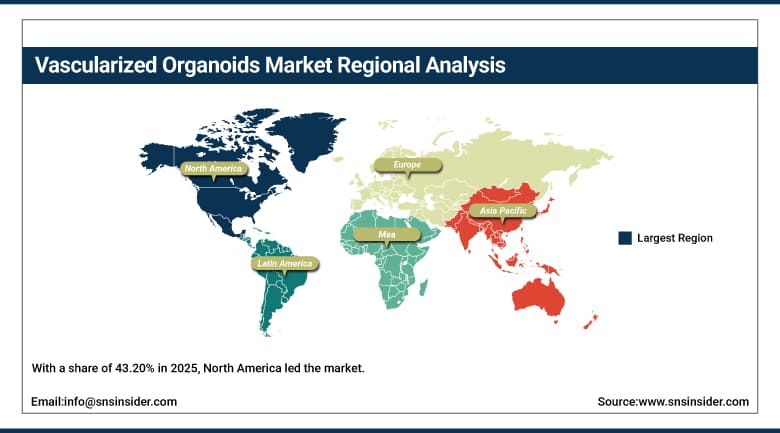
With a share of 43.20% in 2025, North America led the market. The United States anchors regional demand through concentrated federal funding, a dense cluster of organ-on-chip and bioprinting companies, and academic medical centers that routinely translate laboratory vascularization research into commercial partnerships. Canada contributes through university-affiliated regenerative medicine programs and contract manufacturing capacity that supports cross-border research collaborations. Pharmaceutical companies headquartered in the region are early adopters of vascularized screening because it fits directly into existing preclinical toxicology workflows. These structural advantages give North America an entrenched position in vascularized research that newer regional hubs have not yet managed to match.
Government agencies are directly financing next-generation vascularization programs rather than leaving development solely to private investment, which accelerates technology transfer from university laboratories into applied commercial products. Specialized instrument makers and reagent suppliers based in the region continue to expand their vascularized organoid catalogs in response to this funding-driven demand. High costs for microfabrication equipment and a limited pool of bioengineers trained specifically in vascularized tissue work remain constraints even for well-funded laboratories. Nevertheless, the combination of federal backing, supplier density and established pharmaceutical demand keeps North America the largest contributor to global revenue through the full forecast decade.
⮞In October 2023, the Wyss Institute at Harvard University won a Biomedical Advanced Research and Development Authority contract to apply its human organ chip technology to drug discovery for a broad range of health security threats. Sustained federal interest of this kind reinforces the region's lead in translating laboratory vascularization research into funded programs.
Get Customized Report as Per Your Business Requirement - Enquiry Now
Asia Pacific Vascularized Organoids Market Insights
Asia Pacific is the fastest-growing region, projected to expand at a CAGR of 37.60% from 2026 to 2035. China, Japan, South Korea, India and Australia are building organoid research capacity through university laboratories, government biotechnology initiatives and growing contract research capability aimed at serving both local and export-oriented pharmaceutical clients. Rising rates of chronic liver and cardiovascular disease across the region increase local interest in disease modeling applications. Regional suppliers are introducing organoid reagent and toolbox products tailored to local research budgets, lowering the entry cost for laboratories that previously relied entirely on imported kits and instruments from North American and European suppliers.
Conference and collaboration activity is intensifying as researchers across the region present vascularization advances to international audiences and negotiate technology partnerships with established instrument and reagent suppliers. Regulatory frameworks for non-animal testing methods are still developing unevenly across individual countries, which can slow harmonized adoption compared with more established Western markets that already have clearer approval pathways. Even so, expanding government research budgets, a large base of trainable technical talent and rising pharmaceutical outsourcing to the region give Asia Pacific the fastest projected growth rate of any region as local capability steadily catches up with longer established global suppliers.
⮞In October 2025, Tsinghua University researchers presented work at OrganoAsia 2025 in Beijing describing three-dimensional printed vascular organoids and vascularized, immune cell-infiltrated cerebral organoids that improved perfusion recovery in ischemic stroke models. Presentations of this kind at a regional conference attended by institutions from China, Japan and South Korea reflect the pace of local vascularization research.
Europe Vascularized Organoids Market Insights
Europe is the second largest region, with strong research activity in the United Kingdom, Germany, France and the Nordic countries. National funding bodies are financing dedicated vascularization projects alongside broader organ-on-chip networks, and university spin-out companies are translating these programs into commercial microphysiological system products. European reagent and instrument suppliers compete closely with North American counterparts on vascularized culture kits, giving regional laboratories strong local sourcing options. Strict data and research governance frameworks shape how patient-derived organoid material is collected and shared, which adds administrative steps but also builds public trust in the resulting vascularized tissue research across the continent.
Regulatory bodies across the region are moving to formally recognize non-animal testing methods within drug approval pathways, which is expected to steadily increase pharmaceutical sponsor demand for validated vascularized models over the coming decade. Smaller national research budgets compared with the largest American federal programs can limit how quickly some smaller individual countries scale new vascularization infrastructure on their own. Even so, deep academic expertise in organoid biology, a mature biotechnology funding environment and growing regulatory support for alternative testing methods keep Europe a strong, stable secondary hub positioned firmly behind North America throughout the full ten-year forecast period.
⮞In November 2025, the UK Medical Research Council, Wellcome and Innovate UK jointly provided GBP 15.9 million to five university teams, including a University of Hull project named ARTEMIS focused on blood vessel modeling. Dedicated national funding for vascular-focused projects strengthens the region's underlying research base.
MEA & Latin America Vascularized Organoids Market Insights
The Middle East and Africa region is a smaller but gradually developing market for vascularized organoid research. Gulf countries are funding biotechnology infrastructure and attracting international research partnerships, while South African universities are building cell culture and organoid capacity aimed at addressing diseases prevalent in the region. Limited local manufacturing of specialized reagents and instruments means most laboratories depend on imported kits and platforms, which raises costs and extends procurement timelines. Academic and public health institutions are prioritizing capacity building and training over large scale commercial adoption at this stage, positioning the region primarily as an emerging research participant rather than a manufacturing base.
Latin America contributes through university research programs in Brazil, Argentina and Mexico that are increasingly engaging with organoid biology for oncology and infectious disease studies relevant to regional patient populations. Currency volatility and constrained public research budgets slow the pace at which laboratories can acquire imported microfluidic instruments and proprietary reagent kits. Regional scientific societies are nonetheless strengthening collaborative networks with North American and European institutions, which improves access to training and technology transfer. As these partnerships mature and local funding for translational research grows, both regions are expected to expand their share of global vascularized organoid activity gradually through 2035.
⮞In January 2026, a multi-institutional group of researchers writing in Frontiers in Medicine proposed regional organoid biobanking hubs and standardized training programs to build organoid research capacity across low- and middle-income countries. Proposals of this kind point to the capacity-building work still needed before these regions can participate fully in global vascularized organoid research.
Market Dynamics:
Growth Drivers: Regulatory encouragement of non-animal methods and record pharmaceutical R&D spending are expanding adoption
The clearest driver is the regulatory shift toward accepting non-animal testing methods within drug development pathways. As agencies formally recognize organoid and organ-on-chip data within safety assessments, pharmaceutical sponsors gain a direct incentive to validate vascularized models rather than treating them only as purely exploratory tools. This regulatory momentum lowers the perceived risk of building internal vascularized screening capability, which previously required sponsors to justify departing from long established animal protocols without a clear approval pathway. Early movers that adopt validated models now stand to gain lasting efficiency advantages as broader regulatory acceptance continues to expand steadily across major markets.
A second driver is the sheer scale of capital flowing into pharmaceutical research and development, which increases demand for tools that make early-stage screening more predictive and less costly. Sponsors facing pressure to reduce late-stage clinical failures are directing more of this spending toward human relevant preclinical models, including vascularized organoids that better mimic tissue level drug response than conventional cell culture. Growing availability of venture capital for specialized organ-on-chip and bioprinting companies is also expanding the supply of commercial platforms available to pharmaceutical buyers worldwide. Together these financial and regulatory forces reinforce each other to sustain long-term adoption momentum.
⮞In January 2025, RAND Corporation researchers reported in JAMA Network Open that the median direct cost of developing an approved drug, adjusted for failures and forgone investment returns, reached USD 708 million. Development costs at this level give sponsors a strong financial incentive to adopt predictive preclinical models earlier in their pipelines.
Restraints: Manual workflows, limited standardization and high equipment costs slow broader adoption
A persistent restraint is the continued reliance on manual laboratory techniques for much of organoid production, including feeding, passaging and growth assessment that depend heavily on individual researcher judgment. This manual dependence produces real variation between laboratories and even between batches within the same laboratory, which complicates efforts to compare results across different research sites or regulatory submissions. Animal-derived extracellular matrix materials used in many protocols add further batch-to-batch variability and are costly to source consistently. These factors slow the broader transition from research-grade protocols to the reproducible, validated workflows that regulators and large pharmaceutical sponsors ultimately require before adoption.
A second restraint is the high capital cost of microfabrication equipment and vascularization-capable instruments, which puts advanced platforms out of reach for many smaller academic and contract research laboratories. Few standardized assays or universally accepted validation protocols currently exist for vascularized models, leaving individual laboratories to develop and defend their own methods when engaging with regulators or pharmaceutical partners. Shortages of personnel trained specifically in microfluidic engineering and vascularized tissue culture further limit how quickly smaller organizations can scale their technical capabilities. These combined cost and standardization barriers are expected to moderate near-term adoption outside the best-funded research institutions for now.
⮞In February 2026, Molecular Devices told Technology Networks that organoid production workflows still rely on manual techniques that have changed little since the 1990s, creating variability between researchers and laboratories. Persistent manual dependence of this kind illustrates why standardization remains an unresolved barrier for wider market adoption.
Opportunities: Government biodefense funding, bioprinting advances and personalized screening are opening new revenue paths
Government biodefense and public health funding represents a significant opportunity, as agencies look beyond conventional drug discovery toward using vascularized organ models to study chemical, radiological and infectious threats that cannot ethically or practically be tested on humans. These programs provide multi-year funding commitments that give specialized vascularized tissue developers a stable revenue base beyond typical pharmaceutical sales cycles. Suppliers that can demonstrate reliable performance under government contracts also build credibility that supports later commercial sales to pharmaceutical and academic customers. This funding path is expected to expand further as health security priorities broaden well beyond traditional biodefense countermeasure development programs.
Advances in bioprinting that embed functional vasculature directly into tissue constructs open a further opportunity, potentially allowing organoids to grow well beyond the size limits that have historically constrained static culture. Companies successfully scaling these techniques could eventually supply tissue constructs suitable for regenerative medicine applications well beyond today's drug screening use case. Growing clinical interest in patient-derived personalized screening, particularly in oncology, also creates an opportunity for suppliers to move from research-only sales toward diagnostic-adjacent services with recurring revenue streams. Companies that combine reliable vascularization with scalable production stand to capture disproportionate value as these adjacent markets continue to develop.
⮞In March 2026, the National Institutes of Health announced more than USD 150 million for its Complement-ARIE program, funding technology centers, a data hub, and a validation network to advance human-based research methods. Funding commitments at this scale continue to open paths for vascularized organoid developers beyond conventional pharmaceutical screening budgets.
Recent Developments:
-
In October 2025, CN Bio launched PhysioMimix Core, an all-in-one organ-on-a-chip platform supporting single-organ, multi-organ and higher throughput configurations on one benchtop system. The system uses tubeless, recirculating microfluidics and can run up to 288 samples at once for extended repeat-dose studies.
-
In September 2025, Cellbricks Therapeutics reported that mice implanted with its 3D-bioprinted adipose tissue constructs, built using Rousselot's medical-grade gelatin-based bioink, showed rapid tissue integration and vascularization with no signs of fibrosis or rejection after seven weeks. The result demonstrates functional vascularization in an implanted bioprinted tissue construct rather than only in a laboratory dish.
-
In May 2025, Organoid Sciences Ltd. completed South Korea's first organoid-sector listing under the KOSDAQ technology special exemption, continuing to offer its ADIO drug-evaluation platform and organoid culture services to pharmaceutical and research customers. The listing reflects a more established commercial footing than the seed-stage ventures still common among organoid platform developers.
-
In August 2026, Vivodyne opened a human tissue data center near San Francisco where robotic HIVE systems test drug candidates on thousands of lab-grown human tissues to generate training data for its drug-discovery artificial intelligence models. Each HIVE unit is designed to test batches of up to 10,000 tissues.
Vascularized Organoids Market Key Players:
-
Thermo Fisher Scientific Inc.
-
Corning Incorporated
-
STEMCELL Technologies Inc.
-
Emulate, Inc.
-
CN Bio Innovations Ltd.
-
MIMETAS B.V.
-
TissUse GmbH
-
AIM Biotech Pte Ltd
-
Vivodyne, Inc.
Vascularized Organoids Market Report Scope:
| Report Attributes | Details |
|---|---|
| Market Size in 2025 | USD 96.40 Million |
| Market Size by 2035 | USD 1.65 Billion |
| CAGR | CAGR of 32.80% From 2026 to 2035 |
| Base Year | 2025 |
| Forecast Period | 2026-2035 |
| Historical Data | 2022-2024 |
| Report Scope & Coverage | Market Size, Segments Analysis, Competitive Landscape, Regional Analysis, DROC & SWOT Analysis, Forecast Outlook |
| Key Segments | • By Product & Service Type (Kits, Reagents & Media, Instruments & Platforms, Services) • By Vascularization Approach (Static In Vitro Methods, Perfused & Microfluidic Systems, Bioprinted Constructs) • By Organoid Type (Liver, Cardiac, Brain, Kidney, Other Organoids) • By Application (Drug Discovery & Development, Disease Modeling, Toxicity & Safety Assessment, Precision & Personalized Medicine) |
| Regional Analysis/Coverage | North America (US, Canada), Europe (Germany, UK, France, Italy, Spain, Russia, Poland, Rest of Europe), Asia Pacific (China, India, Japan, South Korea, Australia, ASEAN Countries, Rest of Asia Pacific), Middle East & Africa (UAE, Saudi Arabia, Qatar, South Africa, Rest of Middle East & Africa), Latin America (Brazil, Argentina, Mexico, Colombia, Rest of Latin America). |
| Company Profiles | Thermo Fisher Scientific Inc., Corning Incorporated, STEMCELL Technologies Inc., Emulate, Inc., CN Bio Innovations Ltd., MIMETAS B.V., TissUse GmbH, AIM Biotech Pte Ltd, Vivodyne, Inc. |

Frequently Asked Questions
The market includes Thermo Fisher Scientific, Corning, STEMCELL Technologies, Emulate, CN Bio Innovations, MIMETAS, TissUse, AIM Biotech and Vivodyne, among others. These companies compete on vascularization performance, platform throughput and reagent reliability.
The main opportunities lie in government biodefense funding, advances in bioprinted vasculature, and patient-derived personalized screening services. Expanding regulatory acceptance of non-animal methods adds further potential.
The key growth factor is the combination of regulatory encouragement for non-animal testing methods and rising pharmaceutical research spending, which pushes sponsors toward vascularized models that better predict human drug response.
By product and service type, the Kits, Reagents & Media segment dominated the market with approximately 47.85% share in 2025, supported by recurring consumable demand across every active research program.
North America dominated the market with approximately 43.20% share in 2025, supported by concentrated federal funding and supplier density. Asia Pacific is the fastest-growing region with a projected CAGR of 37.60% from 2026 to 2035.
