
Architectural Window Films Market Report Scope & Overview:
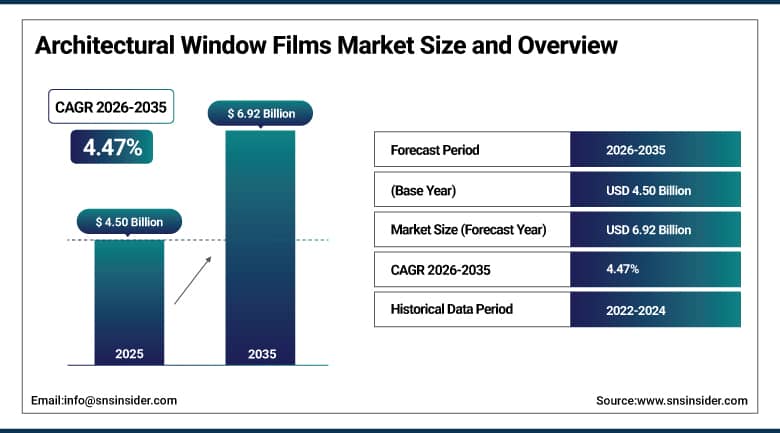
The architectural window films market was valued at USD 4.50 billion in 2025 and is expected to reach USD 6.92 billion by 2035, growing at a CAGR of 4.47% from 2026–2035.
Architectural window films Market has been experiencing consistent growth around the world due to growing demand for energy efficient and sustainable building options at competitive prices in residential, commercial, government, healthcare, and educational segments. Adoption of window film technology such as sun control films, safety & security films, decorative films, and privacy films is gaining traction due to their features of UV resistance, glare prevention, thermal insulation, and improved user experience.
In 2025, the NDFOS company focused on enhancing its nano-ceramic and solar control film technologies, improving heat rejection, UV protection, and optical clarity for modern energy-efficient building applications. In 2026, KDX Window Films focused on improving manufacturing efficiency and introducing advanced high-durability film technologies, supporting increasing demand for cost-effective and performance-oriented window film solutions in emerging construction markets.
Market Size and Forecast
-
Market Size 2026E: USD 4.67 Billion
-
Market Size 2035: USD 6.92 Billion
-
CAGR (2026 - 2035): 4.47%
-
Fastest Growing Region: North America
-
Largest Region: Asia Pacific
To Get More Information On Architectural Window Films Market - Request Free Sample Report
Architectural Window Films Market Trends
-
Increased need for films that will minimize heat and help enhance sustainability in buildings. There is strict compliance from the government with regards to building codes, which is enhancing adoption.
-
Surge in the use of shatter resistant films for commercial and government buildings. Increased concern about the well-being of employees is fueling demand.
-
Increasing application by interior designers and homeowners of films for aesthetic purposes. Films for privacy are increasingly being embraced in health care settings and home environments.
-
The new films have high quality in terms of UV protection and glare reduction. Demand for this advanced product line is growing rapidly in high-end applications.
-
Infrastructure developments in cities will increase the need for retrofits. Window films are an affordable way of upgrading windows without changing the glass.
The US Architectural Window Films Market Size Outlook
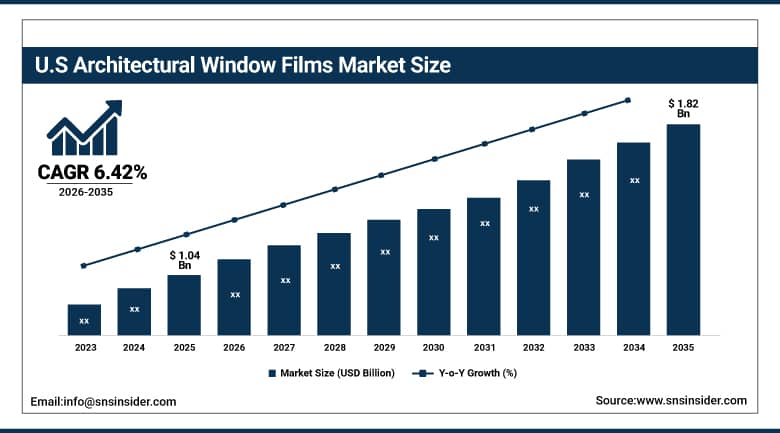
The U.S. architectural window films market was valued at USD 1.04 billion in 2025 and is expected to reach around USD 1.82 billion by 2035, growing at a CAGR of 6.42% from 2026–2035.
The US architectural window films industry is regarded as one of the most technologically evolved industries around the world, owing to the significant investments made in building up the infrastructure, commercial construction activities, and development of smart cities in the country. Rising demand for architectural window films in the country is being influenced by the need for improved energy efficiency, UV protection, reduced glare, and enhanced safety among different end-use sectors including commercial buildings, residential constructions, government establishments, hospitals, and education institutions.
U.S. government assistance with energy efficiency regulations, green buildings, and sustainable infrastructure programs plays an important role in the increased use of architectural window films within residences and commercial properties. Energy-efficient buildings, lower consumption of HVAC energy, and LEED certified buildings have been driving factors for the demand of solar and UV protection films.
Architectural Window Films Market Segment Analysis
-
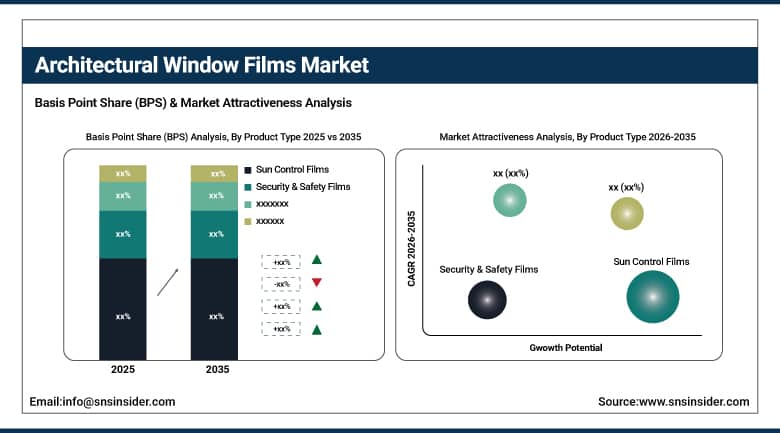
By Product Type, sun control films dominated the architectural window films market with 61.28% share in 2025; security & safety films fastest growing CAGR.
-
By Material Type, polyester films dominated the architectural window films market with 40.23% share in 2025; ceramic films fastest growing CAGR.
-
By Application, commercial buildings dominated the architectural window films market with 59.13% share in 2025; it has also fastest growing CAGR.
-
By Absorber Type, organic absorbers dominated the architectural window films market with 29.17% share in 2025; nanoceramic coatings fastest growing CAGR.
By Product Type, sun control films dominated the architectural window films market, security & safety films are projected to witness the fastest-growing segment
Architectural Window Films were the dominant product type in 2025 due to growing demand for energy-efficient buildings that can help reduce solar heat gains, glare, and air-conditioning expenses. The increasing rate of urbanization along with expanding commercial infrastructure and awareness about UV protection and comfort of occupants have played an important role in the adoption of sun control films.
Security & Safety Films are projected to account for the highest growth rate over the forecast period owing to increasing need for safety of buildings, safety from glass breakage, protection against natural calamities, and forced entrance. Investment in the infrastructure sector by governments is also increasing.
By Material Type, polyester films dominated the architectural window films market, Ceramic Films are expected to register the fastest.
The Polyester Films emerged as the dominant product type in the architectural window films market throughout 2025 because of their high strength, optical clarity, flexibility, economy, and excellent UV resistance properties. Polyester films find extensive applications in residential as well as commercial buildings to regulate the intake of solar energy and to improve the aesthetics and privacy of interiors.
Ceramic Films segment is anticipated to witness maximum CAGR over the forecast period 2026-2033 due to the increasing preference for high-quality window films with excellent thermal rejection abilities, non-metallic properties, friendly signals, and enhanced longevity. The increasing use of nanotechnology-based coatings and the rising inclination towards eco-friendly building materials drive the growth of the ceramic films category.
By Application, commercial buildings dominated the architectural window films market, and are also projected to register the fastest segment.
Architectural window films for commercial buildings emerged as the largest end user segment for the Architectural Window Films market in 2025 due to growing use of energy-saving construction materials in office spaces, shopping centers, hotels, hospitals, and schools. The growing emphasis on energy savings, improving the comfort level of occupants, eliminating glare.
The Commercial Buildings market is also predicted to register the highest CAGR among other end user segments during the forecast period, which can be attributed to the growing trend of smart buildings and investment in sustainable urbanization projects.
By Absorber Type, organic absorbers dominated the architectural window films market, while Nanoceramic Coatings are anticipated to witness the fastest-growing segment.
Organic Absorbers accounted for the highest architectural window films market share in 2025 because of their economical nature, high UV absorber properties, and broad application scope in window films used for domestic and commercial windows. Organic Absorbers find broad applications in increasing indoor thermal comfort, reducing the fading of interior furnishing, and increasing energy efficiency.
Nanoceramic Coatings segment is expected to hold the highest CAGR in the forecast period on account of rising demand for superior performing window films with high heat rejection from infrared, optical clarity, durability, and non-conductive properties. Technological developments in nanotechnology along with increased use of advanced sustainable building materials have led to higher demands for nanoceramic-coated architectural window films.
Regional Analysis:
|
Region |
Major Country |
Share within Region, 2025(%) |
|---|---|---|
|
North America |
United States |
81.04% |
|
Europe |
Germany |
27.23% |
|
Asia Pacific |
China |
45.89% |
|
Middle East & Africa |
UAE |
15.47% |
|
Latin America |
Brazil |
34.20% |
North America Architectural Window Films Market Insights
The North America market for architectural window films continues to experience fastest growth on account with CAGR of 5.52%, the rising need for energy-efficient buildings, increasing retrofitting needs of old commercial facilities, and the strict laws for energy conservation in the United States and Canada. The increased use of green construction through LEED certifications and smart building systems is expected to boost demand for solar control films and UV protection films. Awareness about improved indoor comfort, decreased glare, and protection of furniture from UV radiation is further boosting the market.
In 2025, 3M Company strengthened its Architectural Window Films portfolio by advancing next-generation solar control and spectrally selective film technologies designed to improve building energy efficiency and occupant comfort. The company focused on enhancing heat rejection performance, glare reduction, and UV protection for large-scale commercial and institutional infrastructure.
Asia Pacific Architectural Window Films Market Insights
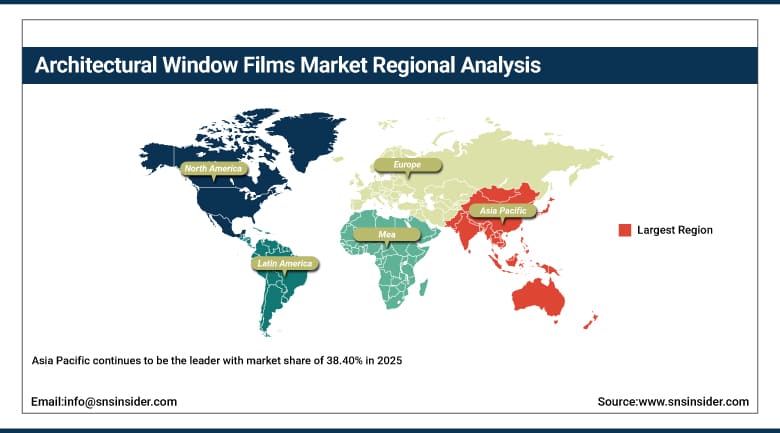
Asia Pacific continues to be the leader with market share of 38.40% in 2025 in industry as a result of fast urbanization, construction of more commercial structures, and investment in smart city infrastructures in countries like China, India, Japan, and South Korea. The increasing need for energy-saving buildings together with awareness about UV protection, reduction of glare, and better indoor thermal comfort are some of the factors that are driving the market growth. Other factors that are contributing to increased market growth include government efforts to promote green construction. The expansion of residential and commercial real estate sectors is also boosting the market growth in this region.
Get Customized Report as Per Your Business Requirement - Enquiry Now
Europe Architectural Window Films Market Insights
The Europe Architectural window films market has been showing significant growth owing to the growing preference for sustainable construction, strict energy efficiency policies, and increased adoption of green buildings in Germany, France, and United Kingdom. Growing investments in commercial building renovation and infrastructural development have led to growing demand for solar control, decorative and safety window films. Rising awareness concerning energy savings indoors, reduction in carbon emissions, and improved thermal comfort for occupants have boosted the growth of this market. Furthermore, stringent standards for energy performance of buildings have fueled the adoption of advanced architectural window films.
Saint-Gobain launched new offerings in the sustainable building materials segment in 2025 by introducing high-performance solar control and low emissivity window film technology products for commercial and residential buildings.
Middle East & Africa and Latin America Architectural Window Films Market Insights
Middle East & Africa's architectural window films market will continue to rise owing to the rise in investments into commercial infrastructural developments, smart cities, and energy-efficient building projects in UAE, Saudi Arabia, and South Africa. Higher ambient temperatures and intense solar radiation levels have led to high growth potential for solar protection and heat rejection window films in residential and commercial constructions. In Latin America, the growth of the Architectural Window Films market is steady owing to urbanization and increased investments in commercial real estate projects in Brazil, Mexico, and Argentina.
Market Dynamics:
Growth Drivers: Rising emphasis on energy-efficient buildings and indoor comfort is accelerating adoption of architectural window film technologies
Rising interest in high-end building products that offer increased energy efficiency, less solar heat gain, and greater occupant comfort levels has resulted in heightened popularity of architectural window films in both residential and commercial infrastructure. Building contractors are becoming more inclined towards adopting architectural window film products to achieve reduced energy consumption from HVAC systems, glare prevention, and ultraviolet radiation protection. Rising awareness regarding sustainable building techniques and the pursuit of green building certification standards has increased the need for environmentally friendly and long-lasting window films.
Restraints: Availability of low-cost conventional shading and glass solutions is limiting adoption of premium architectural window films globally
The presence of conventional solutions in the form of curtains, blinds, tinting of glass, and economical coatings poses as one of the major barriers for the development of the Architectural Window Films market. The majority of households and small businesses have been observed to opt for cheaper conventional options owing to their easier availability and low installation costs. The understanding about the energy-saving potential and UV protection capabilities offered by the newer generation of window films has been lacking in many developing nations, which in turn hinders the market growth.
Opportunities: Rising adoption of smart and energy-efficient window film technologies is creating new opportunities in modern sustainable building infrastructure
Developments in nanoceramic coating technology, spectrally selective film technology, and smart window film technology have generated several opportunities in the Architectural Window Films Market. Advanced window films are being used more often by building developers and infrastructure providers to gain greater heat rejection capability, UV protection, glare reduction capability, and increased energy efficiency. The use of smart building solutions, along with automated lighting control solutions, increases operating efficiency and enhances the level of comfort for occupants.
Recent Developments
-
2025: 3M Company expanded its Architectural Window Films portfolio by introducing advanced solar control, spectrally selective, and nano-ceramic film technologies designed to improve building energy efficiency, reduce HVAC energy consumption, and enhance occupant comfort in commercial and institutional infrastructure. The company also strengthened its focus on sustainable construction solutions aligned with green building certifications and smart city development initiatives across global markets.
-
2026: Eastman Chemical Company advanced its high-performance window films business through innovation in multilayer polyester and ceramic coating technologies under its LLumar portfolio. The company focused on improving heat rejection, UV protection, and long-term durability for retrofit and new construction projects, while expanding its sustainable manufacturing practices to support energy-efficient building demand across North America, Europe, and Asia Pacific regions.
-
2025: Saint-Gobain strengthened its architectural glass and solar control solutions portfolio by expanding high-efficiency glazing and window film technologies for sustainable building applications. The company focused on enhancing energy performance, indoor thermal comfort, and daylight optimization in commercial and residential infrastructure, while supporting global net-zero construction goals and increasing adoption of eco-friendly building envelope solutions across key urban development projects.
Architectural Window Films Market Key Players are:
-
3M Company
-
Eastman Chemical Company
-
Saint-Gobain
-
Avery Dennison Corporation
-
Madico Inc.
-
Johnson Window Films
-
Solar Gard (Saint-Gobain)
-
Hanita Coatings (Avery Dennison)
-
XPEL Inc.
-
Garware Hi-Tech Films
-
LLumar (Eastman)
-
V-KOOL
-
Armolan Window Films
-
Global Window Films
-
Reflectiv
-
Huper Optik
-
NDFOS Co. Ltd.
-
KDX Window Films
-
Pro Film
-
Sekisui S-Lec
Architectural Window Films Market Report Scope:
| Report Attributes | Details |
|---|---|
| Market Size in 2025 | USD 4.50 Billion |
| Market Size by 2035 | USD 6.92 Billion |
| CAGR | CAGR of 4.47% From 2026 to 2035 |
| Base Year | 2025 |
| Forecast Period | 2026-2035 |
| Historical Data | 2022-2024 |
| Report Scope & Coverage | Market Size, Segments Analysis, Competitive Landscape, Regional Analysis, DROC & SWOT Analysis, Forecast Outlook |
| Key Segments | • By Product Type (Sun Control Films, Decorative Films, Security & Safety Films, Privacy Films, Anti-Graffiti Films, Others), • By Material Type (Polyester Films, Ceramic Films, Metalized Films, Hybrid Films, Others), • By Application (Commercial Buildings, Residential Buildings, Government Buildings, Healthcare Facilities, Educational Institutions, Others), • By Absorber Type (Organic Absorbers, Inorganic Absorbers, Nanoceramic Coatings, UV Blocking Layers, Others) |
| Regional Analysis/Coverage | North America (US, Canada), Europe (Germany, UK, France, Italy, Spain, Russia, Poland, Rest of Europe), Asia Pacific (China, India, Japan, South Korea, Australia, ASEAN Countries, Rest of Asia Pacific), Middle East & Africa (UAE, Saudi Arabia, Qatar, South Africa, Rest of Middle East & Africa), Latin America (Brazil, Argentina, Mexico, Colombia, Rest of Latin America). |
| Company Profiles | 3M Company, Eastman Chemical Company, Saint-Gobain, Avery Dennison Corporation, Madico Inc., Johnson Window Films, Solar Gard (Saint-Gobain), Hanita Coatings (Avery Dennison), XPEL Inc., Garware Hi-Tech Films, LLumar (Eastman), V-KOOL, Armolan Window Films, Global Window Films, Reflectiv, Huper Optik, NDFOS Co. Ltd., KDX Window Films, Pro Film, Sekisui S-Lec |
Frequently Asked Questions
The Architectural Window Films market is expected to grow at a CAGR of 4.47% from 2026 to 2035.
The Architectural Window Films market was valued at USD 4.50 billion in 2025.
The major growth factor is the rising demand for energy-efficient and sustainable building solutions, government regulations on green construction, increasing focus on reducing carbon footprints, and the need for UV protection, glare reduction, and enhanced occupant comfort.
Sun Control Films segment dominated the Architectural Window Films market in 2025.
Asia Pacific dominated the Architectural Window Films market in 2025.
Get in Touch
