
Polybenzoxazine Resins Market Report Scope & Overview:
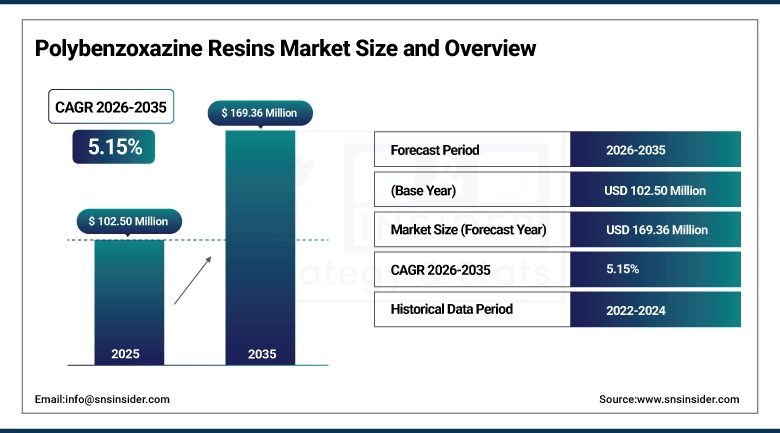
The Polybenzoxazine Resins Market was valued at USD 102.50 Million in 2025 and is expected to reach USD 169.36 Million by 2035, growing at a CAGR of 5.15% from 2026-2035.
The Polybenzoxazine Resins Market remains a small, specialized corner of the broader thermoset composites industry, where demand is defined almost entirely by applications that cannot tolerate the shrinkage, water uptake, or by-product release common to conventional phenolic and epoxy systems. Aerospace and defense programs continue to anchor the largest share of consumption, valuing the near-zero shrinkage during cure and low moisture absorption that polybenzoxazine chemistry offers over competing thermosets in structural and secondary composite parts. Growth is increasingly concentrated in electrical and electronics applications, where rising demand for copper-clad laminates with low dielectric loss at high frequencies is pulling resin formulators toward benzoxazine chemistries purpose-built for next-generation circuit boards.
To Get more information On Polybenzoxazine Resins Market - Request Free Sample Report
Polybenzoxazine Resins Market Trends
-
Bio-based benzoxazine formulations built on cardanol and other renewable phenols are gaining early interest.
-
Low-dielectric benzoxazine grades for high-frequency copper-clad laminates are becoming a distinct product line.
-
Formulators are blending benzoxazines with epoxy and bismaleimide resins to balance toughness against heat resistance.
-
Aerospace qualification programs remain the primary barrier to entry for new benzoxazine grades entering structural use.
-
Resin suppliers are concentrating around a small number of established producers rather than new entrants.
-
Friction material and copper-clad laminate applications are broadening demand beyond traditional aerospace composites.
U.S. Polybenzoxazine Resins Market Outlook
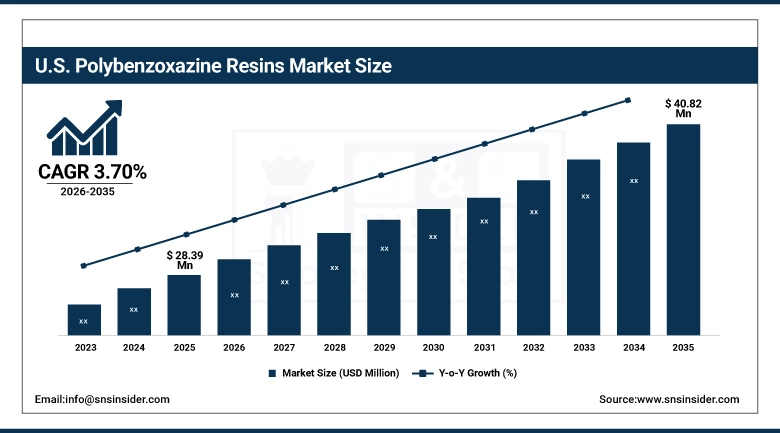
The U.S. Polybenzoxazine Resins Market was valued at USD 28.39 Million in 2025 and is expected to reach USD 40.82 Million by 2035, growing at a CAGR of 3.70% from 2026-2035.
Commercial airframe programs at major U.S. airframers and their Tier 1 composite fabricators account for the bulk of domestic consumption, with benzoxazine resin specified into structural and secondary components across both narrowbody and widebody platforms. Defense procurement cycles add a second, steadier layer of demand that moves independently of commercial aerospace build rates, cushioning the market against swings in civil aircraft production. A small but growing U.S. electronics segment is also emerging as domestic circuit board manufacturers evaluate benzoxazine chemistry for high-frequency applications tied to data center and telecommunications infrastructure investment.
Polybenzoxazine Resins Market Segment Analysis
-
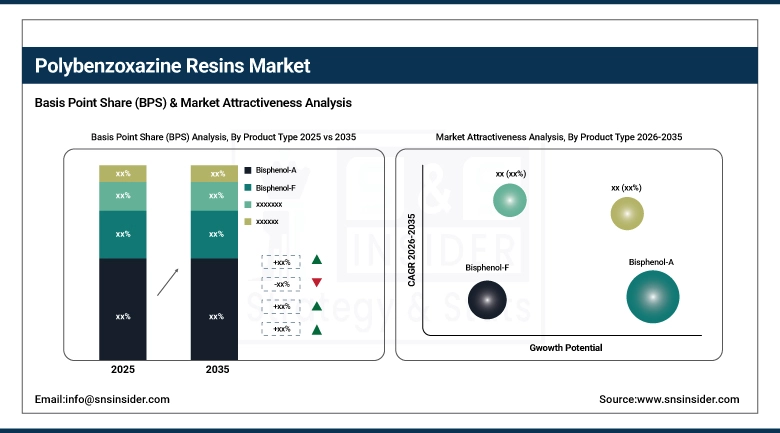
By Product Type, the Bisphenol-A segment dominated the Polybenzoxazine Resins Market with approximately 49.30% share in 2025, while the Bio-Based segment is the fastest growing with a CAGR of approximately 7.05%.
-
By End-User Industry, the Aerospace and Defense segment dominated the Polybenzoxazine Resins Market with approximately 44.35% share in 2025, while the Electrical and Electronics segment is the fastest growing with a CAGR of approximately 6.85%.
By Product Type, Bisphenol-A Dominates the Polybenzoxazine Resins Market and Bio-Based Grows Fastest
Bisphenol-A benzoxazine remains the predominant chemistry, as it offers the most extensively documented performance history of any variant, with decades of aerospace qualification data backing its use in structural and secondary composite parts. Formulators and end users alike favor the predictable processing window and well-characterized cure behavior that come with a chemistry this established, since requalifying a newer variant into an existing aerospace specification carries significant cost and schedule risk. Bisphenol-A grades also benefit from the broadest base of qualified suppliers, giving buyers more sourcing flexibility than any newer chemistry can currently offer.
Bio-based benzoxazine is growing fastest as resin formulators respond to customer pressure to cut reliance on petroleum-derived bisphenol feedstocks, substituting cardanol and other renewable phenolic inputs without abandoning the core benzoxazine cure chemistry. Early-stage qualification work is underway across several end-use industries, though volumes remain small relative to established Bisphenol-A and Bisphenol-F grades. Suppliers positioning early in this category are likely to capture an outsized share as sustainability requirements tighten across the composites supply chain.
By End-User Industry, Aerospace and Defense Dominates the Polybenzoxazine Resins Market and Electrical and Electronics Grows Fastest
Aerospace and defense applications consume the largest share of polybenzoxazine resin, reflecting the chemistry's established role in structural and secondary composite parts that demand multi-decade dimensional stability. A concentrated base of qualified fabricators serving commercial airframe programs and defense primes anchors this demand, with material specifications reviewed by bodies such as NCAMP and individual program engineering teams before a grade enters production use. Military composite applications add a further layer of stable, program-driven demand distinct from commercial aircraft build cycles, spanning airframe structures, radomes, and other secondary components.
Electrical and electronics applications are growing fastest as copper-clad laminate makers adopt benzoxazine chemistries specifically for their low dielectric loss at the high frequencies that next-generation circuit boards require. Rising data traffic and the move toward faster signal transmission standards are pushing laminate producers to qualify low-dielectric benzoxazine grades well beyond the volumes seen in traditional composite applications. This segment's growth is tied closely to electronics manufacturing investment in Asia Pacific, where most qualified laminate producers are based.
Regional Analysis
|
Region |
Major Country |
Share within Region, 2025 (%) |
|---|---|---|
|
North America |
United States |
76.50 |
|
Europe |
Germany |
24.50 |
|
Asia Pacific |
China |
34.20 |
|
Middle East and Africa |
UAE |
29.80 |
|
Latin America |
Brazil |
43.50 |
North America Polybenzoxazine Resins Market Insights
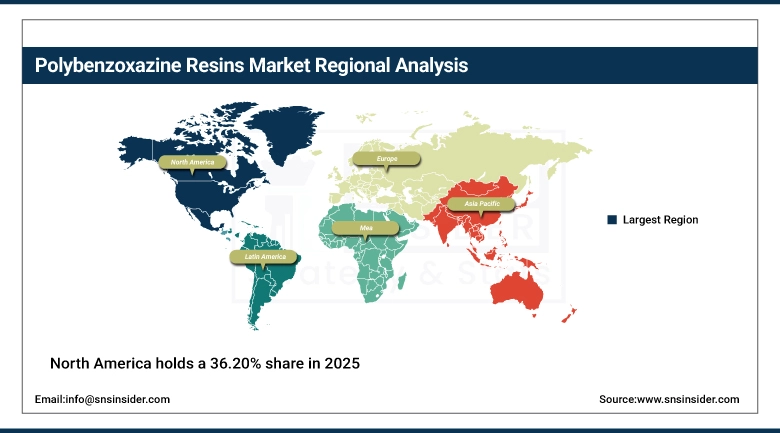
North America holds a 36.20% share in 2025, carried by a concentrated base of aerospace primes and qualified composite fabricators that account for the overwhelming majority of regional consumption. The United States drives nearly all of this activity, supported by both commercial aircraft production programs and steady defense procurement that moves independently of civil build rates. Canada contributes a smaller, specialized base tied mainly to defense and rail composite applications rather than commercial aerospace manufacturing.
Growth across the region trails Asia Pacific, as the underlying aerospace qualification base is already mature and new demand depends on the pace of new airframe programs rather than first-time adoption of the chemistry itself. Existing supplier qualifications inside long-running aerospace programs create a high switching barrier that limits how quickly newer benzoxazine grades can displace material already locked into certified specifications. Defense modernization programs remain the most reliable source of incremental regional demand over the forecast period.
Get Customized Report as per Your Business Requirement - Enquiry Now
Europe Polybenzoxazine Resins Market Insights
Europe holds the second-largest position in 2025, anchored by Germany, France, and the United Kingdom, where established aerospace and automotive composite supply chains provide a steady base of qualified demand. Germany carries the largest share within the region, reflecting its concentration of aerospace component fabricators and composite material research institutions that continue to qualify new benzoxazine grades for structural applications. France and the United Kingdom add a further layer of demand tied to their own national aerospace prime contractors and long-established composite fabrication supply chains.
Growth is proceeding at a measured pace, tracking the broader composites industry's capital investment cycle rather than any single regulatory trigger specific to this resin chemistry. Eastern European countries, including Poland and Russia, remain earlier in building out qualified composite fabrication capacity than Western Europe, leaving limited near-term volume even as regional aerospace supply chains gradually extend eastward in search of lower-cost fabrication capacity. Spain and Italy add smaller, steadily maintained aerospace component manufacturing bases of their own.
Asia Pacific Polybenzoxazine Resins Market Insights
Asia Pacific is projected to be the fastest-growing region at a CAGR of approximately 6.76% from 2026 to 2035, driven by China's expanding copper-clad laminate manufacturing base and its growing role in global electronics production. India is building out its own composite fabrication capacity in parallel, supported by a national aerospace and defense manufacturing push that is creating new qualification opportunities for benzoxazine resin suppliers. Japan and South Korea contribute a smaller, steadier base built on established electronics and specialty chemical manufacturing relationships.
A growing base of China-based specialty chemical producers is scaling domestic benzoxazine resin output to supply local laminate makers, reducing reliance on imported Japanese and Western grades for electronics applications. Australia and the broader ASEAN countries are growing closer to the regional average, reflecting smaller but steadily expanding specialty chemical processing capacity rather than new market entry. South Korea's electronics manufacturers are following a similar path, adding a further source of demand tied to the region's broader semiconductor and printed circuit board investment cycle.
MEA & Latin America Polybenzoxazine Resins Market Insights
The Middle East and Africa combine a small but growing base of aerospace maintenance and composite repair demand in the Gulf states with far more limited specialty resin consumption across most of the rest of the continent. The UAE carries the largest share within the region, supported by its concentration of aviation maintenance, repair, and overhaul facilities. South Africa remains the continent's most developed market outside the Gulf, tied to a smaller national aerospace and defense manufacturing base.
Latin America's demand runs mainly through Brazil's aerospace manufacturing sector, with Argentina, Mexico, and Colombia following at a much smaller scale. Limited local composite fabrication capacity across most of the region keeps demand concentrated among a small number of qualified fabricators serving export-oriented aerospace supply chains. Both regions remain earlier in their adoption curve than North America, Europe, or Asia Pacific, with growth tied closely to how quickly local aerospace and electronics manufacturing capacity expands.
Market Dynamics
Growth Drivers: Aerospace qualification demand and high-frequency electronics
Polybenzoxazine resin's near-zero shrinkage during cure and low moisture absorption give it a durable advantage over competing thermosets in structural and secondary aircraft components, where dimensional stability over a multi-decade service life outweighs a higher material cost. Once qualified into a specific airframe program, this advantage translates into demand that persists for the life of that program, insulating suppliers from the shorter product cycles common elsewhere in specialty chemicals, and giving established producers an unusually predictable revenue base once a grade clears certification.
A second driver is the rising demand for low-dielectric benzoxazine grades in high-frequency copper-clad laminates, as faster data transmission standards push circuit board makers toward resin chemistries that minimize signal loss. This use case is expanding demand well beyond traditional aerospace composite applications and is growing fastest in the electronics manufacturing centers of Asia Pacific, where most qualified laminate producers are concentrated and where investment in next-generation circuit board capacity continues to expand at a steady pace each year.
Restraints: High qualification costs and a narrow supplier base
Qualifying a new benzoxazine grade into an aerospace program requires extensive, costly testing that can take years to complete, discouraging newer or smaller suppliers from entering the market even where their chemistry offers a real performance advantage. This qualification burden concentrates volume among a small number of established producers and slows the overall pace at which the market can absorb truly new formulations, with testing and certification costs often exceeding what a smaller specialty chemical producer can justify against the category's limited near-term volume.
A second restraint is the market's inherently small scale relative to competing thermosets such as epoxy and phenolic resins, which limits the economies of scale available to any single producer and keeps per-unit production costs comparatively high. This cost structure confines polybenzoxazine resin to applications where its specific performance advantages justify the premium, rather than displacing lower-cost alternatives across the broader composites industry, and discourages large-scale capacity investment by any single producer looking to expand output.
Opportunities: Bio-based chemistries and expanding electronics applications
Developing bio-based benzoxazine grades built on cardanol and other renewable phenolic feedstocks gives suppliers a credible response to customer pressure to reduce reliance on petroleum-derived bisphenol inputs, an area where the category remains underdeveloped relative to the rest of the composites industry. Early movers able to qualify a credibly renewable grade into aerospace or electronics applications are likely to capture a share disproportionate to the category's current small size, particularly as procurement teams begin screening suppliers on feedstock origin.
A second opportunity lies in extending low-dielectric benzoxazine chemistry further into electronics applications beyond copper-clad laminates, as the same high-frequency performance advantage that suits circuit boards could extend to other electronic packaging applications facing similar signal-loss constraints. Suppliers already serving the laminate industry are best positioned to extend their existing chemistry into these adjacent, still largely untapped applications ahead of competitors with no established electronics customer relationships to build on, particularly as packaging designers face the same signal-loss constraints laminate makers already solved.
Recent Developments:
-
In February 2025, the U.S. Patent and Trademark Office granted A.C.R. Tech Co., Ltd. of Taipei, Taiwan a patent covering a benzoxazine resin composition and the copper-clad laminate made from it, adding to the pool of patented low-dielectric chemistries available to electronics laminate producers.
-
In March 2025, the U.S. Patent and Trademark Office granted ENEOS Corporation a patent covering a curable resin composition that pairs multifunctional benzoxazine compounds with an epoxy component for semiconductor device encapsulation.
-
In July 2025, the U.S. Patent and Trademark Office granted Soochow University a patent covering a biomass-derived, shape-memory benzoxazine resin synthesized from furfurylamine and vanillin, extending academic research into bio-based benzoxazine chemistry.
-
In October 2025, the U.S. Patent and Trademark Office granted ENEOS Corporation a second patent covering an asymmetric benzoxazine compound formulated with epoxy and phenol-based curing agents for semiconductor device applications.
Polybenzoxazine Resins Market Key Players
-
Huntsman Corporation
-
Shikoku Chemicals Corporation
-
Atul Ltd.
-
Bitrez Group Limited
-
Dongfang Insulation Material Co., Ltd.
-
Kaneka Corporation
-
Japan Material Technologies Corporation
-
ABR Organics Limited
-
Composite Technology Development, Inc.
-
JFE Chemical Corporation
-
Trinitti International Co., Ltd.
-
Chengdu CORYES Polymer Science & Technology Co., Ltd.
-
Tongyu Advanced Materials (Guangdong) Co., Ltd.
Polybenzoxazine Resins Market Report Scope:
| Report Attributes | Details |
|---|---|
| Market Size in 2025 | USD 102.50 Million |
| Market Size by 2035 | USD 169.36 Million |
| CAGR | CAGR of 5.15% From 2026 to 2035 |
| Base Year | 2025 |
| Forecast Period | 2026-2035 |
| Historical Data | 2022-2024 |
| Report Scope & Coverage | Market Size, Segments Analysis, Competitive Landscape, Regional Analysis, DROC & SWOT Analysis, Forecast Outlook |
| Key Segments | • By Product Type (Bisphenol-A, Bisphenol-F, Bio-Based & Others) • By End-User Industry (Aerospace and Defense, Automotive and Transportation, Electrical and Electronics, Marine and Offshore, Building and Construction & Others) |
| Regional Analysis/Coverage | North America (US, Canada), Europe (Germany, UK, France, Italy, Spain, Russia, Poland, Rest of Europe), Asia Pacific (China, India, Japan, South Korea, Australia, ASEAN Countries, Rest of Asia Pacific), Middle East & Africa (UAE, Saudi Arabia, Qatar, South Africa, Rest of Middle East & Africa), Latin America (Brazil, Argentina, Mexico, Colombia, Rest of Latin America). |
| Company Profiles | Huntsman Corporation, Shikoku Chemicals Corporation, Atul Ltd., Bitrez Group Limited, Dongfang Insulation Material Co., Ltd., Kaneka Corporation, Japan Material Technologies Corporation, ABR Organics Limited, Composite Technology Development, Inc., JFE Chemical Corporation, Trinitti International Co., Ltd., Chengdu CORYES Polymer Science & Technology Co., Ltd., Tongyu Advanced Materials (Guangdong) Co., Ltd. |

Frequently Asked Questions
The market includes Huntsman Corporation, Kaneka Corporation, Shikoku Chemicals Corporation, Atul Ltd., Bitrez Group Limited, Dongfang Insulation Material Co., Ltd., Japan Material Technologies Corporation, Toray Industries, and Sumitomo Bakelite, among others. These producers compete on aerospace qualification history, chemistry breadth across bisphenol and bio-based grades, and, increasingly, low-dielectric formulations for electronics applications.
The main opportunities lie in developing bio-based benzoxazine grades built on renewable phenolic feedstocks to meet customer sustainability requirements, and in extending low-dielectric chemistry further into electronics packaging applications beyond copper-clad laminates.
The key growth factor is polybenzoxazine resin's near-zero shrinkage during cure and low moisture absorption, which gives it a durable advantage over competing thermosets in aerospace structural applications and increasingly in high-frequency electronics laminates.
By product type, the Bisphenol-A segment dominated the market with approximately 49.30% share in 2025, supported by its extensive aerospace qualification history. The Aerospace and Defense end-user segment led its axis with approximately 44.35% share.
North America dominated the market with approximately 36.20% share in 2025, supported by a concentrated base of aerospace primes and qualified composite fabricators. Asia Pacific is the fastest-growing region, driven by expanding copper-clad laminate manufacturing in China.
