
Assortment Analytics Market Report Scope and Overview:
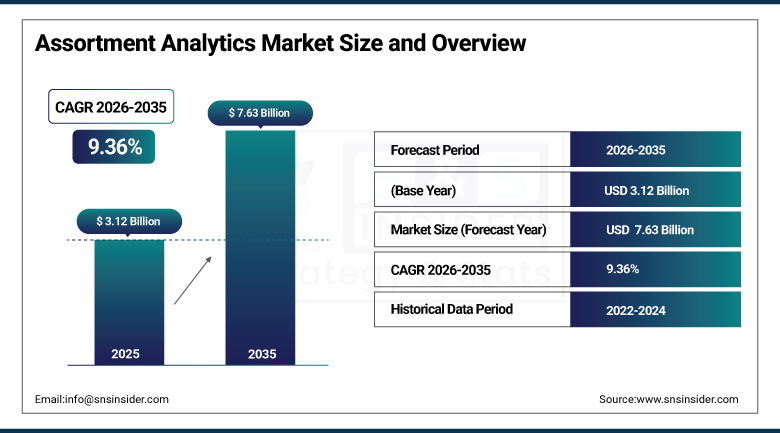
The Assortment Analytics Market was valued at USD 3.12 Billion in 2025 and is projected to reach USD 7.63 Billion by 2035, registering a CAGR of 9.36% from 2026 to 2035. The market continues expanding steadily.
The Assortment Analytics Market is steadily reshaping how retailers and consumer goods companies decide which products to carry, where to place them and how much shelf and inventory to devote to each, moving merchandising from experience-based judgment toward AI-driven, data-led decisions. The market is characterized by rising adoption of machine-learning demand forecasting, consumer decision trees and store clustering, growing integration of assortment, space and supply chain planning on unified cloud platforms, and expanding use of generative and agentic AI to automate category reviews. Significant growth is being witnessed in cloud and hybrid deployments and e-commerce use cases, considering that retailers continue investing in analytics that localize assortments, reduce slow movers and improve margin and availability.
Blue Yonder released new AI-driven innovations for unified retail planning and execution in January 2026 ahead of NRF 2026, including Micro Space Planning that uses AI-based orchestration to create assortment-driven shelf and display plans for every store, reflecting the industry's shift toward store-specific, AI-powered assortment decisions.
To Get more information On Assortment Analytics Market - Request Free Sample Report
Assortment Analytics Market Trends
- Rising use of agentic and generative AI continues automating category reviews and assortment recommendations.
- Growing integration of assortment, space and supply planning continues aligning shelf decisions with inventory and replenishment.
- Expanding store-level localization continues replacing chain-wide assortments with cluster- and store-specific plans.
- Increasing use of retail media and loyalty data continues enriching consumer decision trees and demand transfer models.
- Rising adoption of cloud data platforms continues enabling real-time collaboration between retailers and CPG suppliers.
U.S. Assortment Analytics Market Outlook
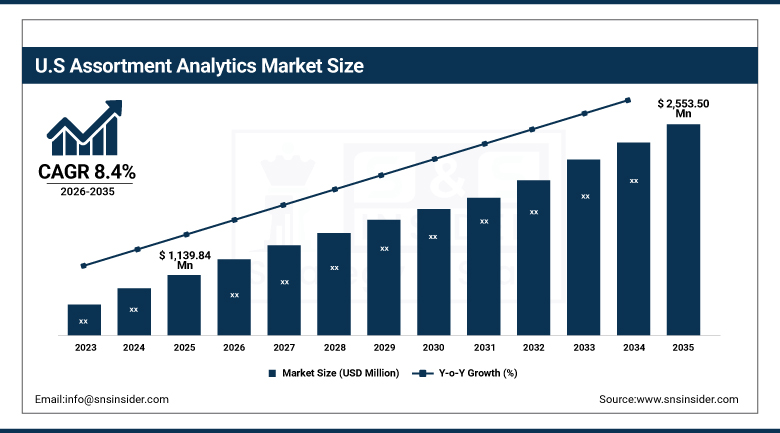
The U.S. Assortment Analytics Market was valued at approximately USD 1,139.84 Million in 2025 and is projected to reach approximately USD 2,553.50 Million by 2035, registering a CAGR of approximately 8.4% from 2026 to 2035.
Demand across the United States continued to be shaped by the country's highly competitive grocery, mass merchandise, drug and specialty retail sectors, large omnichannel retailers with tens of thousands of SKUs, and a mature ecosystem of syndicated data providers and category management vendors. Rising pressure to cut slow-moving inventory, protect margins amid price-sensitive consumers and personalize store assortments continued reinforcing the country's position as the largest national market. Growing retail media networks and first-party loyalty data added further layers of sustained domestic demand, with retailers and CPG manufacturers increasingly prioritizing AI-based assortment and space planning tools.
Circana launched its Complete Why solution with AI-enabled insights in March 2026, offering store-and-week-level modeling that helps American retailers and CPG manufacturers diagnose why category and assortment performance changes, strengthening data-driven category management across U.S. retail.
Assortment Analytics Market Segment Analysis
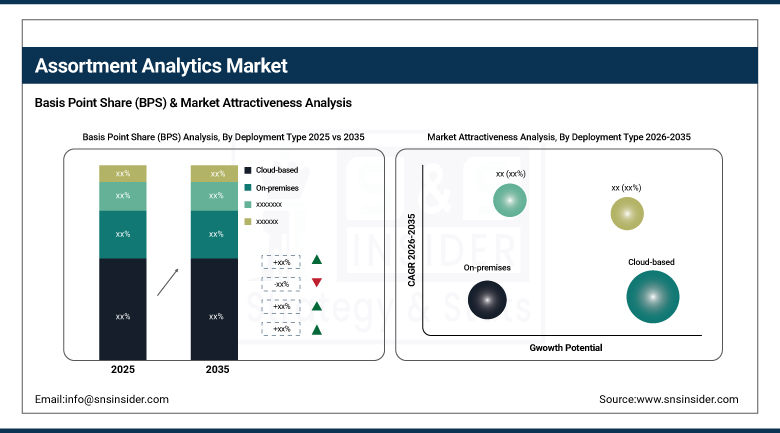
- By Deployment Type, Cloud-based segment dominated the Assortment Analytics Market in 2025 with 52% share; Hybrid segment is the fastest growing segment with a CAGR of approximately 11.4%.
- By Application, Retail Management segment dominated the Assortment Analytics Market in 2025 with 34% share; Supply Chain Optimization segment is the fastest growing segment with a CAGR of approximately 11.2%.
- By End User, Retail segment dominated the Assortment Analytics Market in 2025 with 41% share; E-commerce segment is the fastest growing segment with a CAGR of approximately 12.1%.
- By Component, Software segment dominated the Assortment Analytics Market in 2025 with 62% share; Services segment is the fastest growing segment with a CAGR of approximately 10.8%.
By Deployment Type: Cloud-based Leads, Hybrid Grows Fastest
The Cloud-based segment dominated the Assortment Analytics Market in 2025, driven by retailers' preference for scalable, subscription-based platforms that can process large volumes of point-of-sale, loyalty and inventory data without heavy on-premises infrastructure. Cloud platforms also make it easier to share data and insights with CPG suppliers and to roll out new AI capabilities quickly. Continued migration of planning workloads to cloud data platforms reinforced this segment's position as the largest contributor to total market revenue throughout the base year.
The Hybrid segment is the fastest growing in the Assortment Analytics Market owing to large retailers' need to combine cloud-based analytics with existing on-premises ERP, merchandising and store systems. Hybrid models allow organizations to keep sensitive data and legacy applications in place while using cloud AI engines for forecasting and optimization. Rising data sovereignty requirements in some regions are accelerating this segment's growth trajectory. Growing use of connected data architectures further supports hybrid adoption.
By Application: Retail Management Leads, Supply Chain Optimization Grows Fastest
The Retail Management segment dominated the Assortment Analytics Market because assortment analytics is most widely used to plan category ranges, store clustering, product introductions and delistings, and to measure category performance across stores and channels. Retailers rely on these tools to balance customer choice with space, cost and margin goals. Continued investment in category management and localized merchandising reinforced this segment's dominant contribution to total market revenue throughout the base year.
The Supply Chain Optimization segment is the fastest growing as retailers and manufacturers connect assortment decisions directly with demand forecasting, replenishment, allocation and warehouse operations. Linking what is ranged with how it is supplied reduces stockouts, excess inventory and waste. Rising adoption of unified planning platforms continues attracting investment in supply chain-linked assortment analytics. Growing pressure to reduce working capital further accelerates adoption.
By End User: Retail Leads, E-commerce Grows Fastest
The Retail segment dominated the Assortment Analytics Market because grocery, mass merchandise, drug, convenience and specialty retailers manage large SKU counts across thousands of physical stores, making assortment optimization essential for space productivity and profitability. Brick-and-mortar retailers have long-established category management teams and planogram processes that rely on analytics. Continued investment in store localization and space planning reinforced this segment's dominant contribution to total market revenue throughout the base year.
The E-commerce segment is the fastest growing as online retailers and marketplaces use assortment analytics to decide which products to list, promote and stock across rapidly expanding digital catalogues. Rich clickstream, search and conversion data allow e-commerce businesses to test and refine assortments quickly. Rising online grocery and quick-commerce growth continues attracting investment in digital assortment optimization. Growing use of personalization engines further accelerates adoption.
By Component: Software Leads, Services Grow Fastest
The Software segment dominated the Assortment Analytics Market because assortment optimization, space planning, demand forecasting and analytics dashboards form the core of every deployment. Software platforms embed machine learning, consumer decision trees and scenario modelling that drive recurring subscription revenue. Continued expansion of AI features and cloud platforms reinforced this segment's dominant contribution to total market revenue throughout the base year.
The Services segment is the fastest growing as retailers seek consulting, data integration, implementation, training and managed analytics support to get value from complex assortment platforms. Many organizations lack in-house data science capacity and rely on vendors and integrators to build models and change processes. Rising adoption of AI-driven category management continues increasing demand for expert services. Growing use of managed analytics programmes further accelerates services growth.
Regional Analysis
|
Region |
Major Country |
Share within Region, 2025 (%) |
|---|---|---|
|
North America |
United States |
87.40% |
|
Europe |
Germany |
22.90% |
|
Asia Pacific |
China |
38.60% |
|
Middle East and Africa |
Saudi Arabia |
27.80% |
|
Latin America |
Brazil |
43.20% |
North America Assortment Analytics Market Insights
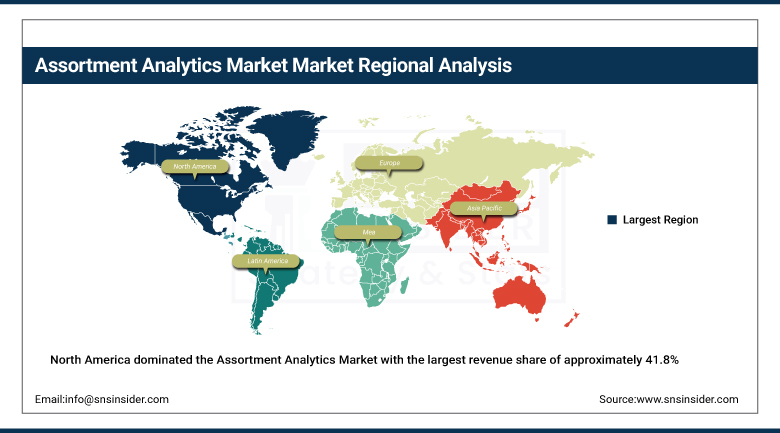
North America dominated the Assortment Analytics Market with the largest revenue share of approximately 41.8% in 2025. A highly competitive retail landscape, large omnichannel retailers, mature syndicated data and category management ecosystems, and early adoption of AI and cloud analytics continued reinforcing this dominant regional position. The region is home to many leading assortment, planning and data analytics vendors. Growing retail media and loyalty data programmes further reinforced this region's leadership position.
The United States accounted for the substantial majority of regional revenue, anchored by large grocery, mass merchandise and specialty chains and strong collaboration between retailers and CPG manufacturers. Canada added further demand through its concentrated grocery and pharmacy sectors, and that combined strength kept the region the largest addressable market for assortment analytics vendors through the forecast period. Continued investment in store localization and e-commerce reinforced sustained demand.
Get Customized Report as per Your Business Requirement - Enquiry Now
Europe Assortment Analytics Market Insights
Europe held a meaningful share of global revenue, supported by strong grocery retail sectors, discount retail competition and a well-developed ecosystem of retail planning software providers in the Nordics, the UK and Germany. European retailers increasingly use assortment analytics to manage private-label ranges, reduce food waste and meet sustainability goals. GDPR shapes how retailers use customer data in analytics. Growing adoption of unified planning platforms further reinforced regional demand.
Germany continued to lead demand at roughly 22.90% of European revenue, supported by its large grocery and discount retail market. The UK, France and the Nordic countries contributed substantial additional demand through advanced category management practices and strong retail technology adoption, and continued European investment in AI-driven retail planning should keep regional demand for assortment analytics climbing through the forecast period. Additional demand from the Netherlands, Spain and Italy reinforced broader regional market strength.
Asia Pacific Assortment Analytics Market Insights
Asia Pacific is advancing at the fastest pace, growing at a CAGR of approximately 12.3% from 2026 to 2035. This growth is driven by rapid expansion of modern retail and e-commerce in China, India, Southeast Asia and Japan, rising digital adoption among retailers and growing investment in data-driven merchandising, with new retail chains, quick-commerce platforms and marketplaces continuing to broaden the region's addressable base well beyond its traditional smaller footprint. Government digitalization programmes further support adoption.
China held a substantial share of regional revenue, supported by its very large e-commerce and omnichannel retail sector. Japan and India contributed meaningful additional demand, with Japan's mature convenience and supermarket chains and India's fast-growing organized retail and quick-commerce sector both reinforcing the region's position as the fastest-growing market tracked in this report. Australia, South Korea and Southeast Asian countries contributed smaller but steadily growing regional demand throughout the period.
MEA and Latin America Assortment Analytics Market Insights
The Middle East and Africa and Latin America both showed steady growth, driven by expanding modern retail, rising e-commerce penetration and growing investment in retail technology across both areas. As regional grocery and hypermarket chains scale, assortment analytics offers an efficient way to localize ranges and improve inventory productivity. Growing cloud adoption across both regions further reinforced analytics uptake.
Saudi Arabia led Gulf demand, supported by retail sector growth and digital transformation under Vision 2030, while the UAE and South Africa contributed further demand through advanced retail chains. In Latin America, Brazil accounted for the largest share of regional revenue, with its large grocery and e-commerce sectors continuing to anchor regional demand for assortment analytics. Mexico and Chile contributed additional demand through expanding modern retail and online commerce.
Market Dynamics
Growth Drivers: Demand for Data-Driven Merchandising and AI Adoption in Retail
The industry is driven by intensifying retail competition, thin margins, rising consumer expectations for relevant product choice, and growing availability of point-of-sale, loyalty, e-commerce and supply chain data. As retailers continue seeking to reduce slow movers, improve on-shelf availability and localize assortments, demand for analytics that recommend what to stock and where continues rising worldwide. Growth of omnichannel retail and retail media further reinforces this sustained industry-wide demand driver.
Rising adoption of artificial intelligence and machine learning continues reinforcing this driver, as forecasting models, demand transfer analysis, consumer decision trees and generative AI assistants make assortment decisions faster and more accurate. Growing integration with space planning and replenishment continues closing the loop between planning and execution, and that combination of business need and technology keeps demand rising at a steady, sustained pace. Expanding cloud data sharing between retailers and suppliers is further widening the addressable user base.
Restraints: Data Quality Challenges and Implementation Complexity
Fragmented, inconsistent and incomplete product, store and customer data continues posing a restraint on faster market-wide expansion, as analytics outputs depend heavily on data quality. Integrating assortment tools with legacy ERP, merchandising and planogram systems can be costly and time-consuming. High subscription and implementation costs also limit adoption among smaller retailers.
A shortage of data science and category management skills continues posing a further restraint, making it difficult for some organizations to act on analytics recommendations. Change management challenges and resistance to replacing experience-based decision making slow adoption. Data privacy rules continue shaping how retailers can use customer-level data in several regions.
Opportunities: Agentic AI and Emerging Market Retail Digitalization
Rising investment in agentic and generative AI represents a significant opportunity, as retailers seek systems that can automatically run category reviews, explain recommendations and execute assortment changes across stores and channels. Vendors positioned early in AI-native, unified planning platforms stand to capture meaningful share as assortment decisions become more automated. Expanding retailer-supplier data collaboration continues widening this addressable opportunity.
Digitalization of retail across emerging markets offers a second substantial opportunity, as organized retail, e-commerce and quick commerce grow rapidly in Asia, Latin America and the Middle East. Vendors with scalable, cost-effective cloud solutions stand to capture meaningful share as regional retailers modernize merchandising. Continued growth of online marketplaces across India, Southeast Asia and Latin America is further accelerating local technology adoption.
Recent Developments:
- May 2026: Blue Yonder announced new Cognitive Solutions for Space Planning and Category Management at ICON 2026, available on its platform and AI data cloud with a single data set aligning planograms across assortment, allocation, replenishment, warehousing and transportation.
- September 2025: SymphonyAI highlighted its next-generation AI assortment optimization solution for eliminating slow-moving inventory, noting that UK retailers Southern Co-op and Scotmid had selected its assortment and space planning software.
Assortment Analytics Market key players are:
- SAP SE
- Oracle Corporation
- IBM Corporation
- Microsoft Corporation
- SAS Institute Inc.
- Blue Yonder (Panasonic)
- RELEX Solutions
- o9 Solutions, Inc.
- SymphonyAI
- NielsenIQ
- Circana
- Salesforce (Tableau)
- Qlik Technologies
- TIBCO Software (Cloud Software Group)
- Strategy (formerly MicroStrategy)
- Kinaxis Inc.
- DotActiv
- LEAFIO AI
Assortment Analytics Market Report Scope:
| Report Attributes | Details |
|---|---|
| Market Size in 2025 | USD 3.12 Billion |
| Market Size by 2035 | USD 7.63 Billion |
| CAGR | CAGR of 9.36% From 2026 to 2035 |
| Base Year | 2025 |
| Forecast Period | 2026-2035 |
| Historical Data | 2022-2024 |
| Report Scope & Coverage | Market Size, Segments Analysis, Competitive Landscape, Regional Analysis, DROC & SWOT Analysis, Forecast Outlook |
| Key Segments | • By Deployment Type (Cloud-based, On-premises, Hybrid) • By Application (Retail Management, Supply Chain Optimization, Merchandising, Inventory Management) • By End User (Retail, E-commerce, Wholesale Distribution, Manufacturing) • By Component (Software, Services, Support and Maintenance) |
| Regional Analysis/Coverage | North America (US, Canada), Europe (Germany, UK, France, Italy, Spain, Russia, Poland, Rest of Europe), Asia Pacific (China, India, Japan, South Korea, Australia, ASEAN Countries, Rest of Asia Pacific), Middle East & Africa (UAE, Saudi Arabia, Qatar, South Africa, Rest of Middle East & Africa), Latin America (Brazil, Argentina, Mexico, Colombia, Rest of Latin America). |
| Company Profiles | SAP SE, Oracle Corporation, IBM Corporation, Microsoft Corporation, SAS Institute Inc., Blue Yonder (Panasonic), RELEX Solutions, o9 Solutions, Inc., SymphonyAI, NielsenIQ, Circana, Salesforce (Tableau), Qlik Technologies, TIBCO Software (Cloud Software Group), Strategy (formerly MicroStrategy), Kinaxis Inc., DotActiv, LEAFIO AI. |
Frequently Asked Questions
The market is driven by intensifying retail competition, demand for data-driven merchandising, AI and machine learning adoption, and growth of omnichannel retail.
The Cloud-based segment dominated the Assortment Analytics Market, accounting for approximately 52% market share.
The North America region dominated the Assortment Analytics Market in 2025 with approximately 41.8% share, driven by a competitive retail landscape, mature category management practices, and early AI adoption.
