
Government Education Market Report Scope and Overview:
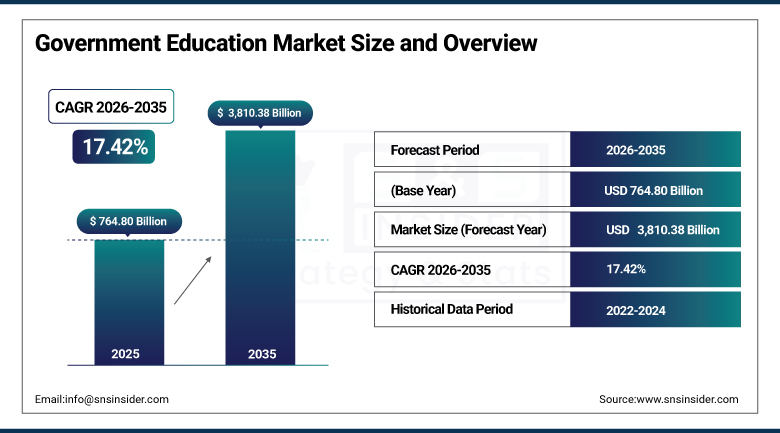
The Government Education Market was valued at USD 764.80 Billion in 2025 and is projected to reach USD 3,810.38 Billion by 2035, registering a CAGR of 17.42% from 2026 to 2035. The market continues expanding steadily.
The Government Education Market is steadily reshaping how nations fund, deliver and modernize public learning by moving from traditional classroom-only systems toward digitally enabled, skills-focused education supported by public-private partnerships. The market features an increase in government spending on early childhood and K-12 education, national efforts towards artificial intelligence literacy, STEM and vocational training, and increased procurement by the government of educational platforms, devices, and connectivity for public institutions of learning. Growth is evident in preschool services and online learning since governments keep on focusing on education to create a competitive workforce and foster economic growth.
China's Communist Party Central Committee and State Council released the Plan for Building a Strong Education Nation (2024-2035) in January 2025, setting national targets for high-quality, digitally enabled education through 2035 and reflecting the global shift toward long-term, state-led education modernization strategies.
To Get more information On Government Education Market - Request Free Sample Report
Government Education Market Trends
-
Rising national AI literacy programmes continue embedding artificial intelligence into public school curricula and teacher training.
-
Growing public investment in early childhood education continues expanding government-funded preschool enrolment.
-
Expanding public-private partnerships continue bringing EdTech platforms, devices and cloud services into public schools.
-
Increasing focus on vocational and skilled-trade pathways continues linking public education to workforce needs.
-
Rising emphasis on student data privacy continues shaping regulation of digital learning tools in public education.
U.S. Government Education Market Outlook
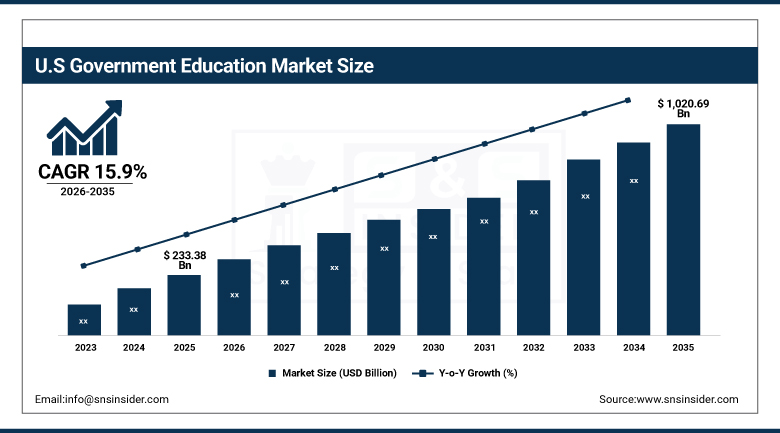
The U.S. Government Education Market was valued at approximately USD 233.38 Billion in 2025 and is projected to reach approximately USD 1,020.69 Billion by 2035, registering a CAGR of approximately 15.9% from 2026 to 2035.
Demand across the United States continued to be shaped by the country's large public K-12 school system, extensive public university and community college networks, and the combination of federal, state and local education funding that supports infrastructure, instruction and technology. Rising federal emphasis on AI literacy, STEM and skilled-trade pathways continued reinforcing the country's position as the largest national market. Ongoing changes to the federal role in education, including shifts of responsibility toward states, added new dynamics to public education spending, while districts increasingly prioritize digital learning platforms, cybersecurity and teacher training.
President Trump signed Executive Order 14277, "Advancing Artificial Intelligence Education for American Youth," in April 2025, creating a White House Task Force on AI Education and directing federal agencies to expand AI literacy, teacher training and public-private partnerships for American K-12 schools.
Government Education Market Segment Analysis
-
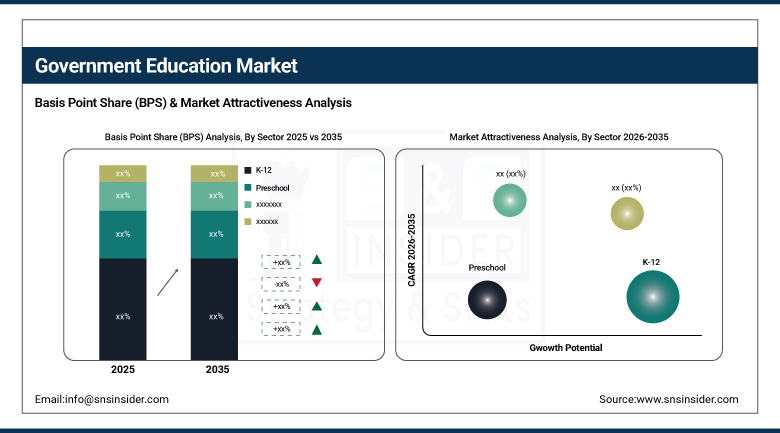
By Sector, K-12 segment dominated the Government Education Market in 2025 with 40% share; Preschool segment is the fastest growing segment with a CAGR of approximately 19.6%.
-
By Delivery Mode, Offline segment dominated the Government Education Market in 2025 with 72% share; Online segment is the fastest growing segment with a CAGR of approximately 21.4%.
By Sector: K-12 Leads, Preschool Grows Fastest
The K-12 segment dominated the Government Education Market in 2025, driven by the very large global population of primary and secondary school students and the central role governments play in funding teachers, school buildings, curricula and learning materials at these levels. Compulsory schooling laws in most countries make K-12 the largest single destination for public education budgets. Continued investment in classroom technology, digital textbooks and teacher training reinforced this segment's position as the largest contributor to total market revenue throughout the base year.
The Preschool segment is the fastest growing in the Government Education Market owing to rising recognition of the long-term benefits of early childhood education for learning outcomes and workforce participation. Governments across Asia, Europe and the Americas continue expanding free or subsidized pre-primary programmes and investing in early-years teacher training and facilities. Increasing parental consciousness and policies supporting the development of universal pre-primary education are driving the expansion of this sector. Another driver is the growing participation of women in the workforce.
By Delivery Mode: Offline Leads, Online Grows Fastest
The Offline segment dominated the Government Education Market because most public education continues to be delivered in physical schools, colleges and universities, where governments fund buildings, teachers, transport and in-person instruction. Face-to-face learning remains central to student development, socialization and assessment in public systems. Continued public investment in school construction, renovation and classroom staffing reinforced this segment's dominant contribution to total market revenue throughout the base year.
The Online segment is the fastest growing as governments expand national digital learning platforms, open online course initiatives and blended learning models that extend access to remote and underserved learners. Improving internet connectivity, falling device costs and public-private partnerships with EdTech providers continue increasing the reach of online public education. Growing national AI and digital skills strategies continue attracting public investment in online learning infrastructure. Expanding use of online platforms for teacher professional development further accelerates adoption.
Regional Analysis
|
Region |
Major Country |
Share within Region, 2025 (%) |
|---|---|---|
|
North America |
United States |
86.20% |
|
Europe |
Germany |
21.80% |
|
Asia Pacific |
China |
41.50% |
|
Middle East and Africa |
Saudi Arabia |
24.30% |
|
Latin America |
Brazil |
44.70% |
North America Government Education Market Insights
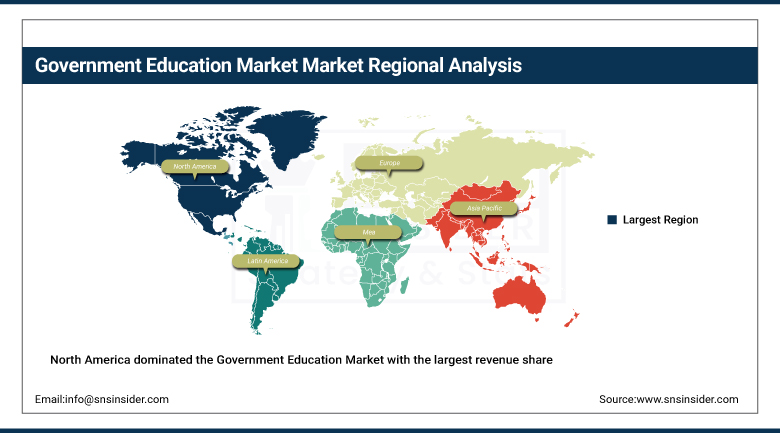
North America dominated the Government Education Market with the largest revenue share of approximately 35.4% in 2025. Well-funded public school and university systems, high per-student spending, advanced digital infrastructure and strong emphasis on research continued reinforcing this dominant regional position. Public institutions across the region were early adopters of learning management systems, one-to-one device programmes and online course delivery. Growing focus on AI literacy and workforce-aligned education further reinforced this region's leadership position.
The United States accounted for the substantial majority of regional revenue, anchored by its large public K-12 system, state university networks and community colleges. Canada added further demand through provincial education systems and public post-secondary institutions, and that combined strength kept the region the largest addressable market for government education spending through the forecast period. Continued investment in STEM, career and technical education reinforced sustained demand.
Get Customized Report as per Your Business Requirement - Enquiry Now
Europe Government Education Market Insights
Europe held a meaningful share of global revenue, supported by strong public funding for education, tuition-free or low-cost public universities in many countries and well-established vocational training systems. EU programmes such as Erasmus+ and the Digital Education Action Plan continue supporting cross-border mobility and digital skills. Growing focus on teacher shortages and digital transformation continued shaping regional investment priorities. Rising emphasis on green and digital skills further reinforced regional demand.
Germany continued to lead demand at roughly 21.80% of European revenue, supported by its large public school system, dual vocational training model and strong public university sector. France, the UK and Italy contributed substantial additional demand through national education budgets and digital schooling programmes, and continued European investment in skills and digital education should keep regional government education spending climbing through the forecast period. Additional demand from Spain, the Netherlands and the Nordic countries reinforced broader regional market strength.
Asia Pacific Government Education Market Insights
Asia Pacific is advancing at the fastest pace, growing at a CAGR of approximately 20.8% from 2026 to 2035. This growth is driven by large and young populations in China, India, Indonesia and other countries, ambitious national education reform strategies, and heavy public investment in digital learning, vocational training and higher education expansion, with new schools, universities and online platforms continuing to broaden the region's addressable base well beyond its traditional smaller footprint. Government focus on AI and STEM skills further supports growth.
China held a substantial share of regional revenue, supported by its long-term national education modernization plan and large-scale investment in digital education. India contributed meaningful additional demand through the National Education Policy 2020, the SWAYAM and DIKSHA digital platforms and expanding public school innovation programmes, while Japan, South Korea and Australia contributed further demand through advanced public education systems, reinforcing the region's position as the fastest-growing market tracked in this report. Southeast Asian countries contributed smaller but steadily growing regional demand throughout the period.
MEA and Latin America Government Education Market Insights
The Middle East and Africa and Latin America both showed steady growth, driven by young populations, rising government education budgets and growing investment in digital learning and skills development across both areas. As these markets continue expanding school enrolment and higher education access, public-private partnerships and online delivery offer efficient ways to scale education quality. International development funding further supports public education programmes across both regions.
Saudi Arabia led Gulf demand, supported by education reform and human capability development programmes under Vision 2030. The UAE and South Africa contributed further demand through national digital education and skills initiatives. In Latin America, Brazil accounted for the largest share of regional revenue, with its large public school and federal university systems continuing to anchor regional government education spending. Mexico and Argentina contributed additional demand through expanding public education and digital learning programmes.
Market Dynamics
Growth Drivers: Rising Public Education Investment and National Skills Strategies
The industry is driven by rising government investment in education as a foundation for economic competitiveness, growing demand for higher education and vocational training linked to population growth and economic development, and national strategies that prioritize STEM, AI and digital skills. As governments continue expanding early childhood education, modernizing school infrastructure and aligning curricula with workforce needs, public education spending continues rising across regions worldwide. International commitments to universal quality education further reinforce this sustained industry-wide demand driver.
Rising adoption of education technology continues reinforcing this driver, as learning management systems, digital content, adaptive learning, AI tutoring tools and connectivity programmes make public education more flexible and personalized. Growing public-private partnerships continue bringing private-sector expertise into public systems, and that combination of policy commitment and technology keeps demand rising at a steady, sustained pace. Expanding teacher training programmes are further widening the impact of public education investment.
Restraints: Budget Constraints and Policy Uncertainty
Fiscal pressures and competing public spending priorities continue posing a restraint on faster market-wide expansion, particularly in countries with high debt levels or slowing economic growth. Education budgets can be reduced or delayed during economic downturns, affecting infrastructure projects and technology programmes. Teacher shortages in many regions also limit the pace at which new programmes can be implemented.
Changes in government policy and the structure of public education funding continue posing a further restraint, creating uncertainty for institutions and suppliers. Data-privacy and cybersecurity concerns around digital learning tools add compliance requirements. Unequal access to connectivity and devices continues limiting the reach of online public education in several regions.
Opportunities: AI-Enabled Learning and Emerging Market Education Expansion
Rising government investment in AI literacy, adaptive learning platforms and digital teacher support represents a significant opportunity, as public systems seek to personalize learning and address teacher workload. Providers positioned early in secure, curriculum-aligned AI and digital learning ecosystems stand to capture meaningful share as governments scale national digital education programmes. Expanding vocational and skilled-trade programmes continue widening this addressable opportunity.
Expanding education access across emerging markets offers a second substantial opportunity, as young populations, rising enrolment and government reforms continue creating fresh demand for schools, teachers, digital content and higher education capacity. Those companies that have effective and scalable local solutions will get a large market share as these countries grow their education programs. Expansion of national digital platforms in countries such as India, Southeast Asia, Africa, and Latin America is only going to accelerate the trend.
Recent Developments:
-
August 2025: The White House Task Force on AI Education published the guidebook for the Presidential AI Challenge, outlining goals, requirements, timelines and prizes for a nationwide competition recognizing student and educator achievements in artificial intelligence.
-
April 2025: The U.S. administration issued Executive Order 14278, "Preparing Americans for High-Paying Skilled Trade Jobs of the Future," directing federal agencies to expand apprenticeships and align workforce and education programmes with skilled-trade demand.
-
March 2025: President Trump signed an executive order directing the Secretary of Education to take steps to facilitate the closure of the U.S. Department of Education and return education authority to the states, to the extent permitted by law.
-
February 2025: India's Union Budget 2025-26 announced the establishment of 50,000 Atal Tinkering Labs in government schools over five years to foster innovation and scientific curiosity among students.
Government Education Market key players are:
-
NIIT Limited
-
SWAYAM (Government of India)
-
EducationUSA
-
Heidelberg University
-
Humboldt University of Berlin
-
Queensland University of Technology
-
Australian Government Department of Education
-
Ernst & Young Global Limited
-
Nuri-Sejong Institute
-
Info Edge (India) Limited
-
Pearson plc
-
Google for Education
-
Microsoft Education
-
Instructure Holdings, Inc.
-
PowerSchool Holdings, Inc.
-
National Skill Development Corporation (NSDC)
-
Duolingo, Inc.
Government Education Market Report Scope:
| Report Attributes | Details |
|---|---|
| Market Size in 2025 | USD 764.80 Billion |
| Market Size by 2035 | USD 3,810.38 Billion |
| CAGR | CAGR of 17.42% From 2026 to 2035 |
| Base Year | 2025 |
| Forecast Period | 2026-2035 |
| Historical Data | 2022-2024 |
| Report Scope & Coverage | Market Size, Segments Analysis, Competitive Landscape, Regional Analysis, DROC & SWOT Analysis, Forecast Outlook |
| Key Segments | • By Sector (Preschool, K-12, Higher Education, Others) • By Delivery Mode (Online, Offline) |
| Regional Analysis/Coverage | North America (US, Canada), Europe (Germany, UK, France, Italy, Spain, Russia, Poland, Rest of Europe), Asia Pacific (China, India, Japan, South Korea, Australia, ASEAN Countries, Rest of Asia Pacific), Middle East & Africa (UAE, Saudi Arabia, Qatar, South Africa, Rest of Middle East & Africa), Latin America (Brazil, Argentina, Mexico, Colombia, Rest of Latin America). |
| Company Profiles | NIIT Limited, SWAYAM (Government of India), EducationUSA, Heidelberg University, Humboldt University of Berlin, Queensland University of Technology, Australian Government Department of Education, Ernst & Young Global Limited, Nuri-Sejong Institute, Info Edge (India) Limited, Pearson plc, Google for Education, Microsoft Education, Instructure Holdings, Inc., PowerSchool Holdings, Inc., National Skill Development Corporation (NSDC), Duolingo, Inc. |
Frequently Asked Questions
Key players include NIIT, SWAYAM, EducationUSA, Heidelberg University, Humboldt University of Berlin, Queensland University of Technology, Pearson, and Google for Education.
Key opportunities include AI-enabled and adaptive learning, national digital education platforms, vocational and skilled-trade programmes, and emerging-market education expansion.
The market is driven by rising public education investment, national STEM and AI skills strategies, expanding early childhood education, and growing adoption of education technology.
The K-12 segment dominated the Government Education Market, accounting for approximately 40% market share.
The North America region dominated the Government Education Market in 2025 with approximately 35.4% share, driven by well-funded public school and university systems and advanced digital infrastructure.
