
Chatbot Based Mental Health Apps Market Report Scope & Overview:
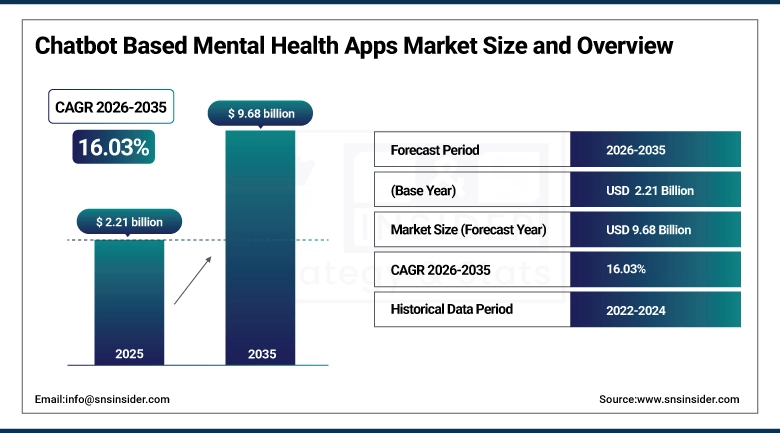
The Chatbot Based Mental Health Apps Market was valued at USD 2.21 billion in 2025 and is expected to reach USD 9.68 billion by 2035, growing at a CAGR of 16.03% from 2026-2035.
The Chatbot Based Mental Health Apps Market is growing due to factors such as an increase in awareness of mental health issues, an increase in smartphone penetration, and a growing need for cost-effective solutions that are accessible and confidential. Advances in technology, such as AI, machine learning, and natural language processing, allow for personalized interactions that are human-like in nature. This has led to an increase in the adoption of mental health solutions, making them extremely popular globally.
According to the World Health Organization (WHO), more than 1 billion people worldwide live with mental health conditions, highlighting the massive unmet need for scalable and accessible support tools such as chatbots and digital interventions.
Chatbot Based Mental Health Apps Market Size and Forecast
-
Market Size in 2025: USD 2.21 Billion
-
Market Size by 2035: USD 9.68 Billion
-
CAGR: 16.03% from 2026 to 2035
-
Base Year: 2025
-
Forecast Period: 2026–2035
-
Historical Data: 2022–2024
To Get more information on Chatbot Based Mental Health Apps Market - Request Free Sample Report
Chatbot Based Mental Health Apps Market Trends
-
Rising awareness of mental health issues and the need for accessible support is driving the chatbot-based mental health apps market.
-
Growing adoption of AI-powered chatbots for therapy, counseling, and stress management is boosting market growth.
-
Expansion across mobile platforms and integration with telehealth services is fueling deployment.
-
Increasing focus on personalized care, 24/7 accessibility, and stigma-free mental health support is shaping adoption trends.
-
Advancements in natural language processing, sentiment analysis, and machine learning are enhancing chatbot effectiveness and engagement.
-
Rising demand for cost-effective mental health solutions and remote care options is supporting market expansion.
-
Collaborations between app developers, healthcare providers, and AI technology firms are accelerating innovation and global adoption.
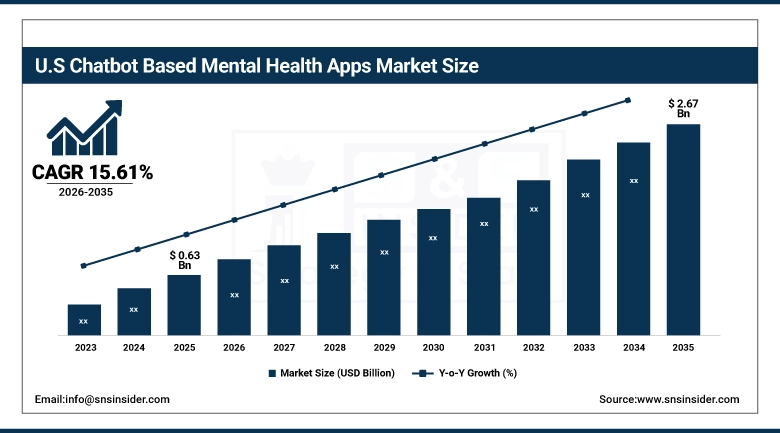
U.S. Chatbot Based Mental Health Apps Market was valued at USD 0.63 billion in 2025 and is expected to reach USD 2.67 billion by 2035, growing at a CAGR of 15.61% from 2026-2035.
The U.S. Chatbot Based Mental Health Apps Market is expanding due to high levels of mental health awareness, widespread use of smartphones, high adoption levels of advanced AI technologies, and a high need for cost-effective emotional support tools in workplaces and healthcare systems.
In 2022, it was estimated that 59.3 million U.S. adults (23.1%) suffered from any type of mental illness. The highest rate occurred in young adults aged 18-25 years (~36.2%), followed by 15.4 million adults (6%) that suffered from a serious mental illness in the last year.
Chatbot Based Mental Health Apps Market Growth Drivers:
-
Rising Mental Health Awareness Combined with Demand for Accessible, Cost-Effective, and Always-Available Digital Emotional Support Solutions
The rising awareness of depression, anxiety, and stress-related issues is prompting people to look for easily accessible mental health resources. The scarcity of mental health professionals, consultation fees, and waiting times is also motivating people to use easily accessible mental health resources, which are based on the use of a chatbot app. The rising use of smartphones and people's familiarity with digital health resources are also boosting the use of mental health resources. People are increasingly looking for easily accessible mental health resources, which provide a sense of individuality.
The government of the United States of America reports that there are tens of millions of people suffering from mental illness, with only half of them being treated. This is a clear indicator of the growing demand for mental health resources.
The statistics published by the Centers for Disease Control and Prevention report that 12.1 percent of adults in the United States of America often experience anxiety, and 4.8 percent of adults often experience depression.
Surveys conducted by major digital mental health providers, such as Woebot Health, report that more than 47 percent of people in America are interested in using a mental health chatbot.
Chatbot Based Mental Health Apps Market Restraints:
-
Concerns Around Data Privacy, Emotional Safety, and Confidential Handling of Highly Sensitive Mental Health Information
Dealing with such personal emotional data creates serious privacy and security issues for users. The fear of misuse, breach, or sharing of such data related to mental health issues is a concern, especially for regions that have stringent data security requirements. There is hesitation in sharing such sensitive information with AI tools, which creates a hindrance despite technological advancements and awareness about mental health issues across the world. There is a high risk of damaging brand trust instantly if any incident of data leakage or misuse is reported. These issues create hesitation in forming partnerships with enterprises, thus hindering the use of such tools despite technological advancements.
American Psychiatric Association, a prominent association, published a health advisory related to using generative AI chatbots for addressing mental health issues, stating that regulation and safety issues are not properly dealt with currently, creating a need to use these tools with caution, as they deal with sensitive emotional information.
Chatbot Based Mental Health Apps Market Opportunities:
-
Rising Adoption in Emerging Markets Supported by Smartphone Growth and Increasing Acceptance of Digital Mental Health Solutions
The emerging markets have tremendous growth potential as the penetration of smartphones is increasing and the number of mental health professionals is low. Chatbot-based applications are helping bridge the gap for people seeking mental health services at an affordable cost. Increasing awareness and normalization of the conversation around mental health are helping people accept the concept of seeking help with chatbot-based applications. Localization of the application with the use of languages and context also helps increase the engagement. The government and NGOs are also exploring the potential of digital-based solutions for the masses.
|
Company |
Description |
|
Wysa |
A global digital mental health platform with an AI chatbot that supports over 20 languages, including Spanish and Hindi. It is available worldwide via mobile apps and health ecosystems, making it relevant for diverse emerging market users. |
|
Woebot Health |
AI‑based conversational agent focusing on CBT‑style support. While based in the U.S., Woebot is used internationally and demonstrates how chatbot tools are being deployed across borders, often in regions with limited traditional mental health access. |
Chatbot Based Mental Health Apps Market Segment Highlights
-
By Technology, Machine Learning and Deep Learning dominated the Chatbot Based Mental Health Apps Market with ~45% share in 2025; Natural Language Processing fastest growing (CAGR).
-
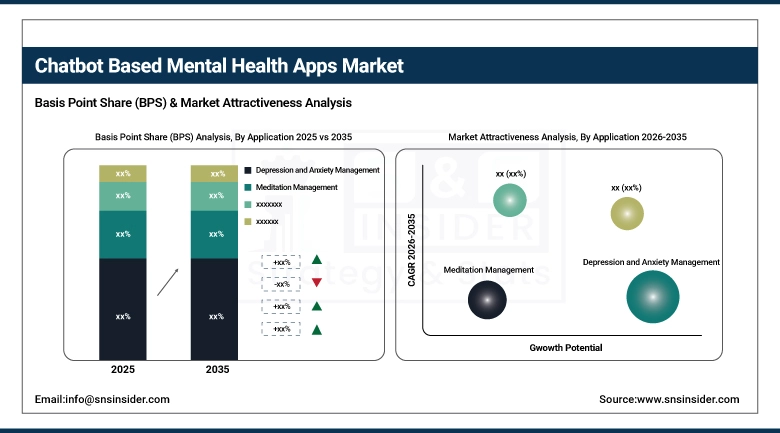
By Application, Depression & Anxiety Management dominated the Chatbot Based Mental Health Apps Market with ~35% share in 2025; Stress Management fastest growing (CAGR).
-
By Platform, Android dominated the Chatbot Based Mental Health Apps Market with ~56% share in 2025; Android fastest growing (CAGR).
-
By Device, Smartphones dominated the Chatbot Based Mental Health Apps Market with ~82% share in 2025; Smartphones fastest growing (CAGR).
Chatbot Based Mental Health Apps Market Segment Analysis
By Application, Depression & Anxiety Management segment dominates the Market, Stress Management segment expected to grow fastest
Depression and Anxiety Management segment held the major share in the Chatbot Based Mental Health Apps Market in 2025 due to the high prevalence rate worldwide and increasing awareness about depression and anxiety disorders. The segment is also gaining popularity due to the ability to monitor emotions, develop coping strategies for depression and anxiety disorders, availability of immediate support, and the stigma-free interface.
The Stress Management segment is also anticipated to have the highest CAGR from 2026 to 2035 due to increased pressure at work and in day-to-day life, which is causing more and more people to seek preventive mental well-being solutions. Chatbot-based tools provide instant relief techniques and mindfulness techniques that are being increasingly accepted by working professionals and youth across the world.
By Technology, Machine Learning & Deep Learning segment dominates the Market, Natural Language Processing segment expected to grow fastest
The Machine Learning and Deep Learning segment held the highest share in the Chatbot Based Mental Health Apps Market in 2025. This is due to the ability of these technologies to analyze user behavior, emotions, and interactions for providing better support. Machine learning and deep learning help in providing adaptive responses and learning for mental health support.
The Natural Language Processing segment is likely to witness the fastest CAGR during the period ranging from 2026 to 2035. This is due to the ability of this technology to support human-like conversations and emotions. Natural language processing is also likely to help in providing better support for mental health through improved sentiment analysis and support for multiple languages.
By Platform, Android segment dominates the Market and is expected to grow fastest
The Android segment accounted for the highest revenue share in the Chatbot Based Mental Health Apps Market in 2025. This is attributed to the widespread use of smartphones, the affordability of Android devices, and the penetration of Android across diverse groups. The easy availability of Android apps, ease of integration with AI tools, and the large user base of Android devices resulted in the highest growth of the segment. Android is also expected to grow at a high rate from 2026-2035.
By Device, Smartphones segment dominates the Market and is expected to grow fastest
Smartphone Segments held the maximum market size in the Chatbot Based Mental Health Apps Market in 2025, owing to the persistent need for user access, portability, and dependency on smartphone-based healthcare services. The increased usage of smartphones allows real-time emotional support, tracking, and instant chatbot interactions, owing to the increased dependency on smartphone-based healthcare services. The increased dependency on smartphone-based healthcare services is expected to increase the market size of the smartphone segments from 2026-2035.
Chatbot Based Mental Health Apps Market Regional Analysis
North America Chatbot Based Mental Health Apps Market Insights
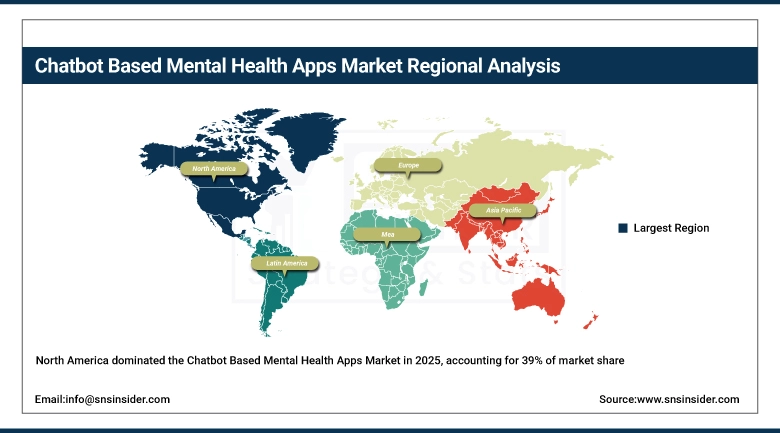
North America held the top position in the Chatbot Based Mental Health Apps Market in terms of revenue share, i.e., around 39% in 2025. This is due to high awareness about mental health disorders and high acceptance of digital mental health care solutions. The region also boasts high-end healthcare facilities, high smartphone penetration rates, and early adopters of AI technologies. Additionally, the region is home to key mental health app developers, favorable reimbursement policies, and employer-sponsored wellness programs. The region is also witnessing high demand for discreet and on-demand emotional support services, thus contributing to high revenue generation.
Get Customized Report as per Your Business Requirement - Enquiry Now
Asia Pacific Chatbot Based Mental Health Apps Market Insights
The Asia Pacific market is expected to grow at the highest CAGR of around 17.43% during the forecast period of 2026-2035. This is due to the high growth rate of urbanization, increasing levels of stress, and awareness of mental health. The increasing number of smartphone users, low-cost internet services, and the presence of a young population are also fueling the growth of the app market. Lack of availability of mental health experts is also leading people to adopt chatbot-based solutions. Government initiatives for digital health and the increasing acceptance of AI-based healthcare solutions are also helping the market grow rapidly.
Europe Chatbot Based Mental Health Apps Market Insights
Europe, in the context of the chatbot-based mental health apps market, is emerging as a market with consistent growth due to increasing awareness about mental health and the use of digital health solutions. Strong regulatory environments, high penetration of smartphones, and increasing acceptance of AI-based mental health services are adding to the growth of the market in this region. Employer-based initiatives, integration with national health services, and data privacy concerns are driving the market in various European countries.
Middle East & Africa and Latin America Chatbot Based Mental Health Apps Market Insights
Middle East & Africa and Latin America in the Chatbot Based Mental Health Apps Market are witnessing a steady growth rate owing to the increasing connectivity of the population with the internet and the overall awareness of mental health. The increasing penetration of smartphones, scarcity of mental health practitioners, and the increasing acceptance of digital health solutions will fuel the growth of the market. The government is promoting the adoption of digital health solutions in the region, and the affordability of chatbot-based support is a major factor for the population.
Chatbot Based Mental Health Apps Market Competitive Landscape:
Wysa
Wysa is an AI-based mental health platform that offers a range of services, including conversational agents, evidence-based therapies, and human coaching, for the betterment of emotional health. The organization was established in 2015 in India, with the AI-based platform detecting stress, anxiety, and mental health risk, while offering interventions like CBT, mindfulness, and journaling exercises, with the platform focusing on privacy, access, and scalability, thereby reaching the world while filling the gaps in mental health with innovative AI-based tools for communication in multiple languages.
-
2023: Wysa’s AI platform detected 82 % of users in crisis via SOS triggers, demonstrating AI’s effectiveness in safety monitoring and escalation support.
-
2025: Wysa launched multilingual chatbot capabilities, adding six languages including French, German, Italian, Arabic, Japanese, and Brazilian Portuguese to expand global access.
Talkspace
Talkspace is an online therapy and tele-mental health service that was founded in 2012 and is based in New York. The company offers licensed therapists and uses AI tools to detect risk factors and improve the quality of service. The AI innovations of the company include the detection of suicide risks and the use of podcasts. With the use of AI and licensed therapists, the company hopes to improve the quality of service and reach more people across the globe.
-
2023: Talkspace’s AI algorithm alerted therapists to suicide risk in patient messages, enabling faster clinician response and intervention during critical moments.
-
2024: Talkspace formed a Dedicated AI Innovation Group to enhance clinical quality and integrate AI features for providers.
-
2025: Talkspace launched Talkcast, an AI-powered personalized podcast feature, supporting clients between therapy sessions with tailored mental health content.
Key Players
Some of the Chatbot Based Mental Health Apps Market Companies
-
Woebot Health
-
Wysa
-
Youper
-
Replika
-
Talkspace
-
Ginger
-
Sanvello
-
Matellio
-
Headspace Health
-
Earkick
-
Marigold Health
-
Life Clips, Inc.
-
Biobeat
-
Cognoa, Inc.
-
Lyra Health, Inc.
-
Limbic (Limbic Inc.)
-
Tess (X2AI Inc.)
-
BetterHelp
-
7 Cups
-
Happify Health
| Report Attributes | Details |
|---|---|
| Market Size in 2025 | USD 2.21 Billion |
| Market Size by 2035 | USD 9.68 Billion |
| CAGR | CAGR of 16.03% From 2026 to 2035 |
| Base Year | 2025 |
| Forecast Period | 2026-2035 |
| Historical Data | 2022-2024 |
| Report Scope & Coverage | Market Size, Segments Analysis, Competitive Landscape, Regional Analysis, DROC & SWOT Analysis, Forecast Outlook |
| Key Segments | • By Application (Depression and Anxiety Management, Meditation Management, Stress Management, Wellness Management, Others) • By Technology (Machine Learning and Deep Learning, Natural Language Processing, Others) • By Platform (Android, iOS, Others) • By Device (Smartphones, Tablets) |
| Regional Analysis/Coverage | North America (US, Canada), Europe (Germany, UK, France, Italy, Spain, Russia, Poland, Rest of Europe), Asia Pacific (China, India, Japan, South Korea, Australia, ASEAN Countries, Rest of Asia Pacific), Middle East & Africa (UAE, Saudi Arabia, Qatar, South Africa, Rest of Middle East & Africa), Latin America (Brazil, Argentina, Mexico, Colombia, Rest of Latin America). |
| Company Profiles | Woebot Health, Wysa, Youper, Replika, Talkspace, Ginger, Sanvello, Matellio, Headspace Health, Earkick, Marigold Health, Life Clips, Inc., Biobeat, Cognoa, Inc., Lyra Health, Inc., Limbic (Limbic Inc.), Tess (X2AI Inc.), BetterHelp, 7 Cups, Happify Health |
Frequently Asked Questions
North America dominated the Chatbot Based Mental Health Apps Market in 2025.
The Android segment dominated the Chatbot Based Mental Health Apps Market in 2025.
Rising Mental Health Awareness Combined with Demand for Accessible, Cost-Effective, and Always-Available Digital Emotional Support Solutions.
The Chatbot Based Mental Health Apps Market was valued at USD 2.21 billion in 2025.
The Chatbot Based Mental Health Apps Market is expected to grow at a CAGR of 16.03% from 2026 to 2035.
