
Clinical Laboratory Services Market Report Scope & Overview:
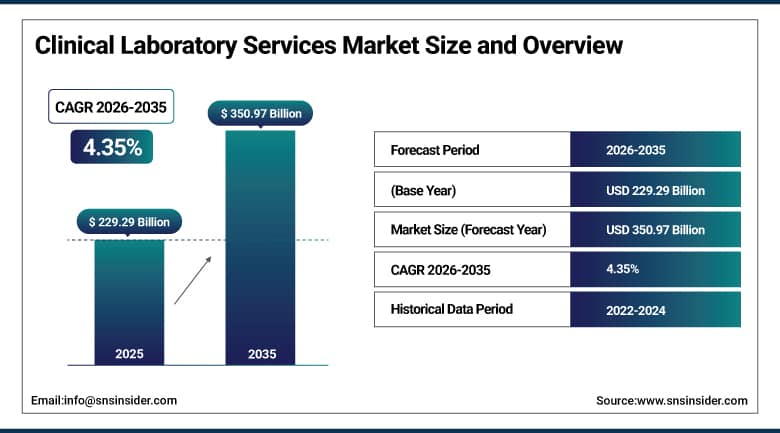
The Clinical Laboratory Services Market was valued at USD 229.29 Billion in 2025 and is expected to reach USD 350.97 Billion by 2035, growing at a CAGR of 4.35% from 2026-2035.
Clinical laboratory services constitute a foundational category within modern healthcare delivery, integrating chemistry analyzers, hematology platforms, and molecular diagnostic instruments with skilled personnel who generate the test results underpinning the majority of clinical decisions. Rising chronic disease prevalence, an ageing global population, and expanding preventive screening programs continue to broaden the patient population requiring routine and specialized laboratory testing. Hospitals, independent reference laboratories, and an expanding base of clinic-based providers rely on this infrastructure to support diagnosis, treatment monitoring, and long-term disease management. Sustained growth is being shaped by broader adoption of genomic and molecular testing, continued laboratory consolidation, and rising government investment in diagnostic infrastructure, reinforcing this market's position as a durable, technology-led segment of the wider healthcare industry.
On July 3, 2024, Quest Diagnostics announced a definitive agreement with OMERS to acquire LifeLabs, a leading provider of community laboratory testing for millions of Canadians, for approximately USD 985 million including net debt. The company stated the acquisition would help accelerate LifeLabs' digital diagnostics capabilities.
To Get More Information On Clinical Laboratory Services Market - Request Free Sample Report
Clinical Laboratory Services Market Trends:
-
Rising integration of genomic and molecular diagnostic platforms supporting personalized treatment decisions.
-
Growing consolidation as leading reference laboratories acquire hospital outreach and independent lab businesses.
-
Expanding adoption of laboratory automation reducing turnaround time across high-volume testing facilities.
-
Increasing demand for direct-to-consumer and point-of-care testing extending diagnostics beyond traditional settings.
-
Rising regulatory scrutiny of laboratory-developed tests shaping compliance investment across major providers.
-
Growing use of artificial intelligence in pathology and cytology interpretation improving diagnostic consistency.
U.S. Clinical Laboratory Services Market Overview:
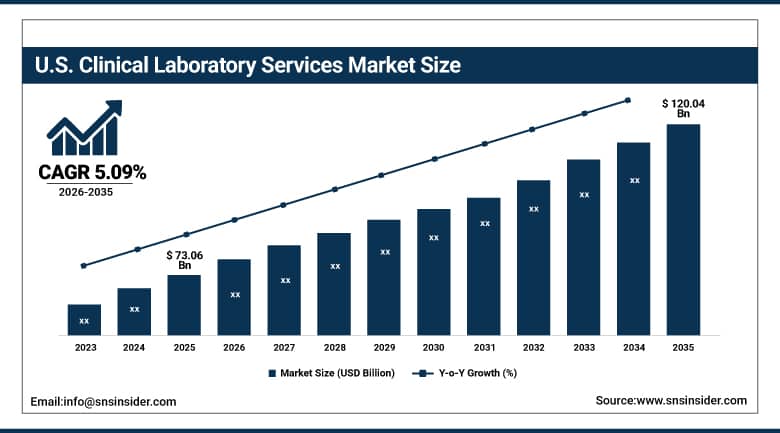
The U.S. Clinical Laboratory Services Market was valued at USD 73.06 Billion in 2025 and is expected to reach USD 120.04 Billion by 2035, growing at a CAGR of 5.09% from 2026-2035.
The domestic market remains driven by the presence of a large and aging patient population needing regular diagnostic tests and by consolidation in reference labs gaining hospital outreach and independent laboratory services in metropolitan markets. Key vendors remain in the process of adding to their portfolio of advanced diagnostic tests, which includes oncology and minimal residual disease tests, whereas the discussion of laboratory payments becomes a part of strategic planning of key vendors in the industry. The growing volume of genomic and molecular tests helps drive domestic market expansion through the development of more advanced diagnostic tests within routine clinical settings across the country. Investments in laboratory automation and digital pathology in major metropolitan healthcare systems help improve domestic testing capabilities and allow for key vendors to manage increased test volume while maintaining turnaround times.
In January 2025, Quest Diagnostics completed the acquisition of the outreach clinical laboratory services business of University Hospitals, expanding access to its diagnostic test menu and health plan network across Ohio. The acquisition extended a broader wave of domestic laboratory consolidation activity throughout 2024 and 2025.
Clinical Laboratory Services Market Segment Analysis:
-
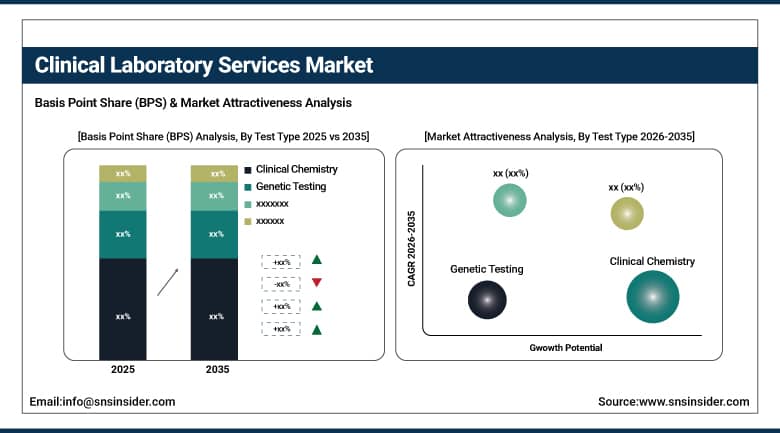
By Test Type, the Clinical Chemistry segment dominated the market with a 45.00% share in 2025, while the Genetic Testing segment is the fastest growing with a CAGR of 7.90% during 2026-2035.
-
By Service Provider, the Hospital-Based Laboratories segment dominated the market with a 56.50% share in 2025, while the Independent/Reference Laboratories segment is the fastest growing with a CAGR of 7.20% during 2026-2035.
-
By Application, the Bioanalytical & Lab Chemistry Services segment dominated the market with a 41.20% share in 2025, while the Genomics & Molecular Diagnostics segment is the fastest growing with a CAGR of 8.10% during 2026-2035.
By Test Type, Clinical Chemistry Dominates the Market and Genetic Testing Grows Fastest
Clinical Chemistry dominated the market in 2025, a position built on its role as the foundational testing category underpinning routine metabolic panels, lipid profiles, and organ function assessments ordered across virtually every clinical encounter worldwide. Physicians favour this test category precisely because it delivers fast, cost-effective, and clinically actionable results across a remarkably broad range of diagnostic and monitoring contexts, a combination that continues to make clinical chemistry the default first-line testing approach across primary care, emergency departments, and specialist practices alike. This everyday clinical relevance, spanning community clinics through large academic medical centers, keeps clinical chemistry central to routine diagnostic testing across virtually every healthcare setting globally, sustaining recurring test volume even as more sophisticated molecular categories continue to expand around it.
Genetic Testing is projected to be the fastest-growing test category over the forecast period. Rising adoption of hereditary cancer screening, pharmacogenomic testing, and prenatal genetic panels continues to expand the clinical use cases for this category well beyond its historical niche in rare disease diagnosis, while continued declines in sequencing costs keep making genomic testing increasingly accessible across mainstream clinical practice. As payers increasingly recognize the value of genetic testing in guiding treatment selection and avoiding adverse drug reactions, this segment continues to pull ahead of more established test categories in overall percentage growth even as clinical chemistry retains the larger overall test volume.
By Service Provider, Hospital-Based Laboratories Dominates the Market and Independent/Reference Laboratories Grows Fastest
Hospital-Based Laboratories dominated the market in 2025. The scale and complexity of testing required to support inpatient care, emergency medicine, and surgical services continues to require the broadest and most comprehensive on-site laboratory infrastructure of any single provider category, spanning routine chemistry through complex microbiology and blood banking services delivered around the clock. This breadth of clinical capability, combined with the sheer testing volume that major hospital systems process daily, continues to sustain hospital-based laboratories as the clear leading service provider category across the broader market.
Independent/Reference Laboratories are expected to be the fastest-growing service provider category over the forecast period. Continued acquisition of hospital outreach laboratory businesses by large national reference laboratories continues shifting testing volume away from smaller, standalone hospital labs toward centralized, highly automated facilities capable of achieving superior economies of scale. As health systems increasingly outsource routine and specialized testing to focus internal resources on core clinical operations, independent and reference laboratories continue closing the gap with hospital-based providers in overall market demand.
By Application, Bioanalytical & Lab Chemistry Services Dominates the Market and Genomics & Molecular Diagnostics Grows Fastest
Bioanalytical & Lab Chemistry Services dominated the market in 2025. Routine diagnostics, therapeutic drug monitoring, and clinical research applications continue to represent the single largest driver of overall laboratory testing volume worldwide, spanning both acute and chronic disease management contexts across virtually every healthcare system globally. This foundational clinical role continues to sustain bioanalytical services as the largest application category by a clear margin, even as genomics-focused applications continue gaining ground as sequencing technology becomes increasingly integrated into mainstream diagnostic workflows.
Genomics & Molecular Diagnostics are projected to expand fastest over the forecast period. Growing integration of next-generation sequencing and multi-omics testing into oncology, infectious disease, and reproductive health workflows continues to expand the clinical footprint of this application category well beyond its historical research-focused origins. As laboratories increasingly build out dedicated molecular diagnostics divisions to capture this growing demand, genomics and molecular diagnostics continue closing the gap with conventional bioanalytical services in overall market demand.
Regional Analysis:
|
Region |
Major Country |
Share within Region, 2025 |
|---|---|---|
|
North America |
United States |
80.67% |
|
Europe |
Germany |
28.40% |
|
Asia Pacific |
China |
33.70% |
|
Latin America |
Brazil |
41.30% |
|
Middle East & Africa |
South Africa |
30.60% |
North America Clinical Laboratory Services Market Insights
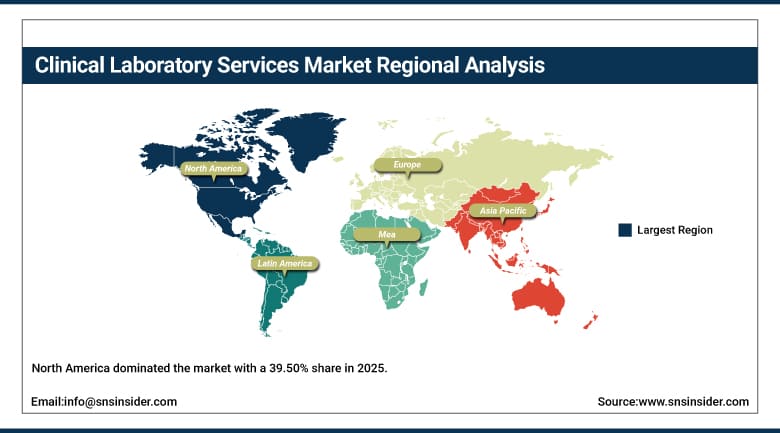
North America dominated the market with a 39.50% share in 2025. Advanced healthcare infrastructure, rising chronic disease prevalence, an ageing population, and continued technological innovation across leading reference laboratories headquartered within the region continue to anchor this leadership position across both hospital and independent laboratory settings. Genomic and molecular testing keeps extending well beyond flagship academic medical centers into community hospitals and independent laboratory networks, as physicians and health systems alike grow increasingly comfortable relying on advanced diagnostic technology to guide treatment decisions, reinforcing the region's position at the technological forefront of this industry.
Canada contributes steady incremental demand as its provincial health systems continue widening laboratory testing access across both urban and rural communities. Continued investment in laboratory automation and genomic testing platforms across the broader region is expected to keep North America in the lead through the forecast period, even as growth in percentage terms trails faster-scaling Asia Pacific markets that continue building out diagnostic infrastructure from a considerably smaller existing base.
Get Customized Report as Per Your Business Requirement - Enquiry Now
Asia Pacific Clinical Laboratory Services Market Insights
Asia Pacific is projected to be the fastest-growing region, registering a CAGR of 6.28% during 2026-2035, supported by rising healthcare spending, expanding hospital infrastructure, and growing public awareness of preventive diagnostic testing across an enormous and rapidly ageing population base. China continues to anchor regional demand as hospital networks and independent laboratory chains expand diagnostic testing capability across both established urban medical centers and rapidly developing regional healthcare facilities, supported by sustained government investment in modernising the country's broader healthcare infrastructure.
India's expanding hospital infrastructure and rising chronic disease incidence continue adding meaningful regional growth as domestic laboratory chains extend testing capability into previously underserved areas. Japan and South Korea contribute further depth through established, technically advanced healthcare systems, with regional laboratories notably active in genomic testing and automation platform development, positioning the wider region to sustain the fastest percentage growth of any global market through 2035.
Europe Clinical Laboratory Services Market Insights
Europe holds a meaningful share of the global market, underpinned by a dense concentration of established diagnostic laboratory networks and continued advancement in molecular testing technology developed for both hospital and independent laboratory settings. Germany's substantial hospital and laboratory manufacturing base anchors regional demand, supported by a well-developed reimbursement framework that continues to favour early adoption of next-generation diagnostic testing technology across both public and private healthcare providers operating throughout the country and neighbouring markets.
The United Kingdom, France, and other major European markets contribute consistent demand as national health systems keep extending advanced diagnostic technology into routine clinical practice. Continued centralization of laboratory services across national health systems keeps informing testing volume distribution and technology investment, reflecting the region's role as both an established manufacturing base and a mature, steadily growing end market for clinical laboratory services.
MEA & Latin America Clinical Laboratory Services Market Insights
The Middle East & Africa market is supported by growing healthcare infrastructure spending across South Africa and Gulf Cooperation Council markets, where rising chronic disease prevalence continues to lift demand for modern diagnostic testing equipment across both public hospital networks and an expanding private healthcare sector. Regional governments continue channeling substantial investment into expanding diagnostic testing access, including dedicated laboratory networks designed to reduce reliance on overseas testing for complex cases.
Latin America's market is anchored by Brazil, where a sizeable domestic healthcare sector sustains steady testing demand across both public and private hospital systems. Mexico contributes further incremental growth as healthcare access continues to widen across the broader region, though adoption of the most advanced genomic and molecular testing platforms across Latin America as a whole still lags meaningfully behind more established markets in North America and Europe.
Market Dynamics:
Growth Drivers: Rising Chronic Disease Burden and Ageing Population
Rising chronic disease prevalence stands as the primary growth driver, reinforced by expanding healthcare spending, an ageing population, and growing rates of diabetes and cardiovascular disease that continue widening the patient pool requiring routine and specialized diagnostic testing worldwide. The World Health Organization's projection that the global population aged over 60 will nearly double between 2015 and 2050 continues to underpin sustained long-term demand, as this demographic shift translates directly into a larger base of patients requiring regular laboratory testing across both developed and emerging healthcare systems alike.
Growing adoption of genomic and molecular diagnostic testing represents a second major driver, supported by declining sequencing costs and rising physician demand for testing capable of guiding increasingly personalized treatment decisions. Increasing prevalence of preventive health screening programs, paired with rising demand for laboratory infrastructure capable of processing growing test volumes efficiently, continues to reinforce sustained market expansion across both established Western healthcare systems and rapidly developing markets.
Restraints: Reimbursement Pressure and Regulatory Compliance Costs
Reimbursement pressure remains a genuine restraint on market growth, as ongoing policy debates around laboratory payment rates continue to command significant industry attention and create uncertainty around long-term revenue predictability for providers operating on tighter margins. This pressure particularly affects smaller independent laboratories operating in markets with less favourable payer mix, where reimbursement rate reductions can meaningfully exceed what many smaller operators can reasonably absorb without impacting service quality or capacity.
Regulatory compliance costs present a further restraint, as continued scrutiny of laboratory-developed tests and evolving quality standards keep raising genuine questions around compliance investment requirements across differing regulatory regimes worldwide. This requires laboratories operating at scale to sustain substantial ongoing compliance investment, spanning proficiency testing, accreditation maintenance, and validation studies that can meaningfully complicate new test introduction timelines.
Opportunities: Genomic Testing Expansion and Laboratory Consolidation
Continued expansion of genomic and molecular diagnostic testing offers a substantial opportunity, as laboratories building out dedicated sequencing and multi-omics testing capability stand to capture meaningful new demand from physicians seeking more precise, personalized treatment guidance. Health systems increasingly view these capabilities not as a novelty feature but as a genuine clinical necessity capable of improving treatment outcomes while reducing costly trial-and-error prescribing across oncology and other complex disease categories.
The continued consolidation of hospital outreach and independent laboratory businesses under large national reference laboratory networks presents a further avenue for growth, as acquiring companies extend their diagnostic test menus and geographic reach without needing to build new infrastructure from scratch. This consolidation pathway continues to lower per-test operating costs for acquiring laboratories while giving acquired businesses access to broader technology platforms and specialized testing capability.
Recent Developments:
-
On September 17, 2024, Labcorp announced an agreement with Cinven, Inc. to acquire a 15% minority interest in SYNLAB, a leading medical diagnostic services and specialty testing provider in Europe, for approximately USD 151.6 million.
-
On September 30, 2024, Labcorp completed the acquisition of select assets of Invitae, extending its specialty genetic testing capabilities and ability to utilize genetic data across oncology and select rare disease treatment programs.
-
In 2024, Sonic Healthcare acquired German laboratory firm Laboratory Group Dr. Kramer and Colleagues for approximately USD 444 million, expanding its diagnostic testing footprint across Germany and Switzerland.
-
On March 11, 2025, Labcorp announced an agreement with OPKO Health, Inc. to acquire select assets of BioReference Health's oncology and oncology-related clinical testing services business for up to USD 225 million.
Clinical Laboratory Services Market Key Players:
-
Becton, Dickinson and Company
-
bioMérieux SA
-
Charles River Laboratories International, Inc.
-
Sonic Healthcare Limited
-
Eurofins Scientific SE
-
Unilabs SA
-
Sysmex Corporation
-
F. Hoffmann-La Roche Ltd
-
Siemens Healthineers AG
-
Danaher Corporation
-
Thermo Fisher Scientific Inc.
-
OPKO Health, Inc.
-
NeoGenomics Laboratories, Inc.
-
ARUP Laboratories
-
Mayo Clinic Laboratories
-
Fresenius Medical Care AG & Co. KGaA
-
SYNLAB Group
Clinical Laboratory Services Market Report Scope:
| Report Attributes | Details |
|---|---|
| Market Size in 2025 | USD 229.29 Billion |
| Market Size by 2035 | USD 350.97 Billion |
| CAGR | CAGR of 4.35% From 2026 to 2035 |
| Base Year | 2025 |
| Forecast Period | 2026-2035 |
| Historical Data | 2022-2024 |
| Report Scope & Coverage | Market Size, Segments Analysis, Competitive Landscape, Regional Analysis, DROC & SWOT Analysis, Forecast Outlook |
| Key Segments | • by Test Type (Clinical Chemistry, Hematology, Genetic Testing, Microbiology, and Immunology) • by Service Provider (Hospital-Based Laboratories, Independent/Reference Laboratories, and Clinic-Based Laboratories) • by Application (Bioanalytical & Lab Chemistry Services, Genomics & Molecular Diagnostics, and Drug Discovery Support) |
| Regional Analysis/Coverage | North America (US, Canada), Europe (Germany, UK, France, Italy, Spain, Russia, Poland, Rest of Europe), Asia Pacific (China, India, Japan, South Korea, Australia, ASEAN Countries, Rest of Asia Pacific), Middle East & Africa (UAE, Saudi Arabia, Qatar, South Africa, Rest of Middle East & Africa), Latin America (Brazil, Argentina, Mexico, Colombia, Rest of Latin America). |
| Company Profiles | Quest Diagnostics Incorporated, Laboratory Corporation of America Holdings (Labcorp), Abbott Laboratories, Becton, Dickinson and Company, bioMérieux SA, Charles River Laboratories International, Inc., Sonic Healthcare Limited, Eurofins Scientific SE, Unilabs SA, Sysmex Corporation, F. Hoffmann-La Roche Ltd, Siemens Healthineers AG, Danaher Corporation, Thermo Fisher Scientific Inc., OPKO Health, Inc., NeoGenomics Laboratories, Inc., ARUP Laboratories, Mayo Clinic Laboratories, Fresenius Medical Care AG & Co. KGaA, SYNLAB Group |
Frequently Asked Questions
Key players include Quest Diagnostics, Labcorp, Abbott Laboratories, Becton Dickinson, bioMérieux, Charles River Laboratories, Sonic Healthcare, Eurofins Scientific, Unilabs, and Sysmex Corporation, among others.
Continued expansion of genomic and molecular diagnostic testing and the continued consolidation of hospital outreach and independent laboratory businesses represent the two most significant opportunities shaping the market's next phase of growth.
Growth is primarily driven by rising chronic disease prevalence and an ageing population, combined with growing adoption of genomic and molecular diagnostic testing guiding personalized treatment decisions.
By Service Provider, Hospital-Based Laboratories dominated the market with a 56.50% share in 2025, reflecting their comprehensive on-site testing infrastructure supporting inpatient and emergency care
North America dominated the market with a 39.50% share in 2025, supported by advanced healthcare infrastructure and a dense concentration of leading reference laboratories headquartered within the region.
