
Computer Vision AI Camera Market Report Scope & Overview:
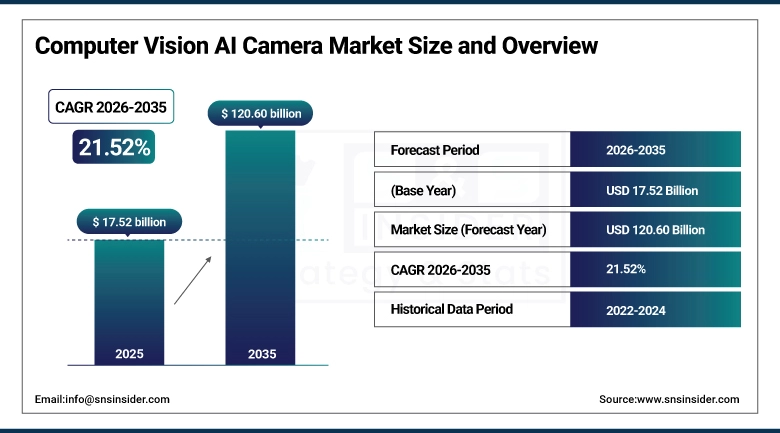
The Computer Vision AI Camera Market size is valued at USD 17.52 Billion in 2025 and is projected to reach USD 120.60 Billion by 2035, growing at a CAGR of 21.52% during the forecast period 2026-2035.
The Computer Vision AI Camera Market analysis report offers a detailed analysis of the Computer Vision AI Camera Market, including its dynamics, technology, and application-based adoption scenario. The increasing need for intelligent surveillance systems, the growing adoption of automation technologies, and the increasing adoption of AI with edge and cloud computing are fueling the Computer Vision AI Camera Market to grow at a rapid pace during 2026-2035.
The computer vision AI camera installations crossed the count of hundreds of millions of units installed in 2025, owing to the rapid adoption of smart cities, industrial automation, and AI camera installations.
To Get more information on Computer Vision AI Camera Market - Request Free Sample Report
Computer Vision AI Camera Market Trends:
-
The growing demand for intelligent security and surveillance systems has led to a widespread adoption of computer vision AI cameras.
-
The growing implementation of smart city projects and infrastructure development has led to a rapid adoption of AI cameras.
-
The growing implementation and adoption of automation and Industry 4.0 concepts in the manufacturing sector has led to a rapid adoption of AI cameras.
-
The rapid development and implementation of edge AI, cloud computing, and IoT technologies have improved system efficiency.
-
The growing use cases and implementation of AI cameras in retail analytics, healthcare, and autonomous vehicles have provided a new avenue for growth.
-
The growing development and implementation of deep learning, computer vision, and image sensor technologies have improved AI camera accuracy and reliability.
U.S. Computer Vision AI Camera Market Size Outlook:
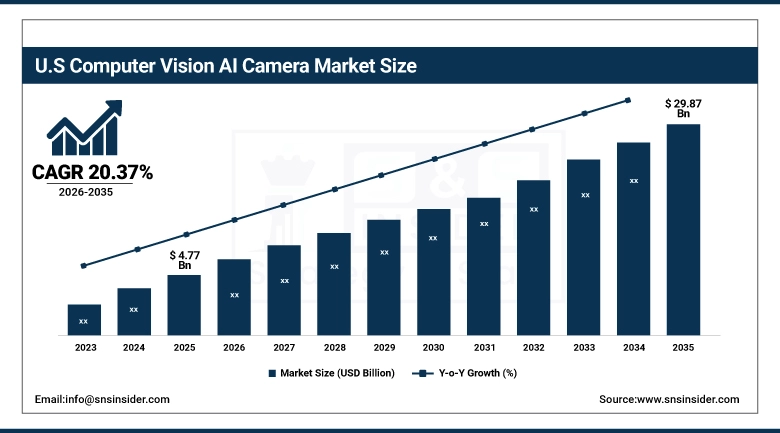
The US Computer Vision AI Camera Market size has been forecasted to grow from USD 4.77 Billion in 2025 to USD 29.87 Billion in 2035, growing at a CAGR of 20.37% during the forecast period. This can be attributed to the increased adoption of AI-based security cameras, growing smart city deployments, a high demand for automation in manufacturing and retail analytics, and increased adoption of edge AI, cloud, and IoT-based camera systems in enterprises, governments, and transportation industries.
Computer Vision AI Camera Market Growth Drivers:
-
Rising demand for intelligent surveillance, automation, and real-time visual analytics driving adoption of computer vision AI cameras across industries.
Rising demand for intelligent surveillance, automation, and real-time visual analytics are key drivers for the Computer Vision AI Camera Market, and its growth can be attributed to the increased use of AI-enabled cameras for security, quality, traffic, and other applications by industries, organizations, and government bodies. The use of intelligent technologies such as deep learning, edge AI, IoT, and cloud-based analytics has improved accuracy, reduced latency, and enabled real-time analytics and decision-making, thereby fuelling the Computer Vision AI Camera Market growth.
More than 60% of enterprises, smart city projects, and industrial facilities adopted AI-enabled vision systems in 2025 for intelligent surveillance, automation, and analytics-based decision-making.
Computer Vision AI Camera Market Restraints:
-
High implementation costs and data privacy issues are some of the restraining factors for the widespread use of computer vision AI cameras in specific industries and regions.
The high implementation costs of AI-based camera solutions, along with the high cost of associated hardware, edge computing devices, and software licensing, are some of the restraining factors for the Computer Vision AI Camera Market. Budget constraints are one of the major restraining factors for small and mid-sized businesses. Moreover, issues related to data privacy and surveillance are also restraining factors for the Computer Vision AI Camera Market. Cybersecurity risks, storage of data, and the need for skilled professionals to manage AI-based solutions are some of the restraining factors for the Computer Vision AI Camera Market.
Computer Vision AI Camera Market Opportunities:
-
Significant opportunities for market expansion can be seen in terms of increased investments in smart cities, industrial automation, and edge computing infrastructure for AI cameras.
Growing investments in smart cities, industrial automation, and edge computing infrastructure for AI camera systems have created tremendous opportunities for the Computer Vision AI Camera Market. Governments and industries have been increasingly investing in smart cities, industrial automation, and edge computing infrastructure for AI camera systems. In parallel, various industries have been increasingly investing in computer vision technology for industrial automation, retail, healthcare, transportation, and other industries for increased efficiency and quality. These opportunities have encouraged technology providers to innovate and expand computer vision technology for AI camera systems in various markets.
More than half of the smart cities, industrial automation, and large industries have been investing in AI-based vision systems for automation, monitoring, and decision-making in 2025.
Computer Vision AI Camera Market Segmentation Analysis:
-
By Type, Smart Cameras (Edge AI Cameras) held the largest market share of 57.25% in 2025, while PC-Based Vision Systems are expected to grow at the fastest CAGR of 17.24% during 2026–2035.
-
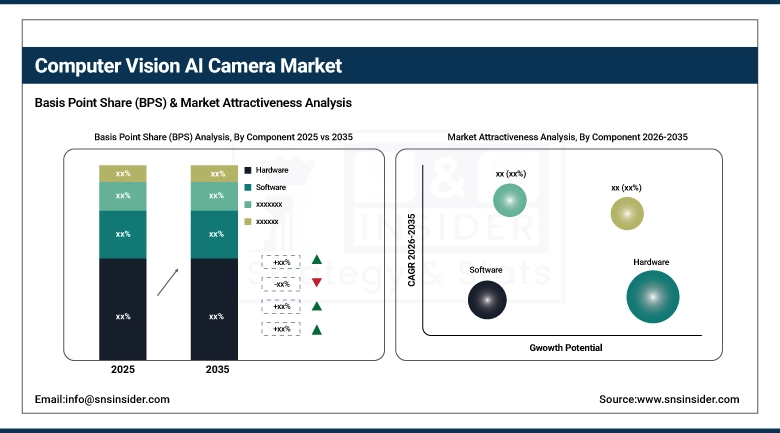
By Component, Hardware accounted for the highest market share of 56.21% in 2025, while Software is expected to grow at the fastest CAGR of 17.41% during 2026–2035.
-
By Technology, Image Processing dominated with a market share of 61.25% in 2025, whereas Deep Learning is projected to grow at the fastest CAGR of 21.47% during 2026–2035.
-
By End-Use Industry, Government & Defense held the largest share of 37.12% in 2025, while Healthcare is expected to grow at the fastest CAGR of 19.37% during 2026–2035.
-
By Application, Surveillance & Security dominated with a market share of 45.25% in 2025, while Traffic Monitoring is expected to grow at the fastest CAGR of 23.36% during 2026–2035.
By Type, Smart Cameras Dominate While Embedded Vision Cameras Grow Rapidly:
Smart Cameras (Edge AI Cameras) segment accounted for the largest share in the market, owing to their real-time processing capabilities, presence of AI, and their widespread use in various applications, including security, industrial automation, and smart infrastructure. In 2025, their use surpassed a considerable base in manufacturing, retail, and security applications, indicating a strong demand for smart vision applications.
Embedded Vision Cameras segment has been observed to be the fastest-growing segment, attributed to the increasing presence of AI capabilities in compact devices, development of IoT, and rising demand for cost-efficient vision applications.
By Component, Hardware Dominates While Software Grows Rapidly:
Hardware segment was at the forefront in terms of market dominance, considering the high demand for sophisticated image sensors, processors, lenses, and camera modules, which act as the basis for computer vision systems. In 2025, large-scale deployments in various enterprises and cities further cemented hardware's position in facilitating image acquisition and processing.
The software segment is witnessing rapid growth due to technological developments in AI, deep learning, and computer vision systems, enabling more accurate object detection, recognition, and predictive analysis. The increased focus on data-driven decision-making and software upgrades is further propelling software segment adoption.
By Technology, Image Processing Dominates While Deep Learning Grows Rapidly:
The image processing segment held the largest market share due to its foundational position in traditional computer vision systems, which facilitate image enhancement, image segmentation, image filtering, and pattern recognition. In 2025, large-scale deployments in industrial and security scenarios will continue to rely on image processing techniques.
Deep Learning is the fastest-growing segment due to the superior ability of deep learning in handling complex visual data, which facilitates object detection, facial recognition, anomaly detection, and autonomous decision-making. The increasing adoption of neural networks, availability of large datasets, and advancements in GPU computing will continue to drive the adoption of deep learning in modern computer vision systems.
By Application, Surveillance & Security Dominates While Traffic Monitoring Grows Rapidly:
The Surveillance & Security segment has dominated the market, with a large installed base of AI-powered cameras integrated into public safety, commercial, and critical infrastructure applications. In 2025, the segment has seen growing adoption due to the demand for real-time monitoring, intrusion detection, facial recognition, and prevention of crimes.
The segment with the highest growth rate is Traffic Monitoring, with growing adoption due to urbanization, increased traffic density, and smart city initiatives. In 2025, the segment has seen growing deployments for highways and intersections for congestion management, traffic flow management, and violation detection.
By End-Use Industry, Government & Defense Dominates While Healthcare Grows Rapidly:
Government & Defense segment accounted for the largest share of the market due to the high adoption of surveillance systems, border security systems, and infrastructure monitoring systems. In 2025, the segment witnessed a high level of adoption of vision systems in various defense facilities and law enforcement agencies.
Healthcare segment is expected to witness the highest growth rate due to the increasing adoption of AI-based vision systems in the diagnosis and treatment of patients and the automation of workflows. In 2025, the segment witnessed a high level of adoption of vision systems in various medical facilities and diagnostic centers.
North America Computer Vision AI Camera Market Insights:
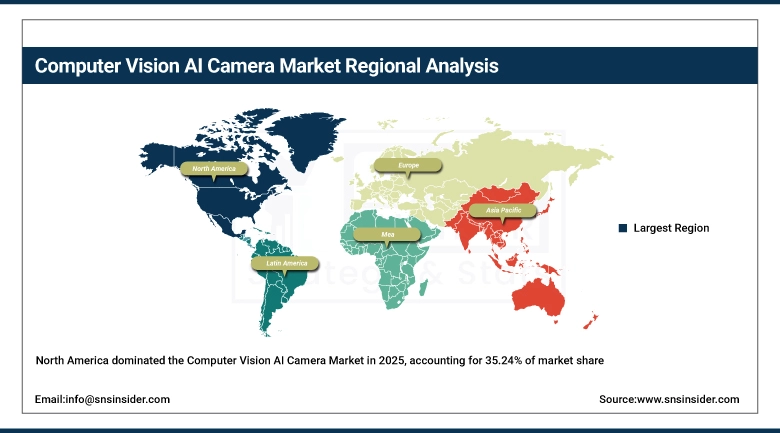
North America Computer Vision AI Camera Market: This segment is dominated by the North America region with a 35.24% share in the year 2025 due to the high adoption of advanced computer vision AI cameras, the presence of technology providers, and the use of these systems in various industries and applications. This region is expected to benefit due to the high investments in AI infrastructure and the early adoption of edge AI and intelligent video analytics in various industries and applications such as manufacturing, retail, and transportation.
Get Customized Report as per Your Business Requirement - Enquiry Now
U.S. Computer Vision AI Camera Market Insights:
U.S. Computer Vision AI Camera Market is driven by the high adoption of AI cameras and computer vision systems in various industries and applications due to the presence of technology providers and the use of these systems in various industries and applications such as retail analytics, autonomous systems, and healthcare imaging.
Asia-Pacific Computer Vision AI Camera Market Insights:
The Asia-Pacific Computer Vision AI Camera Market has been identified as the fastest-growing region, with a growth rate of 23.21% during 2026-2035. The region has been driven by rapid industrialization, smart city development, and increasing adoption of AI camera technologies. Countries such as China, India, Japan, and Korea have been witnessing rapid deployment of AI camera technologies in various sectors such as manufacturing, transportation, and public safety. The region has been witnessing rapid growth in terms of increasing investments in infrastructure development, smart city development, and increasing use of AI camera technologies in sectors such as retail and healthcare.
China Computer Vision AI Camera Market Insights:
The China Computer Vision AI Camera Market has been driven by rapid industrial automation, smart city development, and increasing support from the government toward AI camera technologies. The region has been witnessing rapid development in terms of increasing manufacturing capabilities, increasing use of smart city technologies, and increasing use of AI camera technologies in sectors such as transportation, retail, and public safety.
Europe Computer Vision AI Camera Market Insights:
Europe Computer Vision AI Camera Market: The Europe Computer Vision AI Camera Market is driven by the need for security, the importance of data privacy, and the adoption of advanced technologies in surveillance and automation solutions. The countries in the region, including Germany, France, and the UK, are driving the adoption of computer vision AI cameras in various industries, including manufacturing, transportation, and infrastructure development. The adoption of Industry 4.0 technologies, quality inspection solutions, and intelligent traffic management solutions is driving the adoption of computer vision in the region.
Germany Computer Vision AI Camera Market Insights:
Germany is one of the countries in the Europe region, which has been driving the adoption of computer vision AI cameras due to the presence of a strong manufacturing industry in the country, which has been driving the adoption of automation solutions in the region. The adoption of computer vision AI cameras in the region has been increasing in the automotive, robotics, and quality inspection industries, including the adoption of intelligent vision solutions in the industrial environment, which has been driving the adoption of computer vision in the region.
Latin America Computer Vision AI Camera Market Insights:
The Latin America Computer Vision AI Camera Market is growing due to investments in urban security, development, and digital transformation activities in countries such as Brazil, Mexico, and Argentina, among others. The countries are increasingly using AI-based security cameras in public areas, transportation, and commercial areas. The use of smart traffic management, retail, and security cameras, along with advancements in technological capabilities, is also contributing to the growth of the market.
Middle East and Africa Computer Vision AI Camera Market Insights:
The Middle East & Africa Computer Vision AI Camera Market is growing due to investments in smart city development, infrastructure development, and security activities in countries such as the UAE, Saudi Arabia, and South Africa, among others. The countries are increasingly using AI-based security cameras in public areas, transportation, and commercial areas. The use of AI-based security cameras, along with investments in digital transformation and smart city development, is also contributing to the growth of the market.
Computer Vision AI Camera Market Competitive Landscape:
Sony Group Corporation is a Japanese multinational technology firm that is a major player in the computer vision AI camera industry, offering high-end image sensor technology, professional imaging products, and AI-based computer vision technology. The firm offers high-end image sensor technology, including CMOS image sensor technology, commonly used for surveillance cameras, industrial vision, and autonomous applications. The firm is continuously improving edge AI, sensor miniaturization, and low-light sensor technology, helping to maintain its leadership in computer vision technology.
-
In September 2025, Sony advanced its stacked CMOS sensor technology designed for AI-powered cameras, enhancing real-time image processing, improving energy efficiency, and supporting next-generation edge computing applications across surveillance, automotive vision, and industrial automation systems.
Canon Inc. is a renowned Japanese multinational company with a strong presence in the global arena, especially in the field of computer vision and imaging technology. They specialize in the production of a variety of computer vision-based cameras and machine vision systems with the highest level of accuracy and precision. Their expertise in the field of optics and image processing enables them to provide the most accurate and reliable computer vision systems required in the field of surveillance, manufacturing industries, and health care.
-
In August 2025, Canon expanded its AI-powered machine vision solutions for industrial automation, enhancing defect detection, quality inspection accuracy, and real-time analytics capabilities in manufacturing environments through improved imaging hardware and intelligent software integration.
Nikon Corporation is a renowned and established company from Japan, and they are known for providing optical instruments, image-related technologies, and precision technologies, and they are also moving into computer vision AI camera-based AI technologies. Nikon Corporation has been providing high-resolution image-based technologies, and they are also moving into providing industrial inspection, semiconductor manufacturing, and scientific image-based technologies. Nikon Corporation has been moving into providing automation and smart image-based technologies, and they are also moving into providing AI-based analytics
-
In July 2025, Nikon advanced its industrial vision systems with enhanced automation capabilities, focusing on semiconductor inspection and high-precision manufacturing applications, incorporating improved imaging accuracy and AI-assisted defect detection to support next-generation production environments.
Computer Vision AI Camera Companies are:
-
Sony Group Corporation
-
Canon Inc.
-
Panasonic Holdings Corporation
-
Bosch Group
-
Honeywell International Inc.
-
Teledyne Technologies Incorporated
-
FLIR Systems Inc.
-
Hikvision Digital Technology Co., Ltd.
-
Dahua Technology Co., Ltd.
-
Samsung Electronics Co., Ltd.
-
LG Electronics Inc.
-
Intel Corporation
-
NVIDIA Corporation
-
Qualcomm Incorporated
-
Omron Corporation
-
Cognex Corporation
-
Keyence Corporation
-
Basler AG
| Report Attributes | Details |
|---|---|
| Market Size in 2025 | USD 17.52 Billion |
| Market Size by 2035 | USD 120.60 Billion |
| CAGR | CAGR of 21.52% From 2026 to 2035 |
| Base Year | 2025 |
| Forecast Period | 2026-2035 |
| Historical Data | 2022-2024 |
| Report Scope & Coverage | Market Size, Segments Analysis, Competitive Landscape, Regional Analysis, DROC & SWOT Analysis, Forecast Outlook |
| Key Segments | • By Type (Smart Cameras (Edge AI Cameras), Embedded Vision Cameras, PC-Based Vision Systems, Others) • By Component (Hardware, Software, Services, Others) • By Technology (Deep Learning, Machine Learning, Image Processing, Others) • By End Use Industry (Manufacturing, Automotive, Retail & E-commerce, Healthcare, Transportation & Logistics, Government & Defense, Others) • By Application (Surveillance & Security, Quality Inspection & Automation, Facial Recognition, Traffic Monitoring, Retail Analytics, Healthcare Imaging, Others) |
| Regional Analysis/Coverage | North America (US, Canada), Europe (Germany, UK, France, Italy, Spain, Russia, Poland, Rest of Europe), Asia Pacific (China, India, Japan, South Korea, Australia, ASEAN Countries, Rest of Asia Pacific), Middle East & Africa (UAE, Saudi Arabia, Qatar, South Africa, Rest of Middle East & Africa), Latin America (Brazil, Argentina, Mexico, Colombia, Rest of Latin America). |
| Company Profiles | Sony Group Corporation, Canon Inc., Nikon Corporation, Panasonic Holdings Corporation, Bosch Group, Honeywell International Inc., Teledyne Technologies Incorporated, FLIR Systems Inc., Axis Communications AB, Hikvision Digital Technology Co., Ltd., Dahua Technology Co., Ltd., Samsung Electronics Co., Ltd., LG Electronics Inc., Intel Corporation, NVIDIA Corporation, Qualcomm Incorporated, Omron Corporation, Cognex Corporation, Keyence Corporation, Basler AG |
Frequently Asked Questions
North America dominated the market in 2025 with 35.24%, while Asia-Pacific is the fastest-growing region at a CAGR of 23.21%, driven by rapid industrialization, smart infrastructure development, and increasing adoption of AI-based vision systems.
Smart Cameras (Edge AI Cameras) dominated with a 57.25% share in 2025, while PC-Based Vision Systems are projected to grow at 17.24% the fastest CAGR during 2026–2035.
Growth is driven by rising demand for real-time surveillance, industrial automation, smart city initiatives, AI-powered analytics, and increasing adoption of edge computing technologies.
The market is valued at USD 17.52 Billion in 2025 and is projected to reach USD 120.60 Billion by 2035.
The Computer Vision AI Camera Market is projected to grow at a CAGR of 21.52% during 2026–2035
