
Drug Testing Market Report Scope & Overview:
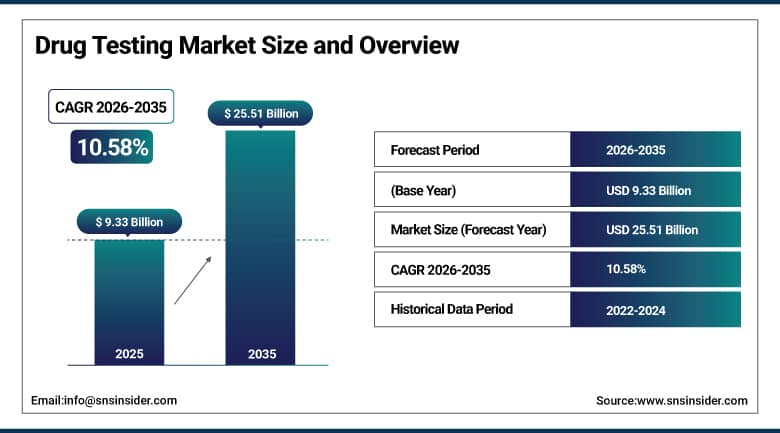
The Drug Testing Market was valued at USD 9.33 Billion in 2025 and is expected to reach USD 25.51 Billion by 2035, growing at a CAGR of 10.58% from 2026-2035.
The Drug Testing Market covers consumables, instruments, rapid test devices, and laboratory services used to detect illicit drugs, prescription misuse, and alcohol in urine, oral fluid, hair, blood, and breath. Employers, courts, treatment programs, hospitals, and sports bodies all rely on testing to protect safety and enforce rules. Immunoassay screening followed by mass spectrometry confirmation is the standard laboratory workflow. Rapid cups and strips serve point of collection settings. Changing drug patterns, including synthetic opioids and legalized cannabis, force laboratories to update panels. Regulatory programs for federal and transport workers set strict standards for certified laboratories. Service providers also supply medical review officers and reporting software that complete the compliance workflow.
⮞In June 2026, the United Nations Office on Drugs and Crime estimated that 331 million people used drugs in 2024, about 34% more than a decade earlier. Growth in the user population keeps demand for screening and confirmation steady.
To Get More Information On Drug Testing Market - Request Free Sample Report
Drug Testing Market Trends
- Rising adoption of oral fluid testing as an alternative to urine
- Hair testing expansion for longer detection windows in safety sensitive jobs
- Panels updated for fentanyl, synthetic cannabinoids, and designer drugs
- Automated benchtop analyzers replacing manual screening in laboratories
- Home and over-the-counter drug test kits growing among parents and treatment programs
U.S. Drug Testing Market Outlook
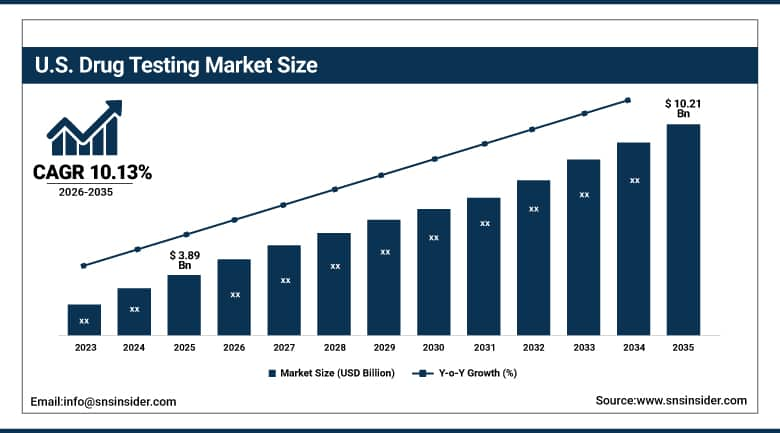
The U.S. Drug Testing Market was valued at USD 3.89 Billion in 2025 and is expected to reach USD 10.21 Billion by 2035, growing at a CAGR of 10.13% from 2026-2035.
The U.S. Drug Testing Market is the largest national market, driven by federal workplace programs, transportation rules, criminal justice supervision, and a very large private employer base. Certified laboratories process millions of urine, hair, and oral fluid specimens each year. Overdose deaths from synthetic opioids keep treatment programs and clinicians testing patients regularly. State cannabis laws are changing employer policies, and some companies have dropped pre-employment cannabis screening while safety sensitive sectors keep it. Large laboratory networks compete with specialized firms and instrument makers that sell to hospital and clinic laboratories. Third party administrators help employers manage random selection and record keeping.
⮞In May 2026, the Centers for Disease Control and Prevention estimated 69,973 U.S. drug overdose deaths in 2025, almost 14% below 2024. Even with the decline, the toll keeps monitoring and testing a core part of treatment and public health work.
Drug Testing Market Segment Analysis
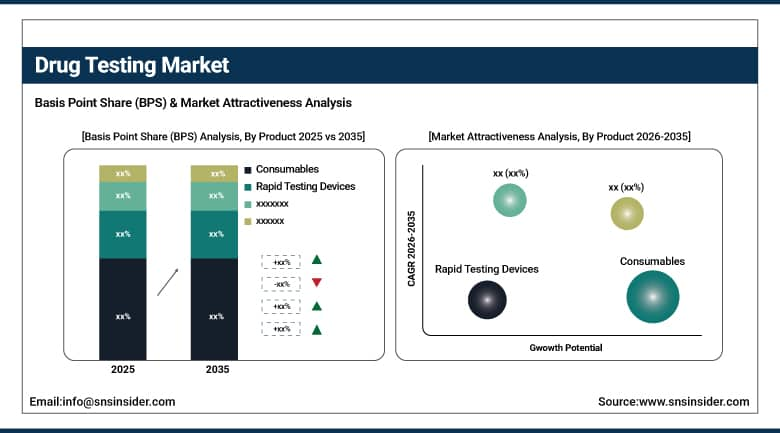
- By Product, the Consumables segment dominated the Drug Testing Market with approximately 33.47% share in 2025, while the Rapid Testing Devices segment is the fastest growing with a CAGR of approximately 12.49%.
- By Sample Type, the Urine segment dominated the Drug Testing Market with approximately 55.25% share in 2025, while the Oral Fluid segment is the fastest growing with a CAGR of approximately 12.58%.
- By Drug Type, the Cannabis segment dominated the Drug Testing Market with approximately 27.67% share in 2025, and is also the fastest growing with a CAGR of approximately 12.08%.
- By End User, the Laboratories segment dominated the Drug Testing Market with approximately 40.37% share in 2025, while the Home and OTC segment is the fastest growing with a CAGR of approximately 15.38%.
By Product, Consumables Dominates the Drug Testing Market and Rapid Testing Devices Grows Fastest
Consumables lead because every test uses reagents, calibrators, controls, collection cups, and cartridges that must be repurchased. Laboratories processing thousands of specimens a day order in bulk, and suppliers sell reagents through long term contracts tied to analyzers. Confirmation testing by mass spectrometry also requires columns, standards, and solvents. Recurring purchases create stable revenue that outpaces one time instrument sales. Regulatory programs require frequent quality control, which raises consumable use. Suppliers also bundle collection kits, chain of custody forms, and software. Standardized reagent packs also simplify inventory management for large laboratories.
Rapid testing devices are growing fastest because they deliver results on site within minutes without laboratory equipment. Employers, probation offices, hospitals, schools, and treatment centers use cups and strips for immediate screening. Digital readers improve accuracy and record results, and multi-drug panels cover the most common substances in one device. Analytical instruments and services also grow steadily as laboratories automate and outsource confirmation testing. Services account for a large share of value in markets where employers send specimens to certified laboratories, since the laboratory bills per test including collection logistics and reporting. Training of collectors and clear result reading guides improve reliability in field use.
By Sample Type, Urine Dominates the Drug Testing Market and Oral Fluid Grows Fastest
Urine leads because it is inexpensive, easy to collect in large volumes, and supported by long established federal procedures. Immunoassay screens are well validated for urine, and laboratories have scalable workflows for it. Detection windows of several days suit pre-employment and random programs, and courts and treatment programs accept urine results. Specimen validity checks for dilution, substitution, and adulteration are standard. Supply chains for collection devices and certified laboratories are mature, which keeps urine testing the default option. Collection sites are widely available, which keeps turnaround short for employers.
Oral fluid is growing fastest because collection can be observed, which limits cheating, and it detects recent use that matters for impairment concerns. Employers in safety sensitive jobs and roadside enforcement programs favor it. Hair testing offers a detection window of about 90 days and is growing in trucking and healthcare hiring. Blood is used in clinical and forensic settings, and breath is the standard for alcohol. Laboratories are investing in automated oral fluid workflows, although the number of certified laboratories for federal oral fluid programs remains limited at present. Suppliers are developing collection devices that preserve small volumes for laboratory confirmation.
⮞In June 2026, the U.S. Department of Health and Human Services listed 16 certified urine drug testing laboratories and noted that no laboratories were yet certified for oral fluid. The gap shows how oral fluid growth depends on laboratory certification.
By Drug Type, Cannabis Dominates the Drug Testing Market and Also Grows Fastest
Cannabis leads because it is the most widely used illicit drug in most regions and appears on virtually every standard panel. Legalization in many U.S. states and in countries such as Canada has increased use, and testing programs must distinguish recent use from past use. Employers in transportation, construction, and healthcare continue to screen, and probation and treatment programs test for it frequently. Panels cover THC metabolites in urine, hair, and oral fluid. High positivity rates keep cannabis testing volumes large. Employers also adjust cutoff levels and policies as laws change.
This segment is also experiencing fast growth owing to policy changes and increased usage. Rescheduling activities at the federal level and medical programs within states pose issues for employers, and thus necessitate policy change. Opiates, cocaine, amphetamines, and benzodiazine will continue to form the mainstay of testing panels, while fentanyl screening will take precedence in both treatment and emergency situations. The designer drugs and synthetic cannabinoid testing will be an issue for laboratory scientists, and thus there will be need for addition of target compounds for mass spectrometry tests. Breath alcohol and biomarker testing will play a crucial role in courts and monitoring programs.
⮞In April 2026, a Drug Enforcement Administration order moved marijuana in FDA-approved products and under state medical licenses from Schedule I to Schedule III. The change keeps cannabis policy and testing practice in flux for employers.
By End User, Laboratories Dominates the Drug Testing Market and Home and OTC Grows Fastest
Laboratories lead because they run the screening and confirmation tests for employers, courts, treatment programs, and clinics. Certified reference laboratories handle federal and transport programs with strict chain of custody. Hospital laboratories test patients in emergency and addiction care. These sites buy analyzers, reagents, and mass spectrometers, and they invest in automation to handle volume. Workplace programs, criminal justice agencies, and drug treatment centers are the largest sources of specimens and rely on laboratory results for decisions. Accreditation and proficiency testing add to laboratory operating costs but raise confidence in results.
Home and over-the-counter testing is growing fastest as parents, families, and treatment programs buy kits for private screening. Retail and online sales make cups and strips easily available, and teen use concerns support demand. Criminal justice programs also use on-site testing at arrest and during supervision. Workplace programs remain a major customer group, with trucking, healthcare, and construction as strong users. Drug treatment centers test patients frequently to monitor recovery and adjust care. Schools and sports bodies add smaller but steady demand. Product packaging now includes clear instructions on how to interpret faint lines.
⮞In May 2025, official data for England and Wales showed 52% of tests positive in the January to March 2025 quarter under the Drug Testing on Arrest programme, from 19,809 tests. Positivity at this level illustrates the steady need for testing in criminal justice settings.
Regional Analysis
|
Region |
Major Country |
Share within Region, 2025 (%) |
|---|---|---|
|
North America |
United States |
92.50% |
|
Europe |
Germany |
26.45% |
|
Asia Pacific |
China |
41.87% |
|
Latin America |
Brazil |
48.93% |
|
Middle East & Africa |
Saudi Arabia |
31.22% |
North America Drug Testing Market Insights
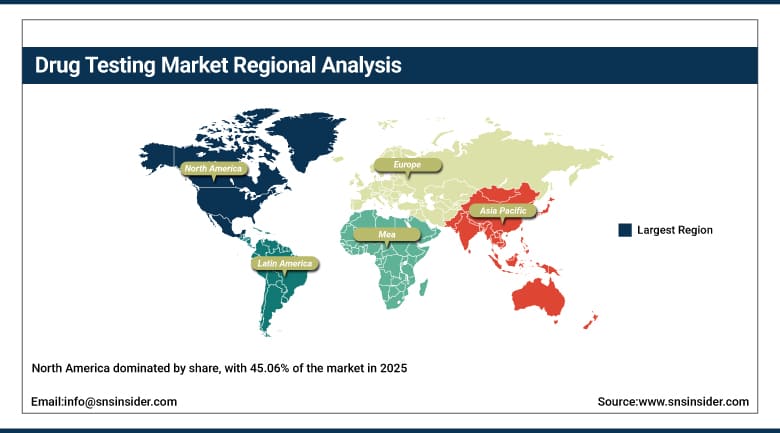
North America dominated by share, with 45.06% of the market in 2025, supported by federal workplace programs, strict transportation rules, and a large private employer testing base. The United States generates most regional demand, and Canada adds activity through safety sensitive employers and treatment programs. Certified laboratory networks process very large specimen volumes, and instrument makers sell analyzers and reagents to hospital laboratories. Overdose and treatment programs create steady demand for clinical testing. Hospitals add to demand through clinical toxicology services for emergency and addiction care.
Policy change is a major influence. Cannabis legalization has led some employers to drop pre-employment testing while safety sensitive industries keep or expand it, often with hair or oral fluid methods. Federal agencies have added oral fluid as an option, although laboratory certification remains limited. Fentanyl and other synthetic opioids are priorities for panel updates. Consolidation among laboratory operators and growth of point of collection testing are shaping competition. Employers increasingly want integrated programs that combine collection, laboratory results, and reporting. Insurers and safety managers continue to value testing as an accident prevention tool.
⮞In June 2026, Health Canada reported 5,608 opioid-related deaths in 2025, about 15 per day and 23% fewer than in 2024. Public health surveillance of this kind keeps drug testing central to harm reduction and treatment.
Get Customized Report as Per Your Business Requirement - Enquiry Now
Europe Drug Testing Market Insights
Europe holds the second largest position, led by Germany, the United Kingdom, France, Italy, and Spain. Testing is used in road safety enforcement, workplace safety, treatment programs, and prisons. Roadside oral fluid screening is widespread, and laboratories confirm positives with mass spectrometry. Cannabis is the most commonly used illicit drug, and cocaine and synthetic stimulants are expanding in many countries. National rules differ, so employer testing is less common than in the United States. Mobile enforcement units use portable analyzers for on the spot screening.
Drugs are tested in hospitals and clinical labs in Europe, especially during emergencies and in addiction treatment cases, whereas wastewater testing is also being used for such surveillance. The drug agency of Europe keeps an eye on new drugs and disseminates warnings, which helps to form laboratory panels. There is a preference for procurement of validated tools and good services in public procurement. The data protection law influences the process of storing and sharing the test results. Large testing laboratories can be found in Germany and the United Kingdom, while the Nordic countries excel in monitoring treatment cases.
⮞In June 2026, the European Union Drugs Agency reported that cannabis is by far the most commonly consumed illicit drug in Europe, with about 25.0 million adults using it in the last year. Prevalence at this level underpins demand for roadside and clinical testing.
Asia Pacific Drug Testing Market Insights
Asia Pacific is the fastest-growing region with a projected CAGR of 12.72% during 2026 and 2035 driven by China, India, Japan, Australia, and South Korea. There are stricter policies on drug control, and authorities conduct rapid tests in roadside and border checks. East and Southeast Asia are the largest markets for methamphetamine, thus increasing demand for amphetamine testing. Increased per capita income and urbanization are factors contributing to increased usage in some nations. There is already extensive roadside and workplace testing in Australia using oral fluid tests. Awareness campaigns on drugs’ effects also motivate voluntary testing.
The manufacturers within the two countries of China and India provide cheap rapid tests while laboratories in Singapore, Japan, and Australia utilize high-tech mass spectrometry. The national surveys are expanding to estimate usage more accurately, which will be helpful for future policies and tests. Sports anti-doping programs and multinational companies are other sources of increased demand. Regulatory guidelines and laboratory accreditations are on the rise. More treatment programs are emerging in many countries, leading to increased demand for clinical tests. The distributors have a key role in small city coverage and sampling training continues to be crucial.
⮞In February 2024, Australia's national household survey for 2022-23 reported past-year cannabis use of 11.5% and cocaine use of 4.5%. Prevalence like this supports roadside and workplace testing programs across the region.
MEA & Latin America Drug Testing Market Insights
Latin America shows growth owing to increased services for the treatment, surveys of public health and workplace initiatives provided by Brazil and Mexico. Mexico is one of the countries that belong to Latin America according to the estimation of the market, and the survey results of this country play an influential role in the formation of the policy. The consumption of cannabis is growing, and the production of cocaine in this region makes the work of testers continuous. Fluctuations of currency and budget constraints impede the purchase of high-quality instruments, so rapid tests and distributors become essential.
⮞In December 2025, Mexico's national public health institute reported that lifetime cannabis use among ages 12 to 65 rose from 8.6% in 2016 to 12.0% in 2025. Rising use is increasing interest in screening and treatment services.
The development in the Middle East and Africa regions involves rigorous drug abuse control strategies by the government in the form of building forensic laboratories, especially in Saudi Arabia, the United Arab Emirates, and Qatar. Border agencies use the rapid test method widely, and seizure of large quantities of amphetamine tablets ensures that screening is continuous. Screening of expatriate employees by employers in the Gulf region is done to clear them medically. Limited forensic laboratories in Africa hinder confirmation testing, except South Africa, which has a developed private sector. International projects sponsor training and equipment in forensic laboratories.
Market Dynamics
Growth Drivers: Rising Drug Use and Safety Regulations Drive Growth in the Drug Testing Market
Increase in drug abuse and development of new drugs is one of the main drivers. There has been an increase in the number of users worldwide and the emergence of synthetic opioids, stimulants, and designer drugs makes things complicated. Patients are tested by hospitals and rehabilitation centers in order to provide proper treatment. There are records of overdose incidences maintained by public health departments, and response to them results in more tests being done. Kits are also purchased by parents and schools for private testing purposes.
Safety regulations add steady volume. Federal and transportation rules require testing of drivers, pilots, and pipeline workers, and many employers extend programs to reduce accidents and insurance cost. Courts and probation services order regular testing. Technology improvements such as automated analyzers, oral fluid devices, and hair testing broaden options. Laboratories that invest in efficient workflows can handle higher volumes at lower cost. Together these forces support double digit growth through 2035 in many segments, although publishers differ widely in their estimates of the pace. Workplace insurers sometimes offer discounts to employers with documented testing programs.
Restraints: Cannabis Policy Changes and Limited Oral Fluid Capacity Restrain Growth in the Drug Testing Market
Cannabis policy changes lead to decreased demand for testing in some workplaces. The legalization of cannabis in many US states forces big employers in the retail and services sector to stop pre-employment cannabis testing because of hiring difficulties and lack of relevance to work performance. This reduces the number of urine panels in non-safety sensitive positions. Testing restrictions because of privacy issues and civil liberties are another factor restricting expansion of testing. Companies calculate the costs of the programs and their usefulness, and during economic declines, hiring and testing decrease. Scarcity of hiring pushes employers to be more lenient in testing.
Capacity limitations and limited availability of new techniques limit growth as well. No laboratories certified for federal oral fluid testing are currently available, which hinders its adoption by the regulated sectors. High price of mass spectrometry equipment and specialists makes implementation for smaller laboratories difficult. Rapid tests can lead to false positive and false negative results and require confirmation. Very fast evolving drug markets require constant updating of the methods. Privacy regulations and different legal standards in other countries make global programs difficult. Competition in pricing from laboratory service companies limits profits.
⮞In July 2026, a National Law Review article reported that a Fisher Phillips survey found roughly half of employers do not test for cannabis before hiring. Policy shifts of this kind reduce routine screening volumes in non-safety sensitive roles.
Opportunities: Oral Fluid Testing and Home Monitoring Create Opportunities in the Drug Testing Market
Opportunities abound in the area of oral fluid testing. The regulations on federal transport have approved its use, and the certification of laboratories will open up great volumes in regulated industries. Employers appreciate the observed collection and detection of current drug abuse. Providers of collection materials, automated tests, and confirmatory testing will earn from it. There are increasing roadside enforcement programs which are using oral fluid testing all around the world. Laboratories and employers can form partnerships to offer integrated testing program that combines collection, testing, and reporting.
Home test kits and technology provide the second opportunity. The parents, treatment facilities, and recovery facilities require a home test kit that provides accurate documentation. The smartphone readers and telehealth monitoring will verify the test results at remote locations. Frequent testing is used by treatment centers to facilitate recovery, and it is covered by the insurers in many cases. The emerging markets require cheap rapid tests and training to create capacity in local testing. The companies who make panels for newly created synthetic drugs can respond immediately to public health concerns. There are sports antidoping and clinical toxicology, which can use high-end mass spectrometry.
Recent Developments:
- In September 2025, Siemens Healthineers launched the Atellica DT 250, a benchtop drug testing analyzer using Syva EMIT technology. It offers more than 65 immunoassays, processes 225 results per hour, and checks urine validity for substitution, adulteration, and dilution.
- In July 2026, Thermo Fisher Scientific presented an oral fluid drugs of abuse automation session at the ADLM conference. The company also highlighted its TSQ Certis triple quadrupole mass spectrometer for toxicology workflows.
- In April 2026, Psychemedics released its 2026 Workforce Insights Report. Healthcare had the highest 2025 positive rate at 20.2%, and trucking positives fell to 5.3%.
- In July 2026, Quest Diagnostics published its Drug Testing Index covering 2025. Fentanyl positivity fell 49.1%, from 0.55% in 2024 to 0.28% in 2025, while hair positivity reached 19.1%.
Drug Testing Market Key Players are:
- Quest Diagnostics
- Labcorp
- Abbott
- Thermo Fisher Scientific
- Roche
- Siemens Healthineers
- Bio-Rad Laboratories
- Agilent Technologies
- Psychemedics
- OraSure Technologies
- Drägerwerk
- Lifeloc Technologies
- Premier Biotech
- Omega Laboratories
- Cordant Health Solutions
- Clinical Reference Laboratory
- Eurofins Scientific
- Shimadzu
Drug Testing Market Report Scope:
| Report Attributes | Details |
|---|---|
| Market Size in 2025 | USD 9.33 Billion |
| Market Size by 2035 | USD 25.51 Billion |
| CAGR | CAGR of 10.58% From 2026 to 2035 |
| Base Year | 2025 |
| Forecast Period | 2026-2035 |
| Historical Data | 2022-2024 |
| Report Scope & Coverage | Market Size, Segments Analysis, Competitive Landscape, Regional Analysis, DROC & SWOT Analysis, Forecast Outlook |
| Key Segments | • By Product (Consumables, Analytical Instruments, Rapid Testing Devices, and Services) • By Sample Type (Urine, Oral Fluid, Hair, Blood, and Others) • By Drug Type (Cannabis, Opioids, Cocaine, Amphetamines, Alcohol, and Others) • By End User (Laboratories, Workplace, Hospitals, Criminal Justice, Drug Treatment Centers, and Home and OTC) |
| Regional Analysis/Coverage | North America (US, Canada), Europe (Germany, UK, France, Italy, Spain, Russia, Poland, Rest of Europe), Asia Pacific (China, India, Japan, South Korea, Australia, ASEAN Countries, Rest of Asia Pacific), Middle East & Africa (UAE, Saudi Arabia, Qatar, South Africa, Rest of Middle East & Africa), Latin America (Brazil, Argentina, Mexico, Colombia, Rest of Latin America). |
| Company Profiles | Quest Diagnostics, Labcorp, Abbott, Thermo Fisher Scientific, Roche, Siemens Healthineers, Bio-Rad Laboratories, Agilent Technologies, Psychemedics, OraSure Technologies, Drägerwerk, Lifeloc Technologies, Premier Biotech, Omega Laboratories, Cordant Health Solutions, Clinical Reference Laboratory, Eurofins Scientific, Shimadzu |

Frequently Asked Questions
Key players in the market include Quest Diagnostics, Labcorp, Abbott, Thermo Fisher Scientific, Roche, and Siemens Healthineers, among others.
Key opportunities include oral fluid testing, as laboratory certification unlocks regulated sectors, and home monitoring with digital verification.
Rising drug use and safety regulations are the major growth factors, as employers, courts, and treatment programs expand testing.
The Urine segment dominated the market in 2025 with approximately 55.25% share, as it is inexpensive, easy to collect, and supported by long established procedures.
North America dominated the market in 2025 with approximately 45.06% share, supported by federal workplace programs, strict transportation rules, and a large private employer testing base.
