
Next-Generation Immunology Drugs Market Report Scope & Overview:
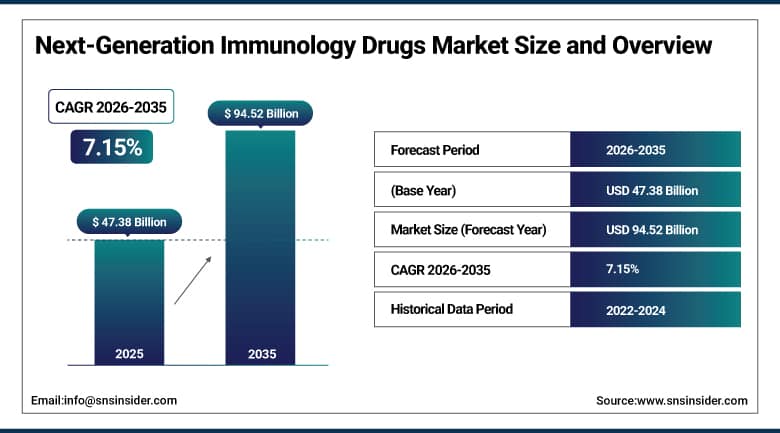
The Next-Generation Immunology Drugs Market was valued at USD 47.38 Billion in 2025 and is expected to reach USD 94.52 Billion by 2035, growing at a CAGR of 7.15% from 2026-2035.
The Next-Generation Immunology Drugs Market is expected to witness growth due to the evolution of drug development from general immunosuppressive treatment to targeted mechanisms for autoimmune and inflammatory diseases. The new drugs target specific cytokines, receptors, and pathways such as IL-23, TL1A, OX40 ligand, and TYK2, providing effective disease management and enhanced safety. With oral peptides, bispecific antibodies, and long-acting injectables becoming a part of the treatment portfolio, the trend looks promising. The increasing incidence of psoriasis, inflammatory bowel disease, and atopic dermatitis coupled with rich pipelines in major pharmaceutical companies ensures strong revenue growth in the next-gen drugs market globally. Licensing and partnering with Asian drug developers also propels innovation.
⮞In March 2026, Johnson & Johnson received U.S. FDA approval for Icotyde (icotrokinra), the first oral peptide targeting the IL-23 receptor for adults and adolescents with moderate-to-severe plaque psoriasis.
To Get More Information On Next-Generation Immunology Drugs Market - Request Free Sample Report
Next-Generation Immunology Drugs Market Trends:
-
Rising development of oral peptides and small molecules that rival injectable biologic efficacy.
-
Growing clinical momentum for anti-TL1A antibodies in ulcerative colitis and Crohn’s disease.
-
Increasing focus on OX40 pathway antibodies for long-lasting control of atopic dermatitis.
-
Expanding use of bispecific antibodies that block two inflammatory pathways at once.
-
Rising pediatric and adolescent label extensions for established interleukin inhibitors.
-
Growing push toward extended dosing intervals and patient-friendly autoinjector formats.
U.S. Next-Generation Immunology Drugs Market Outlook:
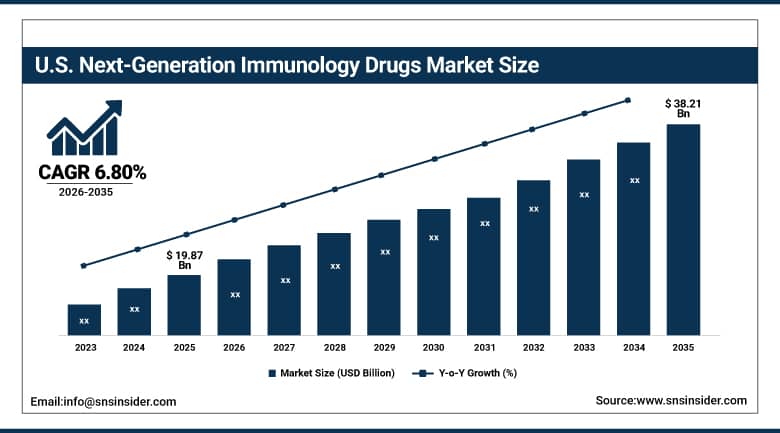
The U.S. Next-Generation Immunology Drugs Market was valued at USD 19.87 Billion in 2025 and is expected to reach USD 38.21 Billion by 2035, growing at a CAGR of 6.80% from 2026-2035.
The U.S. Next-Generation Immunology Drugs Market is the largest national market because of the high diagnosis rate of autoimmune disease, quick adoption of newly approved biologics, and high premium pricing with wide commercial and Medicare coverage. Patients gain access to new drugs shortly after FDA approval through the wide network of specialists in rheumatology, gastroenterology, and dermatology who prescribe them. Intense competition between branded companies leads to continuous label expansion and clinical development. Even though the biosimilar approval of older drugs is changing the market pricing, new mechanisms still attract many consumers.
⮞In June 2026, AbbVie secured U.S. FDA approval for Skyrizi (risankizumab) in pediatric plaque psoriasis and psoriatic arthritis, expanding its immunology franchise and supporting growth through broader biologic access, specialty pharmacy networks, and patient assistance programs.
Next-Generation Immunology Drugs Market Segment Analysis:
-
By Drug Class, the Monoclonal Antibodies segment dominated the Next-Generation Immunology Drugs Market with approximately 58.40% share in 2025, while the Oral Small Molecules & Peptides segment is the fastest growing with a CAGR of approximately 10.85%.
-
By Indication, the Rheumatoid Arthritis & Spondyloarthritis segment dominated the Next-Generation Immunology Drugs Market with approximately 31.80% share in 2025, while the Inflammatory Bowel Disease segment is the fastest growing with a CAGR of approximately 9.60%.
-
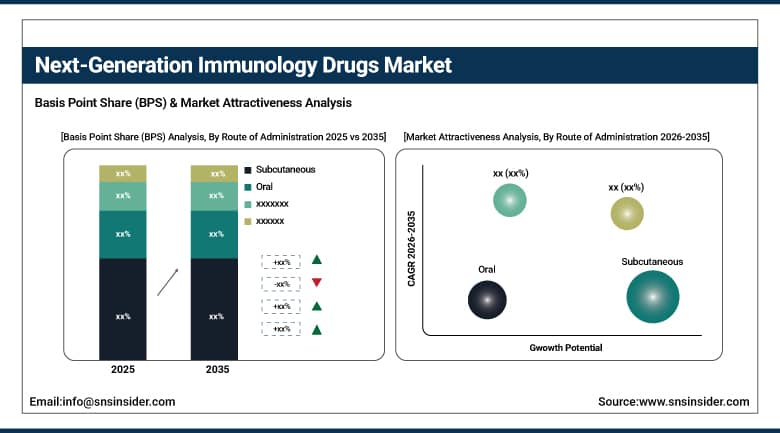
By Route of Administration, the Subcutaneous segment dominated the Next-Generation Immunology Drugs Market with approximately 66.90% share in 2025, while the Oral segment is the fastest growing with a CAGR of approximately 11.20%.
By Route, Subcutaneous Dominates, While Oral Grows Fastest
Subcutaneous segment dominated the Next-Generation Immunology Drugs Market in 2025, as most biologics are delivered through prefilled syringes or autoinjectors that patients can use at home. The home-based administration is an aspect that will help lower cost and increase compliance within the management of chronic illnesses. Companies have now begun working hard to develop drugs in small volumes and even provide extended intervals of treatment of many months. These efforts are geared toward being relevant in terms of competitiveness. Training programs and specialty pharmacies play a crucial role in ensuring patients comply with medication, and hence subcutaneous administration stands out as the best mode of delivery.
Oral route is the fastest-growing segment, driven by strong patient preference for pills and the arrival of targeted oral agents that approach biologic-level efficacy. Needle-free dosing removes barriers for needle-averse patients, adolescents, and those in regions with limited cold-chain infrastructure. Oral products also simplify supply chains and may expand first-line prescribing in primary and community settings. As companies advance additional oral peptides and selective inhibitors through clinical development, this route is expected to capture a steadily rising share of new patient starts over the coming decade. Improved convenience may also reduce treatment discontinuation, which supports stronger long-term revenue for manufacturers.
⮞In April 2026, AbbVie submitted a U.S. regulatory application for subcutaneous induction dosing of Skyrizi (risankizumab) in adults with moderately to severely active Crohn's disease, seeking an additional administration option supported by Phase 3 AFFIRM study data.
By Drug Class, Monoclonal Antibodies Lead, While Oral Small Molecules & Peptides Grow Fastest
Monoclonal antibodies segment dominated the Next-Generation Immunology Drugs Market in 2025, supported by blockbuster interleukin, TNF, and IgE franchises with proven long-term efficacy and safety. Products such as IL-23 and IL-17 inhibitors deliver high rates of skin clearance and sustained remission, which supports sustained prescriber preference. Established manufacturing, extensive real-world evidence, and broad payer coverage reinforce their position. Continuous label expansions into new age groups and indications, together with next-generation antibodies targeting TL1A and OX40 ligand, ensure that this class remains the central revenue engine of the market. Competitive differentiation increasingly relies on longer dosing intervals and head-to-head trial evidence.
Oral small molecules and peptides are the fastest-growing drug class, as patients and physicians increasingly seek effective alternatives to injections. TYK2 inhibitors, selective JAK inhibitors, and newly approved oral IL-23 receptor peptides show that targeted potency can now be delivered in a daily pill. Lower manufacturing costs, simpler distribution, and strong convenience appeal support earlier-line adoption in psoriasis, inflammatory bowel disease, and other conditions. A growing number of oral candidates in late-stage trials is expected to accelerate share gains through 2035. Competing oral entrants are also encouraging manufacturers to improve selectivity, reduce monitoring burdens, and demonstrate safety advantages over earlier generation products in head-to-head studies.
⮞In September 2026, the U.S. FDA approved UCB's Bimzelx (bimekizumab) for moderate-to-severe hidradenitis suppurativa, extending the IL-17A/IL-17F inhibitor's label to a fourth major indication and reinforcing its position among next-generation monoclonal antibody therapies.
By Indication, Rheumatology Leads, While Inflammatory Bowel Disease Grows Fastest
Rheumatoid arthritis and spondyloarthritis dominated the Next-Generation Immunology Drugs Market in 2025, reflecting a large, long-treated patient population and a deep portfolio of approved biologic and targeted synthetic agents. These chronic conditions require continuous therapy, which generates durable recurring revenue for manufacturers. Newer JAK inhibitors, IL-17 inhibitors, and IL-23 inhibitors have broadened options for psoriatic arthritis and axial disease. Strong guideline support for early targeted treatment and increasing diagnosis rates in emerging economies continue to sustain the leading position of this indication group. Biosimilar availability for older agents also allows health systems to reallocate budgets toward newer mechanisms, so overall spending on advanced therapy continues to grow within rheumatology.
Inflammatory bowel disease is the fastest-growing indication, supported by rising global incidence and substantial unmet need among patients who lose response to existing biologics. Anti-TL1A antibodies such as tulisokibart and duvakitug have delivered encouraging clinical remission data in ulcerative colitis and Crohn’s disease, while IL-23 inhibitors and oral options are moving into earlier treatment lines. Combination approaches and biomarker-guided therapy selection are under active investigation. As several late-stage programs approach regulatory filing, inflammatory bowel disease is positioned for the strongest growth among major immunology indications. Growing gastroenterology specialist networks and expanding endoscopy capacity in emerging markets are widening the pool of patients eligible for advanced treatment.
⮞In January 2025, the U.S. FDA approved Eli Lilly's Omvoh (mirikizumab) for adults with moderately to severely active Crohn's disease, extending the IL-23 inhibitor's use beyond ulcerative colitis and broadening targeted treatment options for inflammatory bowel disease.
Regional Analysis:
|
Region |
Major Country |
Share within Region, 2025 (%) |
|
North America |
United States |
94.00% |
|
Europe |
Germany |
24.60% |
|
Asia-Pacific |
Japan |
31.80% |
|
Middle East & Africa |
GCC |
58.30% |
|
Latin America |
Brazil |
47.20% |
North America Next-Generation Immunology Drugs Market Insights
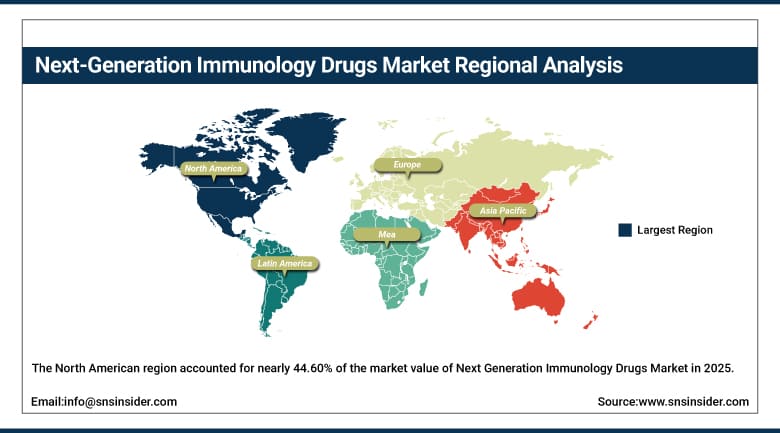
The North American region accounted for nearly 44.60% of the market value of Next Generation Immunology Drugs Market in 2025. This large share reflects the high prevalence of autoimmune disorders, substantial healthcare system investment, and fast physician adoption of newly launched drugs. North America includes US that holds research centers of top immunology drug developers, and a good environment created due to accelerated approvals of drugs also adds to the market. Commercial insurance coverages of the patients along with coverage by Medicare allow people to use best biologics and specialty pharmacies distribute the product. Robust venture capital investment also supports an influx of new immunology companies in the region.
A high public coverage and use of biosimilar agents that allow to cut prices and increase access of people to biologics also contribute to the strength of Canada as a market for next generation drugs. Provinces' formularies now include new drugs after HTAs and there is active participation of academic centers in international clinical trials. There is constant financing for development of infrastructure used for conducting clinical trials and high awareness of rheumatologists, gastroenterologists, and dermatologists also increases demand. It is expected that North America will keep its leadership until 2035 thanks to large pipeline of late stage candidates and good involvement of physicians.
⮞In March 2026, Teva entered a funding agreement with Blackstone Life Sciences providing up to USD 400 million to support the development of duvakitug, an investigational anti-TL1A antibody for inflammatory diseases, including ulcerative colitis and Crohn's disease.
Get Customized Report as Per Your Business Requirement - Enquiry Now
Europe Next-Generation Immunology Drugs Market Insights
Europe captured approximately 28.90% of the Next-Generation Immunology Drugs Market in 2025, supported by universal healthcare systems, a sizable patient base, and strong pharmaceutical research heritage. Within Europe, Germany, France, the UK, Italy, and Spain represent the major markets within the region. Centralized approvals through the European Medicines Agency facilitate broader launches. Bodies conducting health technology assessment will affect pricing and reimbursement to promote value-based competition. The region favors early uptake of biosimilars to realize cost savings that can be redirected toward newer targeted therapies. Cooperation within research institutions drives clinical development and early access programs, which enhances the progress within the region.
The biggest market within Europe is the German market due to rapid reimbursement of approved products, a well-coordinated specialist network, and the existence of large research-based pharmaceutical companies within the country. Another big contributor to the market is the UK with the NHS increasing the usage of biologic drugs, while there are several trials ongoing within the country. European companies are innovating next generation antibodies and oral drugs. Due to the rising incidence rates of inflammatory bowel disease and psoriasis alongside the aging population, the demand for innovative immunology drugs is anticipated to grow consistently until 2035. Employer health plans and dense specialist base within the region drive good usage of newer drugs.
⮞In June 2026, the European Medicines Agency recommended extending Stelara (ustekinumab) to children aged two years and older with moderately to severely active ulcerative colitis, expanding the eligible patient population for an established biologic therapy.
Asia-Pacific Next-Generation Immunology Drugs Market Insights
Asia-Pacific held approximately 20.40% of the Next-Generation Immunology Drugs Market in 2025 and is the fastest-growing region with a CAGR of approximately 9.35%. Increasing middle class population size, improved diagnosis of autoimmune disorders, and higher insurance coverage rates have opened the door to novel drugs in the market. Japan still remains the most developed market for the region in terms of high acceptance rate of biologic treatment. The market is growing quickly due to volume purchasing, local innovations, and inclusion of novel drugs into the national formularies. International corporations are widening their regional and clinical trials to meet the growing needs of the market. Development of national regulatory bodies reduces the time of drug approval, and allows patients to obtain innovative therapy.
In China biopharmaceutical industry manufactures an increasing number of local interleukin inhibitors, JAK inhibitors, and bispecific antibodies, which are licensed by multinational companies. India provides the market with a large number of patients and access to biosimilars and manufacturing capabilities in the country. The region of South Korea and Australia provides an advanced healthcare infrastructure and clinical research capabilities. Increasing awareness of physicians, rising disposable incomes of people, and government attempts to expand the access to specialty medications will most probably make Asia-Pacific the primary region of incremental market development until 2035.
⮞In March 2026, Japan approved Dupixent (dupilumab), developed by Sanofi and Regeneron, for adults with moderate-to-severe bullous pemphigoid, introducing a targeted treatment option for this chronic inflammatory skin disease.
MEA & Latin America Next-Generation Immunology Drugs Market Insights
The Middle East & Africa region forms a smaller part of the Next-Generation Immunology Drugs Market, with demand concentrated in Gulf countries such as Saudi Arabia and the United Arab Emirates, where government-funded healthcare systems cover advanced biologics. Investment in specialty hospitals and partnerships with international pharmaceutical companies will improve the accessibility of modern treatment options. The penetration rate in other regions is constrained by affordability issues, lack of specialists, and cold chain problems. With increasing awareness about autoimmune diseases and gradual improvement of health systems, slow but steady growth is forecasted in the coming years. Medical tourism and specialty centers generate selective demand for advanced immunology treatments.
The Next-Generation Immunology Drugs Market in Latin America demonstrates stable growth and is driven by Brazil and Mexico, where large numbers of patients and public programs ensure access to biological drugs. Collaboration in manufacturing and biosimilars reduce prices, while the regulatory agencies of the region accelerate approval of innovative drugs. Economic instability, currency volatility, and reimbursement issues limit the rapid adoption of premium drugs. However, the growing incidence of psoriasis and rheumatoid diseases, development of private insurance, and the growing knowledge of physicians about targeted drugs will facilitate the market growth until 2035. Clinical trials in the region will increase the accessibility of new treatments.
⮞In April 2025, Saudi Arabia's Food and Drug Authority recorded the approval of Tremfya (guselkumab) as a biological drug, adding another targeted immunology therapy to the country's regulated pharmaceutical market.
⮞In August 2026, Brazil's ANVISA approved Imaavy (nipocalimab) for warm-antibody autoimmune hemolytic anemia in adults and adolescents aged 12 years and older, marking the first approval worldwide for this indication and expanding treatment options for a rare autoimmune disorder.
Market Dynamics:
Growth Drivers: Rising Autoimmune Burden and Precision Mechanisms
The market growth in Next Generation Immunology Drugs Market is due to the increase in the burden of autoimmune and inflammatory diseases globally. Some of the autoimmune disorders include psoriasis, rheumatoid arthritis, inflammatory bowel disease, and atopic dermatitis. Some patients have shown low sensitivity with older therapies, thus the need for treatment options with more advanced mechanisms. Some new drug targets such as IL-23, TL1A, and OX40 ligand provide increased efficacy and tolerability. Increased diagnoses, treatment guidelines, and patient awareness also increase the number of patients who qualify for more advanced treatment options. The confidence of physicians on the safety of biologics in the long term increases the early adoption of advanced therapy.
The future growth is also supported by a robust late-stage pipeline as companies move ahead with oral peptides, bispecific antibodies, and long-acting biologics. Recent approvals and positive results in phase III trials are evidence of innovation translating into successful products. The expansion of labeling of products to the pediatric and adolescent population increases the addressable market for some established franchises. The investment in research by top pharmaceutical companies through acquisitions and licensing deals will ensure a steady stream of differentiated products that drive the growth of revenues during the forecast period.
⮞In June 2026, Spyre Therapeutics reported positive Phase 2 induction results for SPY002, an investigational anti-TL1A antibody, in moderately to severely active ulcerative colitis, strengthening the clinical pipeline targeting inflammatory pathways associated with inflammatory bowel disease.
Restraints: High Treatment Costs and Biosimilar Pricing Pressure
The high cost of treatment is one of the major factors hampering the Next-Generation Immunology Drugs Market. The expensive nature of the new biologics and targeted therapy limits the payer budget, thus restricting their access in low and middle-income countries where out-of-pocket expenditure is still a hurdle. The process of prior authorization and step-therapy limits the use of newer products; as a result, patients need to try old drugs before being prescribed the newer drugs. The pharmaceutical industry needs to prove the value proposition using comparative data; hence, the development cost of innovative immunology drugs is high. Moreover, healthcare systems in developing economies are not able to provide funding for broad access to these drugs. Thus, most of the eligible patients are using old and less targeted drugs.
In addition to this, the threat from biosimilar competition and safety issues can hamper the growth of the market. The expiry of patent protection on leading TNF and interleukin franchises results in revenue loss due to the availability of biosimilars at cheaper prices. Also, there are additional safety issues such as infections and tuberculosis screening for various drug classes. In addition to this, any setback in the late-phase clinical trials and long-term safety concerns of certain targeted agents can negatively impact the adoption rate of these drugs.
Opportunities: Oral Innovation and Inflammatory Bowel Disease Expansion
The development of effective oral therapies represents a major opportunity for the Next-Generation Immunology Drugs Market. Oral peptide and small-molecule candidates are increasingly able to match injectable biologic efficacy, opening the way for earlier-line use and broader community prescribing. Developers pursuing oral candidates in psoriasis, psoriatic arthritis, and ulcerative colitis can reach patients who currently avoid injections. Convenient dosing, simpler logistics, and potentially lower costs may also help expand access in emerging markets over the long term. Success in these programs could shift treatment algorithms substantially, encouraging manufacturers to invest in additional oral candidates against validated immunology targets.
Inflammatory bowel disease offers further opportunity, as developers advance anti-TL1A and IL-23 programs through late-stage trials for patients who do not respond to existing biologics. Biomarker-guided treatment selection, combination regimens, and new delivery systems could improve outcomes for refractory patients. Asia-Pacific and Latin America growth driven by improved diagnostic techniques and access to more specialists will provide a third avenue of growth. Firms with differentiated efficacy and ease of administration will be well-positioned to realize significant returns over the coming years. The commercial success of first-in-class compounds will lead to this indication becoming a prime area of interest for deals.
⮞In March 2026, Sanofi received orphan drug designation in Japan for rilzabrutinib in IgG4-related disease, supporting further development of an oral BTK inhibitor for a rare immune-mediated condition with limited treatment options.
Recent Developments:
-
May 2026, Teva and Sanofi reported phase 2b RELIEVE UCCD results for duvakitug in The Lancet Gastroenterology & Hepatology, showing clinical remission and endoscopic response in ulcerative colitis and Crohn’s disease.
-
July 2026, Sanofi reported positive phase 3 results for amlitelimab, an OX40 ligand antibody, in atopic dermatitis patients aged 12 years and older, and prepared global regulatory filings.
-
September 2026, Apogee Therapeutics reported positive Phase 1b data for APG777, a long-acting anti-IL-13 monoclonal antibody, supporting advancement into Phase 3 trials for moderate-to-severe atopic dermatitis.
-
November 2025, argenx received U.S. FDA approval for an expanded Vyvgart Hytrulo label in chronic inflammatory demyelinating polyneuropathy, broadening the autoimmune neurology indications for its FcRn-blocking antibody platform.
Next-Generation Immunology Drugs Market Key Players:
-
AbbVie Inc.
-
Johnson & Johnson
-
Sanofi S.A.
-
Regeneron Pharmaceuticals, Inc.
-
Eli Lilly and Company
-
Pfizer Inc.
-
Novartis AG
-
Amgen Inc.
-
Bristol Myers Squibb Company
-
Merck & Co., Inc.
-
F. Hoffmann-La Roche Ltd
-
UCB S.A.
-
Takeda Pharmaceutical Company Limited
-
GSK plc
-
Boehringer Ingelheim GmbH
-
argenx SE
-
Incyte Corporation
-
AstraZeneca PLC
-
Spyre Therapeutics, Inc.
-
Apogee Therapeutics, Inc.
Next-Generation Immunology Drugs Market Report Scope:
| Report Attributes | Details |
|---|---|
| Market Size in 2025 | USD 47.38 Billion |
| Market Size by 2035 | USD 94.52 Billion |
| CAGR | CAGR of 7.15% From 2026 to 2035 |
| Base Year | 2025 |
| Forecast Period | 2026-2035 |
| Historical Data | 2022-2024 |
| Report Scope & Coverage | Market Size, Segments Analysis, Competitive Landscape, Regional Analysis, DROC & SWOT Analysis, Forecast Outlook |
| Key Segments | • By Drug Class (Monoclonal Antibodies, Bispecific & Multispecific Antibodies, Oral Small Molecules & Peptides, Cytokines & Fusion Proteins, Cell & Gene Therapies) • By Indication (Rheumatoid Arthritis & Spondyloarthritis, Inflammatory Bowel Disease, Psoriasis & Atopic Dermatitis, Asthma & Respiratory Diseases, Neurological Autoimmune Diseases, Other Indications) • By Route of Administration (Subcutaneous, Intravenous, Oral) |
| Regional Analysis/Coverage | North America (US, Canada), Europe (Germany, UK, France, Italy, Spain, Russia, Poland, Rest of Europe), Asia Pacific (China, India, Japan, South Korea, Australia, ASEAN Countries, Rest of Asia Pacific), Middle East & Africa (UAE, Saudi Arabia, Qatar, South Africa, Rest of Middle East & Africa), Latin America (Brazil, Argentina, Mexico, Colombia, Rest of Latin America). |
| Company Profiles | AbbVie Inc., Johnson & Johnson, Sanofi S.A., Regeneron Pharmaceuticals, Inc., Eli Lilly and Company, Pfizer Inc., Novartis AG, Amgen Inc., Bristol Myers Squibb Company, Merck & Co., Inc., F. Hoffmann-La Roche Ltd, UCB S.A., Takeda Pharmaceutical Company Limited, GSK plc, Teva Pharmaceutical Industries Ltd., Boehringer Ingelheim GmbH, argenx SE, Incyte Corporation, AstraZeneca PLC, Gilead Sciences, Inc. |

Frequently Asked Questions
Key players include AbbVie Inc., Johnson & Johnson, Sanofi S.A., Regeneron Pharmaceuticals, Inc., and Eli Lilly and Company, among others.
Key opportunities include oral peptides and small molecules, anti-TL1A therapies for inflammatory bowel disease, bispecific antibodies, and pediatric label extensions across established franchises.
The primary growth factor is the rising burden of autoimmune and inflammatory diseases, combined with demand for more precise, better-tolerated therapies with novel mechanisms.
By drug class, the Monoclonal Antibodies segment dominates the Next-Generation Immunology Drugs Market with approximately 58.40% share in 2025.
North America dominates the Next-Generation Immunology Drugs Market with approximately 44.60% share in 2025, while Asia-Pacific is the fastest-growing region with a CAGR of approximately 9.35%.
