
Ferroelectric RAM (FeRAM) Market Report Scope & Overview:
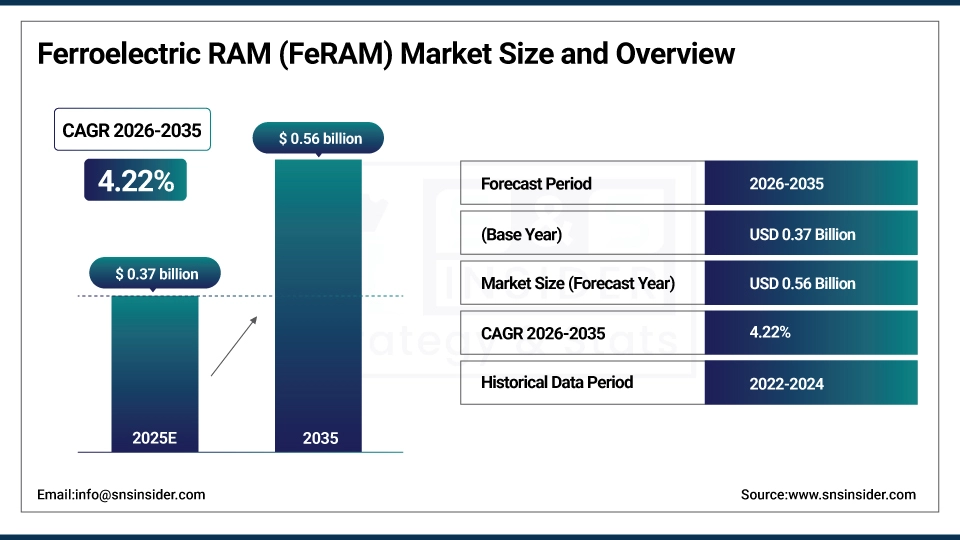
The Ferroelectric RAM (FeRAM) Market size was valued at USD 0.37 Billion in 2025 and is projected to reach USD 0.56 Billion by 2035, growing at a CAGR of 4.22% during 2026–2035.
The Ferroelectric RAM (FeRAM) market is evolving with renewed focus on high-performance, non-volatile memory solutions that bridge the gap between DRAM and traditional storage technologies. Scalable, CMOS compatible designs of hafnium-oxide-based FeRAM are allowing for DRAM-level speed with non-volatile data retention, all new innovations. Expansion plans for advanced memory production in Europe through strategic partnerships showcase an increasing commercial interest in niche, high value applications. FeRAM is being applied increasingly to fields such as AI computing, automotive electronics, industrial automation, and edge devices that demand energy efficiency, endurance, and high-speed write. FeRAM is preparing to enter the growing semiconductor architectures and compete as an embedded and next generation memory.
In Apr 2025 – Ferroelectric Memory Company partnered with Neumonda to relaunch DRAM+ and its hafnium-oxide-based FeRAM back to Europe for a second attempt at DRAM-like performance but non-volatile, SSD-like storage.
To Get more information on Ferroelectric RAM (FeRAM) Market - Request Free Sample Report
Ferroelectric RAM (FeRAM) Market Highlights:
-
High demand for low-power high-endurance non-volatile memory in automotive, industrial, aerospace, and IoT applications.
-
CMOS-compatible HfO₂ technology adoption to offer scalable solutions at advanced nodes.
-
Increasing use of FeRAM in embedded applications and microcontroller as a replacement for NOR flash.
-
Strong application potential with fast write speeds and instant non-volatility for AI & edge computing & real-time data logging.
-
Automotive sector emerging as a key revenue contributor driven by ADAS and vehicle electrification.
-
Ongoing R&D investments focused on improving density, cost-efficiency, and large-scale foundry integration.
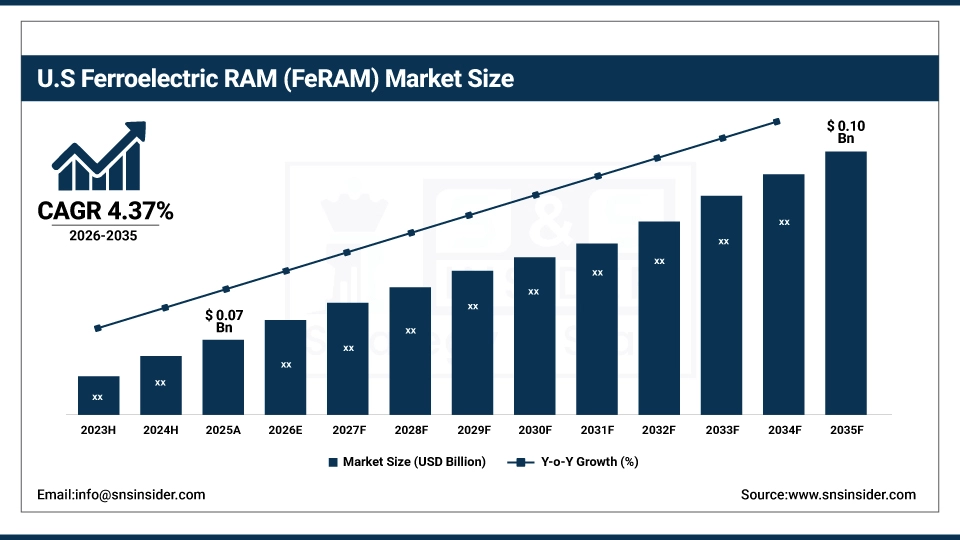
The U.S. Ferroelectric RAM (FeRAM) Market size was valued at USD 0.07 Billion in 2025 and is projected to reach USD 0.10 Billion by 2035, growing at a CAGR of 4.37% during 2026–2035, driven by rising demand for low-power, high-endurance non-volatile memory in automotive electronics, industrial automation, and aerospace applications. The growing demand for fast, energy-efficient embedded memory is fuelled by a growing number of advanced driver-assistance systems (ADAS), IoT devices and other edge computing solutions. Furthermore, active technology development in semiconductors and the rise of local semiconductor foundry investments are additionally enabling FeRAM integration for next-gen electronic systems.
Ferroelectric RAM (FeRAM) Market Drivers:
-
Advanced Node Scalability Accelerates Commercial Potential of Embedded Ferroelectric RAM
Advancements in CMOS-compatible hafnia-zirconia (HZO)-based ferroelectric materials are emerging as a major driver for the Ferroelectric RAM (FeRAM) market. In contrast to existing, perovskite-based FeRAM which is restricted to larger technology nodes, the scalable HZO platforms can facilitate integration at advanced nodes like 22nm FD-SOI, achieving considerable improvements in density, performance and energy efficiency. This improved scalability makes FeRAM less susceptible to the ability to downscale semiconductor geometries compared to traditional DRAM while still achieving low power consumption and exceptional endurance. With embedded FeRAM scalable solutions making them viable alternatives to traditional embedded NOR flash, they are increasingly positioned as competing bit cells in the face of continuing demand for dense, energy-efficient memory for IoT, mobile, and edge computing.
In Dec 2024, CEA-Leti demonstrated its first scalable HZO-based embedded ferroelectric RAM (FeRAM) platform integrated at the 22nm FD-SOI node.
Ferroelectric RAM (FeRAM) Market Restraints:
-
Limited Foundry Adoption and Cost Barriers Constrain Large-Scale Commercialization of Ferroelectric RAM
A major restraint in the Ferroelectric RAM (FeRAM) market is the limited participation of large semiconductor foundries, which restricts mass production and cost competitiveness. Due to the specific material and process integration and optimization needed for FeRAM, manufacturers incur higher development costs and longer qualification cycles over conventional memory technologies. No high-volume manufacturing means high cost per unit, which makes it hard to compete againsall established DRAM and NAND solutions benefiting from matured ecosystems and economies of scales. As a result, these cost and manufacturing limitations also delay mass market adoption and restrict FeRAM mainly to niche embedded and high-reliability applications.
Ferroelectric RAM (FeRAM) Market Opportunities:
-
Scaling Challenges in Conventional Memory Accelerate Adoption Potential for Ferroelectric RAM
Ferroelectric RAM (FeRAM) presents a significant market opportunity in the evolving embedded memory segment, particularly as traditional NOR flash faces scaling challenges below 28nm process nodes. As semiconductor geometries shrink, making traditional memory more complex and costly to manufacture FeRAM technologies, such as the ferroelectric gate ferroelectric transistors (FeFET) and ferroelectric capacitors (FeCAP) provide non-volatility, small switching time, long cycling endurance, and low-power consumption. By avoiding a head-on assault on DRAM or NAND in mass markets, FeRAM developers are in the box seat for an enduring growth niche by targeting microcontroller (MCU) integration as well as automotive electronics, industrial control systems and even aerospace applications where reliability and endurance have proven to be far more important than cost and provides sustainable growth with minimal price erosion at this point.
In Aug 2024 – The Register reported that Ferroelectric RAM (FeRAM) remains commercially stagnant, struggling to compete with DRAM and NAND due to limited production scale and high costs.
Ferroelectric RAM (FeRAM) Market Segment Highlights:
-
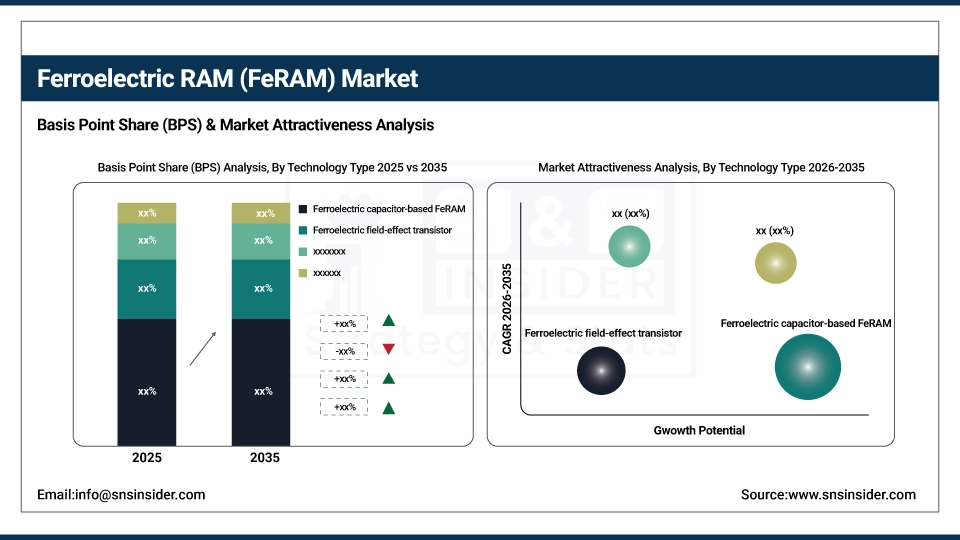
By Technology Type: Dominant – Ferroelectric Capacitor-based FeRAM (43.20% → 35.82%); Fastest-Growing – Ferroelectric Field-Effect Transistor (38.00% → 44.30%, CAGR 5.82%)
-
By Material Type: Dominant – Traditional Perovskite Materials (38.36% → 34.04%); Fastest-Growing – Doped Hafnium Oxide (37.68% → 41.52%, CAGR 5.23%)
-
By Interface Type: Dominant – Serial I2C Interface (41.60% → 38.40%); Fastest-Growing – Serial SPI Interface (38.70% → 44.30%, CAGR 5.63%)
-
By Density Range: Dominant – Medium Density (45.30% → 47.70%); Fastest-Growing – High Density (23.40% → 26.60%, CAGR 5.55%)
-
By End Use: Dominant – Automotive (22.30% → 24.70%); Fastest-Growing – Automotive (CAGR 5.28%)
Ferroelectric RAM (FeRAM) Market Segment Analysis:
Ferroelectric Capacitor-Based FeRAM Dominance and Rapid Growth of Ferroelectric Field-Effect Transistor Technology
Ferroelectric capacitor-based FeRAM continues to dominate the market due to its established reliability, proven architecture, and broad adoption across automotive and industrial applications, despite a gradual share decline. Meanwhile, ferroelectric field-effect transistor (FeFET) technology is the fastest-growing segment, due to scalability benefits, lower power consumption, higher density potential, and growing integration in next-generation embedded and edge computing solutions.
Traditional Perovskite Materials Dominance and Rapid Growth of Doped Hafnium Oxide
Traditional perovskite materials continue to dominate the FeRAM market due to their long-standing commercial use, stable performance characteristics, and established manufacturing processes. Meanwhile, the doped hafnium oxide leads the fastest-growing segment of materials, which can be ascribed to the scalability, CMOS-compatible characteristics, lower power consumption, and growing penetration of advanced semiconductor and embedded memory applications.
Serial I2C Interface Dominance and Rapid Growth of Serial SPI Interface
Serial I2C interfaces remain dominant owing to their simplicity, cost-effectiveness, and widespread integration in low- to mid-speed electronic systems. The serial SPI interface is the fastest-growing segment due to increasing data transfer rates, improved efficiency, high performance of the system, and increasing utilization in automotive, industrial and high-performance embedded applications.
Medium Density Segment Dominance and Rapid Growth of High-Density Solutions
Medium density FeRAM solutions continue to dominate the market due to their balanced cost, performance, and suitability for mainstream automotive and industrial applications. In contrast, high density FeRAM is the fastest growing segment due to the growing volume of data-intensive applications, ever-advancing processing requirements, and increasing adoption in AI-enabled and edge computing devices.
Automotive Sector Dominance and Continued Rapid Growth
The automotive sector dominates the FeRAM market, supported by rising electronic content in vehicles, demand for reliable non-volatile memory, and growth in electric and connected vehicles. It is the second fastest end-use segment that is growing attributed to advanced driver-assistance systems (ADAS), electric vehicles, safety systems, and reliability specifications.
Ferroelectric RAM (FeRAM) Market Regional Highlights:
-
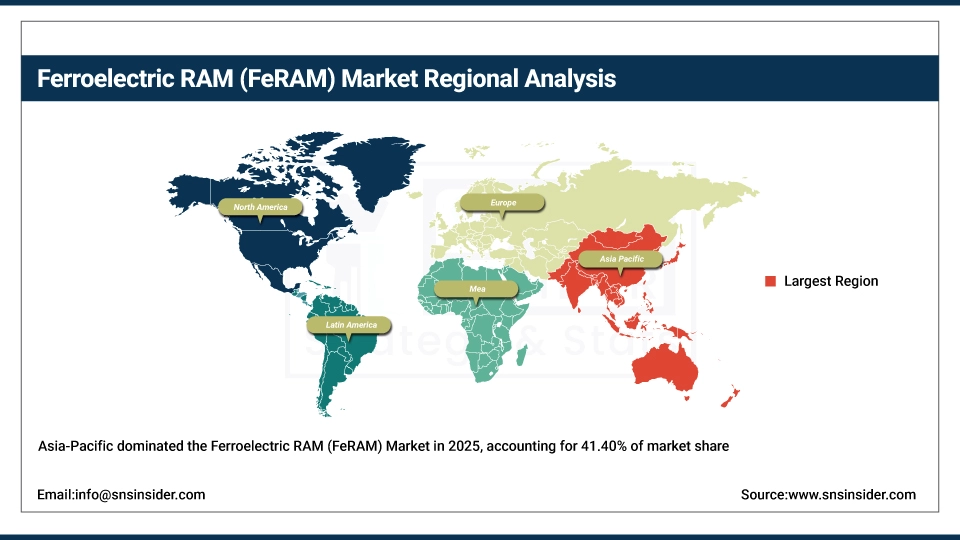
Asia-Pacific: 41.40% (2025) → 44.60% in 2035, Dominant Region with Rising Share driven by semiconductor fabrication expansion, EV production, and embedded memory manufacturing growth (CAGR 4.99%)
-
North America: 27.10% (2025) → 27.90% in 2035, Strong Growth Region supported by AI hardware development, defense electronics, and advanced R&D investments (CAGR 4.52%)
-
Europe: 19.80% (2025) → 18.20% in 2035, Moderate Share with Gradual Decline due to market maturity despite steady automotive and industrial automation demand (CAGR 3.34%)
-
Latin America: 5.90% (2025) → 5.10% in 2035, Small Share with Slow Growth led by gradual industrialization and infrastructure modernization (CAGR 2.70%)
-
Middle East & Africa: 5.80% (2025) → 4.20% in 2035, Emerging Market with Declining Share supported by smart grid and infrastructure investments (CAGR 0.86%)
Ferroelectric RAM (FeRAM) Market Regional Analysis:
Asia-Pacific Ferroelectric RAM (FeRAM) Market Insights:
The Asia-Pacific Ferroelectric RAM (FeRAM) market leads globally, driven by strong semiconductor manufacturing capacity across China, Japan, South Korea, and Taiwan. A rapid growth in the use of electric vehicles, and more use of automation in manufacturing sectors, production of consumer electronics and integration of embedded systems will further enhance the regional demand. The growth of semiconductor investments in Asia Pacific along with AI-driven hardware developments and increasing adoption of low-power, high-speed non-volatile memory ideas are primary factors stimulating the market in this region and fuelling FeRAM penetration in different end-use industries.
Get Customized Report as per Your Business Requirement - Enquiry Now
China Ferroelectric RAM (FeRAM) Market Insights:
China remains the key player in the Ferroelectric RAM (FeRAM) market, due to its semiconductor manufacturing capability, growing EV production, government affording chip investments, and the need for advanced embedded memory solutions.
North America Ferroelectric RAM (FeRAM) Market Insights:
The North America Ferroelectric RAM (FeRAM) market is experiencing robust growth, driving Robust Growth of North America Ferroelectric RAM (FeRAM) Market. Regional market growth has been further strengthened in the face of the presence of leading chip designers and fabless companies as well as rising demand for low-power, high-speed non-volatile memory in industrial automation and data-centric applications.
U.S. Ferroelectric RAM (FeRAM) Market Insights:
The U.S. Ferroelectric RAM (FeRAM) market steady and is projected to rise at a moderate pace owing to the proliferation of semiconductor innovation and demand for defense electronics, AI, and a surge in the adoption of FeRAM in low power embedded memory market across industries.
Europe Ferroelectric RAM (FeRAM) Market Insights:
The Europe Ferroelectric RAM (FeRAM) market is growing moderately, supported by strong automotive electronics demand, industrial automation expansion, and increasing adoption of energy-efficient memory solutions. This region takes advantage of Germany, France and Italy with its new generation of manufacturing capabilities, especially in the segments of EV systems and smart factory technologies. Instead and apart from the rapid growth, steady and controlled growth is regional as orderly the market maturity and relatively slow semiconductor fabrication expansion set a cap on rapid growth.
Germany Ferroelectric RAM (FeRAM) Market Insights:
The Germany Ferroelectric RAM (FeRAM) market is expanding steadily, driven by strong automotive electronics production, industrial automation growth, and increasing demand for reliable, low-power embedded memory solutions across manufacturing sectors.
Latin America Ferroelectric RAM (FeRAM) Market Insights:
The Latin America Ferroelectric RAM (FeRAM) market is witnessing steady growth, owing to the gradual modernization in industrial landscape, automotive assembly expansion, and rising embedded electronics utilization in manufacturing sectors. Increasing investments in digitization of infrastructure and in smart energy systems, etc. are also driving the need for a reliable, low-power non-volatile memory solution. While still constituting a minor portion of the global landscape, increased technology adoption and international semiconductor collaborations are bolstering steady growth in the local market.
Brazil Ferroelectric RAM (FeRAM) Market Insights:
Brazil is the leading country in the Latin America Ferroelectric RAM (FeRAM) market, with increasing automotive production, industrial automation investments and rising demand for advanced embedded memory technologies in sectors such as telecommunications and utilities.
Middle East & Africa (MEA) Ferroelectric RAM (FeRAM) Market Insights:
The Middle East & Africa Ferroelectric RAM (FeRAM) market is growing gradually, owing to the increased investments in smart infrastructure, energy management systems, and industrial automation. Growing uptake of embedded electronics in utilities and transportation will cause a steady demand for non-volatile memory solutions: future demand is great for top reliable low-power solutions. Despite a smaller share of global market share, ongoing digitization projects are continuing to drive limited regional market growth.
United Arab Emirates (UAE) Ferroelectric RAM (FeRAM) Market Insights:
The UAE remains the center of demand owing to rising investments in smart infrastructure, semiconductor deals, high adoption of advanced electronics, and major digital transformation projects in energy, transportation and industrial sectors.
Ferroelectric RAM (FeRAM) Market Competitive Landscape:
Infineon Technologies AG is one of the leading providers of semiconductor wafer foundries and was founded in Germany in 1999 and today creates solutions for three market segments including power systems, automotive electronics and industrial applications, as well security in home, office and mobile environments, and memory solutions such as F-RAM. The company provides energy efficiency, decarbonization and digitalization solutions for automotive, industrial, IoT and security markets around the globe.
-
In June 2024, Infineon Technologies AG announced the industry’s first space-qualified radiation-hardened 1 Mb and 2 Mb parallel interface F-RAMs, offering up to 120 years of data retention at 85°C and near-infinite endurance
Weebit Nano Ltd. was founded in 2015 and is an Australian semiconductor company specializing in memory technology. Weebit Nano develops resistive random-access memory (ReRAM) solutions that provide faster, more energy-efficient, and more durable alternatives to traditional memory technologies for a wide range of applications, including consumer electronics, industrial devices, and Internet of Things (IoT) devices. The company’s products include ReRAM memory cells, memory modules, and integrated solutions for chip manufacturers and technology developers. Weebit Nano has partnerships and collaborations with leading semiconductor companies globally and is focused on advancing next-generation memory solutions.
-
In 2025, Weebit Nano demonstrated its ReRAM technology in commercial IoT devices, highlighting its energy efficiency and reliability advantages over conventional memory solutions, supporting the growth of low-power, high-performance electronics worldwide.
Ferroelectric RAM (FeRAM) Market Key Players:
-
Infineon Technologies AG (Cypress FeRAM Division)
-
Weebit Nano Ltd.
-
LAPIS Semiconductor Co., Ltd. (ROHM Group)
-
Texas Instruments Incorporated
-
STMicroelectronics N.V.
-
Taiwan Semiconductor Manufacturing Company (TSMC)
-
Micron Technology, Inc.
-
Panasonic Holdings Corporation
-
Toshiba Electronic Devices & Storage Corporation
-
RAMXEED Limited
-
Radiant Technologies, Inc.
-
Ferroelectric Memory Company (FMC)
-
Advanced Memory Technologies
-
SK Hynix Inc.
-
Samsung Electronics Co., Ltd.
-
Nantero, Inc.
-
NXP Semiconductors N.V.
-
Renesas Electronics Corporation
-
Intel Corporation
-
GlobalFoundries Inc.
| Report Attributes | Details |
|---|---|
| Market Size in 2025 | USD 0.37 Billion |
| Market Size by 2035 | USD 0.56 Billion |
| CAGR | CAGR of 4.22% From 2026 to 2035 |
| Base Year | 2025 |
| Forecast Period | 2026-2035 |
| Historical Data | 2022-2024 |
| Report Scope & Coverage | Market Size, Segments Analysis, Competitive Landscape, Regional Analysis, DROC & SWOT Analysis, Forecast Outlook |
| Key Segments | • By Technology Type(Ferroelectric capacitor-based FeRAM, Ferroelectric field-effect transistor and Ferroelectric tunnel junction) • By Material Type(Traditional perovskite materials, Doped hafnium oxide and Aluminum scandium nitride) • By Interface Type(Serial I2C interface, Serial SPI interface and Parallel interface), By Density Range(Low density, Medium density and High density) • By End Use(Automotive, Industrial automation, Infrastructure & smart grid, Medical & healthcare, Consumer electronics, Networking & communications and Others) |
| Regional Analysis/Coverage | North America (US, Canada), Europe (Germany, UK, France, Italy, Spain, Russia, Poland, Rest of Europe), Asia Pacific (China, India, Japan, South Korea, Australia, ASEAN Countries, Rest of Asia Pacific), Middle East & Africa (UAE, Saudi Arabia, Qatar, South Africa, Rest of Middle East & Africa), Latin America (Brazil, Argentina, Mexico, Colombia, Rest of Latin America). |
| Company Profiles |
Infineon Technologies AG (Cypress FeRAM Division), Weebit Nano Ltd., LAPIS Semiconductor Co., Ltd. (ROHM Group), Texas Instruments Incorporated, STMicroelectronics N.V., Taiwan Semiconductor Manufacturing Company (TSMC), Micron Technology, Inc., Panasonic Holdings Corporation, Toshiba Electronic Devices & Storage Corporation, RAMXEED Limited, Radiant Technologies, Inc., Ferroelectric Memory Company (FMC), Advanced Memory Technologies, SK Hynix Inc., Samsung Electronics Co., Ltd., Nantero, Inc., NXP Semiconductors N.V., Renesas Electronics Corporation, Intel Corporation, GlobalFoundries Inc. |

Frequently Asked Questions
Asia-Pacific dominated the Ferroelectric RAM (FeRAM) Market in 2025.
Growing demand for low-power, high-speed, and non-volatile memory solutions in automotive, industrial automation, and advanced embedded systems is driving the Ferroelectric RAM (FeRAM) market.
The Ferroelectric RAM (FeRAM) Market size was USD 0.37 Billion in 2025 and is expected to reach USD 0.56 Billion by 2035.
The Ferroelectric RAM (FeRAM) Market is expected to grow at a CAGR of 4.22% from 2026-2035
The “Ferroelectric capacitor-based FeRAM” segment dominated during the projected period.
