
Floating Storage & Regasification Unit (FSRU) Market Report Scope & Overview:
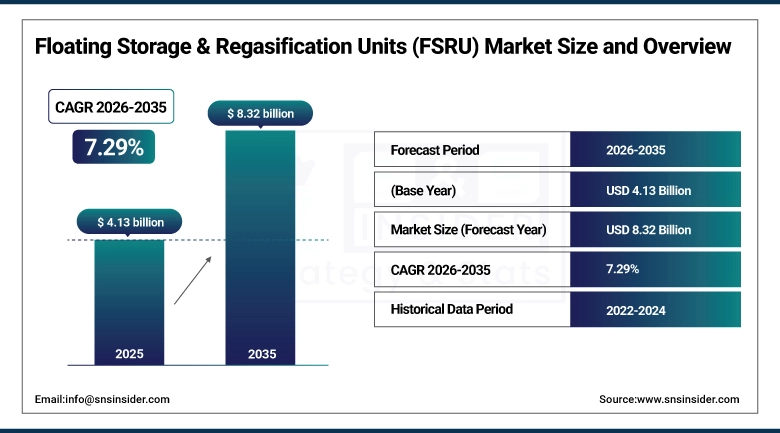
The Floating Storage & Regasification Unit (FSRU) Market was valued at USD 4.13 billion in 2025 and is expected to reach USD 8.32 billion by 2035, growing at a CAGR of 7.29% from 2026-2035.
The Floating Storage & Regasification Unit (FSRU) Market is growing with increasing global demand for LNG, growing demand for energy imports, and the need for flexible and modular regasification solutions. Investments in offshore terminals, technology, and government initiatives in diversifying sources of energy are also driving the market. In addition, rapid industrialization, urbanization, and the use of cleaner energy are increasing demand for LNG, which is driving the sustained use of FSRUs.
New FSRUs are being deployed globally to meet increasing demand for LNG and enhance energy security. Turkey’s first FSRU has increased the national gas grid capacity by 9.3 bcm.
In Singapore, the first FSRU, powered by ABB, is expected to have a capacity of 200,000 m³. This is expected to enhance the import capacity of Singapore by 50 percent over the existing landside terminal. In addition, the project is expected to support Singapore’s aspiration of achieving a net-zero energy future.
STRAIT OF HORMUZ CRISIS - GLOBAL LNG FLOWS AT RISK
A major disruption in the Strait of Hormuz following military escalation in the Middle East has caused a near‑halt of commercial shipping through the strait, a critical chokepoint responsible for 20–25 % of global seaborne crude oil and LNG flows. In response, Gulf oil producers are diverting exports through pipeline alternatives, including Saudi Arabia’s East‑West pipeline and UAE routes to Fujairah.
Europe and global markets are bracing for heightened energy price volatility, with policymakers holding urgent council meetings to address energy security concerns.
Impacts on LNG supply chains are significant:
-
LNG carriers are rerouting or delaying voyages, avoiding the strait entirely.
-
Shipping operators are temporarily suspending routes due to elevated maritime risk and higher insurance costs.
-
Freight costs are rising, and delivery timelines for LNG imports are increasingly uncertain.
Market implications for LNG and FSRUs:
-
Delays in LNG flows from Qatar and other Gulf exporters are expected to push global spot LNG prices higher.
-
Demand for flexible regasification infrastructure, including FSRUs, is rising to buffer short-term supply shortages and ensure uninterrupted energy access.
-
Governments and importers are likely to accelerate FSRU deployment and diversify sourcing to mitigate chokepoint risks.
This crisis underscores the strategic importance of FSRUs and flexible LNG infrastructure in stabilizing supply chains amid geopolitical shocks.
Floating Storage Regasification Units (FSRU) Market Size and Forecast
-
Market Size in 2025: USD 4.13 Billion
-
Market Size by 2035: USD 8.32 Billion
-
CAGR: 7.29% from 2026 to 2035
-
Base Year: 2025
-
Forecast Period: 2026–2035
-
Historical Data: 2022–2024
To Get more information on Floating Storage & Regasification Unit (FSRU) Market - Request Free Sample Report
Floating Storage & Regasification Unit (FSRU) Market Trends
-
Rising global demand for LNG and flexible import solutions is driving the Floating Storage & Regasification Unit (FSRU) market.
-
Growing adoption of FSRUs in emerging markets and regions with limited onshore infrastructure is boosting market growth.
-
Expansion of LNG trade, short-term supply contracts, and energy diversification strategies is fueling deployment.
-
Increasing focus on faster project commissioning, modular solutions, and cost-effective LNG import is shaping adoption trends.
-
Advancements in ship design, regasification technology, and environmental compliance are enhancing operational efficiency.
-
Rising need for energy security and reduced reliance on traditional pipeline infrastructure is supporting market expansion.
-
Collaborations between shipping companies, LNG suppliers, and energy utilities are accelerating innovation and global adoption.
U.S. Floating Storage Regasification Unit (FSRU) Market Size Outlook:
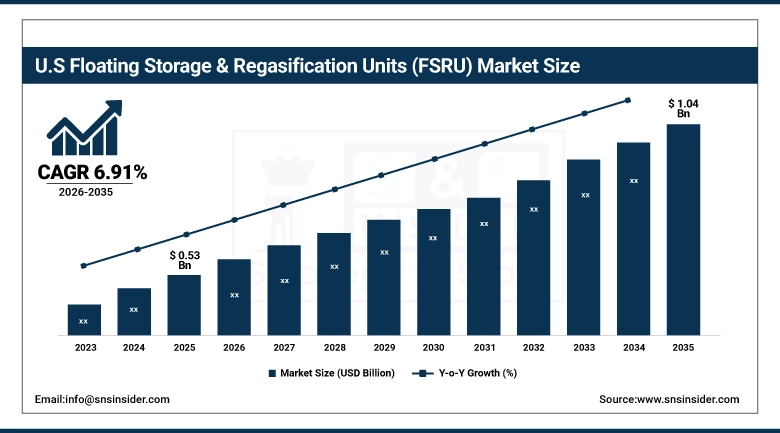
The U.S. Floating Storage Regasification Unit (FSRU) Market was valued at USD 0.53 billion in 2025 and is expected to reach USD 1.04 billion by 2035, growing at a CAGR of 6.91% from 2026-2035. The U.S. FSRU market is growing due to the increase in LNG imports, natural gas requirements for power and industrial uses, supportive government policies, and the development of offshore and coastal FSRU terminals for energy supply.
Floating Storage & Regasification Unit (FSRU) Market Growth Drivers:
-
Rising global LNG demand is pushing countries to adopt flexible FSRU solutions for faster, cost-effective natural gas import infrastructure
Increasing global energy demand and the need for cleaner energy sources are motivating global energy markets to increase LNG import facilities. The advantage of FSRUs over land-based terminals is that they can be installed quickly, thus helping to meet urgent energy demands. The ability of FSRUs to operate offshore allows for flexible supply chains to be put in place. The flexibility to move the FSRUs based on demand or market conditions allows for maximum efficiency. In addition, the increase in investment in LNG vessels, storage facilities, and regasification equipment will boost the demand for FSRUs, as they are an integral part of global energy supply diversification.
Floating Storage & Regasification Unit (FSRU) Market Restraints:
-
Technical limitations and dependency on suitable maritime infrastructure create barriers for global FSRU deployment
Additionally, FSRUs require the availability of deepwater ports, mooring facilities, as well as proximity to pipeline infrastructures, which are necessary for the effective incorporation of FSRUs. The absence of these facilities in some countries has been noted as a limitation to the adoption of FSRUs. Technical limitations, including the efficiency of the FSRU during adverse weather conditions, vessel maintenance, as well as the safety of the process of transferring LNG, may also influence the adoption of FSRUs in some countries. The capital cost may also form an additional requirement in some countries, especially in the absence of maritime facilities, which may influence the incorporation of FSRUs in these countries.
Floating Storage & Regasification Unit (FSRU) Market Opportunities:
-
Technological advancements in regasification and modular storage systems are creating untapped opportunities in FSRU market growth
Innovations in FSRU technology, such as in the regasification system, energy efficiency, and monitoring, make it safer and cheaper for companies to deal in LNG. The modular storage technology also enables companies to store it on a scale that can respond to seasonal demand or variable energy needs. The integration of renewable energy and hybrid energy solutions creates new opportunities for the application of FSRU technology. By leveraging technology, companies can capitalize on new markets in regions that have little or no LNG infrastructure. Technology efficiency enables companies to reduce operational costs, improve turnaround time, and become competitive. The introduction of smart monitoring, predictive maintenance, and AI technology creates a new growth opportunity, thus making the market investment-ready.
Floating Storage & Regasification Unit (FSRU) Market Segment Highlights
-
By Mode of Transportation, Marine / Sea Transportation dominated the Floating Storage & Regasification Unit (FSRU) Market with ~88% share in 2025; Pipeline Integration fastest growing (CAGR).
-
By Application, Base-load Regasification dominated the Floating Storage & Regasification Unit (FSRU) Market with ~64% share in 2025; Peak-shaving/Short-term Regasification fastest growing (CAGR).
-
By Type, New-built FSRU dominated the Floating Storage & Regasification Unit (FSRU) Market with ~61% share in 2025; Converted FSRU fastest growing (CAGR).
-
By End-User, Midstream dominated the Floating Storage & Regasification Unit (FSRU) Market with ~55% share in 2025; Downstream fastest growing (CAGR).
-
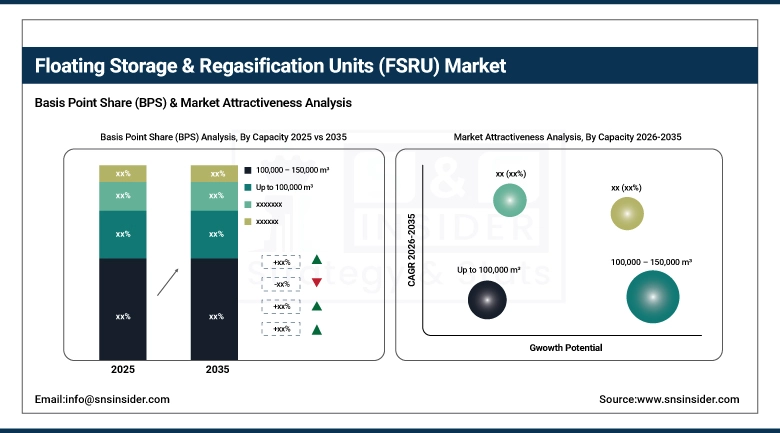
By Capacity, 100,000 – 150,000 m³ dominated the Floating Storage & Regasification Unit (FSRU) Market with ~45% share in 2025; Above 150,000 m³ fastest growing (CAGR).
By Capacity, 100,000–150,000 m³ dominates, Above 150,000 m³ expected to grow fastest
The 100,000 – 150,000 m³ segment held the highest share in the Floating Storage & Regasification Unit (FSRU) Market as it represented the optimal balance in terms of storage, flexibility, and cost-effectiveness. The medium size of the units is used for regional imports, which are used for meeting seasonal demand without any investment risk. The units are scalable, flexible, and applicable in all energy markets around the world, thus ensuring the maximum share in terms of revenue.
Above 150,000 m³ segment is expected to witness the fastest growth rate in terms of CAGR from 2026-2035, as the demand for LNG is expected to rise globally, along with long-term contracts for imports. Large size floating storage and regasification units are used for supporting high-volume supply chains, industries, and energy security programs.
By Mode of Transportation, Marine & Sea Transportation dominates, Pipeline Integration expected to grow fastest in the FSRU Market
Marine and Sea Transportation segment has dominated the market for Floating Storage Regasification Units due to its cost-effectiveness, ability to transport large volumes of LNG, the dependence of the international trade market on these vessels, and the ability of these vessels to transport goods over long distances.
The pipeline integration segment is expected to register the highest CAGR during the forecast period of 2026-2035 due to the safe and efficient transportation of gas to the domestic grid. The need to invest in infrastructure and strategic government initiatives to supply gas to the domestic grid are contributing to the demand for pipeline integration with FSRUs in both developing and developed countries.
By Application, Base-Load Regasification dominates, Peak-Shaving/Short-Term Regasification expected to grow fastest
The base load regasification segment accounted for the highest share in the Floating Storage & Regasification Unit (FSRU) Market due to the permanent or semi-permanent nature of such terminals, providing a continuous supply of LNG to fulfill the steady demand of industries. This makes the base load segment crucial for LNG import terminals across various regions globally.
Peak Shaving/Short-Term Regasification segment is expected to witness the highest CAGR during the forecast period of 2026-2035, as the demand for temporary LNG solutions continues to rise. Seasonal peaks in the demand for energy, emergency response situations, and the need for temporary LNG supplies in remote locations or off-shore projects create the need for peak shaving/short-term regasification, thereby contributing to the growth of the Floating Storage & Regasification Unit (FSRU) Market.
By Type, New-Built FSRU dominates, Converted FSRU expected to grow fastest in the FSRU Market
New-built FSRU dominated the Floating Storage & Regasification Unit (FSRU) Market due to efficiency, storage, and regasification. The custom design of new-built FSRU meets specific requirements for operation, enhancing efficiency and performance. Long-term deployment projects prefer new-built FSRU for reliability and compatibility with modern energy infrastructure, resulting in the highest revenue share.
The Converted FSRU segment is expected to witness the highest CAGR from 2026-2035. Converting existing LNG carriers is more cost-effective and quicker than new construction. The flexibility of deployment, low initial cost, and ability to quickly respond to growing LNG demand in new markets make converted FSRU an attractive option for operators worldwide.
By End-User, Midstream dominates, Downstream expected to grow fastest in the FSRU Market
The Midstream segment accounted for the largest share in the Floating Storage and Regasification Units (FSRU) Market. This is because the transportation, storage, and regasification of LNG demand specific floating infrastructure. They provide modularity, flexibility, and efficiency in ensuring the consistent supply of energy to consumers. In addition, the investments in this industry are significant in the midstream segment, which is the reason behind the dominance of this segment in the global LNG industry.
The downstream segment is expected to witness the highest CAGR from 2026-2035. The demand for LNG from industrial, power generation, and city gas distribution sectors will drive demand for FSRUs. The surge in energy demand, electrification alternatives, and consistent gas supply will drive investments in FSRUs for downstream applications. The flexibility of LNG supply through FSRUs will increase adoption and drive demand for FSRUs.
Floating Storage & Regasification Unit (FSRU) Market Regional Analysis
Asia Pacific Floating Storage & Regasification Unit (FSRU) Market Insights
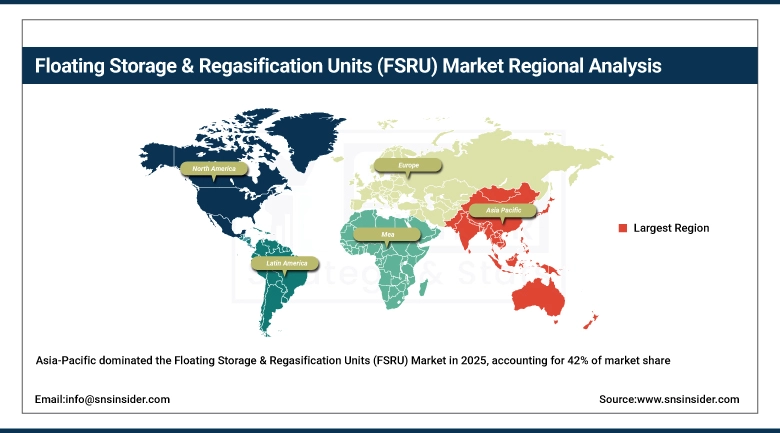
Asia Pacific has the highest share in the Floating Storage & Regasification Unit Market in terms of revenue, which was around 42% in 2025. This is because of the rise in energy demand, increased imports of LNG, and policies adopted by the government to explore alternate sources of energy. The focus on the development of industries, urbanization, and reducing emissions of greenhouse gases is also contributing to the growth of the FSRU infrastructure sector. Japan, Korea, China, and India are investing heavily in the development of LNG terminal capacity, and the policies adopted are favoring these countries in terms of location.
Get Customized Report as per Your Business Requirement - Enquiry Now
North America Floating Storage & Regasification Unit (FSRU) Market Insights
North America in the Floating Storage and Regasification Units (FSRU) Market is driven by the rising LNG imports, energy diversification measures, and the rising demand for natural gas as a power generation and industrial sector fuel. Investments in offshore FSRU terminals and coastal infrastructure, as well as the energy policies of the governments and the advanced maritime infrastructure, are also boosting the FSRU market in the region.
Europe Floating Storage & Regasification Unit (FSRU) Market Insights
Europe in the Floating Storage & Regasification Unit (FSRU) Market is growing, driven by the rise in LNG imports, the need to reduce dependence on pipeline gas, and the shift to cleaner forms of energy. The strategic location of the ports, the quality of the shipping infrastructure, and the incentives provided by the governments are contributing to the speedy adoption of FSRUs in the region, thereby boosting the growth of the power and industrial sectors.
Middle East & Africa and Latin America Floating Storage & Regasification Unit (FSRU) Market Insights
Middle East & Africa in the FSRU market is driven by the availability of oil and gas resources, increasing exports of LNG, and the development of port and pipeline infrastructure, which is boosting energy trade in the region. Latin America is driven by the growth of countries that are developing import terminal facilities, diversifying their energy mix, and increasing demand, thereby creating the need for flexible FSRU solutions in the region.
Floating Storage & Regasification Unit (FSRU) Market Competitive Landscape:
Excelerate Energy Inc. – Company Overview
Excelerate Energy Inc. is one of the leading companies in the development and operation of floating LNG infrastructure, including Floating Storage and Regasification Units (FSRU), as well as offshore terminals for regasification. The company provides turnkey solutions for LNG import, storage, and regasification for the country’s power generation and gas requirements. The company is focused on environmental efficiency and flexibility, enabling the rapid deployment of LNG assets to markets worldwide through their expertise in FSRU chartering, retrofitting, and floating gas solutions.
-
2026: Signed a definitive agreement with Iraq’s Ministry of Electricity to develop the country’s first integrated floating LNG terminal with a 500 MMscf/d FSRU.
-
2024: Announced an FSRU reliquefaction retrofit project with Wärtsilä Gas Solutions to reduce environmental footprint and improve boil-off gas management.
-
2023: Signed a ten-year charter for its FSRU Sequoia with Petrobras for regasification services at the Bahia LNG terminal in Brazil.
-
2022: Signed a term sheet to deploy an FSRU to Germany’s Wilhelmshaven LNG import terminal, enhancing flexible regasification capacity in Europe.
Mitsui O.S.K. Lines (MOL)
Mitsui O.S.K. Lines (MOL) is one of the largest global shipping companies with specializations in container shipping, bulk shipping, and LNG shipping. MOL offers high-tech LNG vessels and FSRU solutions that provide integrated gas-to-power solutions across the Asian region and beyond. MOL is committed to the development of energy infrastructure by combining its shipping knowledge with energy infrastructure development, which can provide fast LNG solutions, secure energy supplies to power plants, and high-efficiency operations to support national energy security and clean energy solutions.
-
2024: Started commercial operations of the FSRU Jawa Satu, supplying LNG to the 1,760 MW Jawa 1 gas-fired power plant in West Java, marking Asia’s first integrated gas-to-power FSRU project.
Floating Storage Regasification Unit Companies:
-
Höegh LNG Holdings Ltd.
-
Golar LNG Limited
-
BW Gas Limited
-
Mitsui O.S.K. Lines (MOL)
-
Samsung Heavy Industries Co., Ltd.
-
Hyundai Heavy Industries Co., Ltd.
-
Daewoo Shipbuilding & Marine Engineering (DSME)
-
Gazprom
-
Royal Dutch Shell plc
-
TotalEnergies SE
-
Bumi Armada Berhad
-
Teekay LNG Partners L.P.
-
FLEX LNG Ltd.
-
Maran Gas Maritime Inc.
-
Offshore LNG Toscana SpA (OLT)
-
Gazprom FLEX LNG
-
MISC Berhad
-
Kawasaki Kisen Kaisha Ltd
| Report Attributes | Details |
|---|---|
| Market Size in 2025 | USD 4.13 Billion |
| Market Size by 2035 | USD 8.32 Billion |
| CAGR | CAGR of 7.29% From 2026 to 2035 |
| Base Year | 2025 |
| Forecast Period | 2026-2035 |
| Historical Data | 2022-2024 |
| Report Scope & Coverage | Market Size, Segments Analysis, Competitive Landscape, Regional Analysis, DROC & SWOT Analysis, Forecast Outlook |
| Key Segments | • By Type (New-built FSRU, Converted FSRU) • By Capacity (Up to 100,000 m³, 100,000 – 150,000 m³, Above 150,000 m³) • By Application (Base-load Regasification, Peak-shaving/Short-term Regasification) • By End-User (Upstream, Midstream, Downstream) • By Mode of Transportation (Marine / Sea Transportation, Pipeline Integration) |
| Regional Analysis/Coverage | North America (US, Canada), Europe (Germany, UK, France, Italy, Spain, Russia, Poland, Rest of Europe), Asia Pacific (China, India, Japan, South Korea, Australia, ASEAN Countries, Rest of Asia Pacific), Middle East & Africa (UAE, Saudi Arabia, Qatar, South Africa, Rest of Middle East & Africa), Latin America (Brazil, Argentina, Mexico, Colombia, Rest of Latin America). |
| Company Profiles | Excelerate Energy Inc., Höegh LNG Holdings Ltd., Golar LNG Limited, BW Gas Limited, Exmar NV, Mitsui O.S.K. Lines (MOL), Samsung Heavy Industries Co., Ltd.,Hyundai Heavy Industries Co., Ltd., Daewoo Shipbuilding & Marine Engineering (DSME), Gazprom, Royal Dutch Shell plc, TotalEnergies SE, Bumi Armada Berhad, Teekay LNG Partners L.P., FLEX LNG Ltd., Maran Gas Maritime Inc., Offshore LNG Toscana SpA (OLT), Gazprom FLEX LNG, MISC Berhad, Kawasaki Kisen Kaisha Ltd |
Frequently Asked Questions
Asia Pacific dominated the Floating Storage & Regasification Unit (FSRU) Market in 2025.
The Midstream segment dominated the Floating Storage & Regasification Unit (FSRU) Market in 2025.
Rising global LNG demand is pushing countries to adopt flexible FSRU solutions for faster, cost-effective natural gas import infrastructure
The Floating Storage & Regasification Unit (FSRU) Market was valued at USD 4.13 billion in 2025.
The Floating Storage & Regasification Unit (FSRU) Market is expected to grow at a CAGR of 7.29% from 2026 to 2035.
