
Fuel Cell UAV Market Report Scope & Overview:
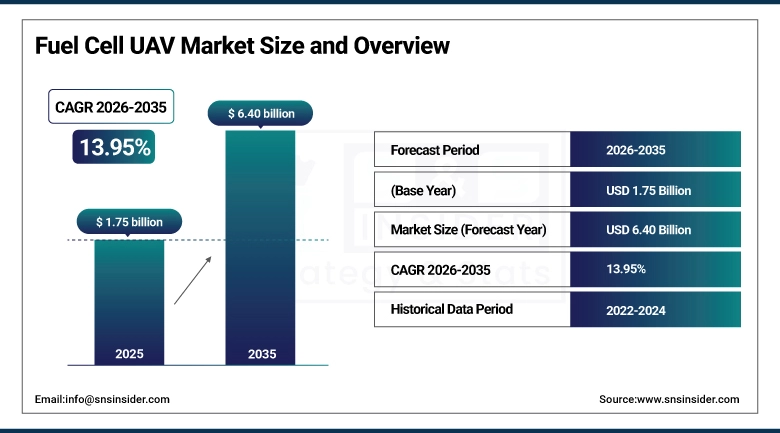
The Fuel Cell UAV Market size is valued at USD 1.75 Billion in 2025 and is projected to reach around USD 6.40 Billion by 2035, growing at a CAGR of 13.95% during the forecast period 2026–2035.
Fuel Cell UAV Market Insights gives a comprehensive study of industry drivers, technology innovations, and applications. An increase in the need for UAVs with extended endurance time, an increase in their use in military and surveillance activities, emphasis on zero emissions and sustainability in power supply, and investment in hydrogen and fuel cells are boosting the market from 2026 to 2035.
Fuel cell UAVs are gaining popularity due to increased endurance, payload capacity, and less downtime than battery-operated UAVs.
Fuel Cell UAV Market Size and Forecast:
-
Market Size in 2025: USD 1.75 Billion
-
Market Size by 2035: USD 6.40 Billion
-
CAGR: 13.95% from 2026 to 2035
-
Base Year: 2025
-
Forecast Period: 2026–2035
-
Historical Data: 2022–2024
To Get more information on Fuel Cell UAV Market - Request Free Sample Report
Fuel Cell UAV Market Trends:
-
Rising demand for long-endurance UAVs is driving adoption of fuel cell propulsion systems in defense, surveillance, and commercial operations.
-
Increasing focus on zero-emission and sustainable aviation technologies is boosting the shift from battery-powered UAVs to hydrogen fuel cell UAVs.
-
Advancements in proton exchange membrane fuel cells (PEMFC) and hydrogen storage systems are improving UAV flight endurance and operational efficiency.
-
Growing use of UAVs in logistics, inspection, mapping, and agriculture is expanding commercial applications of fuel cell UAVs.
-
Expansion of defense modernization programs and ISR (Intelligence, Surveillance, Reconnaissance) missions is accelerating deployment of fuel cell-powered UAV platforms.
-
Increasing R&D investments and collaborations between aerospace companies, fuel cell manufacturers, and defense agencies are driving innovation and commercialization of next-generation UAV systems.
U.S. Fuel Cell UAV Market:
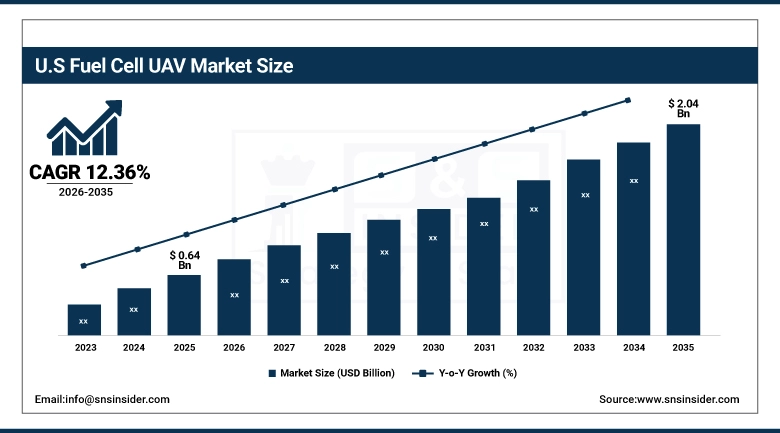
The U.S. Fuel Cell UAV Market is projected to grow from USD 0.64 Billion in 2025 to USD 2.04 Billion by 2035, at a CAGR of 12.36%. Growth is driven by increasing demand for long-endurance UAVs in defense and surveillance applications, rising adoption of hydrogen fuel cell propulsion systems, advancements in PEM fuel cell and hydrogen storage technologies, and expanding use of UAVs in logistics, inspection, mapping, and other commercial operations.
Fuel Cell UAV Market Growth Drivers:
-
Rising demand for long-endurance UAVs and increasing adoption of fuel cell propulsion systems driving growth of the Fuel Cell UAV Market.
The increased demand for enhanced flight endurance, along with the increasing application of UAVs for defense surveillance, logistics, mapping, and inspection purposes, are some of the major factors expected to drive the Fuel Cell UAV Market during the forecast period. The rising use of hydrogen fuel cells in UAVs by defense organizations, private companies, and governments to increase the mission duration, optimize payload capacity, and minimize the downtimes when compared with batteries are some of the major reasons behind the high adoption of such systems among consumers.
More than 50% of defense and commercial UAV providers will be using fuel cell–based systems by 2025.
Fuel Cell UAV Market Restraints:
-
High initial costs and limited hydrogen infrastructure are restraining widespread adoption of fuel cell UAVs.
The high costs associated with fuel cell technology and its deployment and a lack of hydrogen refueling stations are the major restraints for the Fuel Cell UAV Market. The sophisticated nature of fuel cells, hydrogen tanks, and their integration into the UAV increases their price, thus restricting their use by smaller companies and military forces that have fewer budgets to spend on these types of aircraft. Other factors that restrain market growth include an inadequate hydrogen supply chain and safety norms and standards regarding their use.
Fuel Cell UAV Market Opportunities:
-
Expanding integration of fuel cell UAVs in defense modernization and commercial autonomous operations presents significant market growth opportunities.
The growing trend of using fuel cell-powered UAVs for defense and commercial applications including defense surveillance, reconnaissance, intelligence missions and logistics, infrastructure inspections, agriculture, and mapping create a robust potential for the Fuel Cell UAV Market. Both governments and defense forces around the world are making efforts in developing the next generation of UAVs with higher endurance capabilities and lower acoustic and thermal signatures. Moreover, companies are making use of fuel cell UAVs that enable sustained operations with long flights and more payload. Improvement in the efficiency of hydrogen fuel cell technology and policies that favor energy adoption is boosting the market growth.
In the coming years till 2025, more than 45% of the UAV programs for both defense and commercial segments are expected to utilize fuel cells.
Fuel Cell UAV Market Segmentation Analysis:
-
By UAV Type, Fixed-Wing UAVs held the largest market share of 52.25% in 2025, while Hybrid UAVs are expected to grow at the fastest CAGR of 17.31% during 2026–2035.
-
By Fuel Cell Type, Proton Exchange Membrane Fuel Cells (PEMFC) dominated with a 67.25% market share in 2025, whereas Solid Oxide Fuel Cells (SOFC) are projected to record the fastest CAGR of 16.00% through 2026–2035.
-
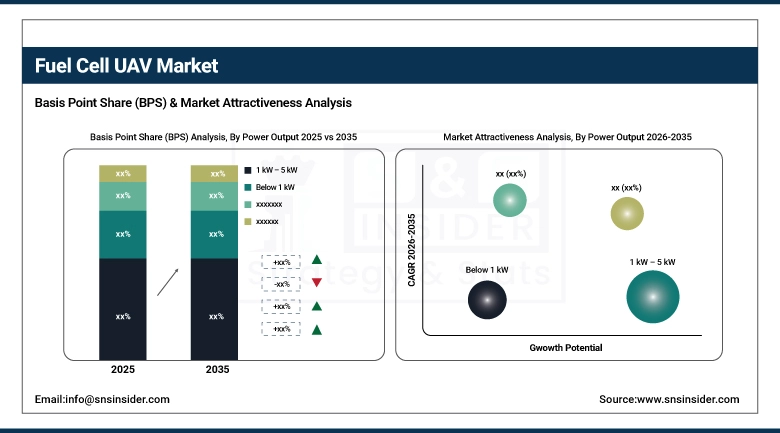
By Power Output, 1 kW – 5 kW segment accounted for the highest market share of 40.25% in 2025, while Below 1 kW segment is expected to grow at the12.25% rate during the forecast period.
-
By Application, Defense & Military dominated with a 52.12% share in 2025, while Commercial applications are anticipated to expand at the fastest CAGR of 14.25% through 2026–2035.
-
By End-User, Defense Organizations held the largest share of 55.54% in 2025, while Commercial Enterprises are expected to grow at the fastest CAGR of 14.74% during the forecast period.
By Power Output, 1 kW – 5 kW Dominates While Below 1 kW Grows Rapidly:
The 1 kW – 5 kW segment dominated the market due to its optimal balance between power output and UAV weight, making it suitable for a wide range of defense and commercial applications. In 2025, adoption accounted for 40 units, reflecting strong utilization across medium-sized UAV platforms.
Below 1 kW segment is the fastest-growing, driven by increasing deployment of compact and lightweight UAVs for surveillance, inspection, and short-range missions. Adoption is expanding due to lower system complexity, cost efficiency, and suitability for small-scale commercial and research applications.
By UAV Type, Fixed-Wing UAVs Dominate While Hybrid UAVs Grow Rapidly:
Fixed-Wing UAVs segment dominated the market due to their superior endurance, longer flight range, and higher payload efficiency, making them highly suitable for defense surveillance, mapping, and long-duration missions. In 2025, deployment exceeded 52 units (in index/normalized terms), reflecting strong preference among defense organizations and commercial operators for extended operational capabilities.
Hybrid UAVs are the fastest-growing segment, driven by increasing demand for versatile platforms that combine vertical takeoff and landing with long-range flight endurance. Adoption reached 20 units in 2025, particularly in logistics, inspection, and mission-critical operations requiring flexibility and efficiency.
By Fuel Cell Type, Proton Exchange Membrane Fuel Cells Dominate While Solid Oxide Fuel Cells Grow Rapidly:
Proton Exchange Membrane Fuel Cells segment dominated the market, widely adopted due to their high efficiency, lower operating temperature, and suitability for lightweight UAV applications. In 2025, utilization exceeded 67 units, indicating strong preference among UAV manufacturers integrating fuel cell propulsion systems.
Solid Oxide Fuel Cells are the fastest-growing segment, driven by their higher energy efficiency and suitability for larger UAV platforms requiring sustained power output. Usage reached 18 units in 2025, supported by advancements in high-temperature fuel cell technology and increasing research investments.
By Application, Defense & Military Dominates While Commercial Applications Grow Rapidly:
Defense & Military segment dominated the market due to extensive use of fuel cell UAVs in surveillance, reconnaissance, intelligence gathering, and mission-critical operations requiring long endurance and low detectability. In 2025, deployment exceeded 52 units (in index/normalized terms), reflecting strong reliance on advanced UAV platforms by defense organizations for extended and continuous missions.
Commercial Applications is the fastest-growing segment, driven by increasing adoption of UAVs in logistics, inspection, mapping, agriculture, and infrastructure monitoring. In 2025, usage reached 14 units, supported by the need for longer flight durations, reduced downtime, and efficient operations in commercial and industrial environments.
By End User, Defense Organizations Dominate While Commercial Enterprises Grow Rapidly:
Defense Organizations segment dominated the market as they are the primary adopters of fuel cell UAVs for surveillance, border security, and tactical operations requiring long-endurance and reliable performance. In 2025, utilization exceeded 55 units, highlighting strong integration of advanced UAV technologies within defense programs and modernization initiatives.
Commercial Enterprises are the fastest-growing segment, driven by increasing deployment of UAVs in delivery services, industrial inspection, agriculture, and data collection applications. Adoption reached 15 units in 2025, reflecting growing investment in fuel cell UAVs to enhance operational efficiency, reduce emissions, and enable longer mission capabilities.
Fuel Cell UAV Market Regional Analysis:
North America Fuel Cell UAV Market Insights:
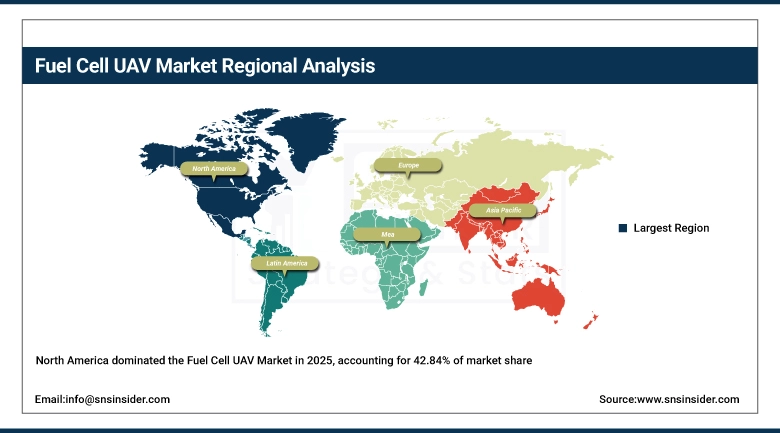
The North America Fuel Cell UAV Market is dominated, holding a 42.84% share in 2025, due to robust defense expenditure, modernized infrastructure of the aerospace industry, and the early adoption of hydrogen fuel cells in the U.S. and Canada. The usage of UAVs in surveillance, reconnaissance, border security, and intelligence operations ensures high demand for endurance-based UAVs. The increasing expenditure on the development of energy-efficient aviation solutions, presence of leading UAV manufacturers, and collaboration between the defense agencies and technology suppliers are some of the other key factors making North America a dominant player in the Fuel Cell UAV Market.
Get Customized Report as per Your Business Requirement - Enquiry Now
U.S. Market Insights:
Fuel Cell UAV Market in the United States is fueled by rising defense modernization efforts, increasing use of UAVs in defense operations, and considerable investment in hydrogen fuel cell technology. The growing number of UAV deployments for surveillance, reconnaissance, logistics, and infrastructure management is fueling the demand for highly durable and efficient UAVs. Availability of established aerospace and defense organizations, research & development expertise, and government policies promoting renewable energy and unmanned aircraft systems are aiding the market growth.
Asia-Pacific Fuel Cell UAV Market Insights:
The Asia-Pacific Fuel Cell UAV Market is the fastest-growing region, projected to expand at a 17.24% during 2026–2035. Growth is driven by rising defense investments, increasing adoption of UAVs for surveillance and border monitoring, and rapid industrialization across China, India, Japan, and South Korea. Expanding use of UAVs in logistics, agriculture, infrastructure inspection, and smart city initiatives is further accelerating demand. Government support for hydrogen energy development, growing domestic UAV manufacturing capabilities, and increasing R&D activities in fuel cell technologies are key factors contributing to rapid market expansion across the region.
China Market Insights:
The driving forces behind the China Fuel Cell UAV Market include significant investment in unmanned aerial vehicles, enhancing defense capabilities, and technological advancements in hydrogen fuel cell technology. The increased use of drones for monitoring, border security, logistics purposes, and infrastructure monitoring has increased demand for long-endurance unmanned aerial vehicles. Consistent developments in PEM fuel cell technology, the integration of unmanned aerial systems in various industrial and smart city applications, and an increased focus on renewable energy have made China a notable contributor to the Asia-Pacific Fuel Cell UAV Market.
Europe Market Insights:
Increasing sustainability initiatives in the form of eco-friendly aircraft technology, the presence of stringent government regulations concerning reduced carbon emissions, and a consistent rise in applications for UAVs have been the primary factors boosting the growth of the Europe Fuel Cell UAV Market. Countries such as Germany, France, and the UK have been contributing significantly to regional demand owing to investments in hydrogen fuel infrastructure and aerospace systems. Growing applications in UAVs for inspection, mapping, agricultural purposes, and safety concerns have further added to market potential.
Germany Market Insights:
Germany is a key market in the European Fuel Cell UAV landscape, driven by advanced aerospace engineering capabilities, strong research initiatives, and emphasis on hydrogen-based mobility solutions. Growth is supported by increasing use of UAVs in industrial inspection, defense applications, and environmental monitoring. Investments in hydrogen infrastructure, coupled with active participation of technology firms and research organizations, are fostering innovation in fuel cell systems and UAV integration.
Latin America Market Insights:
The Latin America Fuel Cell UAV Market is growing due to increasing adoption of UAVs in agriculture, mining, infrastructure monitoring, and border surveillance. Countries such as Brazil, Mexico, and Argentina are witnessing gradual improvements in UAV deployment supported by expanding industrial activities and government interest in advanced aerial technologies. While hydrogen infrastructure remains limited, rising awareness of clean energy solutions and increasing collaboration with international UAV manufacturers are supporting market development.
Middle East and Africa Market Insights:
The Middle East & Africa Fuel Cell UAV Market is expanding due to rising investments in defense modernization, smart city initiatives, and infrastructure development projects. Countries such as Saudi Arabia, the UAE, and South Africa are increasingly adopting UAVs for surveillance, security, oil and gas inspection, and large-scale infrastructure monitoring. Availability of funding for advanced technologies, coupled with growing interest in hydrogen energy initiatives, is supporting gradual adoption of fuel cell UAV systems.
Fuel Cell UAV Market Competitive Landscape:
AeroVironment is a leading U.S.-based defense technology company with a strong presence in the fuel cell UAV market, focusing on long-endurance unmanned aerial systems for military surveillance and reconnaissance missions. Its UAV platforms are widely used by defense organizations for intelligence, surveillance, and target acquisition operations, where extended flight duration and reliability are critical. The company’s continuous investment in hybrid and fuel cell propulsion integration, along with advancements in lightweight UAV design and autonomous capabilities, strengthens its competitive positioning.
-
In September 2025, AeroVironment advanced its next-generation long-endurance UAV program incorporating hydrogen fuel cell propulsion systems to enhance operational range and reduce acoustic signatures for defense applications.
Doosan Mobility Innovation is a South Korea–based company specializing in hydrogen fuel cell systems for UAVs, with a strong focus on enabling long-duration flight capabilities for commercial and industrial applications. Its fuel cell drones are widely adopted in inspection, surveillance, and mapping operations, offering extended flight times compared to battery-powered alternatives. The company’s expertise in hydrogen fuel cell integration, combined with scalable UAV solutions and partnerships with energy and infrastructure providers, supports its growing market presence. Continuous innovation in fuel cell stack efficiency, hydrogen storage systems, and modular UAV platforms enhances its competitiveness across markets.
-
In August 2025, Doosan Mobility Innovation expanded its hydrogen UAV deployment programs for infrastructure inspection and logistics applications, enhancing flight endurance and operational efficiency through upgraded fuel cell systems.
Intelligent Energy is a UK-based hydrogen fuel cell technology company known for developing advanced lightweight fuel cell systems used in UAV applications. The company focuses on providing high-performance power solutions that enable extended UAV flight durations for both defense and commercial use cases. Its proprietary fuel cell technology is designed for scalability, high energy density, and rapid integration into UAV platforms. Strategic collaborations with UAV manufacturers and ongoing R&D investments in fuel cell efficiency and hydrogen systems strengthen its position in the market.
-
In July 2025, Intelligent Energy introduced an upgraded UAV fuel cell system designed to improve endurance and payload capacity, supporting broader adoption in commercial UAV platforms for long-range operations.
Fuel Cell UAV Market Key Players:
Some of the Fuel Cell UAV Market Companies are:
-
AeroVironment
-
Doosan Mobility Innovation
-
Intelligent Energy
-
Ballard Power Systems
-
PowerCell Sweden
-
HyPoint
-
ZeroAvia
-
H3 Dynamics
-
UAVOS
-
Quaternium Technologies
-
MMC UAV
-
UMS Skeldar
-
Schiebel
-
Elbit Systems
-
Israel Aerospace Industries
-
Northrop Grumman
-
Lockheed Martin
-
Boeing
-
Airbus
-
General Atomics
Fuel Cell UAV Market Report Scope:
| Report Attributes | Details |
|---|---|
| Market Size in 2025 | USD 1.75 Billion |
| Market Size by 2035 | USD 6.40 Billion |
| CAGR | CAGR of 13.95% From 2026 to 2035 |
| Base Year | 2025 |
| Forecast Period | 2026-2035 |
| Historical Data | 2022-2024 |
| Report Scope & Coverage | Market Size, Segments Analysis, Competitive Landscape, Regional Analysis, DROC & SWOT Analysis, Forecast Outlook |
| Key Segments | • By UAV Type (Fixed-Wing UAVs, Rotary-Wing UAVs (Multi-rotor / Helicopter), Hybrid UAVs, Others) • By Fuel Cell Type (Proton Exchange Membrane Fuel Cells (PEMFC), Solid Oxide Fuel Cells (SOFC), Direct Methanol Fuel Cells (DMFC), Others) • By Power Output (Below 1 kW, 1 kW – 5 kW, Above 5 kW, Others) • By Application (Defense & Military, Commercial – Logistics & Delivery, Inspection & Monitoring, Mapping & Surveying, Government & Public Safety, Agriculture, Others) • By End-User (Defense Organizations, Commercial Enterprises, Government Agencies, Research & Development Institutions, Others) |
| Regional Analysis/Coverage | North America (US, Canada, Mexico), Europe (Eastern Europe [Poland, Romania, Hungary, Turkey, Rest of Eastern Europe] Western Europe] Germany, France, UK, Italy, Spain, Netherlands, Switzerland, Austria, Rest of Western Europe]), Asia Pacific (China, India, Japan, South Korea, Vietnam, Singapore, Australia, Rest of Asia Pacific), Middle East & Africa (Middle East [UAE, Egypt, Saudi Arabia, Qatar, Rest of Middle East], Africa [Nigeria, South Africa, Rest of Africa], Latin America (Brazil, Argentina, Colombia, Rest of Latin America) |
| Company Profiles | AeroVironment, Doosan Mobility Innovation, Intelligent Energy, Ballard Power Systems, PowerCell Sweden, HyPoint, ZeroAvia, H3 Dynamics, UAVOS, Quaternium Technologies, MMC UAV, UMS Skeldar, Schiebel, Elbit Systems, Israel Aerospace Industries, Northrop Grumman, Lockheed Martin, Boeing, Airbus, General Atomics |
Frequently Asked Questions
Fixed-Wing UAVs dominated with a 52.25% share in 2025, while Hybrid UAVs are projected to grow at the fastest CAGR of 17.31% during 2026–2035.
North America dominated with a 42.84% share in 2025, while Asia-Pacific is the fastest-growing region, expected to expand at a CAGR of 17.24% during 2026–2035
Growth is driven by rising demand for long-endurance UAVs, increasing adoption in defense surveillance and reconnaissance, advancements in hydrogen fuel cell technology, and expanding applications in logistics, inspection, mapping, and agriculture.
The market is valued at USD 1.75 Billion in 2025 and is projected to reach USD 6.40 Billion by 2035.
The Fuel Cell UAV Market is projected to grow at a CAGR of 13.95% during 2026–2035.
