
Identification Friend Or Foe Systems Market Report Scope & Overview:
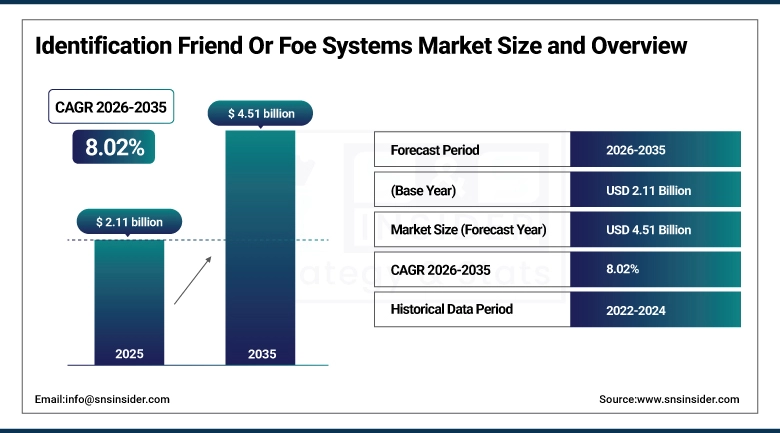
The Identification Friend Or Foe Systems Market size is valued at USD 2.11 Billion in 2025 and is projected to reach USD 4.51 Billion by 2035, growing at a CAGR of 8.02% during the forecast period 2026–2035.
The Identification Friend Or Foe (IFF) Systems Market study examines the dynamics, technology trends, and defense applications associated with identification friend or foe (IFF) systems. The increasing trend toward modernizing defense mechanisms, the widespread use of unmanned aerial vehicles (UAVs), fighter planes, the rising number of cryptographic Mode 5 systems, and greater interoperability demands among NATO and allied nations contribute to the high rate of market expansion between 2026 and 2035.
More than 120,000 IFF systems were installed worldwide in 2025 due to significant upgrades in aircraft, navy ships, and armored vehicles.
Market Size and Forecast:
-
Market Size in 2025: USD 2.11 Billion
-
Market Size by 2035: USD 4.51 Billion
-
CAGR: 8.02% from 2026 to 2035
-
Base Year: 2025
-
Forecast Period: 2026–2035
-
Historical Data: 2022–2024
To Get more information on Identification Friend Or Foe Systems Market - Request Free Sample Report
Identification Friend Or Foe Systems Market Trends:
-
Increased use of Mode 5 crypto IFF systems in the NATO and allied armed forces for enhanced secure identity.
-
The rise in electro-optical and artificial intelligence-based IFF technology for better accuracy in complex scenarios.
-
The rapid modernization in Asia-Pacific countries, thereby becoming the fastest-growing market segment.
-
The growing adoption of naval IFF systems, fueled by modernizing fleets in Europe, Asia, and the Middle East.
-
The rising emphasis on interoperability standards for seamless coordination between allies.
-
The increased spending on test equipment and certification services for maintaining regulatory compliance.
-
The emergence of space-based IFF systems, with satellite-integration anticipated to exhibit a double-digit CAGR.
-
The increased spending on cybersecurity to counter spoofing and jamming by enemy nations.
U.S. Identification Friend Or Foe Systems Market Insights:
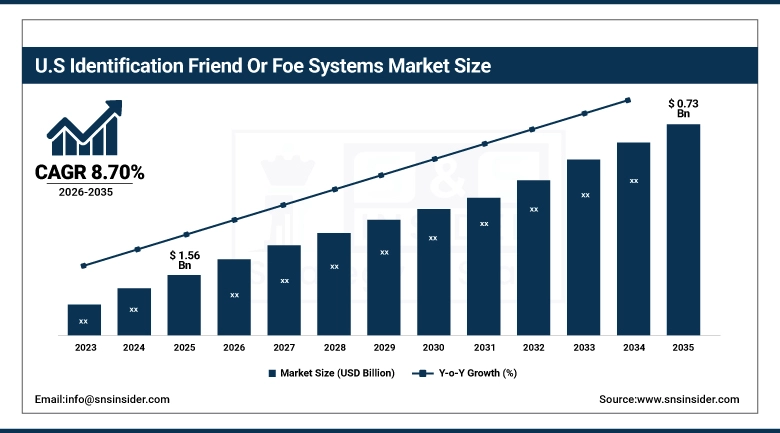
The USA Identification Friend or Foe (IFF) Systems Market size is expected to reach USD 1.56 billion by 2035 from an estimated value of USD 0.73 billion in 2025, growing at a CAGR of 8.70% during the forecast period. Growth will be supported by the increased adoption of modernization initiatives in defense, deployment of highly sophisticated fighters, and UAVs, widespread implementation of IFF Mode 5 cryptographic solutions, and advancements in radar technology and artificial intelligence.
Identification Friend Or Foe Systems Market Growth Drivers:
-
Growing defense modernization programs and increasing deployment of advanced fighter aircraft, UAVs, and naval vessels are key drivers of Identification Friend or Foe (IFF) Systems Market growth.
With the increased need for security, the air force, naval fleet, and ground force are increasingly incorporating advanced transponders, interrogators, and cryptography computing devices that enhance secure identification and communication. Additionally, advancements in IFF technology using radar, electro-optic, and artificial intelligence, coupled with enhanced cybersecurity resistance, have accelerated the process and expanded the market.
In 2025, more than 58% of the military units within the NATO alliance had incorporated advanced IFF equipment.
Identification Friend Or Foe Systems Market Restraints:
-
High procurement costs, complex integration requirements, and export restrictions are key restraints limiting Identification Friend or Foe (IFF) Systems Market growth.
Security threats such as spoofing and electronic warfare can pose risks to system reliability in the long term. The issues of interoperability among allied militaries, and non-compliance with NATO Mode 5 requirements, also limit its implementation. There is also insufficient local manufacturing capability in new markets, leading to a dependence on external vendors.
In 2025, more than 32% of IFF systems upgrade projects were delayed due to regulatory, financial, and technology barriers, affecting market growth.
Identification Friend Or Foe Systems Market Opportunities:
-
Expanding defense modernization programs, rising demand for UAV integration, and growing adoption of Mode 5 cryptographic systems present strong opportunities for the Identification Friend or Foe (IFF) Systems Market.
The rise of technology including electro-optical IFF systems, artificial intelligence-driven signal processing, and satellite-based identification is providing opportunities for future development. Countries in the Asia Pacific region, especially India and China, have been focusing on domestic production to minimize dependency on imports. The growing need for NATO compatibility and transboundary cooperation for defense adds to the market scope.
By 2025, over 41% of the defense contracts comprised the inclusion of advanced IFF systems, which demonstrates the prospects for continued growth.
Identification Friend Or Foe Systems Market Segmentation Analysis:
-
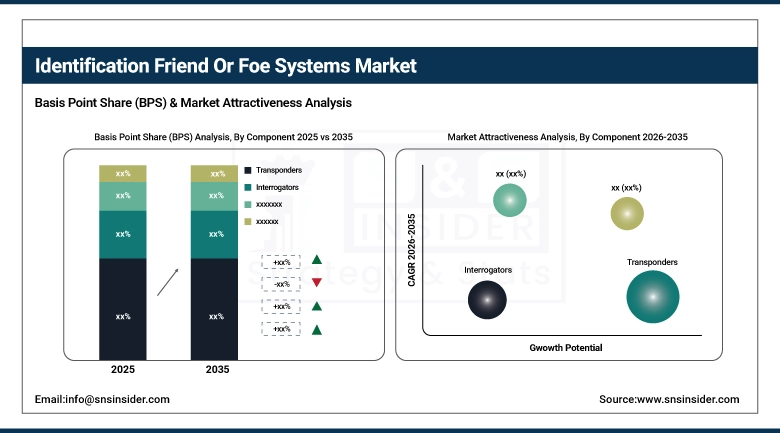
By Component, Transponders held the largest market share of 31.52% in 2025, while Software & Encryption Modules are expected to grow at the fastest CAGR of 9.46% during 2026–2035.
-
By Platform, Airborne dominated with 45.31% market share in 2025, whereas Cytokine Inhibitors are projected to record the fastest CAGR of 10.78% through 2026–2035.
-
By Application, Military Aircraft accounted for the highest market share of 46.29% in 2025, while Ground Forces are expected to grow at the fastest CAGR of 10.06% during the forecast period.
-
By Technology, Radar-based held the largest share of 59.86% in 2025, while Electro-optical are expected to grow at the fastest CAGR of 10.59% during the forecast period.
By Component, Transponders Dominate While Software & Encryption Modules Grow Rapidly:
The Transponders segment had a dominant market share due to their crucial importance in providing secure identification in military airplanes, ships, and land vehicles. Their effectiveness and extensive use by the defense forces around the world make them leaders in this market.
The Software and Encryption modules have shown fastest growth in terms of revenue generation due to increased demand for encryption technology and cybersecurity. The growing popularity of NATO Mode 5 made this segment gain prominence among defense firms.
By Platform, Airborne Dominated While Also Growing Rapidly:
Airborne platforms have become predominant since 2025 due to the high level of incorporation of IFF equipment into fighter aircraft, UAVs, and transports. Given their significant importance in air battles, reconnaissance operations, and safe identity confirmation, airborne platforms enjoy substantial favor in military organizations.
Airborne platforms represent the leading segment growing at the fastest rate due to an increased demand for advanced aircraft, more UAV launches, and NATO regulations mandating Mode 5 installations. The adoption of airborne platforms grew as the aviation industry focused on ensuring reliable communications.
By Application, Military Aircraft Dominated While Ground Forces Grow Rapidly:
The Military Aircraft segment is estimated to have the dominant share in 2025 due to widespread use of the IFF system in fighters, unmanned aerial vehicles, and cargo planes. The significance of these platforms in aerial combat and surveillance activities makes sure that their integration is inevitable.
The Ground Forces segment will experience fastest growth owing to advancements in armored vehicles, increased installation of secure communication systems, and heightened need for interoperability during joint operations and homeland security tasks. This growing inclination toward sophisticated IFF solutions is making rapid adoption a reality.
By Technology, Radar-Based Dominated While Electro-Optical Grow Rapidly:
Radar-based systems accounted for the dominant share owing to their high efficiency and usage in military planes, warships, and land vehicles. The reliability of radar-based systems in conventional warfare guarantees that they will dominate the market in the coming years.
Electro-optical systems are projected to exhibit the fastest growth rate due to increased demand for precision in UAVs, disputed airspaces, and surveillance missions. This technology is gaining popularity among defense agencies due to its high efficiency, minimum interference, and superior performance on the battlefield.
Identification Friend Or Foe Systems Market Regional Analysis:
North America Identification Friend Or Foe Systems Market Insights:
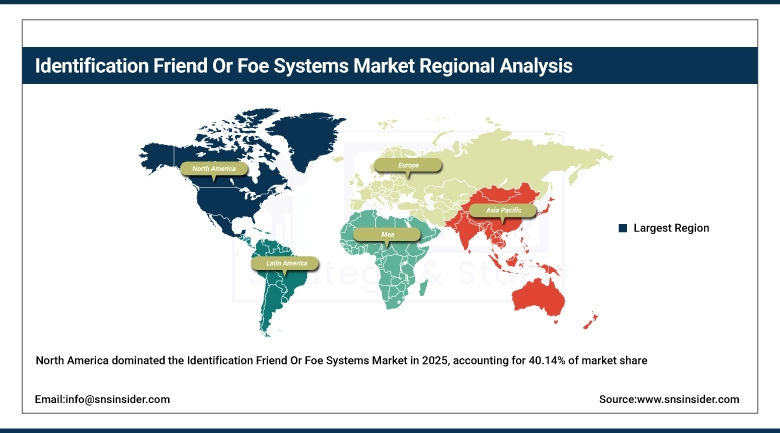
North America captured the largest share of the IFF systems market in 2025 at 40.14%, aided by large military spending, superior aerospace sector development, and robust NATO integration initiatives. North America is at the forefront of developing Mode 5 cryptographic systems, transponders, and interrogators on air, naval, and ground vehicles. The constant upgrading of fighter jets, unmanned aerial vehicles (UAVs), and warships, along with significant investments in cyber security, further accentuates its dominance.
Get Customized Report as per Your Business Requirement - Enquiry Now
U.S. Identification Friend Or Foe Systems Market Insights:
The U.S. market is characterized by widespread defense modernization, major aircraft upgrades, and widespread use of Mode 5 IFF technology. Increasing utilization of UAVs, sophisticated fighter aircraft, and navy ships reflects its dominance in secure IFF technologies. Spending on cryptographic computing devices, radars, and AI-powered devices improves interoperability within allied forces. As the country possesses the largest defense budget, active R&D activities, and well-established industry participants, it continues to dominate the North American IFF market.
Asia-Pacific Identification Friend Or Foe Systems Market Insights:
The Asia-Pacific region represents the most rapidly expanding segment, posting a CAGR of 9.68%. This growth can be attributed to the upgrading of military capabilities through defense modernization programs in nations such as India, China, South Korea, and Japan. The procurement of sophisticated weaponry such as fighter jets, unmanned aerial vehicles (UAVs), and ships drives the need for improved IFF technologies. With increasing geopolitical instability and border disputes, there is an accelerated trend toward deploying crypto and radar-based systems.
China Identification Friend Or Foe Systems Market Insights:
The Chinese market for IFF systems is witnessing rapid growth, driven by major military modernization programs and domestic technology innovations. The installation of cutting-edge transponder and interrogator devices in fighter jets, unmanned aerial vehicles, and naval forces demonstrates the growing domestic demand for such technologies. State-sponsored efforts toward attaining self-sufficiency in defense electronics encourage innovation in radar and electro-optical IFF systems.
Europe Identification Friend Or Foe Systems Market Insights:
Europe constitutes a considerable percentage of the IFF system market due to NATO standards and modernization trends in defense systems in economically developed nations. The countries of the UK, Germany, France, and Italy are equipping their air and maritime fleets with Mode 5 cryptologic systems. The industry in Europe has prominent players such as Thales, Leonardo, and Hensoldt that encourage innovations in the system.
Germany Identification Friend Or Foe Systems Market Insights:
The German market for IFF systems is powered by modernization of the armed forces, compliance with NATO standards, and an established industrial presence. The integration of Mode 5 transponder and interrogator systems for the Eurofighter and naval systems underscores the dominance of Germany in this field. Companies such as Hensoldt and Rohde & Schwarz are key players in developing such technologies.
Latin America Identification Friend Or Foe Systems Market Insights:
The Latin American region is seeing some development with regards to its IFF market, owing to the upgrading of their defense capabilities by countries such as Brazil, Mexico, and Argentina. The purchase of military aircraft and warships, along with increasing homeland security demands, provides support for the use of high-quality transponder and interrogator systems. Financial issues hinder widespread implementation.
Middle East & Africa Identification Friend Or Foe Systems Market Insights:
The Middle East and Africa segment is growing due to the development and upgrades in defense systems in Saudi Arabia, United Arab Emirates, Israel, and South Africa. The rising political instability and need for enhanced border protection have led to the requirement for more sophisticated IFF systems in air, naval, and ground applications. High adoption of cryptographic Mode 5 systems and UAVs show regional emphasis on the segment.
Identification Friend Or Foe Systems Market Competitive Landscape:
Thales Group
Thales Group is a renowned French multinational defense and aerospace corporation that enjoys a considerable presence in the identification friend or foe (IFF) system market, providing high-end transponder products, interrogator, and cryptography for air, naval, and land vehicles. The diversified product line and significant research & development expenditure by the corporation have made it a leader in secure communications, while the introduction of new technology which includes mode five cryptography and AI-based signal processing gives it an additional advantage over its competitors.
- In September 2025, Thales announced successful integration of its next-generation Mode 5 IFF interrogator into NATO aircraft fleets, enhancing secure identification and allied interoperability.
BAE Systems
BAE Systems is one of the largest defense contractors in Britain that also specializes in producing aerospace equipment, which is actively used by both the Royal Navy and the RAF. The company's involvement in the production of IFF equipment is evidenced by its extensive range of military products and consistent investments in developing secure communication methods, resulting in the company's dominance in the field of electronic warfare and interoperability. In addition to this, the company has been continuously expanding into new regions within NATO countries and other allies, which has further cemented its position in the IFF industry.
- In November 2025, BAE Systems announced a new contract with the UK Ministry of Defence to upgrade Royal Air Force platforms with advanced Mode 5 IFF systems, ensuring compliance with NATO standards.
Leonardo S.p.A.
Leonardo S.p.A. is an Italian multinational corporation specializing in aerospace and defense products, playing a leading role in providing integrated IFF system solutions for all military branches. The company develops innovative interrogator, transponder, and cryptography products, backed up by research and development investments into secure communications technologies and electronic warfare. Extensive experience in avionics and naval products makes the company a leader in the process of modernizing Europe’s defense industry. Electro-optical IFF systems and UAVs also contribute to the competitive advantage of Leonardo in this domain.
- In October 2025, Leonardo announced successful trials of its electro-optical IFF system for UAV platforms, aimed at improving secure identification in contested airspaces.
Identification Friend Or Foe Systems Market Key Players:
Some of the Identification Friend Or Foe Systems Market Companies are:
-
Thales Group
-
BAE Systems
-
Leonardo S.p.A.
-
Raytheon Technologies
-
Northrop Grumman
-
Saab AB
-
Collins Aerospace
-
General Dynamics
-
L3Harris Technologies
-
Elbit Systems
-
Bharat Electronics Limited (BEL)
-
Indra Sistemas
-
Rohde & Schwarz
-
Hensoldt
-
CACI International
-
Ultra Electronics
-
Curtiss-Wright Corporation
-
Cobham Limited
-
ASELSAN
-
Textron Systems
| Report Attributes | Details |
|---|---|
| Market Size in 2025 | USD 2.11 Billion |
| Market Size by 2035 | USD 4.51 Billion |
| CAGR | CAGR of 8.02% From 2026 to 2035 |
| Base Year | 2025 |
| Forecast Period | 2026-2035 |
| Historical Data | 2022-2024 |
| Report Scope & Coverage | Market Size, Segments Analysis, Competitive Landscape, Regional Analysis, DROC & SWOT Analysis, Forecast Outlook |
| Key Segments | • By Component (Transponders, Interrogators, Antennas, Crypto Computers, Software & Encryption Modules, Others), • By Platform (Airborne, Naval, Land, Others), • By Application (Military Aircraft, Naval Vessels, Ground Forces, Homeland Security, Others), • By Technology (Radar-based, RFID, Electro-optical, Cryptographic, Others) |
| Regional Analysis/Coverage | North America (US, Canada), Europe (Germany, UK, France, Italy, Spain, Russia, Poland, Rest of Europe), Asia Pacific (China, India, Japan, South Korea, Australia, ASEAN Countries, Rest of Asia Pacific), Middle East & Africa (UAE, Saudi Arabia, Qatar, South Africa, Rest of Middle East & Africa), Latin America (Brazil, Argentina, Mexico, Colombia, Rest of Latin America). |
| Company Profiles | Thales Group, BAE Systems, Leonardo S.p.A., Raytheon Technologies, Northrop Grumman, Saab AB, Collins Aerospace, General Dynamics, L3Harris Technologies, Elbit Systems, Bharat Electronics Limited (BEL), Indra Sistemas, Rohde & Schwarz, Hensoldt, CACI International, Ultra Electronics, Curtiss-Wright Corporation, Cobham Limited, ASELSAN, Textron Systems. |
Frequently Asked Questions
Cybersecurity vulnerabilities (spoofing, electronic warfare), high costs of cryptographic systems, export restrictions, and interoperability issues across allied forces remain the most pressing challenges.
Electro-optical IFF systems are the fastest-growing technology segment, with a CAGR of 10.59%, driven by cybersecurity concerns and NATO’s Mode 5 mandate.
Airborne platforms (fighter jets, UAVs, transport aircraft) lead with 45.31% share, reflecting the critical need for secure identification in aerial combat and surveillance
North America dominates, holding 40.14% of the market share, primarily due to U.S. defense spending and NATO interoperability requirements.
Asia-Pacific is the fastest-growing region, with a projected CAGR of 9.68%, driven by defense modernization in India, China, and South Korea, along with heavy investment in UAV integration
