
Hirsutism Market Overview & Scope
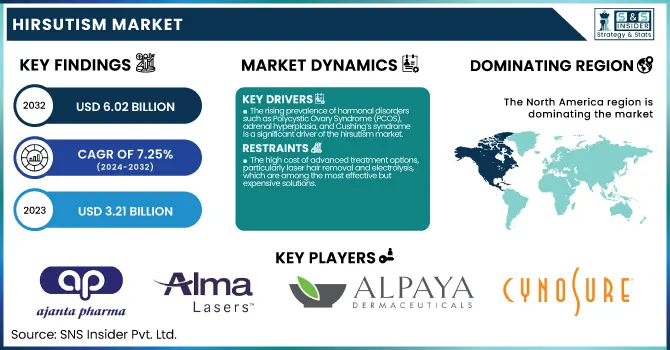
The Hirsutism Market was valued at USD 3.21 billion in 2023 and is expected to reach USD 6.02 billion by 2032, growing at a CAGR of 7.25% over the forecast period of 2024-2032.
This report focuses on aesthetic and procedural treatment trends fueled by the growing need for laser hair removal, hormone therapies, and topical treatments. The research discusses the economic and healthcare expenditure effect, wherein increasing disposable incomes and better insurance coverage affect treatment access. It also discusses technological advances in treatment, including AI-aided laser treatments and tailored hormone-based treatments, which increase effectiveness and patient satisfaction. Consumer education, patient choice, and social influence are important factors, as changing beauty ideals and increased medical awareness stimulate early diagnosis and treatment uptake.
To Get more information on Hirsutism Market - Request Free Sample Report
U.S. Hirsutism Market Forecast
The U.S. Hirsutism Market was valued at USD 0.95 billion in 2023 and is expected to hit USD 1.88 billion by 2032 at a CAGR of 7.86% over the forecast period of 2024-2032. In the United States, the hirsutism market is growing because of the increasing popularity of non-surgical cosmetic treatments, greater access to dermatology clinics, and improvements in treatment options that meet the needs of a diverse patient population.
Hirsutism Market Dynamics
Drivers
-
The rising prevalence of hormonal disorders such as Polycystic Ovary Syndrome (PCOS), adrenal hyperplasia, and Cushing’s syndrome is a significant driver of the hirsutism market.
Research shows that PCOS occurs in 8-13% of women of reproductive age worldwide, and 70-80% of them have hirsutism as a symptom. Increased knowledge of hormonal disorders and their influence on excessive hair growth has driven rising diagnosis levels and treatment adoption. Moreover, increased beauty awareness and aesthetic consciousness have stimulated demand for permanent hair reduction treatments like laser therapy and electrolysis. The worldwide cosmetic procedures market has seen growth, with laser hair removal procedures growing 30% every year over the last five years. In addition, advances in non-invasive and pain-free hair removal technologies like diode laser and intense pulsed light (IPL) therapy have made treatments more effective and desirable. The growing reach of social media and beauty trends has also increased the demand for successful hirsutism remedies, as young consumers are actively looking for professional and home-based solutions. In addition to this, increased disposable income and increasing healthcare spending have further helped make hirsutism remedies more affordable and accessible, fueling market growth.
Restraints
-
The high cost of advanced treatment options, particularly laser hair removal and electrolysis, which are among the most effective but expensive solutions.
One session of laser hair removal can cost anywhere from USD 200 to USD 500, with repeat sessions needed for a long-term outcome, making it a costly investment on the part of patients. Oral contraceptives and anti-androgens are cheaper, but they need to be taken long-term, which generates ongoing expenses. Furthermore, the absence of insurance for cosmetic and elective treatments greatly limits access. Most insurance companies treat laser hair removal and electrolysis as cosmetic instead of medical procedures, making patients shoulder the entire cost. The economic burden keeps most potential customers from accessing professional services, especially in low- and middle-income groups. Additionally, the extended treatment time and requirement for repeated sessions also serve as a barrier since consumers desire quick and cheaper alternatives. The market further struggles with the standardization of treatment protocols due to differences among healthcare providers as to their approaches, making treatment efficacy and patient satisfaction varied and restricting comprehensive adoption.
Opportunities
-
The growing demand for non-invasive, cost-effective, and at-home treatment options presents a lucrative opportunity for the hirsutism market.
The growing popularity of at-home laser hair removal kits is transforming the market, and companies such as Tria Beauty and Philips Lumea are recording double-digit sales growth year on year. The kits are a cheaper, more convenient solution than clinical lasers, opening up advanced treatments to a wider population of consumers. Further, the market is experiencing growth in natural and alternative treatments, including herbal anti-androgens (e.g., spearmint tea, saw palmetto, licorice root), for consumers interested in holistic and hormone-free approaches. Biotech advancements and AI-based dermatology also provide a platform for more customized and successful treatment plans with better patient outcomes. In addition, the incorporation of telehealth services in endocrinology and dermatology enables remote consultations, customized prescription plans, and virtual monitoring of treatment, increasing market coverage. Businesses are also investing in cost-effective laser technology and dermatological advancements, making professional treatments more affordable. As disposable income rises and consumers become more willing to spend on personal grooming, demand for efficient, long-term hair removal solutions will rise, providing a huge market growth opportunity.
Challenges
-
Safety concerns, side effects, and regulatory challenges remain significant barriers to the widespread adoption of hirsutism treatments.
Laser hair removal and electrolysis are effective but pose risks, including skin irritation, burns, and post-inflammatory hyperpigmentation, particularly in patients with darker skin tones. Research shows that up to 10-20% of laser hair removal patients have some type of skin reaction, which is a deterrent to adoption. In addition, oral drugs spironolactone and finasteride pose potential side effects such as dizziness, irregularities in menstrual cycles, and risks to pregnant women, with concerns for long-term use. Furthermore, strict regulatory standards for new treatments and medical devices hinder market growth. The U.S. FDA and EMA have rigorous approvals for new hair removal technology and hormone drugs, resulting in long and expensive research and development processes. In addition, a lack of unified global regulations means that treatment quality and availability vary between regions. Public awareness and education are another key challenge, with most people being ignorant of the available treatment methods, thus contributing to lower diagnosis and treatment rates. Overcoming these challenges through technology, increased safety features, and regulatory compliance enhancement is vital to the market's further growth.
Hirsutism Market Segmentation Analysis
By Treatment Type
The medications segment dominated the hirsutism market in 2023, with a share of 55.8% of the total revenue. The supremacy of the segment is due to the universal prescription of drug treatments like oral contraceptives, anti-androgens (spironolactone, finasteride), and insulin-sensitizing drugs to regulate hormones. The medication has been highly adopted due to it being cost-effective, easy to administer, and highly effective for long-term management of hirsutism when compared to procedural counterparts.
The procedures segment is expected to see the highest market growth during the forecast period. The growing popularity of laser hair removal, electrolysis, and other non-invasive cosmetic procedures is driving market growth. Demand is rising because of increasing awareness of permanent hair reduction treatments, advances in laser technology, and a move towards non-hormonal treatments. The rise in affordability and accessibility of these treatments, increased disposable income, and social acceptance further fuel their expansion.
By Application
The upper lip segment contributed the highest revenue share in 2023, with a share of 23.6% in the overall market. This is because of increased treatment demand for facial hair, especially among females, who need efficient and long-term treatments for aesthetic and social issues. The upper lip region is also among the most treated areas through laser hair removal, electrolysis, and topical treatments, which result in its high market share.
The chin segment should see the strongest growth during the forecast period. Increasing incidence of hormonal disorders such as PCOS, which most often results in overgrowth of chin hair, is a primary driver. Further, the move toward cosmetic procedures, the social stigma attached to visible facial hair, and the growing adoption of advanced hair removal methods are fueling the demand for chin-focused treatments.
By End-use
The dermatology clinics & aesthetic centers segment led the market in 2023, with a revenue share of 51.3%. This leadership is fueled by the growing consumer demand for professional, safe, and effective treatment provided at specialty clinics. The presence of cutting-edge laser technology, experienced dermatologists, and holistic treatment protocols makes these centers the go-to destination for patients looking for long-term hirsutism control.
The other segment is also expected to witness remarkable growth during the forecast period. The segment covers home-based treatment, teleconsultation, and over-the-counter remedies, which are becoming more popular because of convenience, affordability, and privacy. The fast take-up of home laser hair removal devices and the availability of online consultations for hormonal therapy are some of the reasons why this segment is growing at a higher pace.
Regional Insights
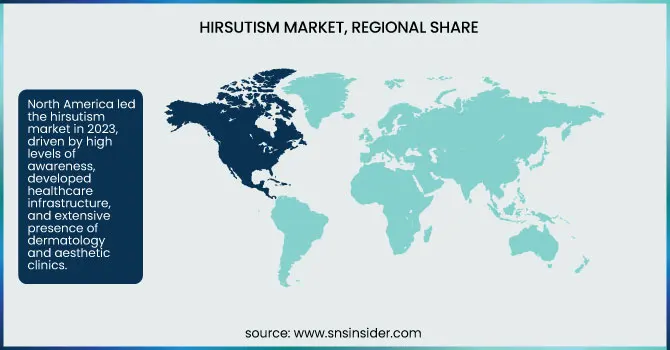
North America led the hirsutism market in 2023, driven by high levels of awareness, developed healthcare infrastructure, and extensive presence of dermatology and aesthetic clinics. The region has a highly developed market for laser hair removal, electrolysis, and hormonal therapies, with the U.S. having the highest treatment adoption. Laser hair reduction was one of the top five non-surgical aesthetic procedures performed in the United States, totaling more than 1.1 million treatments yearly, as cited by the American Society of Plastic Surgeons. Also, supportive insurance coverage of diagnostic testing and prescription drugs ensures patient accessibility increases. Increasing rates of PCOS, hormonal disturbance caused by obesity, and a beautification-oriented patient population further assure market growth.
The Asia-Pacific region is likely to experience the fastest growth during the forecast period based on rising disposable income, escalating demand for aesthetic procedures, and increased access to healthcare. Nations such as China, India, and South Korea are experiencing a rising demand for laser hair removal backed by growing medical tourism and lower treatment prices. The Indian Journal of Endocrinology & Metabolism indicates that almost 20% of women of reproductive age in India have hirsutism associated with PCOS, which increases the demand for therapies. The growth in the market in the region is also spurred by improvements in cost-effective laser devices available at home and telemedicine consultations.
Get Customized Report as per Your Business Requirement - Enquiry Now
Key Players in the Hirsutism Market
-
Ajanta Pharma – Melacare Forte, Pacroma
-
Alma Lasers Ltd. – Soprano ICE, Harmony XL Pro
-
Alpaya Dermaceuticals – Hair Solution Serum
-
Cynosure Inc. – Elite iQ, Icon Aesthetic System
-
Lumenis Inc. – LightSheer Desire, Splendor X
-
Nisim Inc. – Kalo Hair Inhibitor
-
Sciton International – BBL HERO, ClearSilk
-
Koninklijke Philips N.V. – Philips Lumea IPL
-
Merck & Co., Inc. – Propecia (Finasteride), Eflornithine (Vaniqa)
-
Pfizer Inc. – Spironolactone, Cyproterone Acetate (Androcur)
-
Cutera Inc. – Excel HR, XEO
-
El.En. S.p.A. – Motus AY, SmartXide Touch
Recent Developments in the Hirsutism Market
-
In Oct 2022, Sensus Healthcare, a medical device manufacturer specializing in minimally and non-invasive treatments for oncological and non-oncological conditions, introduced the Silk by Sensus hair removal system. This advanced, movable device features blended wavelengths for enhanced effectiveness.
| Report Attributes | Details |
|---|---|
| Market Size in 2023 | USD 3.21 billion |
| Market Size by 2032 | USD 6.02 billion |
| CAGR | CAGR of 7.25% From 2024 to 2032 |
| Base Year | 2023 |
| Forecast Period | 2024-2032 |
| Historical Data | 2020-2022 |
| Report Scope & Coverage | Market Size, Segments Analysis, Competitive Landscape, Regional Analysis, DROC & SWOT Analysis, Forecast Outlook |
| Key Segments | • By Treatment Type [Medications, Procedures, Others] • By Application [Upper Lip, Chin, Chest, Arms, Others] • By End-use [Hospitals, Dermatology Clinics & Aesthetic Centers, Others] |
| Regional Analysis/Coverage | North America (US, Canada, Mexico), Europe (Eastern Europe [Poland, Romania, Hungary, Turkey, Rest of Eastern Europe] Western Europe] Germany, France, UK, Italy, Spain, Netherlands, Switzerland, Austria, Rest of Western Europe]), Asia Pacific (China, India, Japan, South Korea, Vietnam, Singapore, Australia, Rest of Asia Pacific), Middle East & Africa (Middle East [UAE, Egypt, Saudi Arabia, Qatar, Rest of Middle East], Africa [Nigeria, South Africa, Rest of Africa], Latin America (Brazil, Argentina, Colombia, Rest of Latin America) |
| Company Profiles | Ajanta Pharma, Alma Lasers Ltd., Alpaya Dermaceuticals, Cynosure Inc., Lumenis Inc., Nisim Inc., Sciton International, Koninklijke Philips N.V., Merck & Co., Inc., Pfizer Inc., Cutera Inc., El.En. S.p.A. |
Frequently Asked Questions
North America is the dominant region in the Hirsutism Market.
The high cost of advanced treatment options, particularly laser hair removal and electrolysis, which are among the most effective but expensive solutions.
The rising prevalence of hormonal disorders such as Polycystic Ovary Syndrome (PCOS), adrenal hyperplasia, and Cushing’s syndrome is a significant driver of the hirsutism market.
By 2032, the Hirsutism Market is expected to reach USD 6.02 billion, up from USD 3.21 billion in 2023.
The Hirsutism Market is projected to grow at a CAGR of 7.25% during the forecast period.
