
Honey Market Report Scope & Overview:
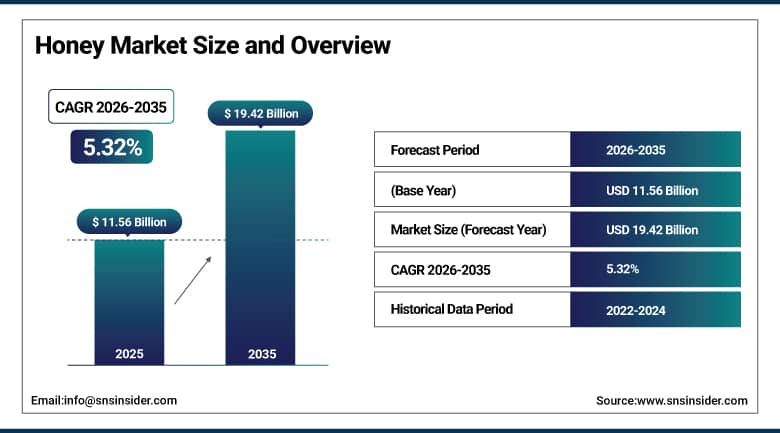
The global Honey Market was valued at USD 11.56 Billion in 2025 and is expected to reach USD 19.42 Billion by 2035, growing at a CAGR of 5.32% from 2026 to 2035.
Honey Market Growth is influenced by increased consumer awareness regarding the benefits of consuming honey as a natural sweetener and its use as an alternate sweetener to refined sugar. Increasing demand for organic, raw, and minimally processed honey is fueling innovation in the product. Furthermore, growing demand for natural and functional foods is aiding consumption of honey through various retail and food & beverages applications. Besides, honey is increasingly being used in bakery products, beverages, confectionery, and personal care products. Increased presence of supermarkets, specialty stores, and online channels is enhancing availability of honey globally. Increasing disposable income, health consciousness, and demand for clean label ingredients is providing growth opportunities for honey players.
Fraser & Neave proposed an investment of up to 19.99% in Comvita Ltd. in April 2026, part of an approximately NZ$30 million capital raise transaction for the New Zealand-based manuka honey, bee products, and olive leaf products company, expected to complete around May 18, 2026, reflecting continued strategic investor confidence in premium, verified honey brands amid a broader industry landscape increasingly focused on quality assurance and traceability.
To Get More Information On Honey Market - Request Free Sample Report
Honey Market Trends
-
Growing consumer preference for premium and specialty honey varieties continues to fuel substantial growth in the monofloral honey segment.
-
Rising demand from processed food manufacturers continues to expand honey's use as a functional food ingredient beyond conventional retail applications.
-
Expanding foodservice and HORECA channel adoption is reinforcing honey's growing role across bakery, beverage, and restaurant applications worldwide.
-
Increasing consumer awareness of widespread honey adulteration is driving demand for certified, traceable brands with verified purity testing.
-
Growing manuka honey market expansion, driven by rising consumer awareness of functional foods, continues to reinforce premium therapeutic honey positioning.
U.S. Honey Market Outlook
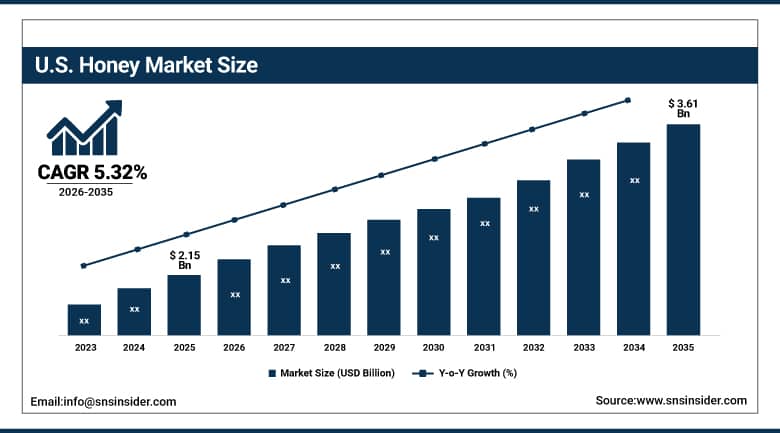
The U.S. Honey Market was valued at USD 2.15 Billion in 2025 and is projected to reach USD 3.61 Billion by 2035, growing at a CAGR of 5.32% during 2026-2035.
Rising health consciousness continues to support robust market growth across the United States, as consumers increasingly seek natural sweeteners as substitutes for sugar and artificial alternatives. Leading brands continue to expand certified, traceable product lines addressing rising consumer awareness of adulteration risk. Growing independent retail giant penetration, including Walmart and Costco, continues to reinforce sustained domestic market development and product visibility nationwide.
True Source Certified and USDA Organic certification standards continue gaining importance as consumers navigate widespread honey adulteration concerns, with leading raw honey brands including Nature Nate's differentiating through verified sourcing transparency and independently tested purity credentials that address the persistent trust gap affecting the broader U.S. honey category.
Honey Market Segment Analysis
-
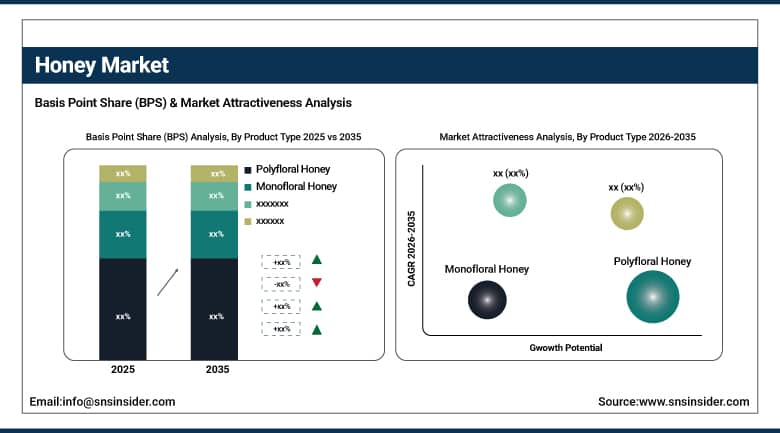
By Product Type, Polyfloral Honey segment dominated the Honey Market in 2025 with approximately 38% share; Monofloral Honey segment is the fastest growing segment.
-
By Processing, Raw Honey segment dominated the Honey Market in 2025 with approximately 42% share; Creamed Honey segment is the fastest growing segment.
-
By Packaging, Bottles segment dominated the Honey Market in 2025 with approximately 40% share; Squeeze Bottles segment is the fastest growing segment.
-
By End Use, Retail segment dominated the Honey Market in 2025 with approximately 55% share; Pharmaceuticals & Nutraceuticals segment is the fastest growing segment.
-
By Distribution Channel, Supermarkets/Hypermarkets segment dominated the Honey Market in 2025 with approximately 43% share; Online Retail segment is the fastest growing segment.
By Product Type, Polyfloral Honey Dominates the Honey Market While Monofloral Honey Emerges as the Fastest-Growing Segment
Polyfloral Honey dominated the Honey Market with approximately 38% share in 2025, because of its wide availability, relatively low price point, and various flavors. Being made from several floral species, it is accessible and can be found throughout different geographic regions at various times. Consumers extensively use polyfloral honey as a natural sweetener in their drinks, baked goods, breakfast meals, and regular food items. The wide availability of this honey on general distribution channels and the possibility to consume it on a daily basis make it the most demanded segment.
Monofloral Honey is expected to be the fastest-growing product type segment in the Honey Market, owing to the rising consumer demand for high-end honey. Made from one particular floral species, it has special flavors, aromas, and functionalities appreciated by health-conscious and high-end consumers. Increasing popularity of organic food items and the growing trend towards natural and specialty foods stimulate producers to provide more monofloral honey types.
By Processing, Raw Honey Dominates the Honey Market While Creamed Honey Registers the Fastest Growth
Raw Honey dominated the Honey Market with approximately 42% share in 2025, owing to the growing consumer preference towards minimally processed and natural food products. Raw honey is believed to contain all the naturally available enzymes, antioxidants and other healthful nutrients which are not present in highly processed types. The growing awareness about clean label products and natural sweeteners is driving consumers towards purchasing raw honey for their home use. Its growing accessibility through supermarkets, specialty stores, farmers’ markets and online channels is contributing to its dominant position.
Creamed Honey is projected to be the fastest-growing processing segment in the Honey Market, driven by the rising demand for convenient and premium honey products. The unique smooth and spreadable texture of creamed honey makes it perfect for usage on toasts, breakfast items, baking and other desserts as an alternative to liquid honey. The growing consumer interest in specialty honey products is motivating manufacturers to offer a range of creamed honey products in different flavors. Premium positioning and enhanced retail
By Packaging, Bottles Dominate the Honey Market While Squeeze Bottles Witness the Fastest Growth
Bottles dominated the Honey Market with approximately 40% share in 2025, because they were convenient, durable, and could be used in domestic households repeatedly. These packages are popular in the market and are available at supermarkets, grocers, specialty stores, and foodservice distribution channel, making it easier for customers to access them. Additionally, the transparent packages increase visibility and help in creating an image of quality and purity. The variety in size and material of bottles makes them versatile and convenient for transportation, storage, branding, and merchandising.
Squeeze Bottles are expected to be the fastest-growing packaging segment in the Honey Market, due to the increase in demand for easy and clean consumption of honey. The unique feature of squeeze bottles is that consumers can squeeze the honey into various food products such as toast, pancakes, cereals, beverages, and desserts without needing other tools for consumption. Moreover, improvements in package design, lighter weight, resealable closure, and ease of use have increased customer preference.
By End Use, Retail Dominates the Honey Market While Pharmaceuticals & Nutraceuticals Experience the Fastest Growth
Retail dominated the Honey Market with approximately 55% share in 2025, owing to the high household demand for honey as a natural sweetener and a common food additive. Common uses of honey by households include use in beverages, breakfast foods, cooking, baking, and even home remedies. Easy availability at supermarkets, grocery stores, specialist stores, and convenience stores makes consumer access simple. Increased consumer demand for natural options as opposed to refined sugar and increased product diversity and good retail packaging continue to drive retail sales.
Pharmaceuticals & Nutraceuticals is projected to be the fastest-growing end-use segment in the Honey Market, owing to the increasing consumer interest in honey as a source of health benefits. Honey is included in numerous formulations including supplements, lozenges, syrups, and wellness products owing to honey's perceived antioxidative, soothing, and antimicrobial properties. With increasing consumer health consciousness and interest in natural products, there are growing efforts among manufacturers to produce honey based functional products.
By Distribution Channel, Supermarkets/Hypermarkets Dominate the Honey Market While Online Retail Records the Fastest Growth
Supermarkets/Hypermarkets dominated the Honey Market with approximately 43% share in 2025 due to their extensive product range, brand awareness, competitive pricing, and one-stop shopping experience for consumers. Customers are able to compare the honey on variety, origin, process used, packaging, price and more under a single roof. Leading retailers offer prime shelf space as well as promotional events, which help increase the purchasing decision of the buyers. Private labeling of honey products as well as the introduction of natural and organic food sections have helped increase the presence of supermarkets/hypermarkets in both mature and developing consumer markets.
Online Retail is expected to be the fastest-growing distribution channel in the Honey Market, with rising consumer preference towards online channels. The online channels give consumers easy access to a wide variety of honey such as monofloral, organic, raw, premium and specialty honey which might not even be available through physical retailing channels. Convenience in home delivery services, comparisons between products, customer reviews, subscription services and promotions offered digitally help in making online retail a growing channel in the honey market.
Regional Analysis
|
Region |
Country |
Share (2025) |
|---|---|---|
|
Europe |
Germany |
24.80% |
|
North America |
United States |
84.60% |
|
Asia Pacific |
China |
34.60% |
|
Middle East & Africa |
Saudi Arabia |
20.60% |
|
Latin America |
Brazil |
24.60% |
Europe Honey Market Insights
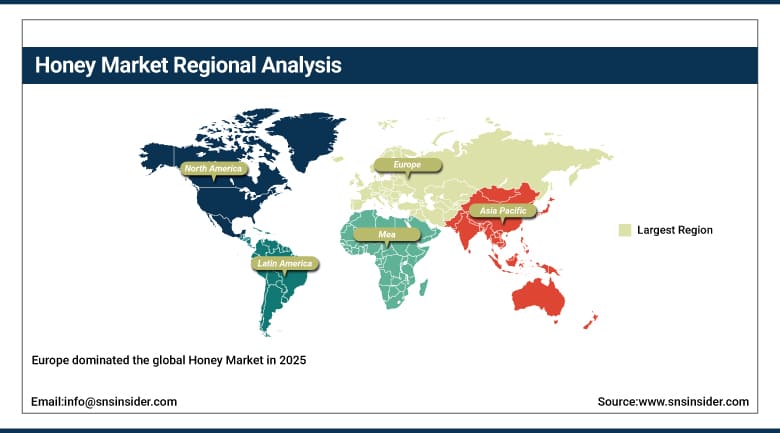
Europe dominated the global Honey Market in 2025, due to the high consumer preference for nutritious and minimally processed food products. Awareness about healthy living practices is driving consumers to utilize honey as a natural and healthy alternative. In addition, the increasing cosmetics industry based on organic and natural ingredients in the region is boosting the demand for honey owing to its extensive use in cosmetics like skin care and hair care.
Germany led the European market with a 24.80% regional share in 2025, supported by its strong health-conscious consumer base and extensive honey retail infrastructure. The United Kingdom, France, and Spain are also contributing meaningfully to regional growth, supported by leading global honey brands headquartered across the region.
Get Customized Report as Per Your Business Requirement - Enquiry Now
North America Honey Market Insights
North America held a significant share of the global Honey Market in 2025, due to increased retail penetration and heightened visibility of the product within retail giants like Walmart and Costco. With the increased availability of different types of honey products through supermarket chains, hypermarket chains, specialty stores, and online marketplaces, increased access is being provided to consumers. Increased consumer awareness regarding health issues has prompted consumers to substitute processed sugar with healthier alternatives like honey. Increased demand for organic, raw, and premium honey products is further adding impetus to this consumption trend.
The United States accounted for approximately 84.60% of the North American market in 2025, reflecting its large health-conscious consumer base and extensive honey retail distribution infrastructure. Canada is contributing to regional growth through steady natural sweetener adoption and growing consumer interest in certified, traceable honey products.
Asia Pacific Honey Market Insights
Asia Pacific is expected to register the fastest growth in the Honey Market during 2026–2035, owing to an increase in its use as a natural alternative to refined sugar and artificial sweeteners. The growing health awareness and increasing consumption of natural foods have resulted in higher consumption in the region. An increase in disposable incomes allows consumers to buy superior quality and organic honey products. In addition, rapid growth in the online shopping and retailing ecosystem has increased the availability of honey products in the emerging markets.
China accounted for approximately 34.60% of the Asia Pacific market in 2025, supported by its large domestic beekeeping industry and growing consumer interest in natural, functional food products. Japan, India, and South Korea are also contributing meaningfully to regional growth, with rising honey consumption across food, pharmaceutical, and cosmetics applications.
Middle East & Africa and Latin America Honey Market Insights
The Middle East & Africa region is exhibiting steady growth as health and wellness awareness expands across the Gulf states, supported by growing modern retail infrastructure. Latin America is similarly benefiting from expanding beekeeping industry investment and growing consumer interest in natural sweeteners across major regional urban centers.
Saudi Arabia led the Middle East & Africa market with a 20.60% regional share in 2025, supported by growing health-conscious consumer demand and expanding modern retail penetration. Brazil represented 24.60% of the Latin American market in 2025, driven by its substantial domestic beekeeping industry, with Argentina also contributing to regional growth through significant honey export production.
Market Dynamics
Growth Drivers: Natural Sweetener Adoption and Functional Food Applications Driving Market Growth
The Honey Market is being driven primarily by increased adoption of natural sweeteners, expanded use of honey as a functional food, and higher demand from processed food manufacturers. High demand for nutritious food products continues as people become increasingly aware of the benefits of living a healthy lifestyle, with honey's antimicrobial properties, stemming from its low water content, acidic pH, and enzyme content, continuing to support its use across wound care and other therapeutic applications.
Growing consumer preference for premium and specialty honey varieties continues to fuel substantial growth in the monofloral honey segment. Rising demand from processed food manufacturers continues to expand honey's use as a functional food ingredient. Expanding foodservice and HORECA channel adoption is further reinforcing honey's growing role across bakery, beverage, and restaurant applications, reinforcing sustained category growth worldwide.
Restraints: Widespread Adulteration and Product Purity Concerns Limiting Market Expansion
Despite favorable underlying demand, the market faces meaningful restraints related to product adulteration, which remains one of the most significant issues facing the global honey market. A 2018 study published in Food Chemistry found that up to 76% of honey samples from major retailers showed signs of adulteration, undermining consumer trust and creating persistent brand reputation risk across the industry.
Regulatory scrutiny of purity claims continues to intensify, as demonstrated by ongoing disputes between major brands and food safety authorities over "100% pure" labeling assertions. Barriers in apiculture or beekeeping, including declining bee populations and climate-related harvest variability, also continue to constrain supply consistency, particularly for specialty varieties like manuka honey requiring specific, weather-dependent flowering conditions.
Opportunities: Certified Traceability Investment and Therapeutic Honey Expansion Creating New Growth Avenues
Substantial opportunity exists in continued investment in certified traceability programs, including True Source Certified and USDA Organic credentials, capable of addressing persistent consumer trust concerns around adulteration. Companies that successfully commercialize verified, independently tested purity claims stand to capture significant share of category growth as consumer awareness of counterfeit honey continues rising.
Growing manuka and therapeutic honey market expansion presents a further significant growth avenue, driven by rising consumer awareness of functional foods and increasing preference for natural remedies across food, pharmaceutical, and personal care applications. Expanding foodservice and industrial applications across emerging markets in Asia Pacific and Latin America also represent meaningful untapped opportunity for honey producers and packers.
Recent Developments:
-
2025-2026: Dabur's honey purity claims faced regulatory scrutiny from India's FSSAI, with the Delhi High Court temporarily staying a ban order pending the company's opportunity to respond.
-
2026: The global manuka honey market was valued at approximately USD 1.1 billion in 2026, projected to reach USD 1.6 billion by 2033.
-
2025-2026: Comvita and Manuka Health continued offering verified UMF/MGO ratings to help combat widespread fake and adulterated manuka honey circulating in the market.
-
2025-2026: Nature Nate's Honey Co. maintained True Source Certified status, reflecting growing brand emphasis on verified, traceable honey sourcing amid persistent adulteration concerns.
Honey Market key players are:
-
Dabur India Ltd.
-
Capilano Honey Ltd. (Hive + Wellness)
-
Comvita Ltd.
-
Barkman Honey LLC
-
Dutch Gold Honey, Inc.
-
Bee Maid Honey Ltd.
-
Sioux Honey Association Co-op
-
Nature Nate’s Honey Co.
-
Rowse Honey Ltd. (Valeo Foods)
-
Billy Bee Honey Products (McCormick & Company)
-
Langnese Honig GmbH & Co. KG
-
Manuka Health New Zealand Ltd.
-
New Zealand Honey Co.
-
Savannah Bee Company
-
Little Bee Impex Pvt. Ltd.
-
Heavenly Organics LLC
-
Y.S. Eco Bee Farms
-
Madhava Ltd.
-
Wedderspoon Organic Inc.
-
Apis India Ltd.
Honey Market Report Scope:
| Report Attributes | Details |
|---|---|
| Market Size in 2025 | USD 11.56 Billion |
| Market Size by 2035 | USD 19.42 Billion |
| CAGR | CAGR of 5.32% From 2026 to 2035 |
| Base Year | 2025 |
| Forecast Period | 2026-2035 |
| Historical Data | 2022-2024 |
| Report Scope & Coverage | Market Size, Segments Analysis, Competitive Landscape, Regional Analysis, DROC & SWOT Analysis, Forecast Outlook |
| Key Segments | • By Product Type (Monofloral Honey, Polyfloral Honey, Organic Wildflower Honey, Manuka Honey, Acacia Honey, Others) • By Processing (Raw Honey, Filtered Honey, Pasteurized Honey, Creamed Honey, Processed Honey) • By Packaging (Bottles, Glass Jars, Squeeze Bottles, Tubs, Tubes, Sachets, Bulk Packaging) • By End Use (Retail, Food & Beverage Manufacturing, Foodservice/HORECA, Pharmaceuticals & Nutraceuticals, Cosmetics & Personal Care) • By Distribution Channel (Supermarkets/Hypermarkets, Convenience Stores, Specialty Stores, Online Retail, Direct-to-Consumer, Others) |
| Regional Analysis/Coverage | North America (US, Canada), Europe (Germany, UK, France, Italy, Spain, Russia, Poland, Rest of Europe), Asia Pacific (China, India, Japan, South Korea, Australia, ASEAN Countries, Rest of Asia Pacific), Middle East & Africa (UAE, Saudi Arabia, Qatar, South Africa, Rest of Middle East & Africa), Latin America (Brazil, Argentina, Mexico, Colombia, Rest of Latin America). |
| Company Profiles | Dabur India Ltd., Capilano Honey Ltd. (Hive + Wellness), Comvita Ltd., Barkman Honey LLC, Dutch Gold Honey, Inc., Bee Maid Honey Ltd., Sioux Honey Association Co-op, Nature Nate’s Honey Co., Rowse Honey Ltd. (Valeo Foods), Billy Bee Honey Products (McCormick & Company), Langnese Honig GmbH & Co. KG, Manuka Health New Zealand Ltd., New Zealand Honey Co., Savannah Bee Company, Little Bee Impex Pvt. Ltd., Heavenly Organics LLC, Y.S. Eco Bee Farms, Madhava Ltd., Wedderspoon Organic Inc., Apis India Ltd. |
Frequently Asked Questions
The Honey Market is expected to grow at a CAGR of 5.32% from 2026 to 2035.
The Honey Market was valued at USD 11.56 Billion in 2025.
The market is driven by increased adoption of natural sweeteners, expanded use of honey as a functional food, and higher demand from processed food manufacturers.
The Polyfloral segment dominated the Honey Market in 2025.
The Europe region dominated the Honey Market in 2025.
