
Palm Oil Market Report Scope and Overview:
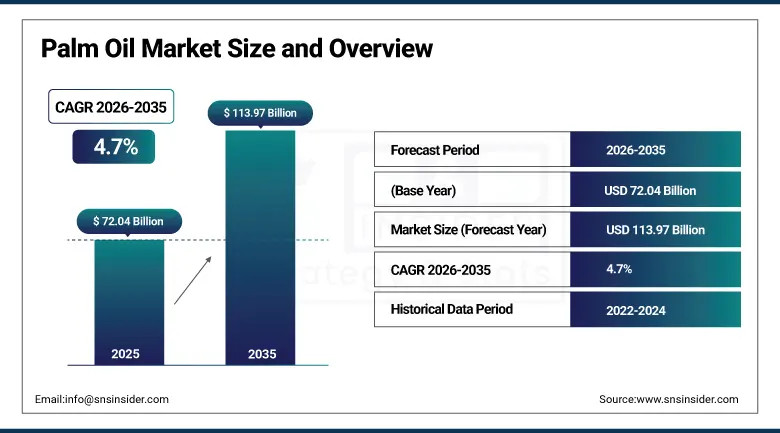
The Palm Oil Market was valued at USD 72.04 Billion in 2025 and is projected to reach USD 113.97 Billion by 2035, registering a CAGR of 4.7% from 2026 to 2035.
Palm oil, which is derived from the fruit of the oil palm tree, still ranks as the most consumed vegetable oil worldwide, considering how profitable it is since palm trees produce more oil per hectare compared to any other crop. Palm oil is one of the most crucial commodities in today’s world because it features in over 50% of all consumer products, including biscuits, margarine, bread, instant noodles, cereals, lipstick, candles, chocolate, shampoo, ice cream, and detergents. The transformation of the palm oil market proceeds rapidly in terms of sustainability, biofuels, and downstream integration, where the main drivers of the global palm oil industry are the increasing demand in food and beverages.
Over 85% of global production of palm oil is accounted for by Indonesia and Malaysia, and producers from these countries still try to diversify their portfolio to increase palm oil applications in cosmetics, biodiesel, and oleochemicals.
Wilmar International continued expanding its downstream palm oil processing and refining capacity throughout 2025, targeting food and beverage manufacturers seeking traceable, sustainably certified palm oil supply amid tightening global regulatory scrutiny of deforestation-linked commodity supply chains.
Market Size and Forecast
-
Market Size in 2026E: USD 75.38 Billion
-
Market Size by 2035: USD 113.97 Billion
-
CAGR: 4.7% from 2026 to 2035
-
Fastest Growing Region: Asia Pacific
-
Largest Region: Asia Pacific
To Get more information On Palm Oil Market - Request Free Sample Report
Palm Oil Market Trends
-
Accelerating biofuel mandates and specialty derivatives continue redefining palm oil demand drivers, signaling strategic shifts toward higher-margin opportunities.
-
Growing use of palm oil in the cosmetics and personal care industry continues expanding the addressable market beyond the category's traditional food-sector stronghold.
-
Rising adoption of efficient processing technologies continues improving palm oil yields and production efficiency across major producing countries.
-
Increasing research and development activity continues exploring palm oil applications in green energy projects, including biogas production and power generation.
-
Surging emphasis on sustainability continues shaping supply chain traceability requirements and certification standards across the global palm oil trade.
U.S. Palm Oil Market Outlook
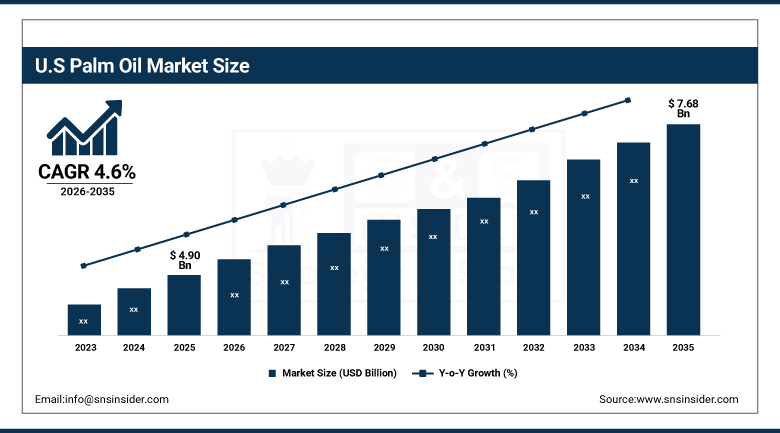
The US Palm Oil Market was valued at approximately USD 4.90 Billion in 2025 and is projected to reach approximately USD 7.68 Billion by 2035, registering a CAGR of approximately 4.6% from 2026 to 2035.
U.S. Demand was further affected by widespread uses in the food processing industry and an increasing consumer desire for cosmetics and personal care products made from palm oil. Increased demands for low VOC, sustainable ingredient sourcing kept fueling American companies towards sourcing of sustainable palm oil all year long. Increasing biofuel mandates kept demanding palm oil as biodiesel feedstock in U.S. energy markets, and increasing demands in packaged and processed food kept strengthening the consistent domestic demand in the food and beverages manufacturing industry of the United States.
Cargill continued expanding its sustainable palm oil sourcing and traceability program throughout 2025, targeting American food and beverage manufacturers seeking certified, deforestation-free palm oil supply chains capable of meeting increasingly stringent corporate sustainability commitments and regulatory disclosure requirements.
Palm Oil Market Segment Analysis
-
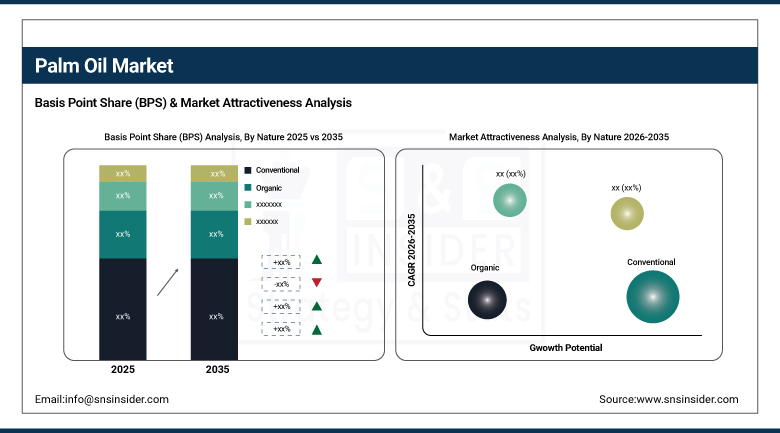
By Nature, conventional led the market, while organic is the fastest-growing nature category, tracking a projected 4.5% CAGR.
-
By Product Type, crude palm oil led the market with an estimated 76.7% share in 2025, while palm kernel oil is the fastest-growing product type, tracking a projected 5.45% CAGR.
-
By Application, food and beverage led the market with an estimated 72.7% share in 2025, while biofuels and energy is the fastest-growing application, tracking a projected 3.4% CAGR.
By Nature, Conventional led the market, Organic grew fastest
The conventional segment held the largest market share in 2025, supported by its high production efficiency, cost-effectiveness, and widespread availability. It remains the preferred choice for food processing, industrial use, and biodiesel production due to its consistent quality and lower price compared to organic alternatives, and the dominance of conventional palm oil is also reinforced by established supply chains across major producing countries including Indonesia and Malaysia, which cater to global demand at scale.
The organic segment is anticipated to grow at the fastest CAGR of 4.5% during the forecast period, driven by rising consumer awareness of sustainability and health concerns. Growing demand for chemical-free, traceable, and ethically sourced products continues driving this growth, as premium food and personal care manufacturers increasingly specify organic-certified palm oil to satisfy tightening corporate sustainability commitments and discerning end-consumer expectations.
By Product Type, Crude Palm Oil led the market, Palm Kernel Oil grew fastest
Crude palm oil segment held the largest market share of 76.7% in 2025, owing to its wide application across the food and beverage industry. The vast applications of crude palm oil across various end-users, including cosmetics and pharmaceuticals, remain considered a crucial part of the production of different products, and these factors continue driving segment growth through wider adoption, keeping crude palm oil the dominant product type by a considerable margin.
Palm kernel oil is expected to grow at a compound annual growth rate of 5.45% through the forecast period, driven by its increasing use in personal care, cosmetics, and specialty food products. That expanding application base beyond crude oil's traditional bulk food and industrial stronghold keeps palm kernel oil's growth rate climbing ahead of the broader, still-dominant crude palm oil category.
By Application, Food and Beverage led the market, Biofuels and Energy grew fastest
Food and beverage segment accounted for the largest revenue share of 72.7% in 2025. Palm oil is an incredibly versatile ingredient used in a wide range of food products, and the growing global population combined with expansion of the middle class in developing countries has increased demand for processed and packaged foods that often contain palm oil, keeping this application category the market's largest by a considerable margin.
Biofuels and energy is assessed to grow at a CAGR of approximately 3.4% during the forecast period. Palm oil has established its position as one of the key feedstocks for biodiesel, a cleaner alternative for transportation and industrial energy use, and increasing research and development activity aimed at exploring palm oil's use in green energy projects, including biogas production and power generation, continues expanding this application category's addressable market well beyond its traditional food-sector stronghold.
Regional Analysis
|
Region |
Major Country |
Share within Region, 2025 (%) |
|
Asia Pacific |
Indonesia |
59.10% |
|
North America |
United States |
80.55% |
|
Europe |
Netherlands |
24.20% |
|
Middle East and Africa |
UAE |
26.35% |
|
Latin America |
Brazil |
34.60% |
North America Palm Oil Market Insights
North America held a meaningful share of global revenue, supported by its extensive food processing sector and growing demand for palm oil-derived cosmetics and personal care products. Rising biofuel mandate compliance requirements continued expanding demand for palm oil as a biodiesel feedstock across the continent throughout the year.
The United States accounted for roughly 80.55% of regional revenue, anchored by extensive food processing sector applications and growing sustainable sourcing initiatives. Canada added further regional demand through its own food manufacturing and biofuel sector, and that combined strength kept the continent a genuinely significant contributor to global palm oil revenue.
Europe Palm Oil Market Insights
Europe held a meaningful share of global revenue, supported by stringent sustainability regulations and growing demand for certified sustainable palm oil across the region's food, cosmetics, and biofuel industries. That regulatory-driven demand continued reinforcing steady European consumption of certified, traceable palm oil supply throughout the year.
Netherlands led demand at roughly 24.20% of European revenue, supported by its position as a major European palm oil import and processing hub. Germany and the UK contributed substantial additional demand, and continued European regulatory emphasis on deforestation-free supply chains should keep shaping regional demand patterns through the forecast period.
Asia Pacific Palm Oil Market Insights
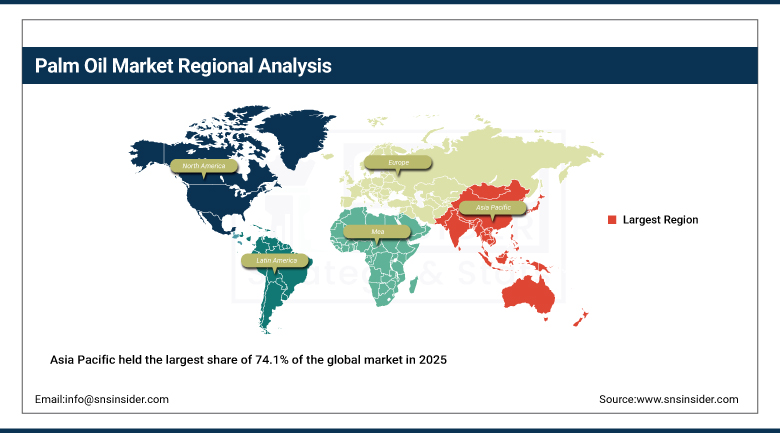
Asia Pacific held the largest share of 74.1% of the global market in 2025 and continued maintaining dominance as the fastest-growing region as well. This dominance was driven by high production and consumption levels concentrated in Indonesia and Malaysia, keeping the region firmly positioned as the market's clear leader on both dominance and growth simultaneously.
Indonesia currently dominates the market, holding a significant market share of over 59.1% in 2025, supported by its position as the world's largest palm oil producer. Malaysia contributed meaningful additional demand through its own substantial production and processing capacity, and Indonesian and Malaysian palm oil producers continued attempting to improve palm oil yields and production efficiency by adopting better land management practices, reinforcing the region's structural leadership in both production and consumption.
Get Customized Report as per Your Business Requirement - Enquiry Now
MEA and Latin America Palm Oil Market Insights
The Middle East and Africa and Latin America both showed steady growth, driven by expanding food processing and cosmetics manufacturing investment, growing biofuel production capacity, and rising government focus on edible oil supply diversification across both areas. As these markets continued developing modern food and industrial manufacturing infrastructure, palm oil demand grew correspondingly from a considerably smaller base than in more mature consuming markets.
The UAE led Middle East and Africa demand, supported by growing food processing and cosmetics manufacturing investment tied to the region's trade hub status. Saudi Arabia contributed further demand through its own food industry development programs. In Latin America, Brazil accounted for the largest share of regional revenue, with growing food processing and biofuel production continuing to anchor regional demand for palm oil.
Market Dynamics
Growth Drivers: Food Sector Expansion and Biofuel Mandate Growth
The global palm oil industry is primarily driven by growing demand from the food and beverage sector, with palm oil's versatility as a food ingredient continuing to anchor sustained baseline demand across a genuinely wide range of packaged and processed food categories. The oil's low to zero trans-fat content combined with competitive pricing has raised demand across an increasingly diverse global consumer base.
The market growth continues being driven by rising global demand for inexpensive edible oils, escalating biofuel mandates, and growth in processed foods and personal care products. Palm oil has become a ubiquitous component of modern life, powering a wide range of industries including pharmaceuticals, cosmetics, food, and biofuels, and that combination of genuine cost-effectiveness and cross-industry versatility is exactly what keeps demand climbing at such a sustained pace across virtually every major consuming region.
Restraints: Deforestation Scrutiny and Sustainability Compliance Costs
Growing regulatory scrutiny around deforestation-linked palm oil production continues posing a genuine restraint on faster market-wide expansion, as tightening supply chain traceability and certification requirements add real cost and complexity for producers seeking to serve increasingly sustainability-conscious markets, particularly across Europe. That compliance burden keeps smaller, less-established producers at a genuine competitive disadvantage relative to larger, better-resourced plantation operators.
Price volatility tied to weather conditions, labor availability, and shifting trade policy across Indonesia and Malaysia continues posing a further restraint, as these two countries' overwhelming production concentration means genuine supply disruption in either market can meaningfully affect global pricing. That geographic concentration keeps buyers genuinely exposed to production risk concentrated in just two countries.
Opportunities: Specialty Derivative Development and Biofuel Application Expansion
Accelerating biofuel mandates and specialty derivatives represent a genuinely significant opportunity, as palm oil's established position as a key biodiesel feedstock continues expanding amid growing global emphasis on cleaner transportation and industrial energy alternatives. Vendors offering genuinely traceable, sustainably certified palm oil supply stand to capture meaningful share as biofuel producers increasingly prioritize supply chain sustainability credentials alongside pure cost considerations.
Growing use of palm oil in the cosmetics and personal care industry offers a second substantial opportunity, as producers increasingly diversify their product portfolios to expand palm oil use across cosmetics, biodiesels, and oleochemicals. Vendors that can deliver genuinely differentiated, higher-margin specialty palm oil derivatives stand to capture meaningful share as this application category continues expanding well beyond the market's traditional bulk food and industrial stronghold.
Recent Developments:
-
2025: Sime Darby Plantation continued expanding its sustainable palm oil certification and traceability program, targeting food and cosmetics manufacturers seeking verified, deforestation-free supply chain documentation.
-
2025: Bunge continued advancing its downstream palm oil refining and specialty derivative production capability, targeting cosmetics and personal care manufacturers seeking higher-margin, specialty palm oil ingredient formulations.
-
2024: FGV Holdings continued expanding its biodiesel feedstock supply agreements, targeting energy customers seeking reliable, sustainably certified palm oil supply for renewable fuel production.
Palm Oil Market Key Players are:
-
Wilmar International Limited
-
Sime Darby Plantation Berhad
-
Cargill, Incorporated
-
Bunge Limited
-
Olam Group Limited
-
FGV Holdings Berhad
-
IOI Corporation Berhad
-
Kuala Lumpur Kepong Berhad
-
Golden Agri-Resources Ltd.
-
Musim Mas Holdings Pte. Ltd.
-
Asian Agri
-
Genting Plantations Berhad
-
First Resources Limited
-
Astra Agro Lestari Tbk PT
-
Indofood Agri Resources Ltd.
-
United Plantations Berhad
-
Godrej Agrovet Limited
-
Bumitama Agri Ltd.
-
Apical Group Ltd.
-
Louis Dreyfus Company B.V.
Palm Oil Market Report Scope:
| Report Attributes | Details |
|---|---|
| Market Size in 2025 | USD 72.04 Billion |
| Market Size by 2035 | USD 113.97 Billion |
| CAGR | CAGR of 4.7% From 2026 to 2035 |
| Base Year | 2025 |
| Forecast Period | 2026-2035 |
| Historical Data | 2022-2024 |
| Report Scope & Coverage | Market Size, Segments Analysis, Competitive Landscape, Regional Analysis, DROC & SWOT Analysis, Forecast Outlook |
| Key Segments | • By Nature (Conventional, Organic) • By Product Type (Crude Palm Oil, RBD Palm Oil, Palm Kernel Oil) • By Application (Food and Beverage, Cosmetics and Personal Care, Biofuels and Energy, Industrial) |
| Regional Analysis/Coverage | North America (US, Canada), Europe (Germany, UK, France, Italy, Spain, Russia, Poland, Rest of Europe), Asia Pacific (China, India, Japan, South Korea, Australia, ASEAN Countries, Rest of Asia Pacific), Middle East & Africa (UAE, Saudi Arabia, Qatar, South Africa, Rest of Middle East & Africa), Latin America (Brazil, Argentina, Mexico, Colombia, Rest of Latin America). |
| Company Profiles | Wilmar International Limited, Sime Darby Plantation Berhad, Cargill, Incorporated, Bunge Limited, Olam Group Limited, FGV Holdings Berhad, IOI Corporation Berhad, Kuala Lumpur Kepong Berhad, Golden Agri-Resources Ltd., Musim Mas Holdings Pte. Ltd., Asian Agri, Genting Plantations Berhad, First Resources Limited, Astra Agro Lestari Tbk PT, Indofood Agri Resources Ltd., United Plantations Berhad, Godrej Agrovet Limited, Bumitama Agri Ltd., Apical Group Ltd., and Louis Dreyfus Company B.V. |
Frequently Asked Questions
The Palm Oil Market is expected to grow at a CAGR of approximately 4.7% from 2026 to 2035, based on triangulated secondary research estimates.
The Palm Oil Market was valued at approximately USD 72.04 Billion in 2025, based on triangulation across multiple independent research sources.
The Conventional segment dominated the Palm Oil Market by nature, representing an estimated 93.4% of revenue in 2025.
Asia Pacific dominated the Palm Oil Market in 2025, holding an estimated 74.1% share of total global market revenue.
