
Nano Metal Oxide Market Report Scope & Overview:
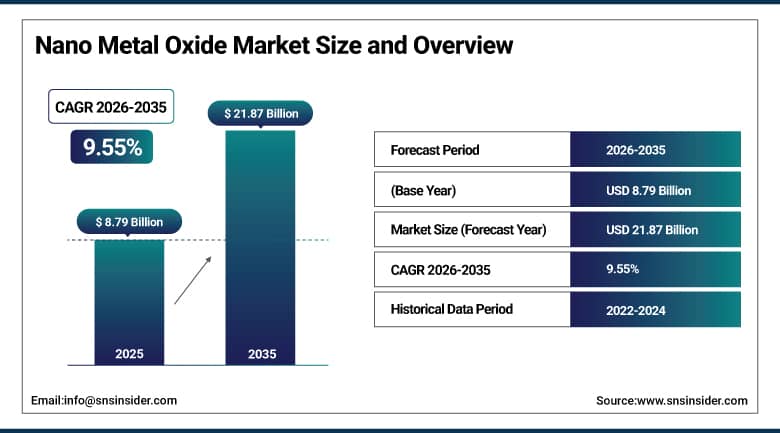
The Nano Metal Oxide Market was valued at USD 8.79 billion in 2025 and is expected to reach USD 21.87 billion by 2035, growing at a CAGR of 9.55% from 2026-2035.
The Nano Metal Oxide Market is driven by increasing demand for advanced materials across electronics, healthcare, paints and coatings, energy storage, and environmental applications. Nano metal oxides like aluminum oxide, iron oxide, titanium dioxide, silicon dioxide and zinc oxide have high surface area, better catalytic activity, better durability and specific optical, electrical and antimicrobial performance. Increasing applications in electronic components, protective coatings, cosmetics, medical products, and energy technologies are supporting the market expansion. The demand is also growing due to increasing investment in the research of nanotechnology and the development of high-performance materials that are application-specific. Advances in synthesis techniques and surface modification are allowing for improved particle stability, dispersion and functional performance in industrial applications.
⮞In June 2024, Evonik Industries commissioned a colloidal silica production facility in Weston, Michigan, to supply IDISIL materials for chemical mechanical planarization in semiconductor manufacturing.
To Get More Information On Nano Metal Oxide Market - Request Free Sample Report
Nano Metal Oxide Market Trends:
-
Growing demand for nano metal oxides in electronics, semiconductors, and advanced functional materials.
-
Rising adoption of nano metal oxides in paints, coatings, and surface treatments to improve durability and performance.
-
Continued advancements in nanotechnology and material engineering enhancing the optical, catalytic, and chemical properties of nano metal oxides.
-
Increasing utilization of nano metal oxides in healthcare, cosmetics, and personal care products due to their specialized functional properties.
-
Expanding applications of nano metal oxides in energy storage, renewable energy systems, and environmental remediation technologies.
U.S. Nano Metal Oxide Market Outlook:
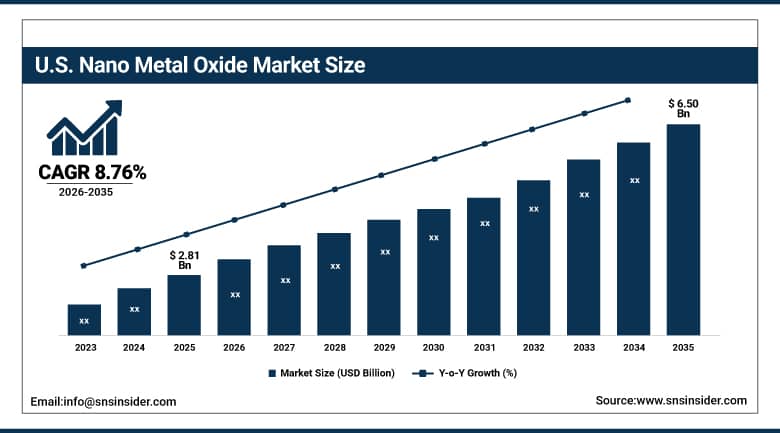
The U.S. Nano Metal Oxide Market was valued at USD 2.81 Billion in 2025 and is expected to reach USD 6.50 Billion by 2035, growing at a CAGR of 8.76% from 2026-2035.
U.S. growth of Nano Metal Oxide Market will remain supported by increasing investments in nanotechnology research, rising demand for advanced materials, and the development of nanomaterials for industrial and commercial applications. The demand will be boosted by increasing application of nano metal oxides in electronics, healthcare, automotive, energy storage, coatings and environmental technologies. Studies on the field of metal oxide nanoparticles and their use in functional coatings and advanced materials will in particular promote continued technological development. Research on the characterization of metal oxide nanoparticles and their dispersion in polymeric coatings has been documented by the U.S. National Institute of Standards and Technology (NIST), showing their potential to improve ultraviolet absorption, material stiffness, toughness and service life.
⮞In July 2024, India’s Department of Science and Technology reported the development of a nickel-doped titanium dioxide nanocomposite for photocatalytic degradation of organic pollutants, highlighting potential environmental applications of metal oxide nanomaterials.
Nano Metal Oxide Market Segment Analysis:
-
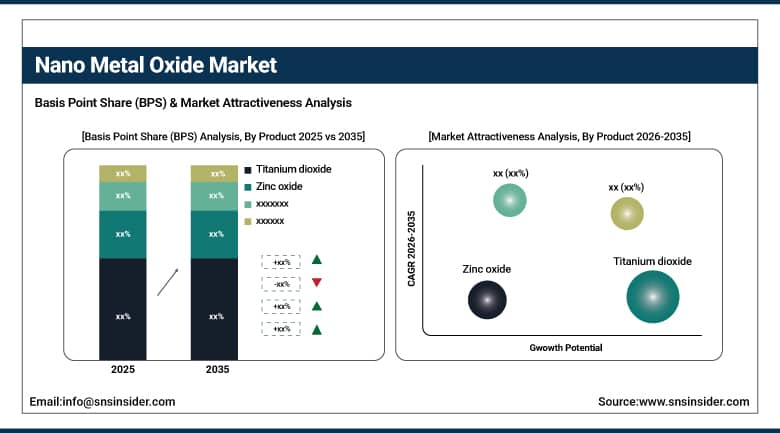
By Product, the Titanium Dioxide segment dominated the Nano Metal Oxide Market with approximately 30.50% share in 2025, while the Zinc Oxide segment is the fastest growing with a CAGR of approximately 10.68%.
-
By Application , the Electronics & Optics segment dominated the Nano Metal Oxide Market with approximately 35.20% share in 2025, while the Medical & Personal Care segment is the fastest growing with a CAGR of approximately 10.29%.
-
By End Use Industry, the Electronics segment dominated the Nano Metal Oxide Market with approximately 28.50% share in 2025, while the Healthcare segment is the fastest growing with a CAGR of approximately 10.14%.
By Product, Titanium Dioxide dominates and Zinc Oxide grows fastest
Titanium Dioxide is the dominating segment in paints and coatings, plastics, cosmetics, and other industrial applications in the Nano Metal Oxide Market. Its excellent opacity, whiteness, UV resistance and durability have led to broad acceptance across multiple sectors. The segment continues to strengthen its position in the market due to the increasing demand for high-performance coatings, advanced materials, and functional additives.
Zinc Oxide is the fastest growing product segment in the Nano Metal Oxide Market, driven by increasing demand across healthcare, personal care electronics and advanced material applications. Its antimicrobial properties, UV-blocking capabilities, and semiconductor traits are aiding in wider adoption. Growing interest towards products based on nanotechnology and increasing applications in medical formulations, sunscreens, sensors and electronic components are further driving the segment growth.
By Application , Electronics & Optics dominates and Medical & Personal Care grows fastest
Electronics & Optics dominates the Nano Metal Oxide Market owing to the increasing utilization of nano metal oxides in semiconductors, optical coatings, displays, sensors, and electronic components. Their electrical, optical and thermal properties make them suitable for improving the performance of devices and the functionality of materials. Further, the segment is supported by the increasing demand for sophisticated electronic devices, miniaturized components and high-performance optical systems.
Medical & Personal Care is the fastest growing application material category in the Nano Metal Oxide Market. The growth is attributed to increasing demand for nanomaterials in skin care formulations, sunscreens, antimicrobial products and medical applications. Metal oxide nanoparticles such as zinc oxide and titanium dioxide offer UV protection and functional properties that are well suited to personal care and healthcare products. Growing interest in advanced formulations and nanotechnology-based medical materials further drives adoption.
⮞In January 2024, researchers published a review in RSC Advances examining developments in nanoparticle-based sunscreens, highlighting zinc oxide and titanium dioxide nanoparticles for ultraviolet protection and improved sunscreen formulations.
By End Use Industry, Electronics dominates and Healthcare grows fastest
Electronics dominates the Nano Metal Oxide Market due to the extensive use of nanomaterials in semiconductors, sensors, displays, electronic coatings, and other advanced components. Nano metal oxides have useful electrical, optical and thermal properties that help device functionality and performance. The industry continues to be driven by growing demand for consumer electronics, advanced computing systems and miniaturized electronic components.
Healthcare is the fastest growing end-use industry in the Nano Metal Oxide Market, supported by rising applications in medical coatings, antimicrobial materials, diagnostic technologies, drug delivery research, and personal care products. Nano metal oxides provide properties that may improve the functionality of healthcare materials and formulations. The segment growth is driven by increasing research in the area of nanomedicine, growing demand for advanced medical technologies, and broader application of nanomaterials in healthcare products.
Regional Analysis:
|
Region |
Major Country |
Share within Region, 2025 (%) |
|---|---|---|
|
North America |
United States |
82.50% |
|
Asia Pacific |
China |
35.64% |
|
Europe |
United Kingdom |
28.47% |
|
Latin America |
Brazil |
32.18% |
|
Middle East & Africa |
Israel |
24.63% |
North America Nano Metal Oxide Market Insights
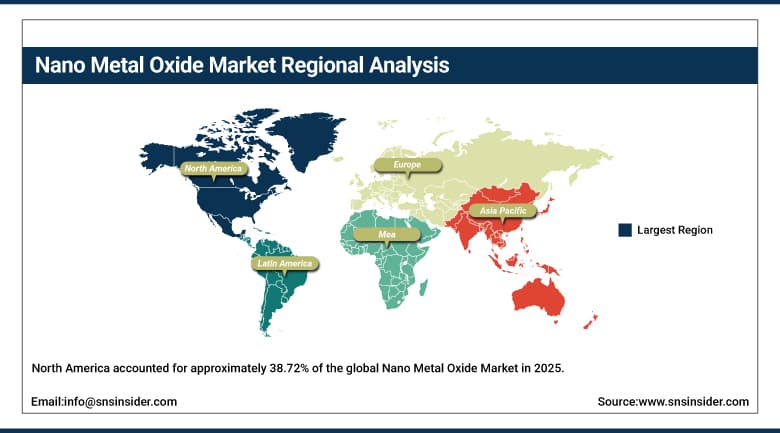
North America accounted for approximately 38.72% of the global Nano Metal Oxide Market in 2025, driven by strong demand from electronics, healthcare, automotive, and industrial applications. The United States accounts for a significant portion of regional demand, underpinned by advanced manufacturing capacities, a developed research infrastructure and the presence of major nanomaterial producers.
Canada supports regional growth through investments in advanced materials research and broadening applications in the industrial and health care sectors. Further, continuous technological advancements in nanotechnology and increased adoption of nano metal oxides in electronics and optics, and the rising demand for high-performance materials further reinforce North America’s position as a significant market for nano metal oxides.
Get Customized Report as Per Your Business Requirement - Enquiry Now
Asia Pacific Nano Metal Oxide Market Insights
Asia Pacific is anticipated to witness the highest CAGR of approximately 11.50% among all regional segments of the Nano Metal Oxide Market throughout the forecast period from 2026 to 2035, driven by increasing demand from the electronics, healthcare, cosmetics, and automotive industries. China will continue to be a major engine of growth in the region, driven by its large manufacturing base and rising investment in nanotechnology and advanced materials.
Japan will contribute through its established electronics, semiconductor and advanced materials industries while India is expected to see rising demand for nano metal oxides due to its expanding pharmaceutical, personal care, construction and automotive sectors.
Europe Nano Metal Oxide Market Insights
Germany is a major producer and consumer of advanced nanomaterials and has a large chemical manufacturing industry, making Europe a key regional market for nano metal oxide. Germany’s position in the European market reflects its well-established industrial base and high demand for nano metal oxides in automotive, electronics and healthcare applications.
The United Kingdom and France contribute additional regional demand, supported by established chemical industries and growing investment in nanotechnology research and development. Continued steady regional demand for nano metal oxide is being driven by ongoing European Union investment in advanced materials, sustainable manufacturing and technological innovation.
⮞In November 2022, the European Union Observatory for Nanomaterials published a study identifying Germany as Europe’s leading country for nanomaterial producers and downstream users across diverse industrial applications.
MEA & Latin America Nano Metal Oxide Market Insights
The Middle East & Africa Nano Metal Oxide Market is witnessing rising opportunities due to escalating investments in industrial development, advanced materials and nanotechnology-based applications. Countries like Saudi Arabia, the United Arab Emirates and South Africa satisfy regional demand with growing construction, energy, healthcare and manufacturing sectors. Growing use of nano metal oxides in coatings, catalysts, electronics, and environmental applications is favoring the growth of the regional market.
Latin America’s Nano Metal Oxide Market is primarily driven by countries such as Brazil and Mexico, where growing industrial activities and increasing manufacturing capabilities are driving the demand for advanced materials. The market growth is driven by the increasing applications in paints & coatings, cosmetics, healthcare, agriculture and energy. Growth in the regional demand is expected to be gradual aided by increasing interest in nanotechnology research and use of high-performance materials.
Market Dynamics:
Growth Drivers: Rising Demand for Advanced Electronics and High-Performance Materials
The demand for advanced electronics and high-performance materials is a major driver for the growth of the Nano Metal Oxide Market. Manufacturers are using nano metal oxides more and more in electronic components, sensors, semiconductors, coatings, and functional materials. Their unique optical, electrical, magnetic and catalytic properties favor applications with increased performance, durability and miniaturization. Increasing adoption of nanotechnology in automotive, healthcare, construction, and industrial manufacturing further strengthens the market demand.
Another driver for market growth is advances in material science and nano-manufacturing technologies. Improved functionality and consistency of nano metal oxides are achieved through advances in particle size control, surface modification and synthesis processes. The market continues to be driven by increasing investments in research and development and increasing demand for high-performance materials in consumer electronics, renewable energy technologies, and advanced industrial applications.
Restraints: High Production Costs and Safety and Environmental Concerns
One of the major restraints for the Nano Metal Oxide Market is the high production costs associated with nano metal oxide manufacturing. The manufacturing costs are higher due to specialized synthesis processes, advanced processing equipment and stringent quality-control requirements. However, it is technically challenging to maintain consistent particle size, purity, dispersion and material performance across large production volumes, which can limit commercialization and adoption by cost-conscious end users.
Market participants are also confronted with additional challenges related to safety and environmental concerns for handling, exposure and disposal of certain nanomaterials. The health and ecological effects of nanoparticles depend on their chemical composition, size, surface properties and exposure routes, and require detailed assessment and appropriate risk management strategies. Furthermore, changing regulatory requirements, environment compliance requirements and workplace safety standards may increase the cost of operation and increase complexities to the commercialization of nano metal oxide products in different sectors.
⮞In February 2022, the OECD published a report on manufactured nanomaterials, highlighting risk assessment challenges, limited safety data, and further research needs concerning human health and environmental risks.
Opportunities: Expanding Energy Storage Applications and Advancements in Nanotechnology
The growing applications in energy storage technologies offer a huge opportunity for growth in the Nano Metal Oxide Market. Researchers and manufacturers are investigating advanced materials for batteries, supercapacitors, fuel cells and other electrochemical systems. Titanium dioxide , manganese oxide and iron oxide nano metal oxides are being explored to enhance the electrode performance, charge-storage characteristics and electrochemical stability. Increasing investments in renewable energy integration, electric mobility and energy storage infrastructure are expected to support further research and commercial development.
Developments in nanotechnology and material engineering provide another opportunity for market participants to develop application specific nano metal oxides with improved functional properties. Enhanced material performances are possible in electronics, health care, environmental remediation and industrial catalysis by advances in surface engineering, nanocomposites and scalable synthesis approaches. Those who invest in efficient manufacturing, in consistent product quality and innovative nanomaterial formulations will benefit from the increasing demand for advanced functional materials.
Recent Developments:
-
2026: Evonik Catalysts launched Chlorocel™ 909, a mixed metal oxide adsorbent designed for catalytic reformer applications. The product offers over 15% higher chloride loading capacity than existing industry alternatives, supporting improved refinery efficiency.
-
2025: Evonik opened its first fumed aluminum oxide production facility in Asia, located in Yokkaichi, Japan. The plant manufactures advanced aluminum oxide materials for lithium-ion batteries, electric mobility, consumer electronics, and coating applications.
-
2024: NEI Corporation introduced NANOMYTE® BE-600, a titanium niobium oxide (TiNb₂O₇) anode powder for next-generation batteries. The material offers potential benefits in energy density, charging speed, and cycle life.
Nano Metal Oxide Market Key Players:
-
American Elements
-
SkySpring Nanomaterials, Inc.
-
Nanophase Technologies Corporation
-
Evonik Industries AG
-
BASF SE
-
Cabot Corporation
-
Baikowski SAS
-
Advanced Nano Products Co., Ltd.
-
Nanostructured & Amorphous Materials, Inc.
-
US Research Nanomaterials, Inc.
-
Nanoshel LLC
-
Hongwu International Group Ltd.
-
Merck KGaA
-
NYACOL Nano Technologies, Inc.
-
Meliorum Technologies, Inc.
-
Inframat Advanced Materials LLC
-
Sakai Chemical Industry Co., Ltd.
-
Nissan Chemical Corporation
-
PlasmaChem GmbH
-
Reinste Nano Ventures Pvt. Ltd.
Nano Metal Oxide Market Report Scope:
| Report Attributes | Details |
|---|---|
| Market Size in 2025 | USD 8.79 Billion |
| Market Size by 2035 | USD 21.87 Billion |
| CAGR | CAGR of 9.55% From 2026 to 2035 |
| Base Year | 2025 |
| Forecast Period | 2026-2035 |
| Historical Data | 2022-2024 |
| Report Scope & Coverage | Market Size, Segments Analysis, Competitive Landscape, Regional Analysis, DROC & SWOT Analysis, Forecast Outlook |
| Key Segments | • By Product (Aluminum Oxide, Iron Oxide, Titanium Dioxide, Silicon Dioxide, Zinc Oxide) • By Application (Electronics & Optics, Medical & Personal Care, Paints & Coatings, Energy & Environment) • By End Use Industry (Automotive, Electronics, Healthcare, Aerospace, Construction) |
| Regional Analysis/Coverage | North America (US, Canada), Europe (Germany, UK, France, Italy, Spain, Russia, Poland, Rest of Europe), Asia Pacific (China, India, Japan, South Korea, Australia, ASEAN Countries, Rest of Asia Pacific), Middle East & Africa (UAE, Saudi Arabia, Qatar, South Africa, Rest of Middle East & Africa), Latin America (Brazil, Argentina, Mexico, Colombia, Rest of Latin America). |
| Company Profiles | American Elements, SkySpring Nanomaterials, Inc., Nanophase Technologies Corporation, Evonik Industries AG, BASF SE, Cabot Corporation, Baikowski SAS, Advanced Nano Products Co., Ltd., Nanostructured & Amorphous Materials, Inc., US Research Nanomaterials, Inc., Nanoshel LLC, Hongwu International Group Ltd., Merck KGaA, NYACOL Nano Technologies, Inc., Meliorum Technologies, Inc., Inframat Advanced Materials LLC, Sakai Chemical Industry Co., Ltd., Nissan Chemical Corporation, PlasmaChem GmbH, Reinste Nano Ventures Pvt. Ltd. |

Frequently Asked Questions
Leading companies in the Nano Metal Oxide Market include American Elements, SkySpring Nanomaterials, Inc., Nanophase Technologies Corporation, Evonik Industries AG, and BASF SE, among others.
Key opportunities include expanding energy storage applications, advancements in nanotechnology, and development of application-specific nano metal oxides for electronics, healthcare, and environmental technologies.
Rising demand for advanced electronics and high-performance materials, combined with advancements in nanomanufacturing and increasing nanotechnology investments, is driving market growth.
The Titanium Dioxide segment dominated the Nano Metal Oxide Market with approximately 30.50% share in 2025, while Zinc Oxide is the fastest-growing segment.
North America dominated the Nano Metal Oxide Market in 2025 with approximately 38.72% share, driven by strong demand from electronics, healthcare, automotive, and industrial applications.
