
PVC Recycling Market Report Scope & Overview:
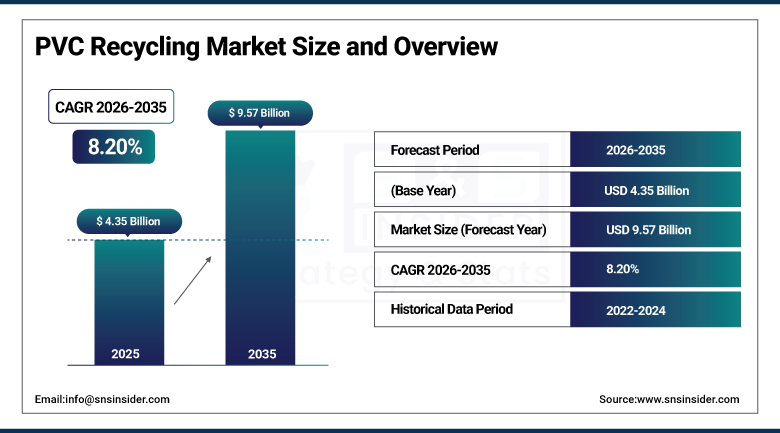
The PVC Recycling Market was valued at USD 4.35 Billion in 2025 and is expected to reach USD 9.57 Billion by 2035, growing at a CAGR of 8.20% from 2026-2035.
The PVC Recycling Market covers the mechanical and chemical processes used to reclaim rigid and flexible polyvinyl chloride waste for reuse in new products. Demand is rising as window, pipe and flooring manufacturers face growing pressure to incorporate recycled content under tightening building waste regulations in major economies. Rigid PVC still accounts for the largest recycled volume given its dominance in pipes and window profiles, while flexible PVC recycling is expanding quickly as cable waste streams mature. Pre-consumer scrap remains the easiest and most common feedstock, though post-consumer collection is catching up as sorting technology improves. Asia Pacific leads current revenue and is also expanding capacity fastest through 2035.
VinylPlus, the European PVC industry's voluntary sustainability program, reported continued year-over-year growth in verified PVC recycling volumes across its member countries in its 2025 progress report. Sustained reporting of rising recycled volumes gives downstream manufacturers more confidence in long-term recyclate supply.
To Get more information On PVC Recycling Market - Request Free Sample Report
PVC Recycling Market Trends
-
Chemical recycling pilot plants are being developed to process mixed and contaminated PVC waste streams that mechanical recycling cannot handle.
-
Window and door profile manufacturers are closing the loop by collecting their own installation and demolition scrap for in-house reprocessing.
-
Additive suppliers are developing stabilizer packages specifically formulated to restore recyclate performance closer to virgin-grade PVC.
-
Building codes in several countries are beginning to set minimum recycled-content thresholds for non-structural PVC products.
-
Mass-balance certification schemes are being adopted to track chemically recycled PVC content through complex supply chains.
U.S. PVC Recycling Market Outlook
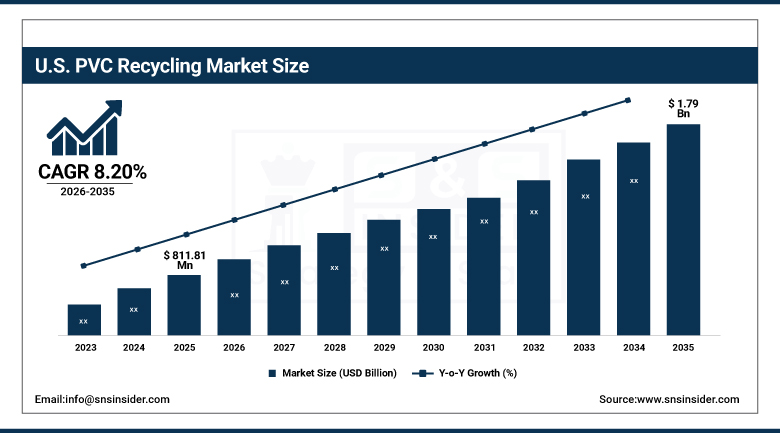
The U.S. PVC Recycling Market was valued at USD 811.81 Million in 2025 and is expected to reach USD 1.79 Billion by 2035, growing at a CAGR of 8.20% from 2026-2035.
The U.S. PVC Recycling Market is the largest national market within North America, supported by a well-established window and pipe manufacturing base that already runs significant pre-consumer scrap recovery programs internally. Post-consumer collection remains underdeveloped relative to Europe, with most reclaimed material still coming from manufacturing floors rather than demolition or curbside sources. Several processors are piloting chemical recycling technology aimed specifically at contaminated construction and demolition PVC waste that mechanical sorting cannot economically process. Fragmented state-level recycling infrastructure continues to complicate consistent post-consumer collection nationwide. Even so, rising building-code pressure for recycled content is expected to support steady U.S. volume growth through 2035.
The U.S. Environmental Protection Agency's most recent municipal solid waste characterization data continues to show PVC recovery rates trailing well behind more widely collected plastics such as PET and HDPE. That persistent collection gap gives processors room to expand post-consumer PVC recovery infrastructure well beyond its current scale.
PVC Recycling Market Segment Analysis
-
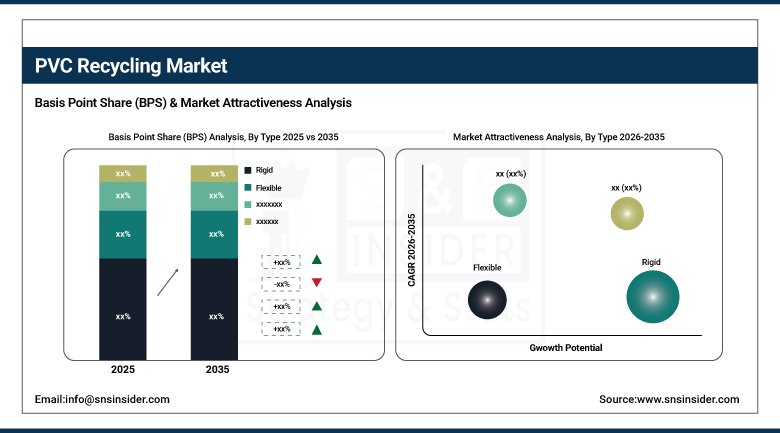
By Type, the Rigid segment dominated the PVC Recycling Market with approximately 54.60% share in 2025, while the Flexible segment is the fastest growing with a CAGR of approximately 9.40%.
-
By Source, the Pre-Consumer Waste segment dominated the PVC Recycling Market with approximately 56.80% share in 2025, while the Post-Consumer Waste segment is the fastest growing with a CAGR of approximately 9.80%.
-
By Application, the Pipe & Fittings segment dominated the PVC Recycling Market with approximately 34.60% share in 2025, while the Wires & Cables segment is the fastest growing with a CAGR of approximately 9.60%.
-
By End-Use Industry, the Building, Construction & Infrastructure segment dominated the PVC Recycling Market with approximately 48.60% share in 2025, while the Automotive segment is the fastest growing with a CAGR of approximately 9.70%.
By Type, Rigid Dominates the PVC Recycling Market and Flexible Grows Fastest
Rigid PVC leads recycled volume because pipes, window profiles and fittings generate large, relatively clean scrap streams that are straightforward to sort and reprocess compared with mixed-material flexible products. Manufacturers of rigid products have operated in-house grinding and reprocessing lines for decades, giving the segment a mature recycling infrastructure most flexible PVC applications still lack entirely. Demolition and renovation projects also generate substantial rigid PVC waste from aging pipe and window installations, feeding a steady supply into established reprocessing channels. These structural advantages keep rigid PVC the dominant recycled material category even as flexible applications expand their own recovery programs.
Flexible PVC recycling is growing fastest as cable insulation, flooring and medical tubing waste streams mature and dedicated separation technology becomes more widely available. Flexible products often blend PVC with plasticizers, fillers and other polymers, historically making clean separation difficult, but improved near-infrared sorting and dissolution-based recycling methods are gradually closing that gap. Cable recyclers in particular are investing in equipment that recovers PVC insulation after metal content is stripped away, turning a previously discarded byproduct into a saleable recyclate stream. As this separation technology scales, flexible PVC recovery is expected to keep outpacing rigid PVC growth through 2035.
⮞Veka Recycling Ltd. has continued investing in UK recycling capacity dedicated to processing end-of-life PVC window profiles back into raw material for new profile manufacturing. Continued capacity investment from an established window profile recycler reinforces rigid PVC's structural advantage in recovered material supply.
By Source, Pre-Consumer Waste Dominates the PVC Recycling Market and Post-Consumer Waste Grows Fastest
Pre-consumer manufacturing scrap remains the leading feedstock source because it is generated in a single, known location with consistent composition, making it far cheaper to collect and reprocess than waste gathered from scattered end-of-life sources across many sites. Profile extruders, pipe manufacturers and compounders routinely grind their own production offcuts back into new batches, creating a closed loop that requires no external collection infrastructure at all to operate. This predictability lets processors guarantee consistent recyclate quality to downstream customers, which post-consumer streams with variable contamination levels still struggle to match reliably at comparable cost and volume today.
Post-consumer waste collection is growing fastest as sorting technology improves and regulatory pressure pushes construction and demolition contractors to separate PVC from mixed waste streams rather than sending it to landfill sites. Demolition of aging buildings built during earlier decades of widespread PVC pipe and window adoption is now generating larger volumes of recoverable material than in previous years of the category. Collection programs targeting end-of-life agricultural film, cable and flooring waste are also expanding in several regions worldwide. As these collection networks mature, post-consumer recovery is expected to keep narrowing the gap with pre-consumer scrap through 2035.
⮞Suez S.A. has continued expanding construction and demolition waste sorting infrastructure across several European markets to improve recovery rates for PVC and other recyclable plastics. Expanded sorting infrastructure from a major waste management company is helping convert previously landfilled demolition PVC into usable recyclate.
By Application, Pipe & Fittings Dominates the PVC Recycling Market and Wires & Cables Grows Fastest
Pipe and fittings account for the largest application share because water supply, drainage and conduit pipe manufacturing consumes enormous volumes of PVC and generates substantial production scrap that is easily reground into new pipe compound at scale. Pipe manufacturers have long incorporated recycled content into non-pressure-rated applications where performance requirements are less stringent than for structural pressure pipe used elsewhere. Established relationships between pipe extruders and regional reprocessors further support consistent recyclate sourcing at scale across many markets. These factors combine to keep pipe and fittings the leading destination for recycled PVC content across most major producing regions worldwide.
Wires and cables are the fastest-growing application as cable recyclers scale dedicated PVC recovery lines following metal extraction, turning a historically discarded insulation layer into a marketable recyclate stream over recent years. Growing volumes of retired telecommunications and power cable, driven by network upgrades in several regions, are feeding larger quantities of PVC-insulated scrap into recycling channels than in prior years of the category. Buyers in lower-grade compound applications are increasingly willing to specify cable-derived recyclate as its quality and consistency improve further. As more cable recyclers add dedicated PVC separation capability, this application is expected to keep outpacing other recycled PVC end uses through 2035.
⮞The European Plastics Pipes and Fittings Association continues to track and report recycled-content usage trends across its member pipe and fitting manufacturers operating throughout Europe. Industry-level tracking of recycled-content usage helps pipe manufacturers benchmark their own recycling performance against sector peers.
By End-Use Industry, Building, Construction & Infrastructure Dominates the PVC Recycling Market and Automotive Grows Fastest
Building, construction and infrastructure remains the leading end-use industry because PVC pipes, window profiles, flooring and roofing membranes are used across nearly every construction project, generating both large production scrap volumes and substantial end-of-life waste as buildings age over the decades. Construction's long product lifecycles also mean recycled PVC content can be specified in non-critical applications without raising the same durability concerns that shorter-lived consumer products face elsewhere. Government building codes in several countries now actively favor products with documented recycled content, reinforcing construction's position as the primary destination for reprocessed PVC material across most markets.
Automotive applications are growing fastest as manufacturers face rising sustainability reporting requirements and look to recycled PVC for underbody coatings, interior trim and wire harness insulation. Vehicle makers are under growing pressure from regulators and investors to document recycled material content across their supply chains, pushing component suppliers to qualify recycled PVC grades for a wider range of parts than previously accepted. End-of-life vehicle recycling programs in several regions are also beginning to recover PVC content more systematically rather than treating it as residual waste. As qualification testing expands, automotive PVC recycling is expected to keep growing faster than other end-use categories through 2035.
⮞The U.S. Green Building Council continues to award credit toward LEED certification for construction projects that specify a documented share of recycled-content building materials, including qualifying PVC products. Credit toward a widely recognized green building certification gives developers a direct incentive to specify recycled PVC content.
Regional Analysis
|
Region |
Major Country |
Share within Region, 2025 (%) |
|---|---|---|
|
Asia Pacific |
China |
71.40 |
|
Europe |
Germany |
28.60 |
|
North America |
United States |
86.40 |
|
Middle East and Africa |
United Arab Emirates |
29.80 |
|
Latin America |
Brazil |
42.60 |
Asia Pacific PVC Recycling Market Insights
With a share of 38.60% in 2025, Asia Pacific led the market, and the region is also the fastest-growing, projected to expand at a CAGR of 9.90% from 2026 to 2035. China anchors regional demand through its extensive pipe, window profile and cable manufacturing base, which generates correspondingly large volumes of recoverable PVC scrap. India, Japan, South Korea and Australia add further regional volume through their own expanding construction and infrastructure sectors. Rapid urban construction across the region continues to generate both production scrap and, increasingly, demolition waste from buildings reaching the end of their service life.
Government recycling targets in several Asia Pacific countries are pushing construction material suppliers to document recycled content more formally than in previous years of the category. Fragmented small-scale recycling operations across parts of the region still produce inconsistent recyclate quality compared with larger, more automated European and North American processors elsewhere. Rising labor costs in some manufacturing hubs are also pushing reprocessors toward more automated sorting and reprocessing equipment over time. As construction activity and environmental policy pressure continue rising together, Asia Pacific's combination of scale and regulatory momentum supports the fastest growth of any region through 2035.
⮞China's Ministry of Ecology and Environment has continued expanding construction and demolition waste sorting requirements across major cities as part of its broader solid waste management policy through 2025. Expanding sorting requirements are pushing more Chinese construction waste processors to separate and recover PVC rather than sending it to landfill.
Europe PVC Recycling Market Insights
Europe is the second-largest region, with concentrated demand across Germany, France, the United Kingdom, Italy and Spain across most major national markets. Germany anchors regional activity through its large window profile and pipe manufacturing base along with some of the most developed post-consumer PVC collection infrastructure in the world today. Long-running voluntary industry commitments among European PVC manufacturers have built decades of reprocessing experience that newer recycling programs elsewhere are still working hard to match. The region's dense network of window and pipe recyclers gives manufacturers reliable, geographically close access to recycled feedstock year-round.
European Union packaging and construction waste directives continue to push member states toward higher recycled-content targets across multiple plastic categories, including PVC-specific collection and reprocessing commitments agreed in recent years. Mature collection infrastructure in Western Europe contrasts with still-developing systems in parts of Eastern Europe, creating uneven recyclate availability across the broader region overall. Rising energy costs have pressured some reprocessors' margins, though recycled PVC remains less energy-intensive to produce than virgin material generally. Even so, sustained regulatory support and established industry infrastructure keep Europe a critical, stable regional base for the category through 2035.
⮞The European Commission's circular economy and construction product regulations continue to set recycled-content expectations that influence PVC product specifications across member states. Continued regulatory emphasis on circularity reinforces long-term demand certainty for European PVC reprocessors.
North America PVC Recycling Market Insights
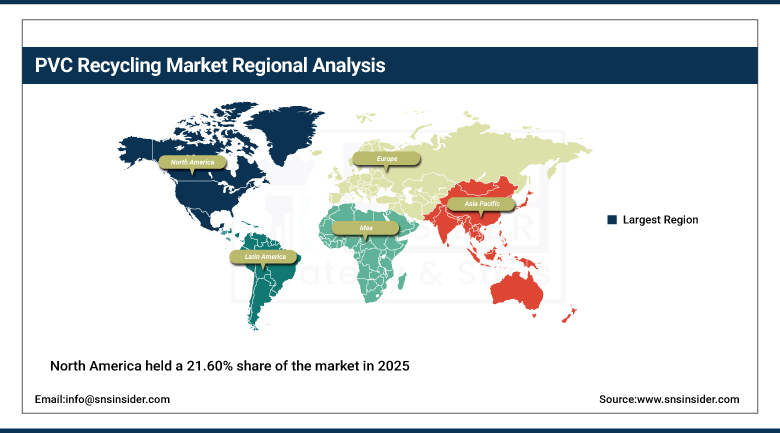
North America held a 21.60% share of the market in 2025. The United States anchors regional demand through a large pipe, window profile and cable manufacturing base that already runs substantial pre-consumer scrap recovery internally. Canada contributes steady demand through its own construction materials and plastics processing sector, particularly in window and pipe manufacturing hubs. Post-consumer collection across the region remains comparatively underdeveloped relative to Europe, with most recovered material still coming from manufacturing floors rather than demolition or curbside sources. Fragmented state and provincial recycling infrastructure continues to complicate consistent nationwide post-consumer collection efforts.
Several processors across the region are piloting chemical recycling technology aimed specifically at contaminated construction and demolition PVC waste that mechanical sorting cannot economically separate. Rising building-code pressure for documented recycled content is gradually pushing more manufacturers to formalize recycled-content tracking across their supply chains. Trade association efforts to expand voluntary recycling directories are helping processors and manufacturers connect more efficiently than informal regional networks previously allowed. Even with underdeveloped post-consumer collection relative to Europe, growing regulatory and certification pressure is expected to support steady North American volume growth through 2035.
⮞The Vinyl Institute has continued expanding its enhanced recycling directory connecting PVC waste generators with qualified recyclers across North America. An expanded industry recycling directory is helping match available PVC waste streams with processing capacity more efficiently across the region.
Get Customized Report as per Your Business Requirement - Enquiry Now
MEA & Latin America PVC Recycling Market Insights
The Middle East and Africa region shows steady, if uneven, demand across its various sub-markets. Gulf countries lead adoption through large-scale construction activity and growing government interest in waste diversion as landfill capacity constraints become more pressing in densely built urban areas. The United Arab Emirates and Saudi Arabia host the region's most developed modern waste sorting infrastructure, supporting wider recovery of construction-grade PVC than elsewhere nearby. South Africa adds steady demand through its own established construction and plastics processing sector. Limited formal waste collection infrastructure and lower landfill costs across much of the rest of the region continue to favor disposal over recycling for now.
Latin America contributes growing demand led by Brazil, followed by Mexico, Argentina and Colombia. Brazil's large construction and plastics processing sector supports rising PVC recycling activity, and regional pipe and profile manufacturers are gradually incorporating recycled content as both cost pressure and sustainability expectations increase across the region. Currency volatility and inconsistent formal waste collection outside major cities remain a constraint on consistent post-consumer feedstock supply for smaller processors. Even so, expanding processing capacity among regional manufacturers and rising interest in construction material sustainability credentials support continued growth in regional PVC recycling activity through 2035.
⮞Plastivida, the Brazilian plastics industry's socio-environmental institute, has continued reporting on recycled plastics initiatives across the country's construction materials sector, including PVC pipe and profile recycling programs. Continued industry-level reporting helps Brazilian manufacturers and regulators track progress toward higher recycled-content adoption in construction materials.
Market Dynamics
Growth Drivers: Building-code recycled-content requirements and circular construction targets are expanding demand
The strongest driver is the growing number of building codes and green certification schemes that reward or require documented recycled content in non-structural construction products. Developers pursuing sustainability certifications increasingly specify recycled PVC pipe, profile and flooring products to earn credits that improve a project's overall environmental rating. This certification-driven demand gives recyclers a predictable, growing customer base willing to pay a premium for verified recycled content rather than treating recyclate purely as a lower-cost commodity alternative to virgin material. As more jurisdictions adopt similar recycled-content expectations, this driver is expected to broaden across additional building product categories.
A second driver is the expanding volume of end-of-life PVC becoming available as buildings constructed during earlier decades of widespread PVC pipe and window adoption now reach demolition age in large numbers. This generational wave of demolition waste is creating feedstock volumes that recycling infrastructure built decades ago was not originally sized to handle, prompting new investment in sorting and reprocessing capacity. Improving separation technology is making it economically viable to recover PVC from increasingly mixed and contaminated waste streams that earlier recycling methods could not process profitably. Together these forces are expanding the addressable feedstock base for the industry.
Renolit SE has continued forming recycling partnerships, including a joint venture with Sobernheimer Rohstoff-Kontor GmbH announced to expand flexible PVC film recycling capacity in Germany. Continued partnership formation from an established flexible PVC film manufacturer reinforces growing industry investment in dedicated recycling capacity.
Restraints: Contamination, additive legacy issues and fragmented collection limit recycled-content use
A persistent restraint is contamination in mixed PVC waste streams, since products manufactured decades ago often contain legacy additives and stabilizers that are no longer permitted in new products, complicating efforts to qualify recyclate for sensitive applications across many sectors. Sorting equipment must increasingly screen for these legacy compounds before recyclate can be certified for use in food-contact, medical or other regulated applications, adding cost and complexity that virgin material production does not face at all. This additive legacy issue is expected to persist for years as older PVC products continue entering the waste stream alongside newer, cleaner-formulated material.
Fragmented collection infrastructure adds a further constraint, particularly outside Europe, where post-consumer PVC is rarely separated from general construction and demolition waste before reaching landfill or incineration facilities. Building this collection infrastructure requires sustained investment in sorting facilities and contractor education that many regions have not yet prioritized relative to more established recycling categories such as packaging plastics. Chemical regulators periodically restricting specific legacy additives used in older PVC products add further reformulation costs for processors trying to qualify recovered material for new uses across different markets.
⮞The European Chemicals Agency continues to review and periodically restrict certain legacy additives historically used in PVC products under its REACH chemical safety framework. Periodic additive restrictions require processors to screen recovered material more carefully before it can be qualified for new applications.
Opportunities: Chemical recycling scale-up and automotive qualification are opening new growth paths
Chemical recycling technology capable of processing contaminated and mixed PVC waste streams presents a clear opportunity for companies able to scale beyond pilot facilities into commercial-volume operations serving multiple industries. These processes can recover usable feedstock from waste that mechanical recycling cannot economically sort, potentially enabling the reuse of large volumes of previously landfilled material. Companies that successfully commercialize chemical recycling at scale are well positioned to supply recyclate for higher-value applications that demand purer, more consistent material than mechanically recovered PVC can typically provide across a broader range of end markets.
Expanding automotive and electrical qualification of recycled PVC presents a second major opportunity as component suppliers face growing pressure to document recycled content across vehicle and equipment supply chains worldwide. Suppliers that invest early in qualification testing for recycled-content automotive and electrical-grade PVC can secure longer-term supply contracts before competitors catch up with their own qualified recyclate grades. Expanding into these higher-value, specification-driven end markets offers recyclers a path to better margins than commodity construction-grade recyclate alone typically provides across the broader industry today.
⮞Veolia Environnement S.A. has continued expanding its plastics recycling and material recovery operations across several European markets, including facilities processing construction-derived PVC waste streams. Continued operational expansion from a major environmental services company reflects broader industry confidence in PVC recycling's long-term growth potential.
Recent Developments:
-
In May 2026, INEOS Inovyn reported progress on its CIRC-PVC consortium project in Wallonia, Belgium, which developed and tested a prototype covering the full PVC value chain, from construction and demolition waste collection to recycled material for new products, including waste that cannot be mechanically recycled.
-
In March 2026, Deceuninck launched a next-generation recycled PVC window profile system with improved thermal insulation and higher recycled material content.
PVC Recycling Market Key Players
-
Stena Recycling AB
-
Adams Plastics, Inc.
-
Suez S.A.
-
Veolia Environnement S.A.
-
Veka Recycling Ltd.
-
Simplas PVC Recycling Ltd.
-
Dekura GmbH
-
INEOS Inovyn
-
Deceuninck NV
-
Return Polymers, Inc.
-
Benvic Europe
-
DS Smith
-
Simplas PVC Recycling
PVC Recycling Market Report Scope
| Report Attributes | Details |
|---|---|
| Market Size in 2025 | USD 4.35 Billion |
| Market Size by 2035 | USD 9.57 Billion |
| CAGR | CAGR of 8.20% From 2026 to 2035 |
| Base Year | 2025 |
| Forecast Period | 2026-2035 |
| Historical Data | 2022-2024 |
| Report Scope & Coverage | Market Size, Segments Analysis, Competitive Landscape, Regional Analysis, DROC & SWOT Analysis, Forecast Outlook |
| Key Segments | • By Type (Rigid, Flexible & Chlorinated) • By Source (Pre-Consumer Waste & Post-Consumer Waste) • By Application (Pipe & Fittings, Window Profiles & Doors, Flooring, Wires & Cables & Others) • By End-Use Industry (Building, Construction & Infrastructure, Electrical, Automotive, Consumer Goods & Others) |
| Regional Analysis/Coverage | North America (US, Canada), Europe (Germany, UK, France, Italy, Spain, Russia, Poland, Rest of Europe), Asia Pacific (China, India, Japan, South Korea, Australia, ASEAN Countries, Rest of Asia Pacific), Middle East & Africa (UAE, Saudi Arabia, Qatar, South Africa, Rest of Middle East & Africa), Latin America (Brazil, Argentina, Mexico, Colombia, Rest of Latin America). |
| Company Profiles | Stena Recycling AB, Adams Plastics, Inc., Suez S.A., Veolia Environnement S.A., Veka Recycling Ltd., Simplas PVC Recycling Ltd., Dekura GmbH, INEOS Inovyn, Deceuninck NV, Return Polymers, Inc., Benvic Europe, DS Smith, Simplas PVC Recycling |

Frequently Asked Questions
The market includes Veolia, Suez, Renolit, INEOS Inovyn, Westlake Vinnolit, Deceuninck, Veka Recycling, Stena Recycling, Aurora Material Solutions and Plastic Back, among others. These companies compete on feedstock access, reprocessing technology and recyclate quality.
The main opportunities lie in scaling chemical recycling technology for contaminated PVC waste streams, and in qualifying recycled content for automotive and electrical applications that currently demand higher-purity material. Building-certification-driven demand adds further potential.
The key growth factor is the expanding volume of end-of-life PVC from buildings reaching demolition age, combined with building codes and green certification schemes that increasingly reward documented recycled content.
By type, the Rigid segment dominated the market with approximately 54.60% share in 2025, supported by large, relatively clean scrap streams from pipe and window profile manufacturing.
Asia Pacific dominated the market with approximately 38.60% share in 2025, supported by China's large pipe and cable manufacturing base, and is also the fastest-growing region with a projected CAGR of 9.90% from 2026 to 2035.
