
Railcar Leasing Market Report Scope & Overview:
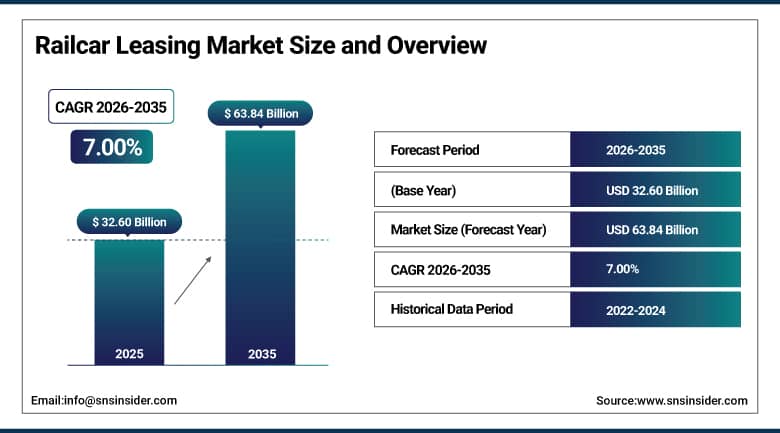
The Railcar Leasing Market was valued at USD 32.60 billion in 2025 and is projected to reach USD 63.84 billion by 2035, expanding at a CAGR of 7.00% over the period from 2026 to 2035.
The rail infrastructure has served as a backbone of industrial logistics for decades, and leasing arrangements have become the preferred route for operators looking to keep fleet costs in check without the burden of full ownership. The railcar leasing market covers a wide range of transactions wherein lessors provide covered railcars and tank railcars to industries such as oil and gas and chemicals under short-term and long-term contractual agreements. Several macroeconomic tailwinds are currently pushing the market forward. The fuel efficiency advantages of rail over road, capacity constraints in the trucking network and growing demand for supply chains to cut carbon emissions have created a positive environment for rail freight, which in turn drives demand for leasing. The active fleet consists of new and remanufactured railcars with leasing companies managing the mix based on procurement economics and customer preferences. North America is the largest global market, but Asia Pacific is growing at a much faster rate due to aggressive rail investment programs in the region.
Rail freight operators across North America have been accelerating fleet renewals to comply with updated safety standards for tank cars carrying hazardous materials. In 2025, industry data indicated that a substantial portion of legacy DOT-111 tank cars were either retired or converted, prompting leasing companies to place significant orders for compliant CPC-1232 and DOT-117 specification tank railcars to replenish available fleet inventory for chemical and energy sector customers.
To Get More Information On Railcar Leasing Market - Request Free Sample Report
Railcar Leasing Market Trends
-
Sustained growth in chemical and energy cargo volumes is pushing lessors to expand their tank railcar fleets, particularly for customers requiring specialized coatings and pressure-rated designs.
-
Long-term lease uptake is gradually gaining share as operators prioritize cost predictability and fleet availability guarantees over the flexibility of short-cycle agreements.
-
Remanufactured railcar supply is attracting renewed interest from cost-conscious lessees, with refurbishment programs offering performance close to new builds at considerably lower lease rates.
-
Asia Pacific rail freight networks are expanding at a pace that is creating new leasing corridors, particularly in economies such as India and China where commodity transport by rail is receiving policy support.
-
Technology integration in fleet management, including telematics and predictive maintenance tools, is becoming a differentiator among leasing companies competing for multi-year industrial contracts during 2025–2026.
The U.S. Railcar Leasing Market Outlook
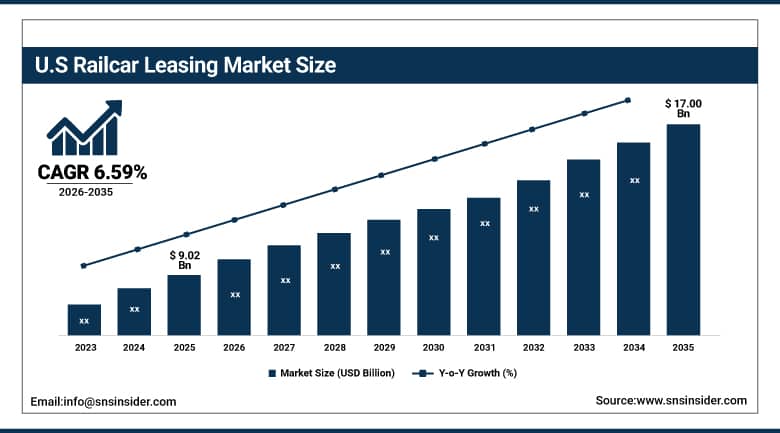
The U.S. Railcar Leasing Market was valued at USD 9.02 billion in 2025 and is expected to reach USD 17.00 billion by 2035, growing at a CAGR of 6.59.
North America railcar leasing revenue generated by the US comprises almost 81%, which is driven by Class I railroad activities and the heavy presence of industry with reliance on rail transport to carry bulky cargoes efficiently. The demand side in the case of energy carriers, especially for crude oil, refined petroleum products, and liquefied gases has driven the growth in tank car leasing activity. For covered hopper leasing, there is a strong demand because of the agricultural commodities transportation. What has changed in the recent past is the increased participation of chemical producers since they have become the major source of the growth in leasing agreements due to an increased production of petrochemicals in the Gulf region. Leasing rates have been steady and increased for secondary markets up until October 2025.
In early 2025, several U.S. Class I railroads announced network investment programs targeting congestion relief and capacity expansion on key corridors serving industrial hubs. These investments are expected to improve asset velocity for leased railcar fleets, effectively increasing the productive life and revenue-generating hours of each car in the fleet and making longer lease commitments more attractive to industrial shippers with predictable annual volume requirements.
Railcar Leasing Market Segment Analysis
-
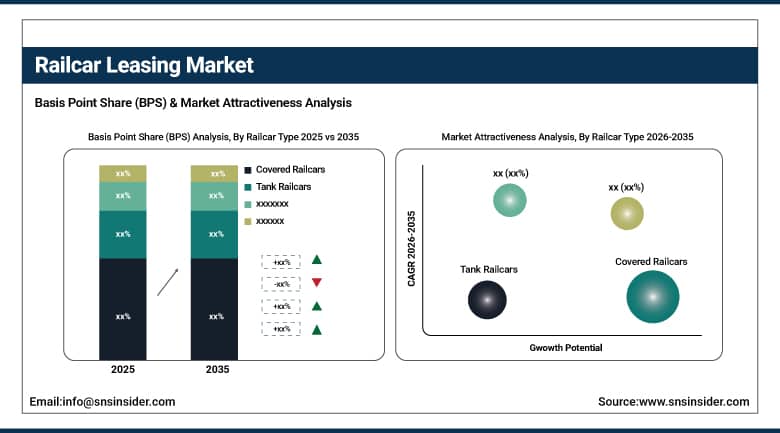
By Railcar Type, covered railcars dominated with approximately 65.33% revenue share in 2025; tank railcars are expected to be the fastest-growing segment at approximately 8.23% CAGR from 2026 to 2035.
-
By Lease Terms, short-term leases dominated with approximately 72.13% revenue share in 2025; long-term leases are expected to be the fastest-growing segment at approximately 7.30% CAGR from 2026 to 2035.
-
By Industry, oil & gas dominated with approximately 68.99% revenue share in 2025; chemicals are expected to be the fastest-growing segment at approximately 7.11% CAGR from 2026 to 2035.
-
By Car Origin, newly built railcars dominated with approximately 54.89% revenue share in 2025; remanufactured railcars are expected to be the fastest-growing segment at approximately 7.64% CAGR from 2026 to 2035.
By Railcar Type, covered railcars dominating while tank railcars gaining momentum as the fastest-growing segment
Covered railcars accounted for approximately 65.33% of total revenues in 2025, supported by the massive volume of agricultural commodities, fertilizers and dry bulk industrial materials moving across North American and European rail networks annually. The covered hopper, in particular, remains the single most common car type in active lease fleets. The segment’s customer base consists primarily of agricultural exporters, grain handlers and food processors, who are stable and repeat customers with relatively predictable seasonal leasing needs. The breadth of the covered railcar category, which includes boxcars, gondolas and flat cars in addition to hoppers, also contributes to the segment’s revenue scale.
Tank railcars, which accounted for 34.67% of revenues in 2025, are expected to grow at the fastest rate of 8.23% CAGR through 2035, driven by two structural factors. First, global petrochemical production continues to migrate toward rail-intensive regions, particularly the U.S. Second the move away from legacy non-compliant tank car designs has resulted in a sustained replacement cycle which leasing companies are actively capitalizing on by ordering new pressure car, stainless-lined, and high-capacity general service tank railcars. Gulf Coast, where pipeline capacity constraints make rail a critical mode for product distribution.
By Lease Terms, short-term leases dominating while long-term leases emerging as the faster-growing structure
Short-term leases made up 72.13% of total revenues in 2025, and such domination stems from the preferences of the wide group of industrial shippers who require flexibility in their fleets. Commodity producers working in cyclical industries prefer to work under short-cycle contracts because they do not want to be bound by lease agreements when demand weakens. Leasing firms benefit from having many opportunities to re-price in the short-term segment at a time when utilization levels are high and second-hand car prices are firm. This segment consists of spot and per diem operations by smaller players with small car fleets that lease additional capacity to cope with demand surges.
Long-term leases, which represented 27.87% of revenues in 2025, are expected to grow at a 7.30% CAGR from 2026 through 2035, exceeding the growth of the short-term segment. This transition is being led by larger industrial customers who want supply certainty in terms of railcar availability, rather than simply optimizing lease costs. Petrochemical complexes with multi-year output growth plans, fertilizer producers with long-range agricultural contracts and energy companies with dedicated distribution networks are all shifting to lease structures of five to ten years. Leasing companies are facilitating this transition by providing fleet management services, maintenance coverage, and tailored car configurations packaged in long-term agreements.
By Industry, oil & gas dominating while chemicals sector expanding at the faster pace
The oil and gas industry represented some 68.99% of railcar leasing revenues in 2025, a ratio that reflects the large number of tank cars dedicated to moving crude oil, liquefied petroleum gas, ethanol, and refined products across North American rail corridors. Even with pipeline construction activity continuing in certain basins, rail remains a critical and flexible transport mode for energy producers who need to reach refineries and export terminals not served by existing pipeline infrastructure. The segment’s lease volumes are closely tied to production activity in major basins such as the Permian, Bakken, and Appalachian plays, all of which maintained strong output levels through 2025.
The chemicals sector accounted for 31.01% of revenues in 2025 and is projected to expand at a 7.11% CAGR over the forecast period. Increased petrochemical manufacturing capacity in the U.S., prompted by access to low-cost NGLs in the region, will generate considerable demand for railcar leases from producers of ethylene, polyethylene and caustic soda. Abroad, chemical companies shipping specialty liquids, acids and pressurized and/or lined tank car gases constitute an increasing portion of the leasing market. This customer base typically signs longer-term contracts for specialized equipment, offering substantial earnings potential for leasing companies with the necessary expertise.
By Car Origin, newly built railcars dominating while remanufactured units gaining share at a faster pace
New railcars constituted around 54.89% of the revenue in 2025. Several reasons contribute to the preference by big industry clients for new railcars including compliance with the most up-to-date environmental and safety guidelines, more modern railcar design which is capable of accommodating more weight and has less tare weight and warranty support from manufacturers. It is also likely that lease providers will choose new railcars when they make huge orders since the same designs will be used, simplifying maintenance and management of residual value over a long period. In 2025, huge demand for new railcars from North American lease providers was reported.
Remanufactured railcars, accounting for 45.11% of revenues in 2025, are projected to grow at 7.64% CAGR through 2035, outpacing the new build segment. Cost economics are the primary driver here. Remanufactured cars, which undergo frame inspection, component replacement, and system upgrades, can be delivered to lessees at rates noticeably below equivalent new cars while delivering comparable operational reliability for standard duty cycles. A broad population of serviceable older car bodies reaching mid-life in the current fleet is expanding the supply of economically viable refurbishment candidates. Emerging market operators with more price-sensitive procurement criteria are especially receptive to remanufactured units, contributing to the segment’s above-average growth outlook.
Regional Analysis:
|
Region |
Major Country |
Share within Region, 2025 (%) |
|---|---|---|
|
North America |
United States |
82% |
|
Europe |
Germany |
23% |
|
Asia Pacific |
China |
33% |
|
Middle East & Africa |
UAE |
18% |
|
Latin America |
Brazil |
36% |
North America Railcar Leasing Market Insights
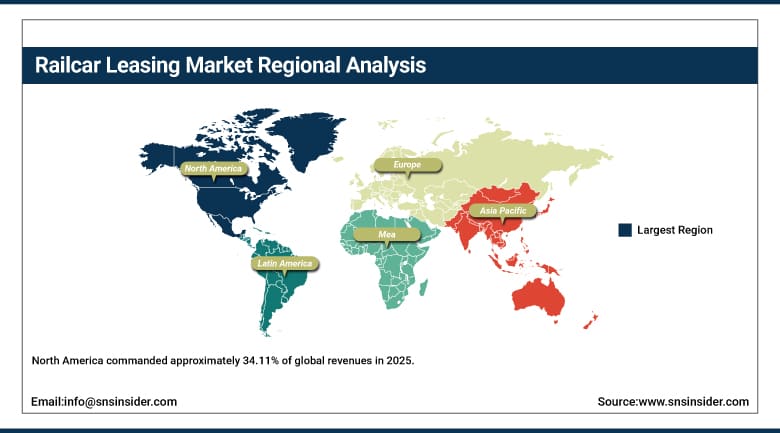
North America commanded approximately 34.11% of global revenues in 2025, making it the largest regional market by a considerable margin. The United States alone contributed around 81% of regional revenues, reflecting the unmatched scale of its rail freight network and the concentration of energy, agricultural, and chemical industries that together generate the bulk of leasing demand. Canada, holding the remaining 19%, contributes through potash and grain transport in Western provinces and petroleum product movements tied to Alberta’s oil sands operations. Infrastructure maturity, an established leasing ecosystem with major financial intermediaries, and a deep pool of institutional investors participating in railcar securitization structures all reinforce the region’s dominance. The regional market is projected to grow at 6.64% CAGR through 2035.
Get Customized Report as Per Your Business Requirement - Enquiry Now
Europe Railcar Leasing Market Insights
Europe, Germany, France, and Poland represent the core markets, with chemical manufacturing corridors and cross-border intermodal routes generating consistent demand for both tank and covered railcar leases. European rail policy frameworks supporting modal shift from road to rail have incrementally added to freight rail volumes. Leasing activity in Eastern Europe has picked up as industrial expansion in countries such as Poland and the Czech Republic creates demand for additional rolling stock that local operators prefer to lease rather than own outright given the capital intensity of fleet acquisition. The region is expected to expand at a CAGR of 6.60% through the forecast period.
Asia Pacific Railcar Leasing Market Insights
Asia Pacific held approximately 26.76% of global revenues in 2025 and is the fastest-growing regional market, projected at 8.12% CAGR through 2035. China has the largest regional rail freight network and continues to grow capacity through ongoing investment in dedicated freight corridors. India is emerging as a high growth market with government commitments to significantly increase rail freight volumes by the end of the decade and dedicated freight corridor projects are creating new demand for specialized railcar types. Coal, iron ore, fertilizer and petroleum products are the dominant freight categories driving leasing requirements across the region. Australia’s bulk commodity export sector also contributes to regional leasing volumes, particularly in the iron ore and coal segments.
Middle East & Africa and Latin America Railcar Leasing Market Insights
Middle East & Africa held with the UAE and Saudi Arabia as the primary contributors within the Gulf Cooperation Council. Rail freight development in the region is still at a relatively early stage compared to North America and Europe, but ambitious infrastructure projects including the GCC Railway network and logistics corridor investments in East Africa are beginning to generate tangible leasing demand, particularly for tank cars serving petrochemical and refinery complexes. Latin America with Brazil as the dominant market owing to its extensive agricultural export commodity flows and the ongoing expansion of private rail concessions. Grain, fertilizer, and mineral ore transport requirements sustain covered and specialized car leasing activity across the region. Both markets are expected to grow in the mid-to-high single digit CAGR range through 2035.
Market Dynamics:
Growth Drivers: industrial freight expansion and rail efficiency advantages accelerating leasing demand across global markets
The core engine of growth for railcar leasing is the expanding volume of industrial freight that moves by rail rather than road or pipeline. Rail offers a compelling cost advantage per ton-mile for bulk commodities moved over medium to long distances, and this advantage becomes even more pronounced as road freight rates face cost pressure from driver shortages and fuel price volatility. Energy and chemical producers that need to move large volumes of product to distribution terminals and export facilities are the natural constituency for railcar leasing, and their output continues to grow in North America and Asia Pacific. Environmental considerations are adding to rail’s appeal, as shipper sustainability commitments create incentives to shift freight to the lower-emissions rail mode. All of these dynamics feed through to higher fleet utilization and rising demand for leased railcars.
Rail freight’s carbon advantage over long-haul trucking is well documented and increasingly relevant to corporate sustainability reporting. According to the Association of American Railroads, moving freight by rail is approximately four times more fuel-efficient than truck transport, meaning that a single leased railcar can move one ton of freight approximately 480 miles per gallon of fuel consumed. As corporate scope 3 emission reduction commitments become binding targets rather than aspirational pledges, logistics managers are under growing internal pressure to shift shippable volumes toward rail where operationally feasible.
Restraints: fleet overcapacity cycles and capital intensity of railcar ownership constraining leasing market returns
Railcar leasing is a capital-intensive business with long asset lives, which means that overcapacity built during demand peaks takes many years to work through the fleet. Historical cycles have shown that when new car deliveries outpace retirement of older units during boom periods, lease rates can compress significantly as inventory availability exceeds demand, particularly in commodity-exposed segments such as covered hoppers during agricultural downturns. Interest rate levels also directly affect the economics of leasing, since railcars are typically financed through securitized structures or direct debt, and higher borrowing costs can compress lessor margins or push up lease rates charged to customers, dampening leasing volumes at the margin. Regulatory compliance requirements, while less immediate than in past years following the major tank car upgrade cycle, remain a potential source of unexpected capital expenditure for fleet operators.
Opportunities: fleet modernization demand and expanding chemical rail networks opening new leasing avenues
The aging profile of active railcar fleets in North America and Europe presents a substantial long-term replacement opportunity for leasing companies positioned to supply modern, specification-compliant equipment. A meaningful share of the active fleet in both regions is now operating in the later years of its serviceable life, and the coming decade will see significant retirement and replacement activity. Leasing companies that have established relationships with Class I and short-line railroads, as well as direct relationships with major industrial shippers, are best placed to capture this replacement demand. Emerging market rail development, particularly in South and Southeast Asia, offers a longer-range opportunity for lessors willing to establish local market presence ahead of the demand growth curve. Service-enriched lease structures incorporating maintenance, fleet management analytics, and compliance tracking represent a further avenue for value addition and margin improvement.
Recent Developments:
-
February 2026: GATX Corporation reported strong fourth quarter 2025 lease renewal activity in North America, noting that renewal rates on covered and tank railcars achieved pricing above expiring lease levels, reflecting tight fleet utilization across the North American Class I railroad network.
-
2025: Trinity Industries Leasing expanded its remanufactured railcar offering, launching a refurbishment program for general service tank cars that received interest from chemical sector customers seeking specification-compliant equipment at lease economics below equivalent new build rates.
-
February 2026: Wells Fargo Rail completed the acquisition of an additional block of lease railcars from a secondary market transaction, adding tank and covered hopper units to its managed fleet and signaling continued institutional investor appetite for railcar leasing assets as a yield-generating infrastructure category.
Railcar Leasing Market Key Players are:
-
GATX Corporation
-
Trinity Industries Leasing Company
-
Wells Fargo Rail
-
CIT Rail (Minyard)
-
SMBC Rail Services
-
TTX Company
-
First Union Rail
-
Union Tank Car Company (UTLX)
-
VTG AG
-
Chicago Freight Car Leasing
-
RAIL Management Corp.
-
Andersons Rail Group
-
TrinityRail Maintenance Services
-
Touax Rail
-
The Greenbrier Companies
-
Progress Rail Services
-
American Railcar Industries
-
ATEL Capital Equipment
-
IronHorse Rail Leasing
-
Midwest Railcar
Railcar Leasing Market Report Scope:
| Report Attributes | Details |
|---|---|
| Market Size in 2025 | USD 32.60 Billion |
| Market Size by 2035 | USD 63.48 Billion |
| CAGR | CAGR of 7% From 2026 to 2035 |
| Base Year | 2025 |
| Forecast Period | 2026-2035 |
| Historical Data | 2022-2024 |
| Report Scope & Coverage | Market Size, Segments Analysis, Competitive Landscape, Regional Analysis, DROC & SWOT Analysis, Forecast Outlook |
| Key Segments | • By Railcar Type (Covered Railcars, Tank Railcars) • By Lease Terms (Short-Term Leases, Long-Term Leases) • By Industry (Oil & Gas, Chemicals) • By Car Origin (Newly Built Railcars, Remanufactured Railcars) |
| Regional Analysis/Coverage | North America (US, Canada), Europe (Germany, UK, France, Italy, Spain, Russia, Poland, Rest of Europe), Asia Pacific (China, India, Japan, South Korea, Australia, ASEAN Countries, Rest of Asia Pacific), Middle East & Africa (UAE, Saudi Arabia, Qatar, South Africa, Rest of Middle East & Africa), Latin America (Brazil, Argentina, Mexico, Colombia, Rest of Latin America). |
| Company Profiles | GATX Corporation, Trinity Industries, Inc., Greenbrier Companies, Inc., CIT Group Inc., Wells Fargo Rail Corporation, VTG GmbH, Ermewa Group, Touax Group, Union Tank Car Company, SMBC Rail Services LLC, American Industrial Transport, Inc., Andersons, Inc., Rail First Asset Management Pty Ltd., Beacon Rail Leasing, Procor Limited, NACCO Industries, Inc., Chicago Freight Car Leasing Co., CF Rail Services LLC, Herzog Railroad Services, Inc., FreightCar America, Inc. |
Frequently Asked Questions
Short-Term Leases dominated the market in 2025 with approximately 72.13% of revenues.
North America dominated the Railcar Leasing Market in 2025 with approximately 34.11% of global revenues.
