
Battery Vents Market Report Scope & Overview:
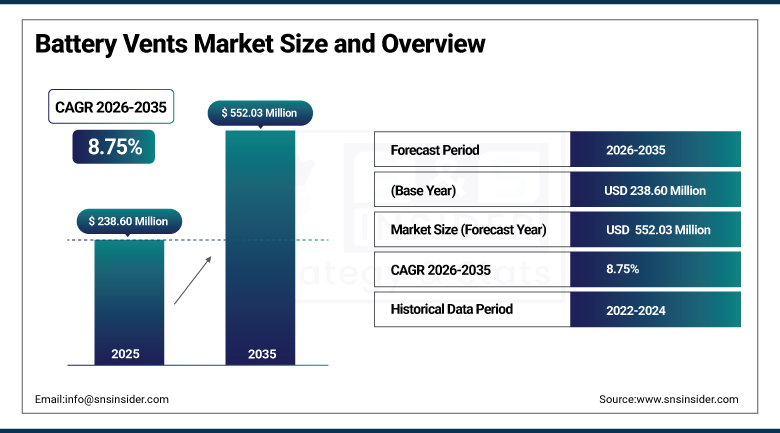
The Battery Vents Market was valued at USD 238.60 Million in 2025 and is expected to reach USD 552.03 Million by 2035, growing at a CAGR of 8.75% from 2026-2035.
The Battery Vents Market growth is being driven primarily by the accelerating global shift toward lithium-ion battery packs across passenger and commercial electric vehicles, where pressure equalization and controlled gas release have become non-negotiable safety requirements rather than optional design features. Regulatory frameworks such as UN38.3 and GB 38031 are compelling OEMs and battery pack integrators to specify certified venting components at the design stage, while the parallel build-out of stationary energy storage systems is opening a second, fast-growing demand channel that did not exist at meaningful scale a decade ago. Suppliers are responding with dual-stage and jettison-style vent architectures that combine everyday moisture and dust ingress protection with high-flow emergency degassing, allowing pack designers to reduce total vent count while meeting stricter thermal-runaway mitigation targets. Material advances in the membrane, especially concerning the use of expanded and sintered PTFE, have been aiding in achieving increased degassing while not compromising on water repellency, thus emphasizing the importance of the segment as a safety-focused part and not a commodity.
In June 2024, Donaldson Company unveiled its Dual-Stage Jet battery vent at The Battery Show Europe in Stuttgart, a medium-pressure design that ejects the poppet and cap to open a substantially larger gas-escape path during a thermal event while cutting the number of vents required on a given pack by as much as 90 percent; the launch illustrates how component-level innovation is directly reshaping OEM sourcing decisions as battery packs grow larger and more energy-dense.
To Get more information On battery vents market - Request Free Sample Report
Battery Vents Market Trends
-
OEMs are consolidating vent count per pack by adopting high-flow dual-stage and jettison-style designs that combine routine pressure equalization with emergency degassing in a single component.
-
Stationary energy storage system integrators are emerging as a distinct demand pool, applying automotive-grade venting standards to containerized and rack-mounted battery enclosures.
-
Membrane suppliers are scaling ePTFE and sintered PTFE production capacity in response to concentrated order growth from a small number of tier-one automotive customers.
-
Regulatory tightening around thermal-runaway propagation is pushing pack designers toward vents that are certified against UN38.3, GB 38031, and equivalent regional standards.
-
Two- and three-wheeler electrification in South and Southeast Asia is creating a distinct low-cost vent category separate from passenger and commercial vehicle specifications.
-
Suppliers are localizing R&D and testing capacity closer to battery manufacturing hubs in China to shorten qualification cycles for new cell and pack formats.
U.S. Battery Vents Market Outlook
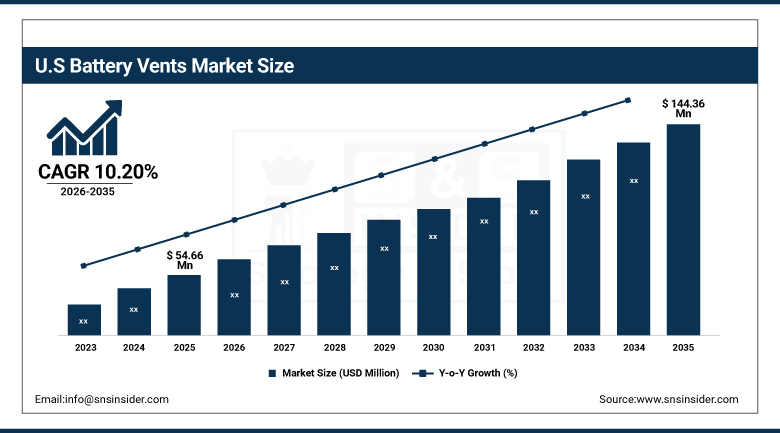
The U.S. Battery Vents Market was valued at USD 54.66 Million in 2025 and is expected to reach USD 144.36 Million by 2035, growing at a CAGR of 10.20% from 2026-2035.
The U.S. Battery Vents Market growth continues to be reinforced by domestic gigafactory investment and by federal and state policy support for electric vehicle and battery manufacturing that has pulled cell and pack production onshore over the past several years. Tier-one suppliers to Detroit-based and transplant automakers are increasingly requiring vent qualification to run in parallel with North American cell-line commissioning rather than after the fact, shortening the window between design freeze and production sourcing. Commercial vehicle electrification, including transit and medium-duty truck fleets operating under stricter total-cost-of-ownership scrutiny, is broadening the domestic customer base for venting components beyond passenger EVs alone. At the same time, the buildout of grid-scale and behind-the-meter energy storage capacity across the country is creating a second, less cyclical demand channel that is less exposed to swings in EV sales volume than the automotive channel alone, giving U.S.-facing suppliers a more diversified order book heading into the back half of the decade.
In February 2024, Freudenberg Sealing Technologies announced it was tripling production capacity for its DIAvent HighFlow pressure-compensation element across its German and U.S. manufacturing sites after securing major new orders from automotive groups in Asia and the United States, underscoring how quickly qualified vent suppliers have had to scale to keep pace with North American battery pack production ramps.
Battery Vents Market Segment Analysis
-
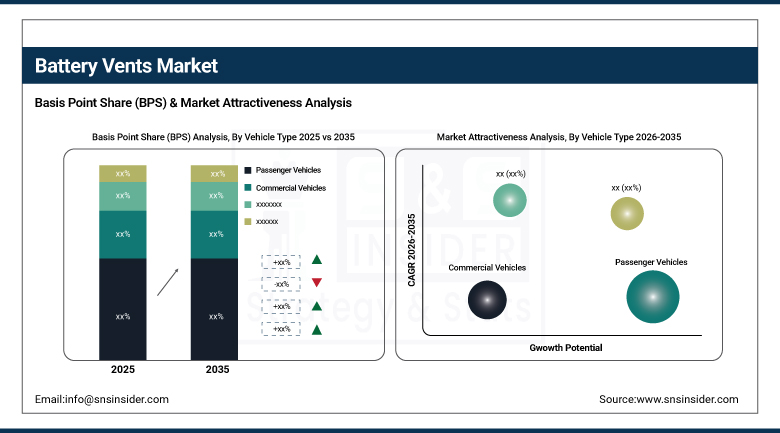
By Vehicle Type, the Passenger Vehicles segment dominated the Battery Vents Market with approximately 54.20% share in 2025, while the Commercial Vehicles segment is the fastest growing with a CAGR of approximately 10.85%.
-
By Battery Type, the Lithium-ion segment dominated the Battery Vents Market with approximately 81.40% share in 2025, and is also the fastest growing with a CAGR of approximately 9.65%.
-
By Vent Type, the Passive/Pressure-Equalization Vents segment dominated the Battery Vents Market with approximately 58.30% share in 2025, while the Dual-Stage Vents segment is the fastest growing with a CAGR of approximately 11.20%.
-
By Membrane Material, the ePTFE Membrane segment dominated the Battery Vents Market with approximately 62.75% share in 2025, while the Sintered PTFE Membrane segment is the fastest growing with a CAGR of approximately 10.40%.
-
By Application, the Electric Passenger & Commercial Vehicles segment dominated the Battery Vents Market with approximately 71.60% share in 2025, while the Stationary Energy Storage Systems segment is the fastest growing with a CAGR of approximately 12.30%.
-
By Sales Channel, the OEM segment dominated the Battery Vents Market with approximately 88.90% share in 2025, while the Aftermarket segment is the fastest growing with a CAGR of approximately 9.50%.
By Vehicle Type, Passenger Vehicles dominates and Commercial Vehicles grows fastest
The Passenger Vehicle segment continues to dominate, given the sheer number of light-duty electric vehicles produced on a global scale and consequently the high number of vent units needed at the pack level per vehicle platform. This is due to the well-established qualification processes for vents between the suppliers and the passenger vehicle OEMs, who normally have just one vent design across several vehicle variants to manage costs associated with validation.
Commercial Vehicles represent the vehicle type segment expected to be the fastest growing, fueled by an increasing trend towards fleet electrification by transit agencies, last-mile delivery vehicles, and medium-duty truck manufacturers to reduce operating expenses. This particular market is all about large battery packs requiring better degassing capabilities per vent, and the fact that procurement specifications for fleet safety are becoming increasingly stringent makes it all the more strategically important.
By Battery Type, Lithium-ion dominates and grows fastest
Lithium-ion is both the dominant and fastest-growing battery-type segment, reflecting the near-universal replacement of lead-acid chemistry across new electric vehicle and stationary storage programs. This segment is characterized by higher energy density and a correspondingly greater need for controlled, high-flow gas release during abnormal events, making venting a safety-critical rather than incidental component of the pack design.
Lead-acid applications persist mainly in legacy 12V auxiliary systems and select industrial equipment, but this residual demand is growing only modestly relative to lithium-ion. Suppliers are focusing new product development almost entirely on lithium-ion pack architectures, where evolving cell chemistries and higher pack voltages continue to raise the technical bar for pressure-relief performance, reinforcing lithium-ion's expanding share of supplier R&D investment and revenue.
By Vent Type, Passive/Pressure-Equalization Vents dominates and Dual-Stage Vents grows fastest
Passive/Pressure-Equalization Vents rule in the Vent-Type category because essentially all battery packs need basic pressure equalization and moisture exclusion capabilities irrespective of their having an emergency relief vent as well. The Vent-Type category enjoys relatively low cost per unit and easier qualification, making it the de facto specification for passenger cars and two-wheelers.
Dual-Stage Vents are the fastest-growing vent type, combining everyday pressure equalization with a separate high-flow emergency degassing path in a single housing. This segment is being pulled forward by regulatory pressure to demonstrate thermal-runaway mitigation and by OEM demand to reduce total vent count per pack, allowing suppliers offering validated dual-stage designs to capture a disproportionate share of new program awards.
By Membrane Material, ePTFE Membrane dominates and Sintered PTFE Membrane grows fastest
ePTFE Membrane holds the dominant material share, owing to its established track record for combining high airflow with reliable water and contaminant resistance across a wide operating temperature range. This segment benefits from deep supplier experience and existing qualification data, which lowers the validation burden for OEMs specifying it on new platforms.
Sintered PTFE Membrane is the fastest-growing material category, favored where higher mechanical robustness and higher-flow emergency venting are prioritized over the thinnest possible form factor. This segment is supported by ongoing materials-science investment from major suppliers seeking to differentiate on degassing rate, positioning sintered constructions as the preferred choice for next-generation dual-stage vent designs.
By Application, Electric Passenger & Commercial Vehicles dominates and Stationary Energy Storage Systems grows fastest
Electric Passenger & Commercial Vehicles remain the dominant application, accounting for the large majority of pack-level vent demand given the sheer number of vehicles entering production each year relative to other end uses. This segment benefits from well-established OEM sourcing relationships and standardized qualification protocols that favor incumbent suppliers on successive vehicle generations.
Stationary Energy Storage Systems are the fastest-growing application, as utility-scale and behind-the-meter storage deployments adopt automotive-grade venting practices to manage moisture ingress and thermal-runaway risk in containerized enclosures. This segment focuses on higher-capacity, higher-throughput vent designs suited to larger enclosure volumes, giving it a distinct and rapidly scaling specification path relative to vehicle-oriented components.
By Sales Channel, OEM dominates and Aftermarket grows fastest
OEM sales dominate the channel segment, since battery vents are almost universally specified and installed during original pack assembly rather than retrofitted afterward. This segment benefits from long-term supply agreements tied to vehicle production programs, giving qualified suppliers multi-year revenue visibility once a design is awarded.
Aftermarket sales have been recording the highest growth from a low base on the back of the increase in the number of electric vehicles and stationary energy storage systems that have reached an age where it makes sense to perform battery packs maintenance and replacement. The aftermarket sector is increasing due to the demand from independent service providers for certified replacement vents.
Regional Analysis
|
Region |
Major Country |
Share within Region, 2025 (%) |
|---|---|---|
|
Asia Pacific |
China |
54.60% |
|
North America |
United States |
82.40% |
|
Europe |
Germany |
27.85% |
|
Middle East & Africa |
Saudi Arabia |
31.20% |
|
Latin America |
Brazil |
45.75% |
Asia Pacific Battery Vents Market Insights
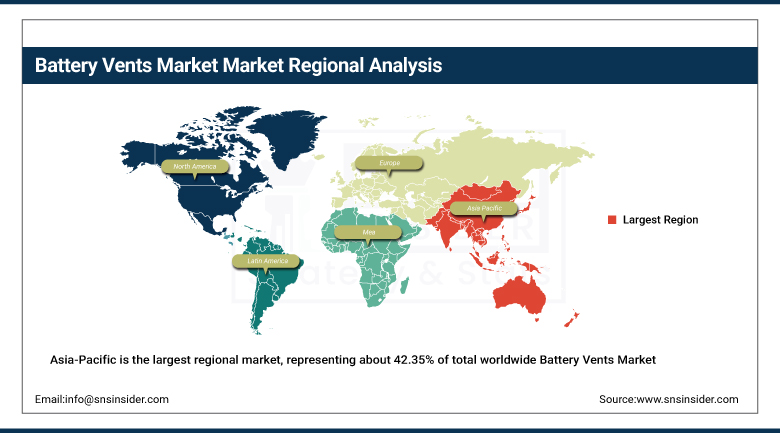
Asia-Pacific is the largest regional market, representing about 42.35% of total worldwide Battery Vents Market sales in 2025, owing to China’s dominance as the largest producer of electric vehicles and lithium-ion battery cells globally. China alone is responsible for almost 54.60% of total regional sales, owing to the clustering of pack assembly and membrane supplier manufacturing facilities in Ningbo, Shenzhen, and other filtration and materials science hubs. In addition, South Korea and Japan generate further demand due to their cell-manufacturing facilities. Furthermore, India’s two-wheelers and three-wheelers’ electric vehicle movement has resulted in the formation of a rapidly growing and price-sensitive vent segment.
Suppliers have been increasingly localizing their R&D and qualification capabilities in the region, as illustrated by Gore's establishment of its Battery Lab in Shanghai in November 2025. This localization has reduced the qualification period for the Chinese domestic battery makers, and has made Asia Pacific not only the largest consumption center but also a major vent development center in the region, as opposed to just being a production center of designs made elsewhere.
Get Customized Report as per Your Business Requirement - Enquiry Now
North America Battery Vents Market Insights
North America is the fastest-growing region, with Battery Vents Market revenue in the region projected to expand at a CAGR of 10.20% from 2026 to 2035, supported by sustained domestic gigafactory investment and federal and state incentives directed at electric vehicle and battery manufacturing. The United States accounts for approximately 82.40% of regional revenue, reflecting the concentration of new cell and pack assembly capacity in states such as Michigan, Georgia, and Tennessee, alongside a growing base of grid-scale energy storage installations.
Supplier capacity additions are tracking closely with this build-out: Freudenberg Sealing Technologies tripled production of its DIAvent HighFlow pressure-compensation element across U.S. and German sites in February 2024 after securing major new orders from American and Asian automotive groups. Canada's growing cell-manufacturing investments and Mexico's expanding role as a nearshored component supplier to U.S. assembly plants are further broadening the regional demand base beyond the United States alone.
Europe Battery Vents Market Insights
Europe ranks third in terms of regional market size with respect to the strict regulation on safety of the vehicle, in addition to the high density of the regional tier-one suppliers that design venting systems along with the battery pack designers. Germany is responsible for 27.85% of the regional market size due to the well-known filtration and sealing companies like MANN+HUMMEL and Freudenberg Sealing Technologies.
Regional demand is further shaped by the European Union's evolving battery safety and end-of-life regulations, which are pushing pack designers toward certified, traceable venting components. MANN+HUMMEL's continued expansion of its modular VentPlus system, first broadened at Battery Show Europe in Stuttgart, illustrates how regional suppliers are tailoring pressure-equalization designs to the specific housing geometries used by European passenger and commercial vehicle platforms.
MEA & Latin America Battery Vents Market Insights
The Middle East & Africa region remains a comparatively small but developing market, with Saudi Arabia accounting for approximately 31.20% of regional revenue as the country's electric vehicle assembly ambitions and renewable-energy storage projects begin to generate meaningful component demand. Growth here is closely tied to sovereign investment programs in domestic battery and vehicle assembly rather than organic consumer EV adoption, which remains at an early stage across most of the region.
Demand in Latin America is being driven by Brazil, which comprises approximately 45.75% of regional revenues due to investments in electric buses and batteries in the region's cities. The contribution of Mexico to the region's demand through its nearshoring position of supplying North America-bound vehicles should also be highlighted as one of the growing pockets of growth for venting suppliers in Latin America.
Market Dynamics
Growth Drivers: Rising Lithium-ion EV and Energy Storage Adoption
Drivers of Growth are based on the rapid rise in the use of lithium-ion battery packs in passenger vehicles, commercial fleets, and stationary storage that rely on qualified pressure-equalization and emergency gas-release valves not as a luxury but as a standard requirement for safety. With increasing energy density of the packs, the risks of non-qualified venting increase, and OEMs have to incorporate dual-stage venting into their design early in the process.
The tightening of regulations, which includes the transport safety regulations UN38.3 and China GB 38031 safety regulation on electric vehicles, is pushing battery packs manufacturers to rely solely on vent manufacturers that have proof of thorough testing for thermal runaway. These regulations will push more demand to vent manufacturers with testing capabilities, which includes having battery laboratories, compared to those who do not have such capabilities.
Restraints: Raw Material Cost Volatility and Qualification Barriers
Reinforcements are mainly due to the high cost and variability in supply of the fluoropolymer base material of the ePTFE and sintered PTFE membranes, which can impact supplier margins as well as make it difficult to enter into long-term pricing contracts with the OEM customers. Since the material comes from a handful of global suppliers of fluoropolymers, any disruption in this chain can rapidly manifest itself in vent lead times.
Long OEM qualification processes form another important constraint, since the introduction of any new vent design is going to necessitate comprehensive testing for thermal runaway, ingress protection, and durability before being specified for the vehicle program. The requirement for qualification testing works well for established suppliers, who have already done all of this testing and makes it harder for new suppliers to get into the game.
Opportunities: Stationary Storage Expansion and Two-Wheeler Electrification
Opportunities are expanding most rapidly in stationary energy storage, in which utility-scale and customer-side deployments are embracing automotive-quality venting technology faster than the vehicle market itself is growing, thereby creating an additional market that is not dependent on cyclical vehicle purchases. Manufacturers of automotive-quality technology who can scale their products to larger, containerized form factors will gain disproportionately.
Electrification of two- and three-wheelers throughout South and Southeast Asia provides a unique opportunity for vent designs that can be cost-optimized for smaller battery packs and sensitive manufacturing settings. Suppliers setting up local manufacturing and qualifying capabilities near these emerging manufacturing centers, as we've seen recently in India, will have an opportunity to capitalize on early mover advantage as these two-wheeler OEMs ramp up production.
Recent Developments:
-
In November 2025, W.L. Gore & Associates has set up a separate Battery Lab in Shanghai, China, to increase their research and development capacity on developing, evaluating, and testing venting, equalization, and thermal runaway mitigation materials for batteries. This lab will help in reducing the time it takes from prototype to commercial production for local EVs and energy storage battery customers through customized materials solutions.
-
In June 2024, Parker Hannifin’s Prädifa Technology Division has released CliPHvent, which represents a new breed of vent valves designed especially for EV battery enclosures. The release marks Parker Hannifin’s expansion of its range of seals and vents to the rapidly expanding electric vehicles market, catering to those looking for pressure-management solutions from a reputable motion-and-control company.
-
In May 2023, MANN+HUMMEL featured a range of battery components at Battery Show Europe in Stuttgart that includes new versions of the VentPlus pressure-balancing unit which provides additional housing mounting possibilities for automotive original equipment manufacturers (OEMs). The extension comes amid the Ludwigsburg-based filter manufacturer’s ongoing focus on developing venting technology for European EV enclosures.
-
In October 2025, At The Battery Show North America in Detroit, W. L. Gore & Associates launched its new dual-purpose evacuation vent and battery insulation technology designed to protect batteries from contamination and thermal runaway damage. The event was aimed at engineers working on advanced high-voltage battery systems.
-
In December 2025, Technology International Group has announced that it will build a manufacturing plant in Jarod, Vadodara, Gujarat, for expanding production of its PorVent and Biovent series of porous polymer venting products. This is in keeping with the company’s declared intention of increasing the manufacturing capacity of venting components in India for use both domestically and abroad.
Battery Vents Market Key Players
-
Donaldson Company, Inc.
-
W. L. Gore & Associates, Inc.
-
Freudenberg Sealing Technologies
-
Parker Hannifin Corporation (Prädifa Technology Division)
-
MANN+HUMMEL
-
Porex Corporation
-
Saint-Gobain
-
3M Company
-
DuPont de Nemours, Inc.
-
Sang-A Frontec Co., Ltd.
-
IPRO GmbH
-
Dongguan PUW ePTFE Material Co., Ltd.
-
SMJ Venture Private Ltd.
-
Dätwyler Holding Inc.
-
ElringKlinger AG
-
Kedal (Shenzhen) Technology Co., Ltd.
-
Trelleborg AB
-
Nitto Denko Corporation
-
Interplex Holdings Pte. Ltd.
-
Shin-Etsu Polymer Co., Ltd.
Battery Vents Market Report Scope:
| Report Attributes | Details |
|---|---|
| Market Size in 2025 | USD 238.60 Million |
| Market Size by 2035 | USD 552.03 Million |
| CAGR | 8.75% from 2026 to 2035 |
| Base Year | 2025 |
| Forecast Period | 2026-2035 |
| Historical Data | 2022-2024 |
| Report Scope & Coverage | Market Size, Segments Analysis, Competitive Landscape, Regional Analysis, DROC & SWOT Analysis, Forecast Outlook |
| Key Segments | • By Vehicle Type: Dominant – Passenger Vehicles (54.20% share in 2025); Fastest-Growing – Commercial Vehicles (CAGR 10.85%) • By Battery Type: Dominant – Lithium-ion (81.40% share in 2025); Fastest-Growing – Lithium-ion (CAGR 9.65%) • By Vent Type: Dominant – Passive/Pressure-Equalization Vents (58.30% share in 2025); Fastest-Growing – Dual-Stage Vents (CAGR 11.20%) • By Membrane Material: Dominant – ePTFE Membrane (62.75% share in 2025); Fastest-Growing – Sintered PTFE Membrane (CAGR 10.40%) • By Application: Dominant – Electric Passenger & Commercial Vehicles (71.60% share in 2025); Fastest-Growing – Stationary Energy Storage Systems (CAGR 12.30%) • By Sales Channel: Dominant – OEM (88.90% share in 2025); Fastest-Growing – Aftermarket (CAGR 9.50%) |
| Regional Analysis/Coverage | North America (US, Canada), Europe (Germany, UK, France, Italy, Spain, Russia, Poland, Rest of Europe), Asia Pacific (China, India, Japan, South Korea, Australia, ASEAN Countries, Rest of Asia Pacific), Middle East & Africa (UAE, Saudi Arabia, Qatar, South Africa, Rest of Middle East & Africa), Latin America (Brazil, Argentina, Mexico, Colombia, Rest of Latin America). |
| Company Profiles | Donaldson Company, Inc., W. L. Gore & Associates, Inc., Freudenberg Sealing Technologies, Parker Hannifin Corporation (Prädifa Technology Division), MANN+HUMMEL, Porex Corporation, Saint-Gobain, 3M Company, DuPont de Nemours, Inc., Sang-A Frontec Co., Ltd., IPRO GmbH, Dongguan PUW ePTFE Material Co., Ltd., SMJ Venture Private Ltd., Dätwyler Holding Inc., ElringKlinger AG, Kedal (Shenzhen) Technology Co., Ltd., Trelleborg AB, Nitto Denko Corporation, Interplex Holdings Pte. Ltd., Shin-Etsu Polymer Co., Ltd. |
Frequently Asked Questions
Leading suppliers include Donaldson Company, W. L. Gore & Associates, Freudenberg Sealing Technologies, Parker Hannifin's Prädifa Technology Division, MANN+HUMMEL, and Porex Corporation, alongside a broader group of specialized membrane and pressure-relief component manufacturers serving automotive and energy storage customers.
The largest opportunities lie in stationary energy storage system venting, where utility-scale deployments are adopting automotive-grade specifications, and in two- and three-wheeler electrification across South and Southeast Asia, which is opening demand for cost-optimized vent designs suited to smaller battery packs.
Growth is primarily driven by the accelerating adoption of lithium-ion battery packs across passenger and commercial electric vehicles and stationary storage, combined with tightening regulatory requirements such as UN38.3 and GB 38031 that mandate certified pressure-equalization and emergency gas-release components.
By Application, Electric Passenger & Commercial Vehicles dominate the Battery Vents Market with approximately 71.60% share in 2025, reflecting the scale of global EV production relative to other end uses such as stationary storage and industrial equipment.
Asia Pacific dominates the Battery Vents Market, accounting for approximately 42.35% of global revenue in 2025, driven by China's position as the world's largest producer of electric vehicles and lithium-ion battery cells.
