
Rubber Accelerator Market Report Scope & Overview:
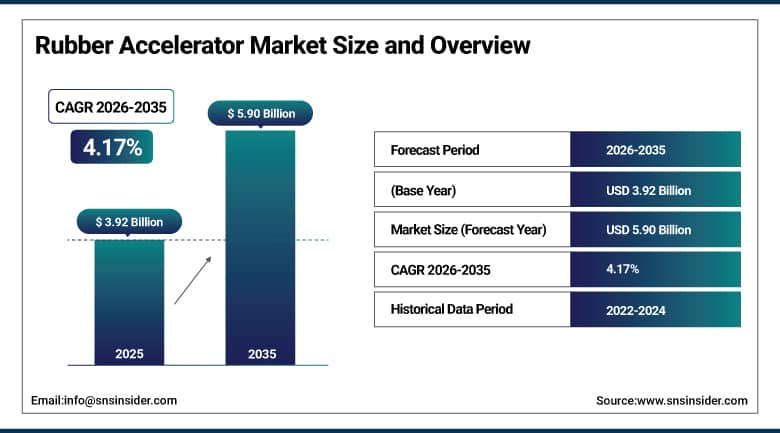
The Rubber Accelerator Market was valued at USD 3.92 Billion in 2025 and is expected to reach USD 5.90 Billion by 2035, growing at a CAGR of 4.17% from 2026-2035.
The Rubber accelerators Market are special chemicals that act as catalysts in the process of the cross-linking of sulfur molecules between vulcanising agents and rubber molecules, reducing vulcanisation time, the temperature required for vulcanisation, and enabling producers to determine with exactness the final physical characteristics of the rubber end product. In the absence of rubber accelerators, vulcanising the rubber would be a much more time-consuming and energy-intensive process, making them an essential, albeit often overlooked, ingredient behind many rubber goods in use today. The market will be driven by increased production of tires globally, increased demand for high-performing rubber goods by the automotive industry, and growing use of vulcanised rubber in industrial hoses, seals, conveyor belts, and medical devices.
In November 2025, LANXESS completed an expansion of two production lines at its Rhein Chemie site in Qingdao, China, marking the company's largest investment in the rubber additives sector globally in the past five years, boosting production capacity for processing promoters and polymer-bound rubber chemicals by 50 percent alongside a comprehensive green upgrade across the site's entire value chain.
To Get More Information On Rubber Accelerator Market - Request Free Sample Report
Rubber Accelerator Market Trends:
-
Rising investment in bio-based and sustainable accelerator formulations reducing reliance on fossil-derived chemistry.
-
Growing regional manufacturing capacity expansion reducing dependence on longer international supply chains.
-
Expanding demand for low-nitrosamine, medical-grade accelerator chemistry suited to healthcare applications.
-
Increasing focus on polymer-bound and dust-free accelerator formats improving workplace handling safety.
-
Rising raw material price volatility prompting manufacturers to pursue backward integration strategies.
-
Growing environmental regulation continuing to phase out legacy accelerator chemistries in favour of safer alternatives.
U.S. Rubber Accelerator Market Overview:
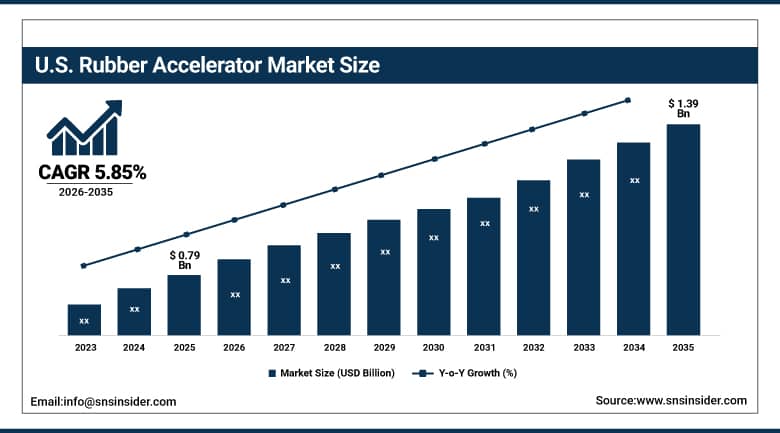
The U.S. Rubber Accelerator Market was valued at USD 0.79 Billion in 2025 and is expected to reach USD 1.39 Billion by 2035, growing at a CAGR of 5.85% from 2026-2035.
The U.S. Rubber Accelerator Market experiences favorable conditions due to high volume of automotive and tire manufacturing activity in the region, increasing demand for industrial rubber products in the construction, mining, and manufacturing industries, and continuous investment by major specialty chemicals companies in capacities to increase their manufacturing presence within the market to ensure the reliability of supplies to their customers. Major rubber accelerators producers are continuing to build up their manufacturing capacities to address rising demand for their products in the automotive, pharmaceutical, and industrial rubber products sectors, eliminating dependence on imported rubber accelerator chemistry previously observed and ensuring reliable supplies of their products to tire and rubber products manufacturers. The increase in the use of rubber products in medical devices and the healthcare sector is adding a true differentiating factor to the industry demand base that goes beyond the existing tire and industrial products core.
On September 5, 2025, LANXESS announced an expansion of rubber processing promoter production at its Bushy Park facility in Goose Creek, South Carolina, with new production capacity, including its Aflux and Aktiplast product lines, becoming operational in November 2025 to meet increasing demand and improve supply reliability for automotive, pharmaceutical, and industrial rubber product customers.
Rubber Accelerator Market Segment Analysis:
-
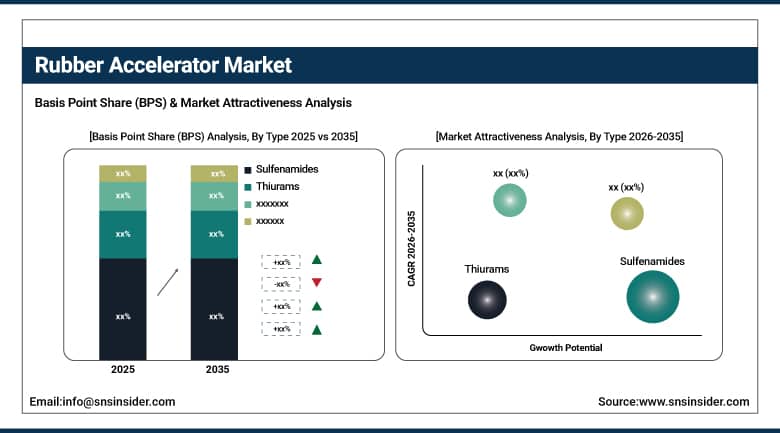
By Type, the Sulfenamides segment dominated the market with a 58.70% share in 2025, while the Sulfenamides segment is the fastest growing with a CAGR of 5.40% during 2026-2035.
-
By Application, the Tires segment dominated the market with a 68.75% share in 2025, while the Industrial Rubber Products segment is the fastest growing with a CAGR of 5.85% during 2026-2035.
-
By Rubber Type, the Synthetic Rubber segment dominated the market with a 61.40% share in 2025, while the Natural Rubber segment is the fastest growing with a CAGR of 5.65% during 2026-2035.
-
By End-User Industry, the Automotive segment dominated the market with a 64.85% share in 2025, while the Healthcare segment is the fastest growing with a CAGR of 6.25% during 2026-2035.
By Type, Sulfenamides Dominates the Market and Sulfenamides Grows Fastest
Sulfenamides dominated the market in 2025 with a 58.70% share. This accelerator class, including widely used grades such as CBS and TBBS, continues to represent the industry standard for tire manufacturing given the favourable balance of delayed action, processing safety, and final cure properties these chemistries deliver, and this established position across the largest single rubber accelerator application continues to anchor sulfenamides as the clear leading type category by a considerable margin over every alternative chemistry.
Sulfenamides are also expected to grow fastest over the forecast period, registering a CAGR of 5.40%, as continued tire industry growth and rising demand for high-performance, precisely controlled vulcanisation continue to reinforce this chemistry class's already dominant position even further. Manufacturers continue to invest most heavily in sulfenamide product line expansion and formulation improvement given the category's outsized importance to their largest customer base, positioning sulfenamides for sustained above-market growth relative to the broader accelerator type mix.
By Application, Tires Dominates the Market and Industrial Rubber Products Grows Fastest
Tires dominated the market in 2025 with a 68.75% share. The sheer scale of global tire production, spanning passenger vehicles, commercial trucks, and off-road equipment, continues to represent the largest single consumer of rubber accelerator chemistry worldwide, and rising vehicle production combined with steady replacement tire demand continues to anchor tires as the clear leading application category across the broader rubber accelerator market.
Industrial rubber products are projected to be the fastest-growing application over the forecast period, registering a CAGR of 5.85%, as expanding use of vulcanised rubber across industrial hose, sealing, and conveyor belt applications continues to widen demand beyond the sector's traditional tire manufacturing stronghold. Rising industrial and infrastructure investment worldwide continues to drive above-market growth for this application relative to the broader tire-dominated application mix.
By Rubber Type, Synthetic Rubber Dominates the Market and Natural Rubber Grows Fastest
Synthetic rubber dominated the market in 2025 with a 61.40% share. It has been observed that the major share of the world’s rubber usage today is done through synthetics rubber, especially in the production of tires where synthetics rubber provides superior and controllable properties compared to natural rubber and the existing preference keeps synthetics rubber the largest type of rubber.
Natural rubber is projected to be the fastest-growing rubber type over the forecast period, registering a CAGR of 5.65%, as rising demand for sustainable, bio-based tire and rubber product manufacturing continues to renew interest in natural rubber formulations among manufacturers seeking to reduce their reliance on petroleum-derived synthetic alternatives. Continued growth in sustainability-focused tire and rubber product development continues to drive above-market growth for natural rubber-compatible accelerator chemistry relative to the broader synthetic-dominated rubber type mix.
By End-User Industry, Automotive Dominates the Market and Healthcare Grows Fastest
Automotive dominated the market in 2025 with a 64.85% share. The industry's direct linkage to tire manufacturing, combined with substantial demand for rubber seals, hoses, and vibration dampening components used throughout modern vehicles, continues to anchor automotive as the largest end-user industry category across the broader rubber accelerator market by a considerable margin over every alternative sector.
Healthcare is projected to be the fastest-growing end-user industry over the forecast period, registering a CAGR of 6.25%, as rising demand for medical devices, gloves, and other rubber-based healthcare products continues to require specialised, low-nitrosamine accelerator chemistry suited to stringent biocompatibility requirements. Continued growth in global healthcare infrastructure and medical device manufacturing continues to drive above-market growth for this end-user industry relative to the broader automotive-dominated end-user mix.
Regional Analysis:
|
Region |
Major Country |
Share within Region, 2025 |
|
Asia Pacific |
China |
41.65% |
|
North America |
United States |
81.90% |
|
Europe |
Germany |
25.90% |
|
Latin America |
Brazil |
20.65% |
|
Middle East & Africa |
United Arab Emirates |
18.40% |
Asia Pacific Rubber Accelerator Market Insights
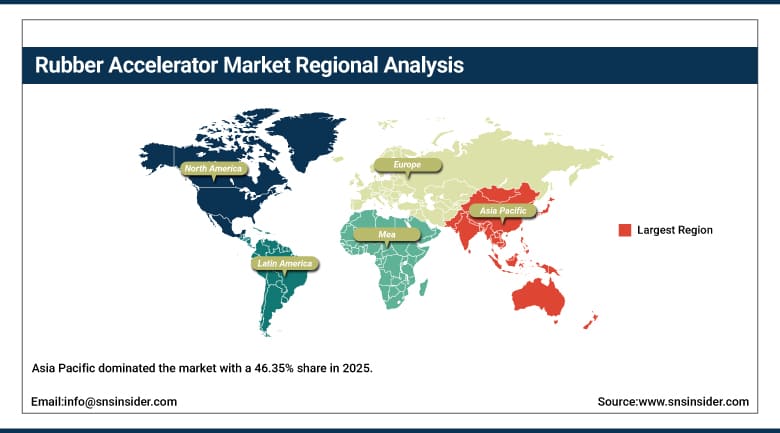
Asia Pacific dominated the market with a 46.35% share in 2025. The region's position as the world's largest tire and rubber product manufacturing base, combined with substantial domestic accelerator production capacity across several major regional economies, continues to anchor this leadership position across every major accelerator type and application category.
China anchors regional demand through its substantial domestic tire manufacturing base and a well-established network of local accelerator producers serving both domestic and export markets. India contributes significant regional growth as domestic tire and industrial rubber production continues to expand, while Japan and South Korea add further regional depth through established automotive and specialty chemical manufacturing sectors.
Get Customized Report as Per Your Business Requirement - Enquiry Now
North America Rubber Accelerator Market Insights
North America is projected to be the fastest-growing region over the forecast period, registering a CAGR of approximately 5.85%. Substantial tire and automotive manufacturing activity, combined with continued capacity investment by leading specialty chemical producers expanding production within the region, continues to accelerate regional adoption of advanced rubber accelerator chemistry.
The United States accounts for the substantial majority of regional demand, driven by sustained automotive production and growing industrial rubber product manufacturing. Canada contributes additional regional demand through its own automotive and industrial manufacturing sectors, and continued capacity expansion is expected to sustain the region's above-average growth trajectory through the forecast period.
Europe Rubber Accelerator Market Insights
Europe holds a significant share of the global market, anchored by Germany's substantial automotive manufacturing base and its position as home to several of the world's leading specialty rubber chemical producers with deep formulation and research capability built over decades of serving demanding automotive and industrial customers.
France, Italy, and other major European automotive markets contribute consistent regional demand as national tire and rubber product manufacturers continue extending advanced accelerator chemistry adoption. Continued European regulatory emphasis on safer, more sustainable accelerator chemistries is expected to sustain steady growth in reformulated product adoption across the broader regional market through the forecast period.
MEA and Latin America Rubber Accelerator Market Insights
The Middle East and Africa region is supported by growing industrial and automotive manufacturing investment across the United Arab Emirates and Saudi Arabia, where regional economic diversification strategies continue to expand domestic industrial and rubber product manufacturing capability.
Latin America is anchored by Brazil, where a substantial domestic tire and automotive manufacturing sector sustains steady rubber accelerator demand. Mexico contributes further incremental growth given its deep integration into North American automotive supply chains and its growing role as a manufacturing base for tires and rubber components destined for both domestic and export markets.
Market Dynamics:
Growth Drivers: Tire Production Growth and Industrial Rubber Demand
Rising global tire production volumes stand as the primary growth driver, as accelerating automotive sector demand for high-performance rubber compounds continues to require increasingly sophisticated accelerator chemistry capable of delivering precise, consistent vulcanisation across an expanding range of tire specifications and performance requirements. Continued global vehicle production growth, combined with steady replacement tire demand, continues to sustain a large and dependable base of underlying accelerator demand.
Expanding use of vulcanised rubber across industrial hose, sealing, conveyor belt, and medical device applications represents a second major driver, as these applications continue to widen accelerator demand well beyond the category's traditional tire manufacturing stronghold. Continued industrial and infrastructure investment worldwide, alongside growing medical device manufacturing activity, further reinforces sustained market demand across an increasingly diverse range of end-use applications.
Restraints: Raw Material Price Volatility and Environmental Regulation
Fluctuating raw material prices remain a genuine restraint, as accelerator production depends on a range of specialty chemical inputs whose pricing can vary considerably, adding cost pressure that manufacturers must balance against competitive pricing expectations from tire and rubber product customers operating in a genuinely price-sensitive commodity industry.
Stringent environmental regulations present a further restraint, as tightening rules governing certain legacy accelerator chemistries, particularly those associated with nitrosamine formation, continue to require manufacturers to invest in reformulation and compliance, adding cost and complexity relative to established, already-qualified product lines that customers have relied on for years.
Opportunities: Sustainable Formulation Development and Regional Capacity Expansion
Continued development of bio-based and sustainable accelerator formulations represents a substantial opportunity, as manufacturers that can deliver genuinely more environmentally responsible chemistry while maintaining the vulcanisation performance tire and rubber product manufacturers require stand to capture demand from customers increasingly prioritising sustainability credentials alongside cost and technical performance.
The continued growth in the region’s manufacturing capabilities will be another opportunity, especially for those companies able to set up manufacturing operations close to large markets for cars and other manufacturing industries. Such companies will find demand in consumers looking for reliable supplies and are therefore keen to reduce reliance on international supply lines.
Recent Developments:
-
On September 5, 2025, LANXESS announced an expansion of rubber processing promoter production at its Bushy Park facility in Goose Creek, South Carolina, with new capacity becoming operational in November 2025.
-
In November 2025, LANXESS completed a major capacity expansion at its Rhein Chemie site in Qingdao, China, boosting production of processing promoters and polymer-bound rubber chemicals by 50 percent, its largest rubber additives investment globally in five years.
-
In 2025, Sumitomo Chemical announced a significant expansion of its specialty chemicals plant in Japan, increasing capacity for aromatic amines used in accelerator production to meet rising global automotive and industrial rubber demand.
-
Throughout 2025 and 2026, major players including ExxonMobil and Sumitomo Chemical continued investing in bio-based accelerator research aimed at reducing reliance on fossil fuels and hazardous chemicals in rubber vulcanisation chemistry.
Rubber Accelerator Market Key Players:
-
Lanxess AG
-
Eastman Chemical Company
-
Sumitomo Chemical Co., Ltd.
-
Akrochem Corporation
-
Shandong Sunsine Chemical Co., Ltd.
-
Zhejiang Wynca Chemical Industry Group Co., Ltd.
-
NOCIL Limited
-
PMC Group
-
Kumho Petrochemical Co., Ltd.
-
Puyang Willing Chemicals Co., Ltd.
-
Arkema S.A.
-
China Sunsine Chemical Holdings Ltd.
-
Solvay S.A.
-
Rhein Chemie (Lanxess)
-
King Industries, Inc.
-
Jiangsu Sinorgchem Technology Co., Ltd.
-
Wuhu Huaxing Chemical Industry Co., Ltd.
-
Shandong Yanggu Huatai Chemical Co., Ltd.
-
Henan Kailun Chemical Co., Ltd.
-
Weifang Xinlianxin Chemical Co., Ltd.
Rubber Accelerator Market Report Scope:
| Report Attributes | Details |
|---|---|
| Market Size in 2025 | USD 3.92 Billion |
| Market Size by 2035 | USD 5.90 Billion |
| CAGR | CAGR of 4.17% From 2026 to 2035 |
| Base Year | 2025 |
| Forecast Period | 2026-2035 |
| Historical Data | 2022-2024 |
| Report Scope & Coverage | Market Size, Segments Analysis, Competitive Landscape, Regional Analysis, DROC & SWOT Analysis, Forecast Outlook |
| Key Segments | • By Type (Sulfenamides, Thiazoles, Thiurams, Guanidines & Dithiocarbamates) • By Application (Tires, Industrial Rubber Products, Footwear, Medical Devices & Consumer Goods) • By Rubber Type (Synthetic Rubber & Natural Rubber) • By End-User Industry (Automotive, Industrial, Healthcare & Consumer Goods) |
| Regional Analysis/Coverage | North America (US, Canada), Europe (Germany, UK, France, Italy, Spain, Russia, Poland, Rest of Europe), Asia Pacific (China, India, Japan, South Korea, Australia, ASEAN Countries, Rest of Asia Pacific), Middle East & Africa (UAE, Saudi Arabia, Qatar, South Africa, Rest of Middle East & Africa), Latin America (Brazil, Argentina, Mexico, Colombia, Rest of Latin America). |
| Company Profiles | Lanxess AG, Eastman Chemical Company, Sumitomo Chemical Co., Ltd., Akrochem Corporation, Shandong Sunsine Chemical Co., Ltd., Zhejiang Wynca Chemical Industry Group Co., Ltd., NOCIL Limited, PMC Group, Kumho Petrochemical Co., Ltd., Puyang Willing Chemicals Co., Ltd., Arkema S.A., China Sunsine Chemical Holdings Ltd., Solvay S.A., Rhein Chemie (Lanxess), King Industries, Inc., Jiangsu Sinorgchem Technology Co., Ltd., Wuhu Huaxing Chemical Industry Co., Ltd., Shandong Yanggu Huatai Chemical Co., Ltd., Henan Kailun Chemical Co., Ltd., Weifang Xinlianxin Chemical Co., Ltd. |
Frequently Asked Questions
Key players include Lanxess AG, Eastman Chemical Company, Sumitomo Chemical Co., Ltd., Akrochem Corporation, and Shandong Sunsine Chemical Co., Ltd., among other specialty chemical manufacturers.
Continued development of bio-based and sustainable accelerator formulations and continued regional manufacturing capacity expansion represent the primary opportunities.
Growth is primarily driven by rising global tire production volumes, combined with expanding use of vulcanised rubber across industrial and medical applications.
By Type, Sulfenamides dominated the market with a 58.70% share in 2025, reflecting their favourable processing safety and cure properties for tire manufacturing.
Asia Pacific dominated the market with a 46.35% share in 2025, supported by the region's position as the world's largest tire and rubber product manufacturing base.
