
N-Vinylformamide Market Report Scope & Overview:
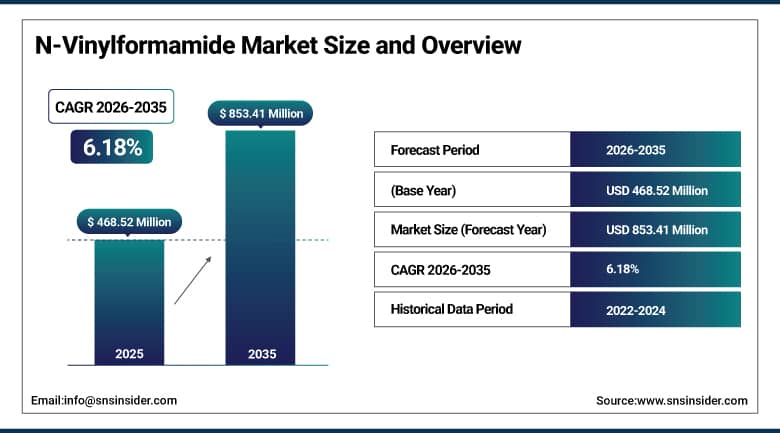
The N-Vinylformamide Market was valued at USD 468.52 Million in 2025 and is projected to reach USD 853.41 Million by 2035, growing at a CAGR of 6.18% during 2026–2035.
The N-Vinylformamide Market is expanding steadily as paper mills, water utilities, and specialty polymer formulators look for water-soluble chemistries with high primary amine density. NVF is mainly converted into poly(N-vinylformamide) and then selectively hydrolyzed into polyvinylamine, a cationic polymer that improves retention, drainage, and dry strength at the wet end. Recycled-fiber packaging, stricter effluent limits, and low-VOC adhesive formulations are widening the demand base. Supply has long been concentrated around Japanese technology, but new European capacity is now changing procurement patterns, while ultra-pure grades are entering membrane and battery uses.
SNF and Mitsubishi Chemical confirmed in March 2025 that the N-vinylformamide plant at SNF’s Flocryl site in Dunkirk, France, was fully operational following its December 2024 start-up. The unit applies Mitsubishi Chemical’s proprietary process to produce NVF polymers and PVAm derivatives for paper and water treatment customers, giving European mills a local, integrated monomer-to-polymer supply route and reducing their reliance on long-haul Asian imports.
To Get More Information On N-Vinylformamide Market - Request Free Sample Report
N-Vinylformamide Market Trends:
-
Integrated NVF-to-PVAm production is expanding outside Japan to secure regional supply.
-
Dry-powder PVAm delivery with on-site dissolution is cutting freight and carbon costs.
-
Recycled-fiber packaging grades are lifting demand for multifunctional wet-end strength additives.
-
High-purity NVF is gaining traction in carbon-capture membranes and redox flow batteries.
-
Water-soluble polymer leaders are acquiring oilfield chemical assets to broaden recovery portfolios.
-
Low-VOC waterborne adhesives and coatings are adopting NVF copolymers for mixed-material bonding.
U.S. N-Vinylformamide Market Outlook:
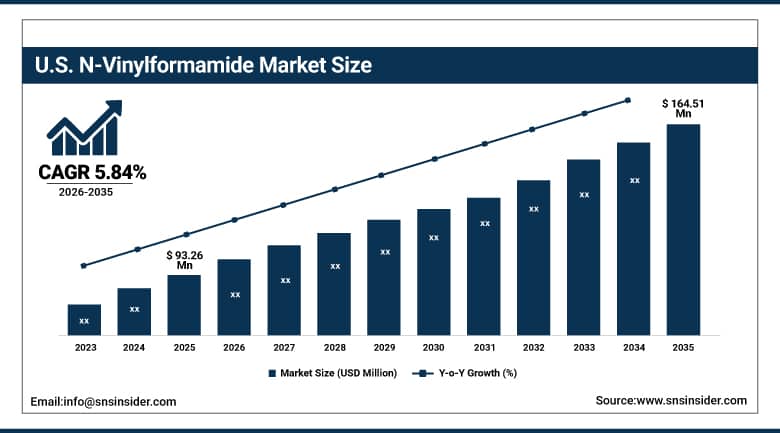
The U.S. N-Vinylformamide Market was valued at USD 93.26 Million in 2025 and is projected to reach USD 164.51 Million by 2035, growing at a CAGR of 5.84% during 2026–2035.
The U.S. N-Vinylformamide Market is supported by one of the world’s largest containerboard and tissue production bases, where mills in the Southeast and Midwest rely on PVAm programs to raise strength while running higher recycled content. Solenis, headquartered in Wilmington, Delaware, anchors the Xelorex PVAm franchise, and its dry-powder Xelorex Plus format is reducing shipping volumes for inland mills. Municipal wastewater upgrades under federal infrastructure funding, produced-water treatment in the Permian Basin, add further volume. Stricter handling rules for acute-toxic monomers, however, are pushing many U.S. users toward pre-hydrolyzed polymer solutions.
In January 2024, Solenis announced a USD 193 million expansion in Suffolk, Virginia, covering a new 80,000-square-foot production facility, a packaging facility, a tank farm, and a rail spur built to support polyvinylamine polymer production. The project, expected to create 34 jobs, adds U.S. capacity for paper and cardboard applications and positions Solenis to diversify PVAm into additional end markets.
N-Vinylformamide Market Segment Analysis:
-
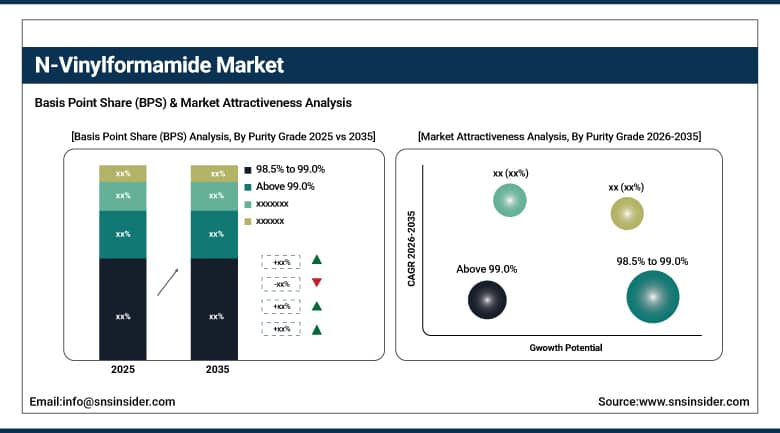
By Purity Grade, the 98.5% to 99.0% segment dominated the N-Vinylformamide Market with 56.14% share in 2025, while the Above 99.0% segment is the fastest growing with a CAGR of 6.87%.
-
By Product Type, the Polyvinylamine (PVAm) Derivatives segment dominated the N-Vinylformamide Market with 44.36% share in 2025, while the NVF Copolymers segment is the fastest growing with a CAGR of 7.12%.
-
By Application, the Paper Processing segment dominated the N-Vinylformamide Market with 28.47% share in 2025, while the Water Treatment segment is the fastest growing with a CAGR of 7.29%.
-
By End-Use Industry, the Pulp & Paper segment dominated the N-Vinylformamide Market with 34.62% share in 2025, while the Municipal & Industrial Water Treatment segment is the fastest growing with a CAGR of 7.08%.
By Purity Grade, Standard 98.5%–99.0% NVF Leads as Ultra-Pure Grades Accelerate
The 98.5% to 99.0% grade dominated the N-Vinylformamide Market in 2025, since it falls within the residual monomer specifications for large volume paper, municipal water, and adhesive applications without the need to distill as required by premium quality. It is also where the mills and flocculants manufacturers purchase their products using long-term contractual agreements, and where the formulation of the polymerization process is based on the impurities that are contained in the product.
The Above 99.0% grade is the fastest-growing segment, supported by formulators who need tighter control over amine availability for downstream functionalization. Carbon-capture membrane developers, redox flow battery researchers, and gene-delivery polymer programs require consistent molecular weight and minimal side products, which lower-purity monomer cannot reliably deliver. Specialty adhesive and coating producers also value the cleaner performance in low-VOC waterborne systems. As these applications move from pilot to commercial scale, suppliers with high-purity distillation capability are gaining pricing power.
By Product Type, PVAm Derivatives Hold the Lead While NVF Copolymers Advance Fastest
Polyvinylamine (PVAm) derivatives dominated the N-Vinylformamide Market in 2025, as most commercial NVF is ultimately consumed after hydrolysis into cationic polymers for papermaking and wastewater treatment. A single PVAm program can deliver dry strength, retention, drainage, and charge control, allowing mills to consolidate several additives. Solenis’ Xelorex line and SNF’s Dunkirk derivatives illustrate how value accrues at the derivative stage. Buyers also prefer ready-to-use solutions, since they avoid the storage and handling requirements attached to the raw monomer.
NVF copolymers are the fastest-growing product type, as formulators combine NVF with acrylamide, vinyl acetate, and other comonomers to tune charge density, hydrophobicity, and film behavior. These materials are finding use in waterborne adhesives, textile sizing, hair-care fixatives, and viscosity modifiers for saline oil reservoirs. Copolymer architecture lets suppliers command a premium over homopolymers, and patent activity around modified PVAm networks for membranes is broadening the technical pipeline.
By Application, Paper Processing Anchors Demand as Water Treatment Gains Momentum
Paper Processing dominated the N-Vinylformamide Market in 2025, as PVAm is considered one of the most effective wet-end additives for recycled containerboard, tissue, and specialty papers. Increase in the amount of recycled fiber content lowers sheet strength, while PVAm helps by binding fibers and fines through hydrogen and ionic bonds. Growth in demand for packaging from e-commerce and plastics substitution regulations will ensure that the usage will remain central.
Water Treatment is the fastest-growing application, supported by tightening discharge limits for municipal plants and industrial effluent in chemicals, mining, textiles, and food processing. PVAm-based flocculants achieve effective removal of colloids and metal complexes at lower dosages than many conventional polyacrylamides of similar molecular weight. They also support membrane bioreactor pretreatment by reducing colloidal membrane fouling. Infrastructure programs across China, India, and Southeast Asia, along with produced-water management in oil basins, are expanding the addressable volume for NVF-derived chemistries.
By End-Use Industry, Pulp & Paper Dominates as Water Treatment Operators Scale Up Usage
Pulp & Paper dominated the N-Vinylformamide Market in 2025, reflecting the industry’s long history of using PVAm as a dry-strength and retention agent since the chemistry was commercialized in the 1990s. Large integrated producers operate continuous machines where small gains in runnability translate into significant cost savings, which justifies premium additives. Containerboard mills processing old corrugated containers are the heaviest users. Chemical suppliers also embed technical service teams at mills, which strengthens customer retention and supports stable repeat demand.
Municipal & Industrial Water Treatment is the fastest-growing end-use industry, as operators seek high-charge-density polymers that perform in difficult, high-turbidity streams. Chemical and pharmaceutical effluent in Germany’s Rhine-Ruhr corridor, mining tailings in South Africa, and desalination pretreatment in the Gulf are all creating demand for advanced coagulants. Consolidation among water-chemical suppliers is also expanding sales reach into mid-market industrial accounts, helping NVF-derived products move beyond traditional paper-focused distribution channels into broader service contracts.
Regional Analysis:
|
Region |
Major Country |
Share within Region, 2025 (%) |
|---|---|---|
|
North America |
United States |
78.46% |
|
Europe |
Germany |
27.83% |
|
Asia Pacific |
China |
41.27% |
|
Middle East & Africa |
Saudi Arabia |
36.52% |
|
Latin America |
Brazil |
48.19% |
Asia Pacific N-Vinylformamide Market Insights
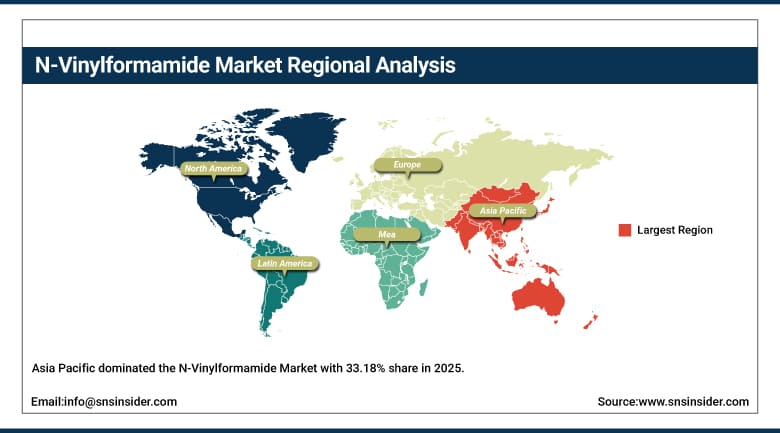
Asia Pacific dominated the N-Vinylformamide Market with 33.18% share in 2025 and is also the fastest-growing region, expanding at a CAGR of 7.14% during 2026–2035. China drives regional volume through the world’s largest paper and board output and a rapid build-out of municipal and industrial wastewater treatment capacity. Japan remains the technology base, with Mitsubishi Chemical having commercialized NVF synthesis in 1993, while Japanese and South Korean research programs push high-purity grades into carbon-capture membranes and energy-storage materials.
India is emerging as a significant growth market, as packaging paper capacity rises and river-cleanup programs raise demand for effective flocculants. ASEAN industrial parks in Vietnam, Indonesia, and Thailand are tightening wastewater norms, creating new outlets for PVAm-based coagulants. Lower-cost Chinese monomer producers compete aggressively in the standard grade, keeping regional pricing sharp, while multinational suppliers focus on premium grades and service-led contracts with large integrated mills.
Get Customized Report as Per Your Business Requirement - Enquiry Now
North America N-Vinylformamide Market Insights
North America demonstrated strong growth in the N-Vinylformamide Market in 2025, supported by a large recycled containerboard base, advanced municipal water systems, and a strong specialty adhesives sector. The United States dominates regional consumption, with Solenis expanding PVAm production in Suffolk, Virginia, and SNF strengthening its Texas oilfield chemical presence through the Obsidian acquisition. Demand is concentrated in Southeastern paper mills, Gulf Coast chemical plants, and Permian Basin produced-water operations, where high-charge-density polymers are valued for performance in challenging conditions.
Canada contributes through pulp and paper operations in Quebec and British Columbia, where mills are shifting toward packaging grades that require wet-end strength programs. Mexico’s demand is linked to expanding corrugated packaging for export manufacturing and to industrial wastewater compliance in Nuevo León and the Bajío corridor.
Europe N-Vinylformamide Market Insights
Europe showed strong demand in the N-Vinylformamide Market in 2025, shaped by high recycling rates, strict effluent standards, and new local monomer supply from Dunkirk. SNF’s Flocryl site serves European paper and water customers with integrated NVF and PVAm production based on Mitsubishi Chemical technology, reducing lead times previously dependent on Asian imports. The EU’s packaging and packaging waste rules are encouraging mills to increase recycled content, supporting demand for effective strength additives.
Germany leads regional demand, supported by its large paper industry and chemical and pharmaceutical effluent treatment along the Rhine-Ruhr corridor. France, Finland, Sweden, and Italy add volume through board and tissue production, while BASF’s Lupamin heritage and Solenis’ European mill service network keep technical know-how concentrated in the region. REACH compliance and worker-safety obligations raise handling costs, favoring suppliers able to deliver pre-hydrolyzed solutions and consistent documentation.
Middle East & Africa and Latin America N-Vinylformamide Market Insights
Middle East & Africa showed growing demand in the N-Vinylformamide Market in 2025, driven by desalination pretreatment, produced-water management, and mining effluent treatment. Saudi Arabia leads regional usage, while the UAE is gaining relevance as ADNOC and SNF explore expanded enhanced oil recovery development involving local chemical manufacturing. South Africa’s mining sector uses high-performance flocculants for tailings and metal-laden water, supported by supplier portfolios such as the Magnafloc and Rheomax lines now owned by Solenis.
Latin America demonstrated steady demand in the N-Vinylformamide Market in 2025, with Brazil anchoring consumption through its export-oriented pulp industry and growing corrugated packaging segment. Brazilian mills are adopting PVAm retention aids to improve quality in higher-value grades, while Argentina’s Vaca Muerta shale activity supports polymer demand for petroleum recovery. Regional supply relies largely on imports from North American, European, and Asian producers, leaving buyers exposed to freight costs and currency fluctuations.
Market Dynamics:
Growth Drivers: Recycled-fiber papermaking and tighter effluent rules sustaining polymer demand
Rising recycled-fiber use in packaging is the core driver of the N-Vinylformamide Market, since each recycling loop shortens fibers and weakens sheet strength. PVAm offers mills a way to restore strength, improve retention, and speed drainage with a single chemistry, reducing additive complexity. E-commerce shipping volumes and policies replacing plastic packaging with paper continue to lift containerboard output, particularly in China, Europe, and North America, keeping wet-end chemical spending on a steady upward path.
Tightening wastewater regulation adds a second, fast-expanding demand layer. Municipal plants and industrial sites in chemicals, mining, and oil and gas are being required to remove finer solids and metal complexes, favoring high-charge-density PVAm flocculants. Consolidation among water-chemical suppliers, including Solenis’ acquisition of NCH, is widening market reach into mid-sized industrial customers. Together, these forces diversify NVF demand beyond paper and reduce exposure to cyclical board production.
Restraints: Hazard classification and feedstock volatility limiting monomer economics
NVF is classified as an acute toxic substance under several chemical safety frameworks, requiring strict labeling, storage controls, worker training, and transport documentation. These obligations raise costs for smaller producers and distributors and discourage some users from handling the raw monomer on site. Hydrolysis and storage also demand careful temperature and pH control, since off-specification batches can degrade polymer performance, which limits the number of qualified converters in the supply chain.
Feedstock exposure is another constraint, as NVF synthesis depends on formamide and acetylene, both tied to energy and ammonia pricing. Sharp input-cost increases compress margins in the standard grade, where Chinese suppliers compete aggressively on price. Concentrated production technology, historically centered on a few licensors, has also limited supply diversification. Although new European capacity is easing this issue, buyers still face longer qualification cycles when switching monomer sources.
Opportunities: Carbon-capture membranes and energy-storage polymers opening premium applications
Functional membranes represent a promising opportunity for high-purity NVF. PVAm-based facilitated-transport membranes have shown strong CO₂/N₂ selectivity in published research, and porous PVAm sorbents are being developed for direct air capture with low-temperature regeneration. As industrial decarbonization programs scale, demand for cost-effective amine-rich polymers could create a premium outlet far removed from commodity paper chemistry, rewarding suppliers able to guarantee tight specifications.
Energy storage and biomedicine add further upside. PVAm layers are being studied in anion exchange membranes that limit vanadium-ion crossover in redox flow batteries, while low-cytotoxicity PVAm derivatives are under investigation for nucleic acid delivery. Dry-powder PVAm logistics and on-site generation systems also create service-based revenue opportunities. Suppliers that pair monomer purity with formulation support are best placed to convert these developments into commercial contracts.
Recent Developments:
-
In January 2026, Syensqo finalized the sale of its Oil & Gas division to SNF Group at an enterprise value of €135 million, following the agreement signed in October 2025. The transaction strengthens SNF’s specialty polymer offering for petroleum recovery applications.
-
In November 2025, Solenis completed its acquisition of NCH Corporation, expanding into an enterprise operating in more than 160 countries with approximately 23,000 employees. The deal widens Solenis’ access to middle-market industrial water treatment customers.
-
In August 2025, SNF announced the acquisition of Obsidian Chemical Solutions LLC of Midland, Texas, a provider of completion chemicals and produced water treatment formulations serving the Permian Basin. The move adds bulk storage and manufacturing capacity close to U.S. oilfield customers.
-
In May 2026, ADNOC and SNF were reported to be exploring expanded enhanced oil recovery development in the UAE, including local chemical manufacturing. The initiative could establish regional production of water-soluble polymers for reservoir applications.
-
In November 2024, BASF completed the divestiture of its mining flocculants business to Solenis, including the Magnafloc, Rheomax, and Alclar product lines. The transfer sharpened BASF’s portfolio focus while consolidating solid-liquid separation chemistries under Solenis.
N-Vinylformamide Companies are:
-
Mitsubishi Chemical Group Corporation
-
SNF Group
-
BASF SE
-
Solenis LLC
-
Evonik Industries AG
-
Eastman Chemical Company
-
Wacker Chemie AG
-
Nippon Shokubai Co., Ltd.
-
Kemira Oyj
-
Ecolab Inc.
-
Merck KGaA
-
Thermo Fisher Scientific Inc.
-
Tokyo Chemical Industry Co., Ltd.
-
Avantor, Inc.
-
Santa Cruz Biotechnology, Inc.
-
Kuraray Co., Ltd.
-
Arakawa Chemical Industries, Ltd.
-
Seiko PMC Corporation
-
Harima Chemicals Group, Inc.
-
Kurita Water Industries Ltd.
N-Vinylformamide Market Report Scope:
|
Report Attributes |
Details |
|---|---|
|
Market Size in 2025 |
USD 468.52 Million |
|
Market Size by 2035 |
USD 853.41 Million |
|
CAGR |
CAGR of 6.18% From 2026 to 2035 |
|
Base Year |
2025 |
|
Forecast Period |
2026-2035 |
|
Historical Data |
2022-2024 |
|
Report Scope & Coverage |
Market Size, Segments Analysis, Competitive Landscape, Regional Analysis, DROC & SWOT Analysis, Forecast Outlook |
|
Key Segments |
• By Purity Grade (98.5% to 99.0% & Above 99.0%) |
|
Regional Analysis/Coverage |
North America (US, Canada), Europe (Germany, UK, France, Italy, Spain, Russia, Poland, Rest of Europe), Asia Pacific (China, India, Japan, South Korea, Australia, ASEAN Countries, Rest of Asia Pacific), Middle East & Africa (UAE, Saudi Arabia, Qatar, South Africa, Rest of Middle East & Africa), Latin America (Brazil, Argentina, Mexico, Colombia, Rest of Latin America). |
|
Company Profiles |
Mitsubishi Chemical Group Corporation, SNF Group, BASF SE, Solenis LLC, Evonik Industries AG, Eastman Chemical Company, Wacker Chemie AG, Nippon Shokubai Co., Ltd., Kemira Oyj, Ecolab Inc., Merck KGaA, Thermo Fisher Scientific Inc., Tokyo Chemical Industry Co., Ltd., Avantor, Inc., Santa Cruz Biotechnology, Inc., Kuraray Co., Ltd., Arakawa Chemical Industries, Ltd., Seiko PMC Corporation, Harima Chemicals Group, Inc., Kurita Water Industries Ltd. |
Frequently Asked Questions
Key players include Mitsubishi Chemical Group Corporation, SNF Group, BASF SE, Solenis LLC, and Evonik Industries AG, among others.
Key opportunities include PVAm-based carbon-capture membranes, redox flow battery separators, dry-powder on-site PVAm generation, and high-purity NVF for specialty adhesives and biomedical polymers.
Rising recycled-fiber use in packaging paper combined with tightening municipal and industrial wastewater discharge standards that favor high-charge-density PVAm polymers.
Paper Processing dominated with 28.47% share in 2025, while Water Treatment is the fastest growing segment with a CAGR of 7.29%.
Asia Pacific dominated the N-Vinylformamide Market in 2025 with 33.18% share and is also the fastest-growing region with a CAGR of 7.14%.
