
Solar Thermal Market Report Scope & Overview:
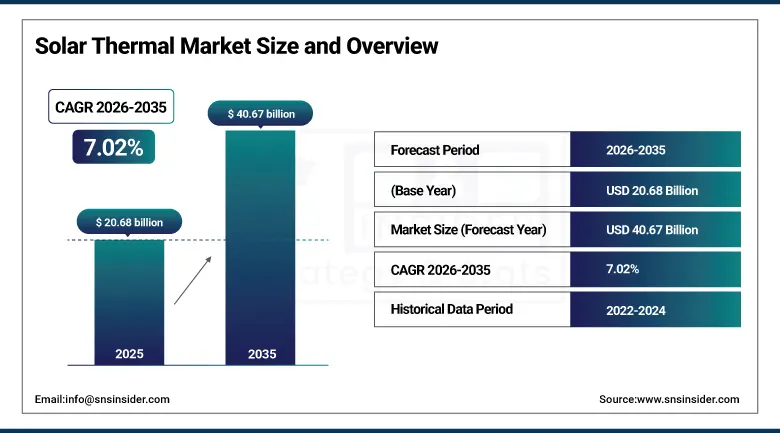
The Solar Thermal Market was valued at USD 20.68 billion in 2025 and is expected to reach USD 40.67 billion by 2035, growing at a CAGR of 7.02% from 2026–2035.
The solar thermal market is witnessing steady global growth due to rising demand for renewable heating solutions and clean industrial process heat. Across residential, commercial, and industrial sectors, adoption is increasing for water heating, space heating, and power generation applications. Growth is further supported by CSP technologies, evacuated tube collectors, and integrated thermal systems. The solar thermal market is also driven by increasing deployment of concentrated solar power plants and hybrid renewable energy systems. Industries such as food processing, chemicals, textiles, and manufacturing are rapidly adopting solar process heat solutions. Rising focus on decarbonization and energy efficiency is accelerating market expansion.
Government initiatives related to the deployment of solar thermal energy, reduction in carbon emissions, and advancement in clean energy technologies are propelling the solar thermal market. Europe has come up with RED III, where renewable energy sources for providing heating in buildings and industries are promoted. China is working on large-scale CSP installations in locations like Gansu and Xinjiang. The Inflation Reduction Act in the US is promoting the deployment of renewable energy technologies using tax incentives.
To Get more information on Solar Thermal Market - Request Free Sample Report
Solar Thermal Market Trends
-
Fast-paced growth of CSP plants increases capacity for solar thermal power production and facilitates thermal energy storage system integration into the grid.
-
The growing popularity of solar thermal process heat among industrial applications decreases the use of boilers fueled by coal in chemical and textile industries and food manufacturing.
-
Development of hybrid renewable energy systems including solar thermal and photovoltaic panels and heat pumps boosts the efficiency of energy systems and ensures their reliability.
-
Better thermal energy storage solutions using molten salt and phase change materials make it possible to ensure round-the-clock solar thermal power availability.
-
Supportive policies and commitment to zero-carbon emissions stimulate rapid installation of solar thermal power plants in Europe, China, India, and the USA.
-
Digitization and IoT technologies increase energy efficiency, facilitate real-time monitoring, and ensure proper maintenance of solar thermal plants.
Solar Thermal Market Size Outlook
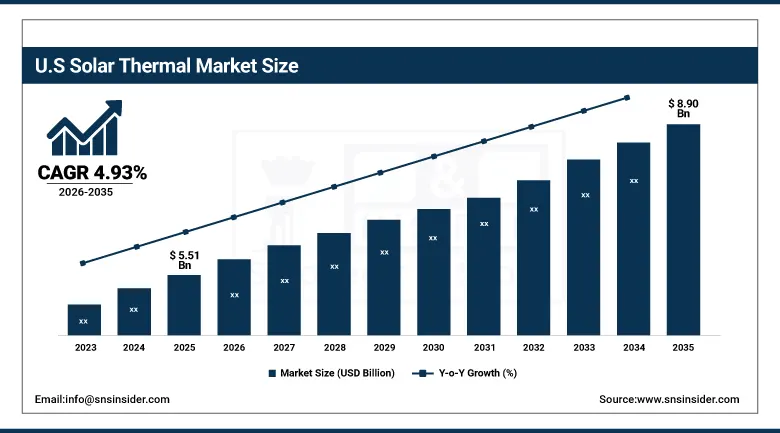
The U.S. Solar Thermal Market was valued at USD 5.51 billion in 2025 and is expected to reach around USD 8.90 billion by 2035, growing at a CAGR of 4.93% from 2026–2035.
The U.S. solar thermal market growth is taking place in a constant manner due to increasing demands for water heating purposes in residential applications, commercial buildings, industrial applications, and concentrated solar power plants. Market growth can be associated with increased utilization of evacuated tube collectors, flat plate collectors, CSP technology, solar thermal storage, and hybrid solar-heating systems. Decarbonization activities, enhanced energy efficiency, and reduced dependence on fossil fuels in heating processes serve as one of the key drivers behind the growth of the said market.
The United States government is aiding in the development of the solar thermal market by providing tax incentives for clean energy under the provisions of the Inflation Reduction Act, which has been offering investments up to 30 percent for solar heating and CSPs. Additionally, the United States Department of Energy has increased its funds allocated to efforts of reducing carbon emissions in industrial sectors that have high temperatures of heating. While solar thermal capacity in the US remains low, solar heating is increasing in the sun belt states.
Solar Thermal Market Segment Analysis
-
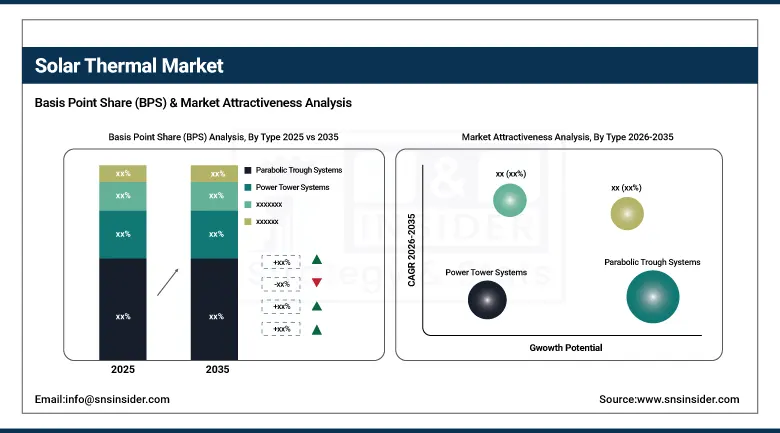
By Type, parabolic trough systems dominated the solar thermal market with 42.35% share in 2025; while power tower systems is the fastest growing segment.
-
By System Type, flat plate collectors dominated the solar thermal market with 34.80% share in 2025; while concentrated solar power (CSP systems) is the fastest growing segment.
-
By Application, domestic hot water systems dominated the solar thermal market with 37.85% share in 2025; while solar combi systems is the fastest growing segment.
-
By End-User Industry, residential sector dominated the solar thermal market with 30.10% share in 2025; while industrial sector is the fastest growing segment.
By Type, parabolic trough systems dominated the solar thermal market, while power tower systems is the fastest growing segment.
The Parabolic Trough Systems segment held a dominated share of the revenue generated from the solar thermal market in 2025. The success of the segment was because of advanced technology in place, large-scale implementation, and reliable operations in utility scale. The segment utilizes cylindrical reflectors to capture heat effectively and is popularly used in currently available CSP systems. Cost-effective operation and well-established infrastructure have helped the segment hold its leading position within the global solar thermal market and industry sector.
The Power Tower Systems segment is anticipated to exhibit the fastest CAGR during 2026-2035. The growth was because of higher efficiency in generating heat and ability to operate at high temperatures. In addition, effective energy storage via the usage of molten salt systems made the segment popular amongst consumers. With rising focus on continuous power generation via renewable sources, there was an increased demand for these segments. Developments in heliostat technology and government support for future projects were driving the segment's growth.
By System Type, flat plate collectors dominated the solar thermal market, while concentrated solar power (CSP systems) is the fastest growing segment.
Flat Plate Collector had the dominated market share of the solar thermal market in 2025 because of their simple design, cost-effective installation, and extensive application in water heating. Flat plate collectors are highly efficient, maintenance-friendly, and are designed for applications requiring low to medium temperature. One other reason for the growing demand for flat plate collectors in the global solar thermal market is the increasing popularity of cheap solar water heaters among residential and industrial consumers.
Concentrated Solar Power (CSP systems) segment is anticipated to register the fastest CAGR during 2026–2035 on account of the growing need for large-scale solar-based power generation and heat production. CSP technology provides high efficiency and has the ability to store heat energy which allows for uninterrupted power generation even when there is no sunshine. Investment in utility scale solar power plants and de-carbonization initiatives by governments have increased the adoption of CSP systems worldwide.
By Application, domestic hot water systems dominated the solar thermal market, while solar combi systems is the fastest growing segment.
Domestic hot water systems segment dominated the Solar Thermal Market with the highest revenue share in 2025 due to widespread adoption in residential buildings, hotels, hospitals, and small commercial facilities. Rising demand for cost effective and energy efficient water heating solutions is driving installation across urban and rural areas. Government incentives, easy rooftop integration, low maintenance requirements, and long operational life are further supporting strong market dominance. Increasing electricity prices and growing awareness of renewable heating solutions are also accelerating adoption across households and commercial infrastructures globally.
Solar combi systems segment is expected to grow at the fastest CAGR from 2026–2035 due to increasing demand for integrated heating and cooling solutions in modern buildings. These systems combine space heating, water heating, and cooling functions, making them highly efficient for energy optimization. Rising focus on zero energy buildings, green construction standards, and smart energy management systems is driving adoption. Technological advancements and hybrid integration with renewable sources are further enhancing system efficiency. Expanding urban infrastructure and sustainability targets are supporting strong growth across residential and commercial sectors globally.
By End-User Industry, residential sector dominated the solar thermal market, while industrial sector is the fastest growing segment.
The Residential Sector was leading segment in the solar thermal market during 2025, holding the dominated share in terms of revenues because of growing use of solar water heaters in residences. The increase in energy costs and the high need for energy-saving heaters are pushing their adoption rate higher. Various factors, including government incentives, ease of rooftop installation, and low maintenance are also aiding the growth in this segment. Growing awareness about sustainable energy resources has contributed significantly to market leadership.
The Industrial Sector is anticipated to witness the fastest CAGR between 2026 and 2035 because of growing requirement for process heating in industrial plants. Industries like chemicals, food processing, textile, and manufacturing sectors are gradually switching to solar thermal energy from conventional sources of energy. Factors, including carbon emission norms, zero net emissions, and increasing cost of conventional energy sources are contributing to this trend.
Regional Analysis
|
Region |
Major Country |
Share within Region, 2025(%) |
|---|---|---|
|
North America |
United States |
78.60% |
|
Europe |
Germany |
22.40% |
|
Asia Pacific |
China |
30.20% |
|
Middle East & Africa |
UAE |
6.80% |
|
Latin America |
Brazil |
5.75% |
North America Solar Thermal Market Insights
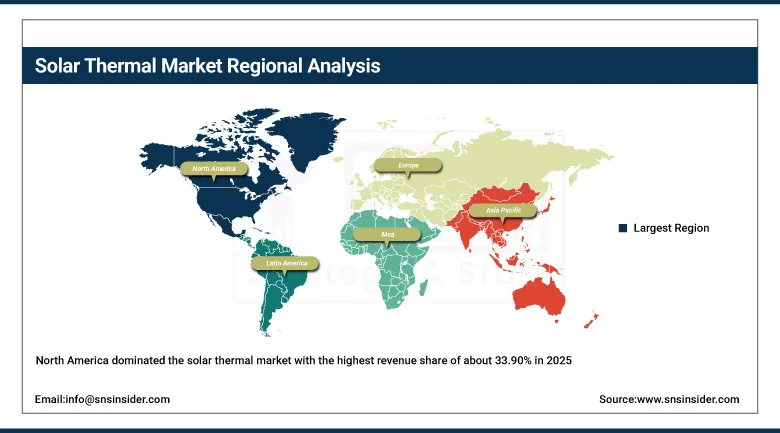
North America dominated the solar thermal market with the highest revenue share of about 33.90% in 2025 due to strong demand from residential water heating systems, commercial building heating applications, industrial process heat users, and utility scale concentrated solar power projects, along with increasing adoption of advanced solar thermal technologies such as evacuated tube collectors, flat plate systems, CSP plants, thermal energy storage solutions, and hybrid renewable heating systems. The region benefits from strong presence of key players such as BrightSource Energy, GlassPoint Solar, Siemens Energy, GE Vernova, and ENGIE, along with widespread deployment of clean heating infrastructure and renewable energy integration across the United States and Canada.
Get Customized Report as per Your Business Requirement - Enquiry Now
Europe Solar Thermal Market Insights
Europe represents an exceptionally important part of the solar thermal market, characterized by a strong emphasis on the implementation of renewables in heating, energy-efficient buildings, and industrial decarbonization. Nations such as Germany, Spain, France, Italy, and Austria have been implementing solar water heating systems, solar district heating systems, and concentrated solar power systems. European policies like the Renewable Energy Directive RED III, carbon neutrality policy, and energy-performance regulations for buildings are promoting solar thermal solutions throughout Europe.
Asia Pacific Solar Thermal Market Insights
Asia Pacific segment is expected to grow at the fastest CAGR of about 9.10% from 2026–2035 due to rapid industrialization, increasing energy demand, and large-scale deployment of solar heating and CSP projects across China, India, Japan, and South Korea. Rising adoption of industrial process heat systems, district heating networks, and renewable energy integration is driving strong market expansion. Government initiatives such as China solar expansion programs, India National Solar Mission, and Japan renewable heat policies are significantly supporting solar thermal deployment. Rising investments in clean energy infrastructure and decarbonization targets are further accelerating adoption across the region.
Middle East & Africa and Latin America Solar Thermal Market Insights
Middle East & Africa and Latin America have been marked as markets with sustainable growth in solar thermal market due to high solar irradiation potential and emphasis on diversifying renewable energy sources. Countries such as UAE, Saudi Arabia, and South Africa are using CSP technology and solar water heating systems to generate electricity and use it for industrial purposes. Similarly, countries like Brazil and Mexico in Latin America are focusing on using solar thermal technology for heating purposes in homes and other commercial uses.
Market Dynamics
Growth Drivers: Rising demand for renewable heating solutions across residential, commercial, and industrial sectors globally
The quick transition towards renewable energy use is raising the requirement for renewable sources of heating in all three categories of consumers around the world – residential, industrial, and commercial. The hike in electricity costs and reliance on nonrenewable energy sources is forcing people to switch to solar thermal technology for water and process heating. Energy efficiency schemes, decarbonization initiatives, and other government policies are favoring the widespread use of such solar thermal technology. Also, carbon neutrality and sustainability have become important for people, which has enhanced the market even further.
Restraints: Dependence on climatic conditions and lower efficiency in low solar irradiation regions globally
The efficiency of solar thermal technologies relies heavily on the amount of sunlight that is available, thus limiting their applicability in areas that receive less sunshine. The seasons play a great role in their efficacy, thus reducing their reliability in specific geographical regions. They become inefficient during winter and nighttime, and therefore cannot be used continuously in heating without some complex storage facilities. This makes solar thermal technologies inefficient in temperate and cold areas compared to other forms of heating technologies. Integration into existing heating systems presents difficulties and limits their applicability further.
Opportunities: Rising adoption of hybrid renewable energy systems and smart thermal storage technologies globally
Rising trend towards hybrid renewable energy systems using solar thermal, PV solar, and heat pumps systems has been creating numerous opportunities in the market. Utilization of innovative thermal energy storage technologies such as molten salt and phase change materials system is contributing towards enhancing the energy reliability and providing constant supply of heat throughout the day. Higher levels of usage of smart energy grid systems and sustainable buildings systems will further facilitate solar thermal energy usage. The rising focus on energy resilience and decentralized energy systems is creating numerous opportunities for adoption of solar thermal energy across the globe.
Recent Developments
-
2026: Masdar and ENGIE further developed large-scale solar thermal hybrid installations in Abu Dhabi, concentrating on integrated CSP and energy storage technologies to generate uninterrupted green power.
-
2026: Siemens Energy enhanced its CSP and thermal energy storage systems for large-scale solar thermal installations worldwide.
-
2025: ACWA Power made progress on the Noor Energy 1 CSP installation, enhancing the large-scale solar thermal capacity along with energy storage technologies.
-
2024: Increased CSP installations were seen around the world with new CSP installations in China and elsewhere, promoting concentrated solar thermal power plants.
Solar Thermal Market Key Players are:
-
Abengoa Solar
-
Acciona Energia
-
ACWA Power
-
BrightSource Energy
-
Siemens Energy
-
GE Vernova
-
ENGIE
-
SENER
-
Cobra Instalaciones y Servicios
-
TSK Group
-
EDF Renewables
-
Enel Green Power
-
Masdar
-
Larsen & Toubro Limited
-
GlassPoint Solar
-
SCHOTT AG
-
Flabeg Solar
-
Rioglass Solar
-
ACME Group
-
Noor Energy 1
Solar Thermal Market Report Scope:
| Report Attributes | Details |
|---|---|
| Market Size in 2025 | USD 20.68 Billion |
| Market Size by 2035 | USD 40.67 Billion |
| CAGR | CAGR of 7.02% From 2026 to 2035 |
| Base Year | 2025 |
| Forecast Period | 2026-2035 |
| Historical Data | 2022-2024 |
| Report Scope & Coverage | Market Size, Segments Analysis, Competitive Landscape, Regional Analysis, DROC & SWOT Analysis, Forecast Outlook |
| Key Segments | • By Type (Parabolic Trough Systems, Power Tower Systems, Dish Stirling Systems, Linear Fresnel Systems) • By System Type (Flat Plate Collectors, Evacuated Tube Collectors, Concentrated Solar Power (CSP Systems), Integrated Solar Thermal Systems) • By Application (Residential Use, Commercial Use, Industrial Use, Utility Power Generation) • By End-User Industry (Residential Sector, Commercial Sector, Industrial Sector, Utilities & Power Plants, Agriculture Sector) |
| Regional Analysis/Coverage | North America (US, Canada), Europe (Germany, UK, France, Italy, Spain, Russia, Poland, Rest of Europe), Asia Pacific (China, India, Japan, South Korea, Australia, ASEAN Countries, Rest of Asia Pacific), Middle East & Africa (UAE, Saudi Arabia, Qatar, South Africa, Rest of Middle East & Africa), Latin America (Brazil, Argentina, Mexico, Colombia, Rest of Latin America). |
| Company Profiles | Abengoa Solar, Acciona Energia, ACWA Power, BrightSource Energy, Siemens Energy, GE Vernova, ENGIE, SENER, Cobra Instalaciones y Servicios, TSK Group, EDF Renewables, Enel Green Power, Masdar, Larsen & Toubro Limited, GlassPoint Solar, SCHOTT AG, Flabeg Solar, Rioglass Solar, ACME Group, Noor Energy 1 |
Frequently Asked Questions
The solar thermal market is expected to grow at a CAGR of 7.02% from 2026 to 2035.
The solar thermal market was valued at USD 20.68 billion in 2025.
Rising demand for renewable heating solutions, industrial process heat, and CSP integration is driving the market.
Large DHW systems dominated the market in 2025 due to high adoption of solar water heating systems.
North America dominated the market in 2025 due to strong adoption of solar thermal systems and CSP projects.
