
Hydrogen Infrastructure Market Report Scope & Overview:
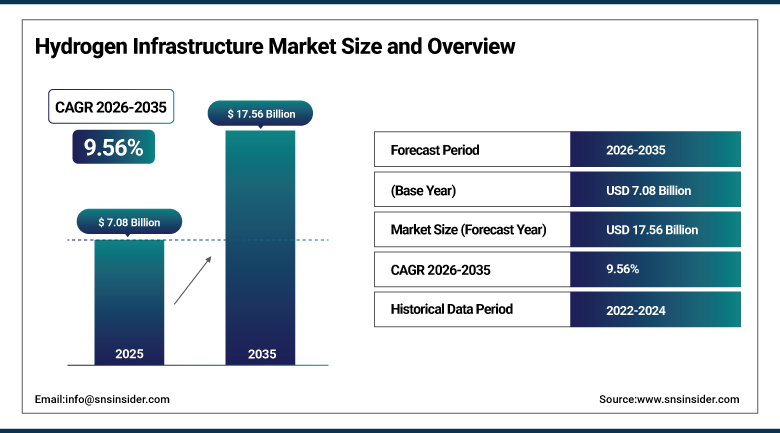
The Hydrogen Infrastructure Market was valued at USD 7.08 billion in 2025 and is expected to reach USD 17.56 billion by 2035, growing at a CAGR of 9.56% from 2026-2035.
The Hydrogen Infrastructure Market is being driven by the increasing need to develop reliable infrastructure for the production, storage, transportation, distribution, and refueling of hydrogen. Governments and energy companies are investing in hydrogen infrastructure which will allow decarbonization across transportation, industry, power generation and other energy intensive applications. Government funding and clean-energy targets are supporting the expansion of green and low-carbon hydrogen projects and driving the demand for electrolyzers, hydrogen storage systems, pipelines, transport equipment and refueling stations. Infrastructure deployment to connect hydrogen producers with industrial and mobility users also underpins the development of regional hydrogen hubs and integrated supply chains. The growth of fuel cell vehicles and industrial processes using hydrogen will also probably stimulate the development of infrastructure.
In March 2024, the U.S. Department of Energy announced USD 750 million in funding for 52 projects across 24 states to advance electrolysis technologies and improve the manufacturing and recycling of hydrogen systems and components. The initiative is intended to reduce the cost of clean hydrogen and strengthen the domestic hydrogen technology supply chain, supporting broader large-scale hydrogen deployment.
To Get more information Hydrogen Infrastructure Market - Request Free Sample Report
Hydrogen Infrastructure Market Trends
-
Growing investment in hydrogen production, storage, transportation, distribution, and refueling infrastructure.
-
Rising deployment of green hydrogen projects supported by renewable energy expansion and decarbonization targets.
-
Increasing development of hydrogen refueling stations to support the adoption of fuel-cell electric vehicles.
-
Continued advancement in hydrogen storage, pipeline, transportation, and dispensing technologies to improve efficiency and reliability.
-
Expanding government policies, funding programs, and regulatory frameworks supporting the development of hydrogen infrastructure.
Hydrogen Infrastructure Market Outlook
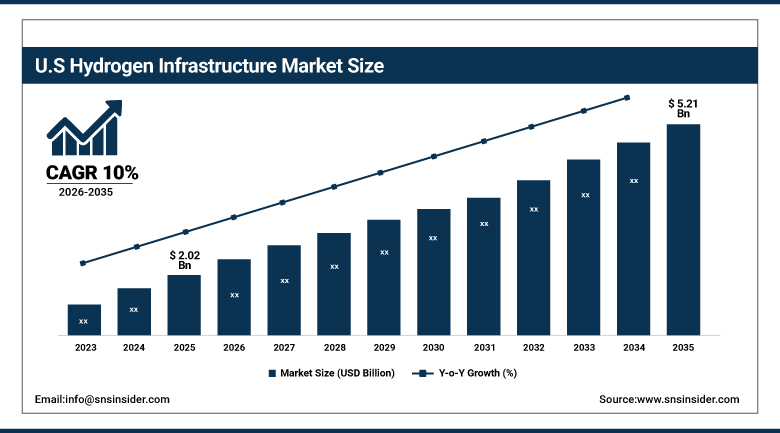
The U.S. Hydrogen Infrastructure Market was valued at USD 2.02 Billion in 2025 and is expected to reach USD 5.21 Billion by 2035, growing at a CAGR of 10% from 2026-2035.
U.S. growth of the Hydrogen Infrastructure Market will remain supported by continuous investments in clean energy infrastructure, increasing government initiatives to develop hydrogen production and distribution networks, and the presence of major energy and industrial companies investing in hydrogen technologies. On the demand drivers front, domestic demand will be supported by growing hydrogen applications in industrial processes, heavy duty transportation, power generation and energy storage. Demand from industrial applications is anticipated to remain a major driver of demand and the transportation and clean energy applications will support the growth of hydrogen infrastructure as investments in production, storage, transportation, and refueling facilities rise
In July 2024, U.S. Department of Energy announced up to $2.2 billion in federal funding for the Midwest and Gulf Coast Regional Clean Hydrogen Hubs, supporting the development of hydrogen production, storage, delivery, and end-use infrastructure across multiple states.
Hydrogen Infrastructure Market Segment Analysis
-
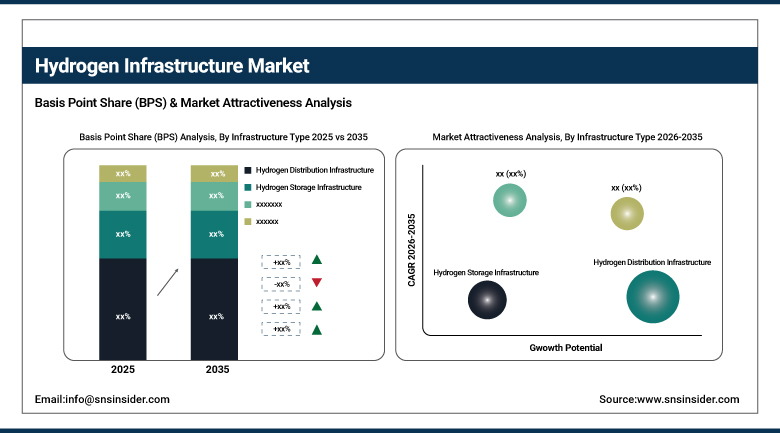
By Infrastructure Type, the Hydrogen Distribution Infrastructure segment dominated the Hydrogen Infrastructure Market with approximately 28.56% share in 2025, while the Hydrogen Storage Infrastructure segment is the fastest growing with a CAGR of approximately 12.89%.
-
By Component, the Electrolyzers segment dominated the Hydrogen Infrastructure Market with approximately 21.60% share in 2025, while the Electrolyzers segment is also the fastest growing with a CAGR of approximately 10.08%.
-
By End Use Industry, the Industrial Manufacturing segment dominated the Hydrogen Infrastructure Market with approximately 22.67% share in 2025, while the Residential and Commercial segment is the fastest growing with a CAGR of approximately 14.96%.
By Infrastructure Type, Hydrogen Distribution Infrastructure dominates and Hydrogen Storage Infrastructure grows fastest
Hydrogen Distribution Infrastructure dominating the Hydrogen Infrastructure Market owing to the rising demand for the efficient transportation and distribution of hydrogen from the production sites to the industrial users, refueling stations and other consumption points. Increased investment in hydrogen supply chains and the growth of low-carbon hydrogen projects are leading to the development of dedicated hydrogen pipelines, distribution networks and associated infrastructure. The increasing adoption of hydrogen for industrial, transportation and energy applications is also contributing to the need for reliable distribution infrastructure.
Hydrogen Storage Infrastructure is the fastest growing segment in the Hydrogen Infrastructure Market Hydrogen Storage Infrastructure is the fastest growing segment in the Hydrogen Infrastructure Market owing to the increasing demand for safe and efficient hydrogen storage in the production, transportation, distribution, and end-use applications. With the growth of hydrogen production capacity, the expansion of refuelling networks and the intermittent nature of renewable hydrogen production, the need for storage solutions to balance supply and demand is growing. Further driving the rapid growth of this segment are advancements in high pressure storage systems, liquefied hydrogen storage and other storage technologies.
By Component, Electrolyzers dominates and grows fastest
Electrolyzers Segment to dominating to Increasing Investments in Hydrogen Production Infrastructure and Increasing Usage of Green Hydrogen Projects Increasing demand for low-carbon hydrogen in industrial, energy, transportation and chemical applications is helping to drive the deployment of electrolyzer systems. Government initiatives, renewable energy integration, and investment in large-scale hydrogen production facilities are further strengthening the demand for electrolyzers as a critical component of hydrogen infrastructure.
Electrolyzers are also the fastest growing segment in the Hydrogen Infrastructure Market, owing to rising investments in clean hydrogen production worldwide and increasing renewable energy capacity. Developments in alkaline and proton exchange membrane electrolyzer technology are enhancing efficiency, scalability and operational flexibility. Large scale green hydrogen projects, government policies, decreasing technology costs and growing demand for low emission energy solutions are expected to drive the adoption of electrolyzers in several end-use industries.
By End Use Industry, Industrial Manufacturing dominates and Residential & Commercial grows fastest.
Industrial Manufacturing segment is the dominating segment in the Hydrogen Infrastructure Market due to the extensive usage of hydrogen in refining, chemicals, metals, fertilisers and other industrial processes. The infrastructure needs are driven by increased demand for low-carbon production pathways and increased investments in hydrogen-based industrial applications. The Industrial Manufacturing segment further dominates, aided by growth in hydrogen production, storage, transportation and distribution networks around major industrial sites.
Residential & Commercial is the fastest growing segment of the Hydrogen Infrastructure Market. This growth is due to the rising interest in hydrogen-based energy solutions for heating, distributed power generation, and nascent low-carbon building applications. Investment is pouring into hydrogen infrastructure as the drive to reduce carbon emissions in buildings and commercial facilities intensifies. Advances in hydrogen technologies, clean-energy policies and an increase in demonstration projects are also creating opportunities for hydrogen uptake across residential and commercial applications.
Regional Analysis
|
Region |
Major Country |
Share within Region, 2025 (%) |
|---|---|---|
|
North America |
United States |
82.36% |
|
Asia Pacific |
China |
42.69% |
|
Europe |
United Kingdom |
19.74% |
|
Latin America |
Brazil |
46.18% |
|
Middle East & Africa |
Israel |
18.62% |
North America Hydrogen Infrastructure Market Insights
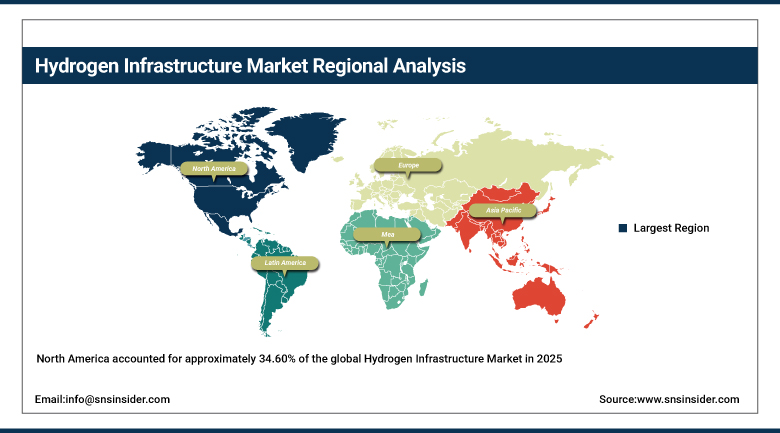
North America accounted for approximately 34.60% of the global Hydrogen Infrastructure Market in 2025, supported by growing investments in hydrogen production, storage, transportation, distribution, and refueling infrastructure. The bulk of regional demand is from the United States, driven by federal clean-energy policies, growing hydrogen projects, and the presence of large energy and industrial firms developing hydrogen infrastructure and related technologies.
Canada contributes additional regional demand through government-supported clean hydrogen initiatives, investments in low-carbon energy systems, and expanding hydrogen production and transportation projects. Improvements in electrolyzers, hydrogen storage, pipelines, transportation systems and refueling stations are enhancing regional infrastructure capacity. North America is also a key market for hydrogen infrastructure, and the growing use of hydrogen in transportation, industrial, power generation and energy applications further bolster its role.
Get Customized Report as per Your Business Requirement - Enquiry Now
Asia Pacific Hydrogen Infrastructure Market Insights
Asia Pacific is anticipated to witness the highest CAGR of approximately 28.05% among all regional segments of the Hydrogen Infrastructure Market during the forecast period from 2026 to 2035, supported by rapid hydrogen economy development, government-backed clean energy initiatives, and increasing investments in hydrogen production, storage, transportation, and refueling infrastructure. China is expected to remain a major contributor, backed by large-scale investments and expanding hydrogen applications in transportation, industrial and energy sectors.
Japan and South Korea are expected to contribute significantly through continued investments in hydrogen supply chains, fuel-cell mobility, and clean energy infrastructure. India too is expected to see rising demand supported by its National Green Hydrogen Mission and rising investments in electrolyzers, hydrogen production, storage, transportation and refueling networks. Australia will also continue to support regional development through big renewable hydrogen projects and export-oriented infrastructure, further cementing Asia Pacific’s role in the global hydrogen economy.
Europe Hydrogen Infrastructure Market Insights
Europe represents a significant regional market for the Hydrogen Infrastructure Market, supported by increasing investments in hydrogen production, storage, transportation, and distribution networks. As the region works to decarbonize industrial operations, and transportation and energy systems, demand for dedicated hydrogen infrastructure is increasing. Germany, France, the Netherlands and Spain are major contributors, supported by national hydrogen strategies, increased renewable energy capacity and investments in integrated hydrogen corridors.
Germany accounts for a substantial share of European hydrogen infrastructure demand, supported by its large industrial base, extensive energy networks, and strong focus on hydrogen-based decarbonization. France and the Netherlands provide additional demand through investments in hydrogen production facilities, storage systems, pipelines and import terminals. The forecast period will witness continued regional market expansion driven by continued support from the European Union for hydrogen development, cross-border infrastructure and renewable energy integration.
MEA & Latin America Hydrogen Infrastructure Market Insights
The Middle East & Africa represents an emerging market for the Hydrogen Infrastructure Market, supported by abundant renewable energy resources, natural gas availability, and growing investments in hydrogen production and export infrastructure. Countries such as Saudi Arabia, the United Arab Emirates and Oman are developing large-scale hydrogen projects. South Africa is developing its hydrogen ecosystem with investments in production, transportation and industrial use.
In Latin America, the Hydrogen Infrastructure Market is led by countries such as Chile and Brazil, supported by substantial renewable energy potential and increasing interest in green hydrogen production. Chile is building hydrogen infrastructure for export, whereas Brazil has an existing energy sector and growing renewable capacity. Higher investments in hydrogen storage, transportation, distribution networks and port infrastructure are likely to underpin the development of the regional market.
Market Dynamics
Growth Drivers: Decarbonization Targets and Expanding Hydrogen Demand
Rising global decarbonization targets and increasing government commitments toward net-zero emissions represent a primary growth driver for the Hydrogen Infrastructure Market, as countries continue investing in infrastructure required for hydrogen production, storage, transportation, and distribution. This dynamic is driven by increased use of hydrogen in hard-to-abate sectors including steel, chemicals, refining, heavy transport and industrial manufacturing where hydrogen can help reduce emissions.
Expanding hydrogen demand is further supported by increasing investments in clean hydrogen projects, renewable energy integration, and dedicated transportation and storage networks. Technological improvements to electrolyzers, compression and pipeline systems, liquefaction and hydrogen refueling infrastructure are improving the scale and efficiency of hydrogen supply chains. Increasing commercial interest in green hydrogen and hydrogen-derived fuels, fueled by policy frameworks and financial incentives is likely to encourage infrastructure development and accelerate market growth.
Restraints: High Infrastructure Costs and Technical Challenges
High Infrastructure Development Cost is a Major Restraint for Hydrogen Infrastructure Market. Setting up of production facilities, storage systems, pipelines, transportation networks and refueling stations requires significant amount of capital investment. This is especially applicable to green hydrogen projects where the electrolyzers, renewable power systems, compressors and associated infrastructure are the upfront capital cost of the project. Financing constraints and uncertain project economics are impeding infrastructure development, particularly in emerging hydrogen markets.
Technical challenges in storing, transporting and distributing hydrogen also limit market expansion, as hydrogen requires specialized materials, high-pressure systems and strict safety measures. Hydrogen embrittlement, potential leaks, the need for compression and the lack of dedicated pipeline infrastructure all add to the complexity of operations and maintenance costs. Moreover, differences in standards and regulatory requirements across jurisdictions can lead to uncertainty for hydrogen project developers at scale and constrain the deployment of infrastructure.
Opportunities: Green Hydrogen Expansion and Infrastructure Development
Continued expansion of green hydrogen production presents a substantial growth opportunity for the Hydrogen Infrastructure Market, as governments and energy companies invest in renewable-powered electrolysis projects to support decarbonization objectives. Growing development of hydrogen hubs, production facilities, storage terminals, pipelines and transportation networks is creating opportunities across the hydrogen value chain. As large scale green hydrogen projects reach commercial scale deployment, the companies that can provide scalable and cost effective infrastructure solutions will benefit the most.
Rising investments in hydrogen refueling networks and cross-border hydrogen transportation present an additional opportunity for infrastructure providers, particularly as demand expands across heavy mobility, industrial manufacturing, and energy applications. Dedicated hydrogen corridors, advanced storage technologies, liquefaction systems and distribution infrastructure can be developed to improve availability of supply and access to markets. Policies, public funding and private sector investment are speeding up hydrogen deployment, enabling infrastructure developers to capture new opportunities related to the growth of integrated hydrogen ecosystems.
Recent Developments:
-
2026: Air Liquide advanced construction of its ELYgator 200 MW electrolyzer project in Rotterdam, designed to produce renewable and low-carbon hydrogen for industrial and mobility applications.
-
2026: Air Liquide continued developing its Normand’Hy project in France, featuring a 200 MW PEM electrolyzer designed to supply renewable and low-carbon hydrogen to industry.
-
2026: Asahi Kasei began installing its Aqualyzer™-C³ 1 MW-class alkaline-water electrolyzer at Finland’s first commercial hydrogen refueling station, supporting hydrogen-powered transportation.
Hydrogen Infrastructure Market Equipment & Machinery Key Players
-
Linde plc
-
Air Liquide
-
Air Products and Chemicals, Inc.
-
Nel ASA
-
Plug Power Inc.
-
thyssenkrupp nucera AG & Co. KGaA
-
ITM Power plc
-
Siemens Energy AG
-
Cummins Inc.
-
John Cockerill
-
Sunfire GmbH
-
McPhy Energy S.A.
-
Chart Industries, Inc.
-
Hexagon Purus ASA
-
Worthington Enterprises, Inc.
-
Haskel
-
PDC Machines
-
Atlas Copco AB
-
Burckhardt Compression Holding AG
-
Ohmium International
Hydrogen Infrastructure Market Report Scope:
| Report Attributes | Details |
|---|---|
| Market Size in 2025 | USD 7.08 Billion |
| Market Size by 2035 | USD 17.56 Billion |
| CAGR | CAGR of 9.56% From 2026 to 2035 |
| Base Year | 2025 |
| Forecast Period | 2026-2035 |
| Historical Data | 2022-2024 |
| Report Scope & Coverage | Market Size, Segments Analysis, Competitive Landscape, Regional Analysis, DROC & SWOT Analysis, Forecast Outlook |
| Key Segments | • By Infrastructure Type (Hydrogen Production Infrastructure, Hydrogen Storage Infrastructure, Hydrogen Transportation Infrastructure, Hydrogen Refueling Infrastructure, Hydrogen Distribution Infrastructure) • By Component (Electrolyzers, Compressors, Storage Tanks and Cylinders, Pipelines, Dispensers and Refueling Equipment, Valves, Pumps and Flow Meters, Monitoring and Control Systems) • By End Use Industry (Transportation and Mobility, Power Generation and Energy Storage, Industrial Manufacturing, Oil and Gas, Chemicals and Petrochemicals, Residential and Commercial) |
| Regional Analysis/Coverage | North America (US, Canada), Europe (Germany, UK, France, Italy, Spain, Russia, Poland, Rest of Europe), Asia Pacific (China, India, Japan, South Korea, Australia, ASEAN Countries, Rest of Asia Pacific), Middle East & Africa (UAE, Saudi Arabia, Qatar, South Africa, Rest of Middle East & Africa), Latin America (Brazil, Argentina, Mexico, Colombia, Rest of Latin America). |
| Company Profiles | Linde plc, Air Liquide, Air Products and Chemicals, Inc., Nel ASA, Plug Power Inc., thyssenkrupp nucera AG & Co. KGaA, ITM Power plc, Siemens Energy AG, Cummins Inc., John Cockerill, Sunfire GmbH, McPhy Energy S.A., Chart Industries, Inc., Hexagon Purus ASA, Worthington Enterprises, Inc., Haskel, PDC Machines, Atlas Copco AB, Burckhardt Compression Holding AG, Ohmium International |
Frequently Asked Questions
Leading companies in the Hydrogen Infrastructure Market include Linde plc, Air Liquide, Air Products and Chemicals, Inc., Nel ASA, and Plug Power Inc., among others.
Key opportunities include the continued expansion of green hydrogen production, development of hydrogen hubs, storage terminals, pipelines, transportation networks, refueling infrastructure, and cross-border hydrogen transportation.
Rising global decarbonization targets and increasing hydrogen demand across hard-to-abate sectors such as steel, chemicals, refining, heavy transport, and industrial manufacturing are major factors driving market growth.
The Electrolyzers segment dominated the Hydrogen Infrastructure Market with approximately 21.60% share in 2025, while the Electrolyzers segment is also the fastest growing with a CAGR of approximately 10.08%.
North America dominated the Hydrogen Infrastructure Market in 2025 with approximately 34.60% share, supported by growing investments in hydrogen production, storage, transportation, distribution, and refueling infrastructure.
